On the opening night of the Beirut Art Fair, crowds of well-dressed visitors gathered in the lobby, exchanging greetings and air kisses before filing slowly into the main hall. Amongst them, in a piece of superb incongruity, roamed a live sheep, most of its torso shorn of wool, its bald pink flanks inscribed with a mysterious pattern of black dots. Faro, as the sheep was named, was the centrepiece of a performance artwork by Lebanese artist Ghassan Ghazal.
Curated by the fair’s French artistic director Pascal Odille, ‘Virtual/Reality’ was the main non-commercial undertaking and the highlight of the sixth edition of the fair, which ran from September 17th to 20th. Featuring work by nine contemporary artists, the exhibition explored the coexistence of the real and the virtual in the digital age. Set in the centre of the hall, amid booths by 42 art galleries and 10 design galleries, it provided an effective counterpart to the work on show elsewhere, which was dominated by paintings (but also included plenty of sculpture, photography and some work in less traditional formats.)
“We have reached a moment in society where we interact a lot more via social networks than through direct contact,” Odille told me in one of those rare face-to-face meetings in a quiet café in Sursock. “There is this sense that the lines are blurring between what is real and what is virtual in our day-to-day lives. So I began asking myself how to depict this process from the beginning, in a way that is playful and interactive, and allows for a measure of reflection. I set out to discover where the notion of real versus virtual began, with regards to art.”
Odille’s starting point was 17th century Flemish perspective boxes, in which a convincing illusion of an interior was created inside a box, using truncated perspective and a strategic placement of walls and floor. The works on show at the fair included a contemporary perspective box by South African artist Vivian Van Blerk, which gave visitors a glimpse into Lebanon’s cultural history, inviting them to peer through a peephole of a house full of figures set against a landscape of marvels, from tiny Roman mosaics and artefacts housed in the National Museum.
Ghazal’s Faro juxtaposed the reality of the animal, out of place and afraid in a sea of people, with the persona carefully constructed around it. “Faro exists, as a sheep, but Faro has a whole virtual story,” said Odille. “On Instagram, Facebook, Whatsapp and Youtube, Faro had an identity. He received a personalised invitation to the fair. Ghassan had the great idea that Faro exists as a natural link between the monotheistic religions, all of which sacrificed sheep. The writing on his body was from two sacred texts, one Muslim, one Christian, but written in Braille. And what’s the unique thing about Braille? It’s a universal language. There is only one way of writing it.”
Other work on show included three videos by New York-based Serbian performance mega-artist Marina Abramovic, reflecting on self-control, mastery of the body and surrender to forces beyond our control, such as nature, gravity and the cycle of life and death.
Polish artist Janek Simon’s ‘Carpet Invaders’, a historic piece of interactive art from 2002, allowed viewers to engage in a game of Space Invaders, projected onto the floor and integrated into a pattern playfully reminiscent of a traditional Oriental rug. “It’s fun, but it also has a message behind it,” says Odille. “It’s often said that computer games isolate people, but here, on the contrary, is a game that allows you to play with others and to enter into communication and exchange.”
Beside it, a poetic installation piece by Italian duo Nadia Antonello and Paolo Ghezzi consisted of small mirrors, lit from behind by candles and pierced with tiny holes. Each one mapped out a computer simulation of what the night sky above Beirut will look like each decade for the next 150 years. “This thread running between past, present and future demonstrates the notion of time in relation to the real and the virtual."
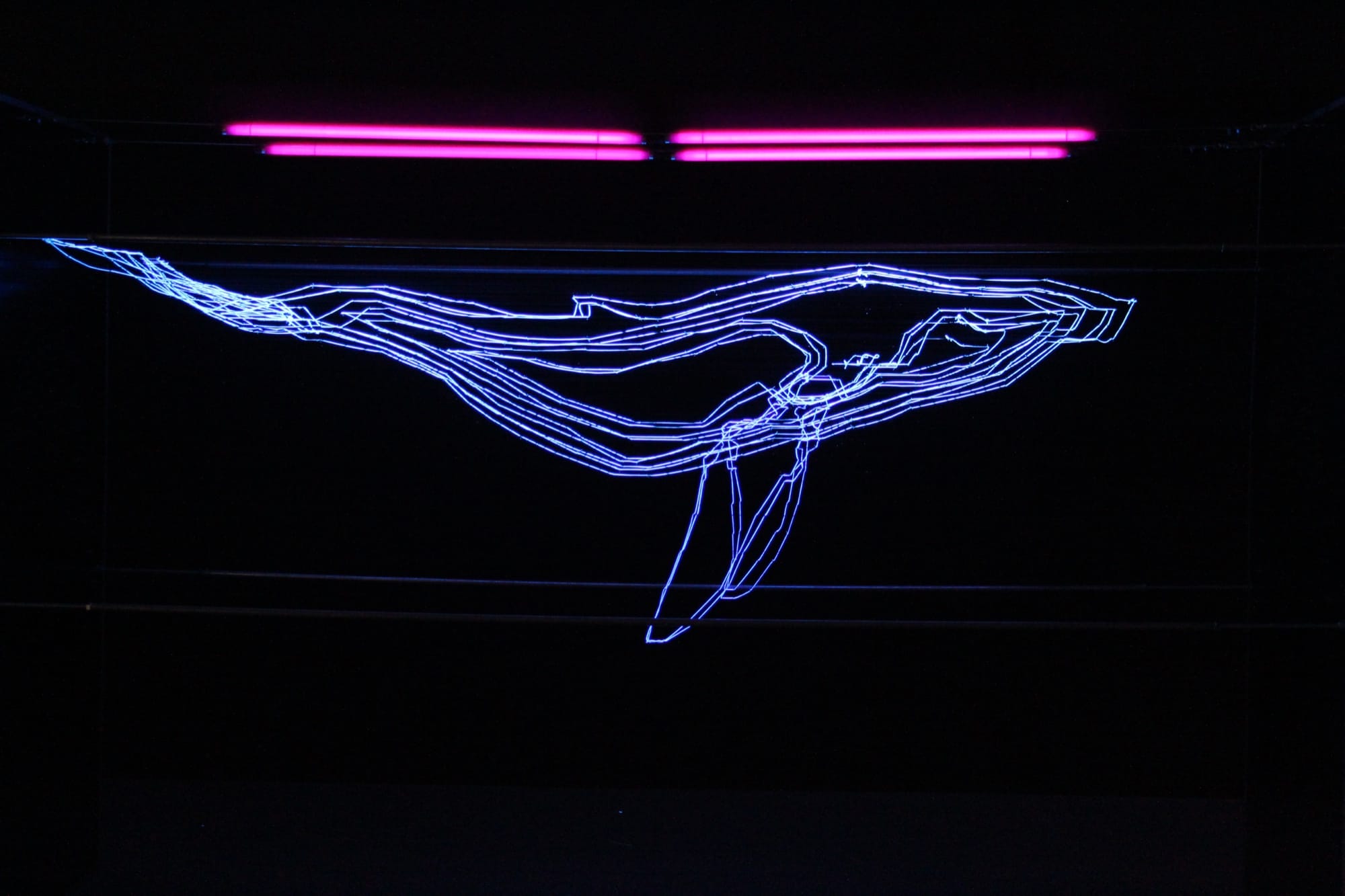
Perhaps the most surreal experience was with a sculpture by Cuban artist Duvier Del Dago, consisting of a shark suspended in a rectangular frame. The piece initially appeared to be a hologram but in fact, Del Dago creates his painstaking sculptures using wire and thread, lighting them with a black light to create an optical illusion, making the real appear digital.
I remember that when I entered the space on opening night, a man approached me to say that the work I was looking at was unfinished, the artist having sold the work he had intended to exhibit just before the fair opened. He then invited me to view a digital photograph of the absent piece on his mobile phone. In any other context, it would have been a marked failure of professionalism, but in this case it only added to the complex layers surrounding the virtual/reality theme. Could a digital photograph represent the reality of the artist’s work more accurately than a physical sculpture? The Virtual Reality exhibition left us feeling that perhaps there is no ‘real’ answer to this question.
WHAT Beirut Art Fair
WHO Pascal Odille, Artistic Director
SINCE 2010
WHY Instead of simply focussing on art produced in this region, Odille took a broader approach in last September’s fair by curating a themed exhibition that is a playful, interactive and provocative depiction of the boundaries between the virtual and the real.