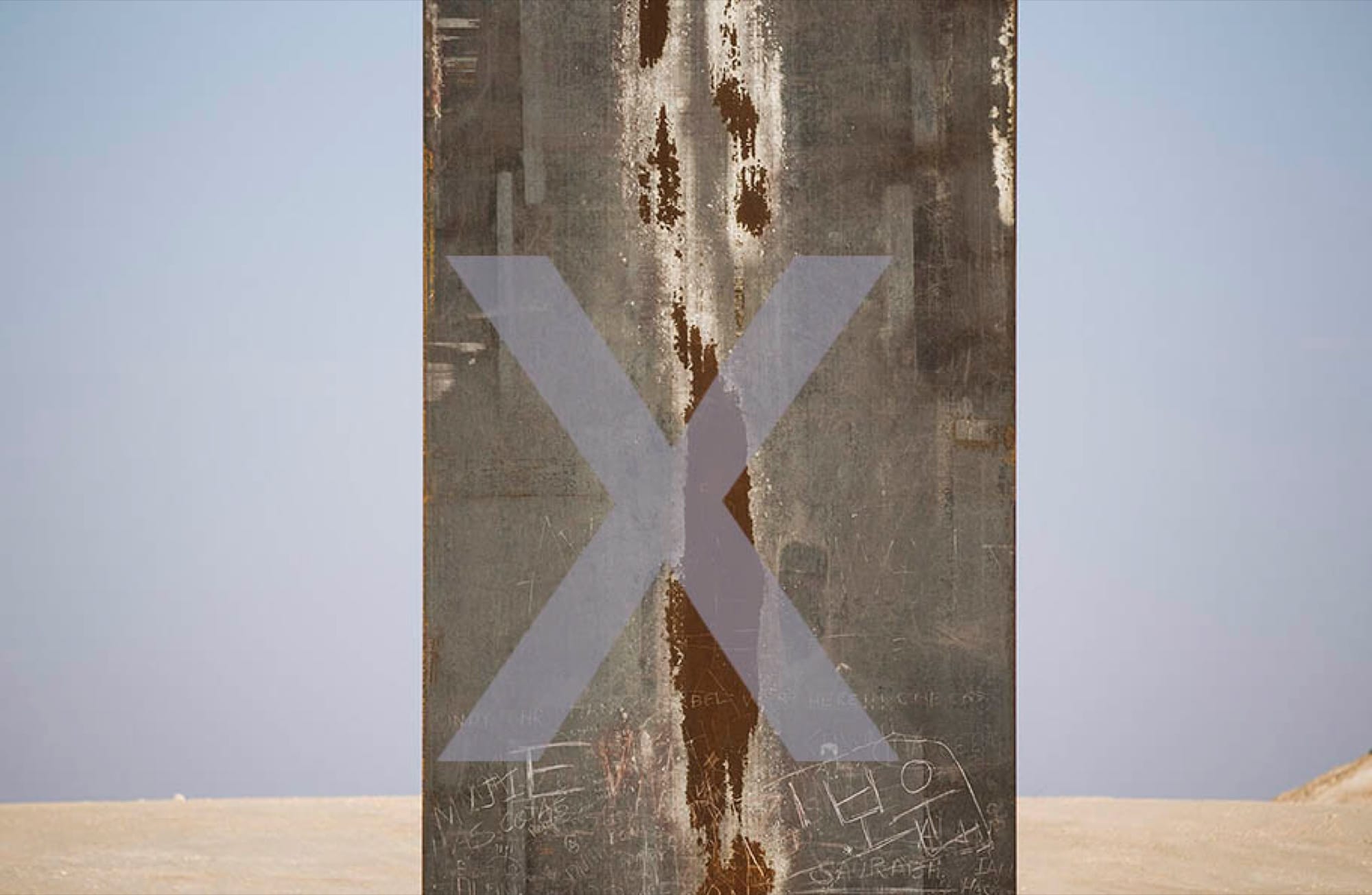
Colossal, site-specific compositions that express the tension of their own weight, you could recognise a Richard Serra sculpture anywhere. Now 76 years of age, he was one of the world’s first artists to mould non-traditional materials, like fiberglass, rubber, molten lead, timber and his favourite, steel (said to have been influenced from his early work on steel mills) in minimalist but massive forms. Although American-born, the son of immigrant parents (a Spanish father and a Russian Jewish mother) living in San Francisco, most of his larger works are outside the US and are so immediately identifiable in fact, that if you pay a visit to his latest, located in Qatar’s Ras Brouq nature reserve, about an hour from the capital, you’ll immediately know it’s a Serra.
Entitled ‘East-West/West-East’, it was commissioned by the Qatar Museums Authority, the governmental agency chaired by Sheikha Mayassa bint Hamad bin Khalifa Al Thani that spends over a billion dollars a year on art (or rather, over thirty times more than the expenditure of New York’s Museum of Modern Art). But this was not Serra’s first project in the country. That was actually ‘7’, an almost 25-metre-high heptagonal tower completed in 2011, adjacent to the I.M.Pei-designed Museum of Islamic Art in Doha. Requiring more than a million man-hours to construct and a year to build, it is still the tallest public art piece Serra has ever made.
For Serra, perspective is everything and this new project plays with both horizontality and verticality, on a grand scale – taking the immensity of the barren, uninhabited desert landscape from whence it emerges, as a starting point. “When I first came to Qatar, Sheikha Mayassa said to me, 'you should build a piece in the landscape'. I said, 'what landscape?' She said, 'the desert',” Serra explained, adding that he had never worked in the desert before. So he had a Bedouin take him on explorations of different desert landscapes until he found the site he was looking for, near Zekreet, a peninsula surrounded to the east and west by water. “I called it ‘East-West’ not only because it is on the axis of east-west, but also because I am a Westerner working in the East, and it kind of multiplies that joining of both propositions.”
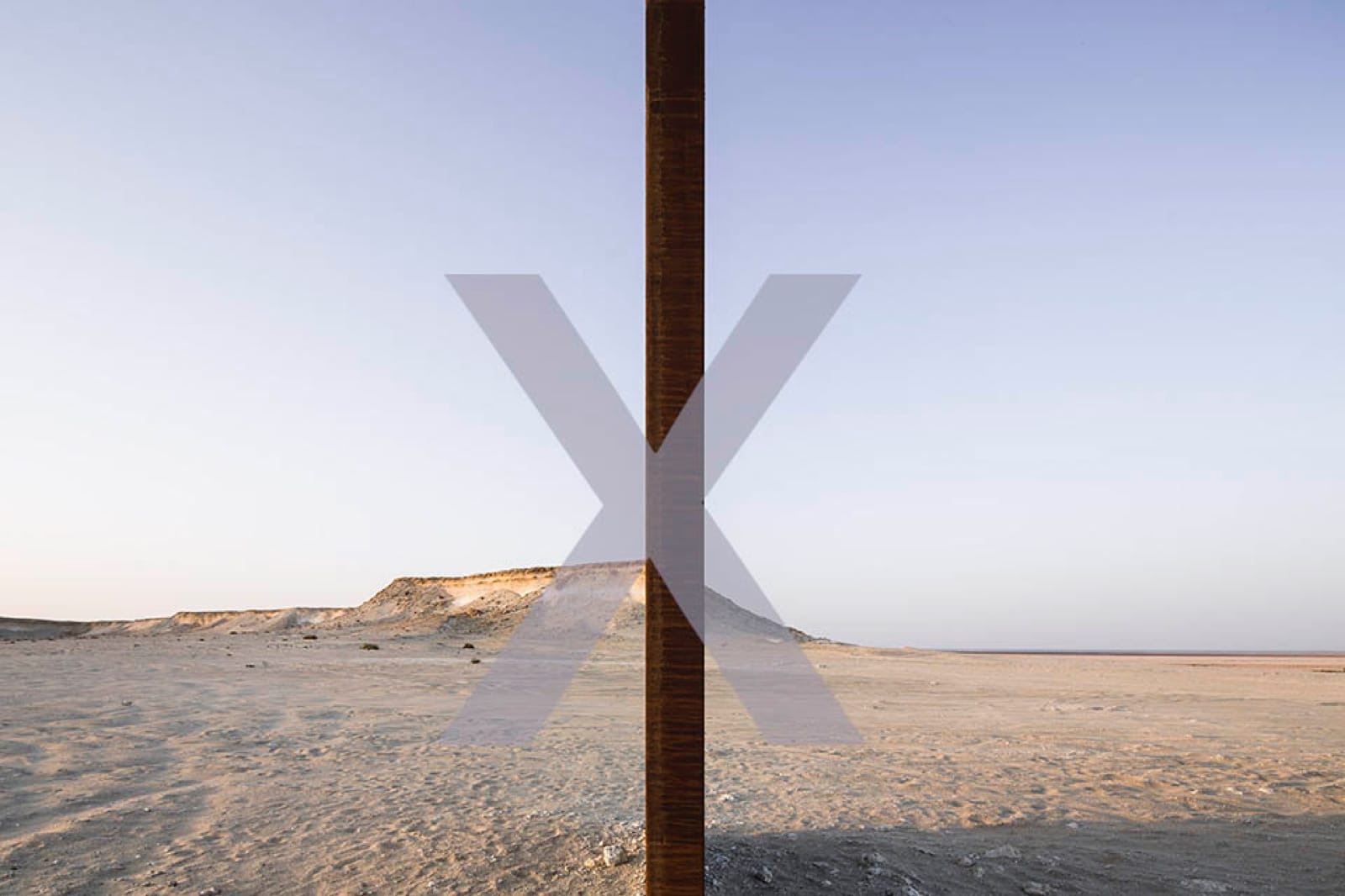
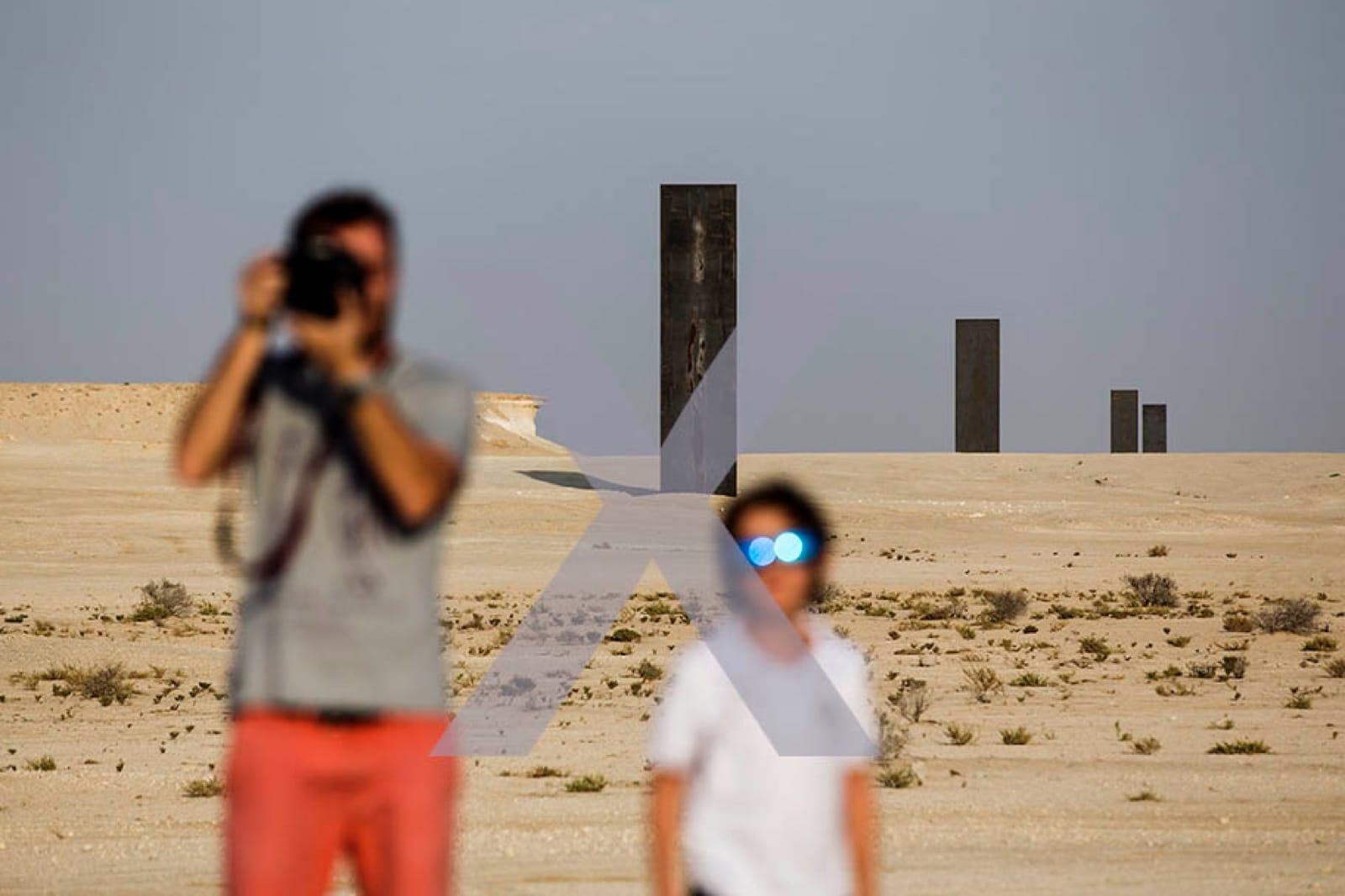
Though you’ll need GPS coordinates to get there due to the sheer vastness of the space, once you find it, you’ll see Serra’s four rectangular, oxidised steel plates as perfectly aligned pillars, ranging between 14.7 metres and 16.7 metres in length, shooting up from a natural corridor formed by the erosion a seabed millions of years ago. “The placement of the pieces is not geometrical, it's topological, so it's a bit like you have two elevation planes within one field.” Despite the great distance they cover, all four, each 250 metres apart, can be seen and explored from either end of the trail, which spans a kilometre.
"If one walks through the pieces; he will understand not only the rhythm of himself in relationship to the landscape but also the rhythm of himself in relationship to the height and the length of the pieces… What that piece does is give you a point of reference in relationship to a line, and your upstanding relationship to a vertical plane and infinity, and a perspectival relationship to a context – and pulls that context together. It makes it graspable. That’s actually a place out there now, and there certainly wasn’t one before. We did that simply by putting up four plates,” said Serra, after the project was completed. In this way, his work engages the landscape with your body and the mammoth-like sculptures with your movement through them.
Although it’s undoubtedly uncomfortable to walk through Serra’s queue of sculptures during the blazing heat of the day, as the sun sets, they take on another quality. They punctuate the desert landscape like a vast theatre of eerie monuments, their orange-amber sheens of corrosion glowing against the darkness.
Otherworldly, stark and silent, Serra’s works speak to the power of land art to transform and reflect the unspoilt beauty of their surrounding natural landscapes.
WHAT East-West/West-East
BY Richard Serra
WHERE Qatar’s Ras Brouq nature reserve near Zekreet
WHY Although Qatar has a reputation for spending the most money on buying internationally acclaimed artists’ works and building mega-museum outposts, this is the second time the world-renowned sculptor was commissioned to make something for the country’s landscape and not the other way around. The results are stunning and dramatic, and make us proud.