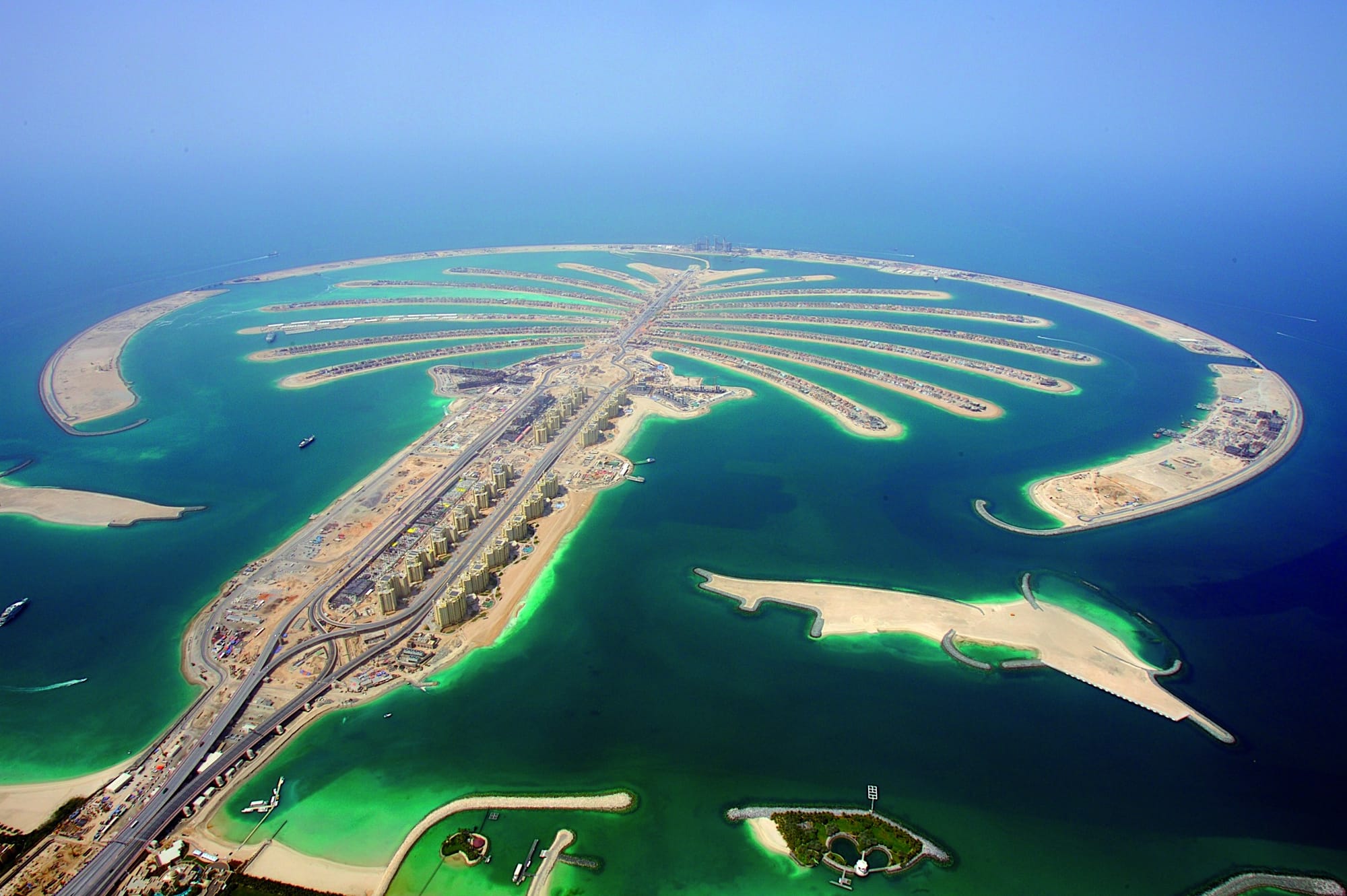
Nakheel and Dubai
To understand the story of Nakheel is to understand the story of Dubai: one of limitless ambition and a dogged vision. Once a sleepy town, whose major industries were fishing, pearl diving, and low-level trade, Dubai has within the space of a generation transformed itself into the world’s fastest growing city and the hub for business and tourism in the Middle East.
A key spur to Dubai’s growth was the discovery of oil in the late 1960s, but this is only part of the story; relative to its neighbours Dubai has insignificant oil supplies. In 2006 just five per cent of Dubai’s GDP was oil related and it is predicted that this will be as little as one per cent within the next decade. Diversification was needed.
The drive naturally led Dubai to capitalise on the world’s biggest industry: tourism. Sheikh Mohammed bin Rashid Al Maktoum identified Dubai’s key tourist attraction as its year-round sun and pristine beaches. However, there was one problem: Dubai has less than 70km of natural beachfront, much of which was already developed and so beaches were in short supply. If Dubai wanted to attract more tourists, it would have to find a solution to this problem. In the late 1990s, Sheikh Mohammed devised an incredible solution – to create more beachfront by building an island. The Palm Jumeirah was born.
The Concept
Land reclamation techniques had already played a key role in Dubai’s growth. It was Sheikh Rashid bin Saeed Al Maktoum’s decision in 1959 to dredge the creek which opened up shipping lines into Dubai. The excavated soil and rock was deposited on low- laying land along the shores, and this new land was sold to fund the dredging project. Similarly, Dubai’s first great icon, Burj Al Arab, which opened in 1999, was constructed on a man-made island. Yet The Palm Jumeirah was to be no simple reclamation exercise.
The concept evolved from a plan to build an island that would create 10km of beachfront to one that would provide more than 70km; from a simple round island to one that would be an iconic, complex shape. Initially dhow boats and falcons were proposed but eventually it was the palm design that was deemed the winner. Its shape both maximised the amount of beachfront created, and represented a legendary symbol of Dubai: the palm tree had for centuries been a key source of food and shelter for the people of Dubai.
Thus in 2001, The Palm Jumeirah was launched. Measuring 5km by 5km, the concept seemed outlandish to many, overly ambitious or even impossible. Yet Dubai, and now Nakheel’s, mantra was to say yes when others said no.
The Creation of Nakheel
At the launch of The Palm Jumeirah, Nakheel as a company had not been formed. But with subsequent projects such as The Palm Jebel Ali – the second in The Palm trilogy – and The World, the formation of Nakheel in 2003 proved inevitable. Literally meaning ‘The Palms’ in Arabic, Nakheel was more than simply a real estate developer; it was a company that would reshape the map of Dubai by creating innovative, bold and avant-garde developments.
It is just over six years since the first grain of sands were laid on The Palm Jumeirah, and Nakheel has accomplished more than many companies achieve in a lifetime. In time for the awarding of our Ultimate Living award, the handover of the first phase of The Palm Jumeirah’s 4,000 apartments and villas has been completed.
But Nakheel is more than just the Palm Jumeirah. The company has completed a number of developments including the world’s largest themed mall, Ibn Battuta Mall; the world’s largest inland man-made island residential community, Jumeirah Islands; and one of Dubai’s most popular residential communities, The Gardens. Nakheel currently has a portfolio of projects ranging across 186 million square metres of land and worth more than 30 billion USD.
Constructing The Palm Jumeirah
The Palm Jumeirah was built using only the organic materials of sand and rock. The rock was mostly sourced from Ras Al Khaimah and the sand was dredged from the seabed. Within just a year, two-thirds of the breakwater needed to protect the fragile organic island was finished. And in August 2003 it was fully completed.
The pace and scale of construction was flabbergasting and probably incomprehensible in metric terms. Every 24 hours of construction of breakwater, the equivalent weight of two jumbo jets of rocks was dumped allowing the construction to be completed in just a couple of years. Once the breakwater was completed the reclamation immediately began.
The sand that was hosed onto the island was enough to build a 2.5-metre wall all the way around the world. One of the issues of the sand was that because it had been sprayed into place it was loose and not compact enough to build on. Within years it would have compacted alone but due to the project’s tight deadline, this option was not possible. A solution was found in creating a special compacting machine that would accelerate the process.
Manal Shaheen, Nakheel’s director of dales, marketing and customer services heralds the construction as a great achievement, “From the first grain of sand being placed in the Arabian Gulf to the first residents moving in took little more than five years. With such an unprecedented project of such complexity and scale, that’s an incredible achievement,” she says. Yet Shaheen is fully aware of the challenges that lay ahead. And even if the project can be spotted from space, The Palm Jumeirah will only truly come into its own when it becomes a tourist destination, “This is just the first of many more milestones on The Palm Jumeirah, which will see it established as not only one of the region’s, but also one of the world’s leading tourist destinations,” affirms Shaheen.
However, a fact Nakheel prefers to dispel is that the project was planned for 60,000 people and based on this masterplan all the properties sold in a mere three days. But, bit by bit and with the cost of construction rising, the project is now due to accommodate 120,000 occupants and no official response has been made concerning this fact.
Hotels of The Palm
The numbers are pretty astonishing. The Palm Jumeirah will be home to more than thirty hotels along its 70km of beachfront, in one fell swoop increasing the number of beachfront hotels in Dubai by almost 150 per cent.
One of the first of the hotels to open, in November 2008, will be Atlantis, The Palm; the centrepiece hotel of The Crescent which is a 1,500-room hotel and resort, featuring more than 65,000 marine creatures and 2km of interconnected rides at what will be the region’s largest water-park.
Anticipation is running high with the advanced bookings going well into as 2012. Shaheen is excited by the prospect, “The opening of Atlantis will be a huge moment; marking the transformation of The Palm Jumeirah from a residential community into a tourist destination,” she says. The other thirty hotels are scheduled to open as of 2009, and should be completed by 2012, including The Palm Jumeirah’s centrepiece hotel, Trump International Hotel & Tower, a 61 storey mixed-use hotel and residential building. Donald Trump has heralded the site as the best location in Dubai, saying, “When I look at potential sites for real estate investment, I concentrate on location, location, location – and this is the best location not only in Dubai but the whole of the Middle East.”
In a city of hundreds of skyscrapers, the eye-catching design of Trump International Hotel & Tower will be The Trump Organization’s first development in the Middle East. Trump and Atlantis aren’t the only big name hotels on The Palm Jumeirah, with others including Hilton, Fairmont, Mövenpick, Kempinski and W Hotels.
Of course, you won’t necessarily have to be on land to stay at The Palm Jumeirah, as one of the world’s most famous cruise-liners, the QE2, is set to find a permanent home there from 2009. Sultan Ahmed bin Sulayem, Nakheel’s executive chairman, sees the QE2 as another important piece of the tourism jigsaw, “QE2 at The Palm Jumeirah will become one of the must-see experiences of Dubai and of the Middle East. We are investing in creating a truly global tourism destination.” Bin Sulayem is keen to ensure that the integrity of the iconic ocean-liner is preserved, “Dubai is a maritime nation and we understand the rich heritage of QE2. She is coming to a home where she will be cherished,” he promises.
Cirque of the Region
Another world-renowned tourism attraction due to take up residence at The Palm Jumeriah will be the spectacular Cirque du Soleil. Nakheel and Cirque du Soleil will jointly design and build a 1,800-seat theatre on The Palm Jumeirah that will be home to the first Cirque resident show to be staged outside of the USA and Japan. The new show will be exclusive and original to The Palm Jumeirah and is expected to open during the last quarter of 2010.
Daniel Lamarre, president and ceo of Cirque du Soleil, believes that The Palm Jumeirah is ideally suited to hosting the world’s most famous circus. “Cirque is always looking for new markets for permanent shows, but it’s not easy to find the perfect combination of visitor traffic, hotel accommodation, transportation links, modern facilities and area attractions. We are very confident that The Palm Jumeirah offers Cirque all of the components we need,” he says.
Nakheel has pursued a strategy of aligning itself with the world’s leading brands. Chris O’Donnell, Nakheel’s ceo believes it is a strategy that works, and a fundamental part of promoting Dubai and The Palm Jumeirah on the international stage, “Cirque du Soleil will reaffirm The Palm Jumeirah as the premier tourist destination in the region and is further proof that Dubai is fast becoming a key hub and a global player in the entertainment arena.”
O’Donnell also believes that having Cirque du Soleil will not only further improve the offer for visitors on The Palm, but will attract many more visits to Dubai, “Permanent Cirque Du Soleil shows in Las Vegas have always been major draws in attracting tourists from all over the world – people plan their holidays around seeing a new Cirque Du Soleil show. The figures speak for themselves – shows such as ‘0’ have played host to more than six million visitors in just eight years.”
The vision to turn Dubai into one of the world’s leading tourist destinations is already coming to fruition. Whereas in 1990 there were only 600,000 tourists visiting the Emirate, in 2006 there were more than six million.
The future of Nakheel
Of course, The Palm Jumeirah is just the first of a number of Nakheel tourism projects, The Palm Jebel Ali and The Palm Deira are the next two chapters in The Palm Trilogy, and will add more than 300km more of coastline to Dubai. The first phase of reclamation on The Palm Jebel Ali is already complete, and the palm shape once again is visible from space. The reclamation is progressing well on The Palm Deira – a project that when complete will be four times the size of The Palm Jumeirah, and home to a million people.
Then there is The World. The Palm Jumeirah may have provided beachfront villas, but for many investors, this was not enough. If Nakheel could provide villas on islands, why could it not provide the opportunity for investors to shape the island of their dreams? Four kilometres from the shores of Dubai, Nakheel envisioned a remarkable collection of luxury resorts, hotels, villas and apartments in the most recognisable shape on the planet – The World. What’s next? Only time will tell.