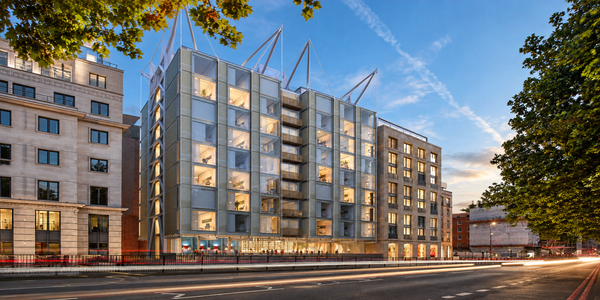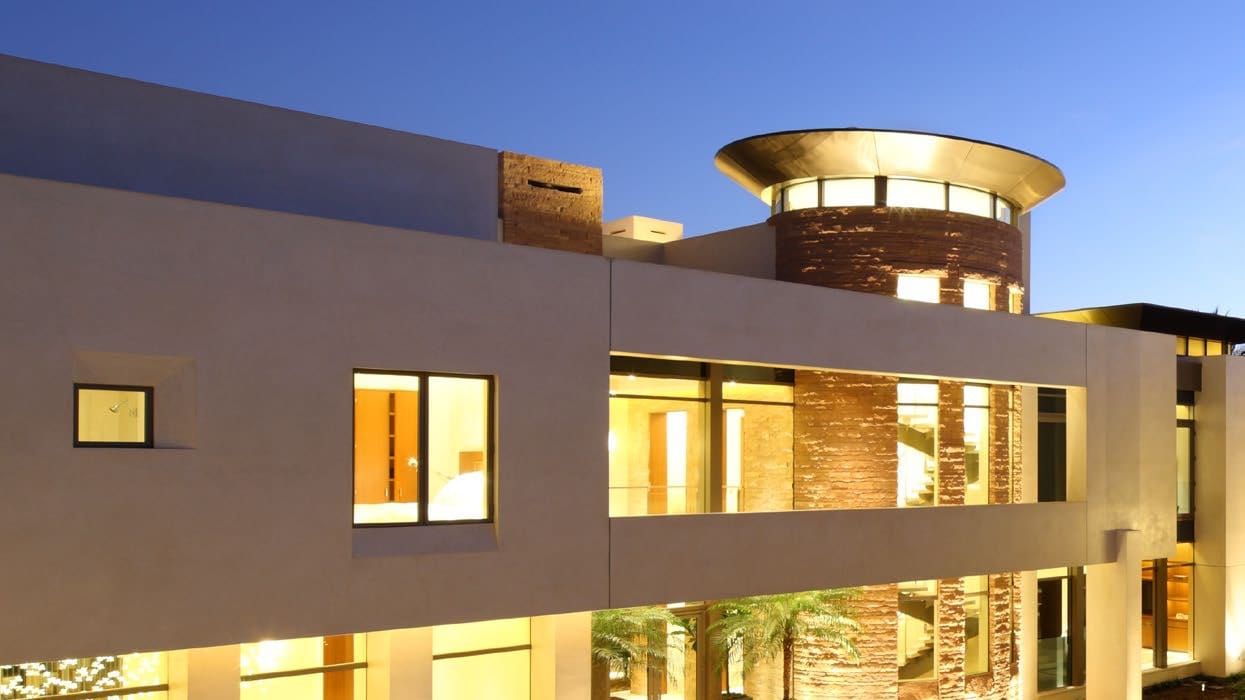
One thing that strikes me, as I chat with Richard Landry, is the way he emphasises that his architectural practice also designs small. “We have a number in the 500 square-metre range and every year we seek to sign some of those smaller commissions,” he tells me, adding that, of course, size is relative. “People tend to talk more about our larger houses, they’re more sensational but we have a lot of regular clients, even some on a tight budget, where we’re working really hard to give them the most we can for their money.”
Landry’s desire to draw attention to this side of his practice is all the more interesting because the popular perception is that he is Los Angeles’ master of the mega. With a number of homes ranging upwards of 18,000 square metres under his belt, there’s no ‘Mc’ to these mansions.
“People say well, ‘how can anyone live in such a large house’,” he continues, “but many times it is a family compound, where you have multiple generations living together. You add all the structures together and it makes for a large project but there may be 5, 6, 7 buildings on the property.”
Another popular misconception is that he is architect to the rich and famous. The LA homes of Mark Wahlberg, Rod Stewart, Gisele Bündchen, even the rental Michael Jackson died in, are all by Landry. Many of the larger commissions tend towards the French and the Classical, at least from the outside and so in a way, Landry could be described as the man who made the Coast, Ouest.
But to pigeonhole the architect in this way – as some of LA’s less charitable bloggers have done – is to ignore the fact that even at its most Classical, his work is much more than faux chateaus.
Warm and animated, even via a rather patchy Facetime connection, Landry’s French-Canadian accent is still apparent even after more than two decades working in America. If the dictum that ‘you can take the boy out of Quebec but you can’t take the Quebec out of the boy’ applies, it may also be proof – but this is entirely my inference – that he’s shrewd enough to realise the edifying effect a European accent (especially a British or a French one) can have on the ‘classless’ Americans.
Trained in Montreal, with a second diploma in architecture and urban design from Denmark’s Københaven Institute, Landry founded his practice in 1987. Capable of managing a project in its entirety, both architecture and interior design, the Landry Design Group developed a reputation for their private residences and their willingness to adopt a flexible, open-minded approach towards client desires.
“We come with no preconceived notion,” Landry explains, adding that determining a broad aesthetic preference and sounding out the ways a client intends to use the house are the starting points for every discussion. “We offer many options, so by the time a client commit to a project, they’ve examined them all. This willingness to involve clients, to demystify the process is a lot more fun for them. Once I know their needs, it’s my job to design something that is beautiful and functional.”
This willingness to listen and to be flexible may be one reason why, without needing to resort to headline catching competitions or public buildings, the Group has been able to build a reputation through word-of-mouth. “It’s a very small world somehow, people talk, people travel, they socialise together and so they see our houses,” he continues. “Our books have been really helpful for us, too.”
These would be the practice’s two in-house publications, ‘Modern to Classic’ and ‘Private Estates’, both of which lavishly and lovingly detail some of their more notable projects. Press attention has also helped. A fixture in US lifestyle magazine, homes Landry has designed have also featured in Architectural Design’s annual AD100 list four times in the past decade.
Another interesting feature is the way the studio has its feet in two different worlds. Decide to peruse their online portfolio, for example, and you’ll be asked whether you would rather look at modern or classical homes. When I ask Landry about this seeming dichotomy, the two styles being polar opposites in many ways, his response is to point to the underlying similarity that unites them; architecture’s essential role, the manipulation of volume and through that, the creation of space and light.
“There’s so much to learn from the history of architecture. Working within the traditional world doesn’t prevent you from being creative. We don’t pretend to copy. We look at architectural precedents, study their vernacular, get inspired and adapt that to today’s lifestyle. This can be a lot of fun. Even when we do more modern work, we still apply what we’ve learned about proportion and scale through traditional architecture. Maybe what we do is more Contemporary than Modern, as we try to make it more comfortable to live with, more like a home.
“Maybe that’s me talking from my traditional side,” he continues, adding that his personal preference is for the contemporary. “What we learn in school is ninety per cent modern but when you talk to many clients, they can’t relate to that kind of architecture.”
While many other American firms his size and smaller, have struggled since the recession, Landry Design’s forays into the burgeoning markets of Asia and the Middle East have enabled it to not merely survive but to thrive.
China has been a major focus – the country’s reputed million millionaires have a rapacious appreciation for both the “timeless” look of Classicism and the very Modern – but he’s also built homes in Saudi Arabia and Bahrain, as well as second homes for Arab clients in Los Angeles.
As even Landry’s most classical homes are recognisably of today once you get inside – details are traditional but the layout and flow is American – I ask him if, when designing in Asia and the Middle East, he introduces elements of the vernacular. While emphasising that he is willing to do so and that a discussion of how much a client wants their home to reflect their country or culture happens early on, he adds that most approach him because they want an American-style home.
Unlike some architects, for whom the design of a building can often become a case of ‘their way or the highway’, Landry Design Group is oriented to cater to the broadest possible market, even if this means that in the process, unlike Gehry or Hadid, this means not developing a recognisable house style.
“One day I’m creating a neo-Classical home, the next day, something completely modern. It’s all about diversifying. If I can do small and big, if I can do traditional and modern, if I can work for the world, we’re always going to be busy,” Landry drawls, leaving me with little doubt that for this architect at least, variety is the spice of life. “We’re more interested in listening to the client, in getting into their head, in wanting to create something that’s fresh. And fun. Always something fun.”
WHO Richard Landry
WHAT Founder of the Landry Design Group, an architectural and interior design firm
SINCE 1987
WHY By adopting a diversity of styles and listening to the client, Landry has created homes that vary from the traditional to the modern, appealing to a broad range of cultures and pockets.