In times of financial uncertainty, it is comforting to know that there's more to life than profit and loss. To evolve from little desert oases into booming international cities the recent trend in the Gulf has been to invest, invest and invest into businesses, entertainment, sports, and other profit-generating industries and sectors.
With the financial crisis threatening to undermine the financial prowess that has come to define the Gulf, it is indeed time to look beyond the skyscrapers, the multi-billion dollar deals, the cut-throat businessmen, Blackberries and convertible Bentleys. Enter Qatar's Museum of Islamic Art which opened its doors to the public on December 1st, 2008 and which is the first of several ambitious cultural projects to be realised in the region.
Qatar beat both Abu Dhabi and Dubai to the post over their equally ambitious projects. The Solomon R. Guggenheim Museum of New York and the Louvre of Paris will both open satellites in Abu Dhabi, and Dubai is constructing the local equivalent of New York City's famous museum mile (a stretch of Fifth Avenue that includes the original Guggenheim Museum building designed by Frank Lloyd Wright).
The Museum of Islamic Art is a stark, imposing structure designed by the renowned Chinese-American architect, Ieoh Ming Pei, professionally known as I.M. Pei, who at the age of 91 is nearing the end of a most illustrious career. Amongst a lifetime’s work he designed the Pyramid of the Louvre in Paris, and the East Building of the National Gallery of Art in Washington. The Museum of Islamic Art represents his architectural finale and one for which he had to be lured out of retirement.
In designing the Museum, Pei drew inspiration from Islam. "Islam was one religion I did not know," he said in an interview. "So I studied the life of Mohammed. I went to Egypt and Tunisia. I became very interested in the architecture of defence, in fortifications.” The structure seems to be strongly influenced by the 9th century mosque of Ahmad ibn Tulun in Cairo, and ancient fortresses in Tunisia.
Situated on its own island lying just off Doha’s newly developed waterfront corniche, the colossal and geometrically austere structure most definitely resembles a fortress. "The architecture is very strong and simple," Pei said. "There is nothing superfluous." The architecture is a fusion of minimalistic design and the ornamental geometries found in Islamic art. The building has a classic, somewhat naïve form and resembles building blocks piled one on top of the other.
With a structure of such simplicity, the choice of location was absolutely crucial. Pei wanted to harness the blazing sun's play of light and shadow to give the museum some vivacity, and hence needed a position that would benefit from all angles of the sun. He turned down many of the proposed sites downtown, worried that in the future his structure would be overshadowed by new construction, and chose a spot off the end of the new corniche. Seeking to isolate the museum from the rest of the city, he asked for a private island. The Emir of Qatar, Sheikh Hamad bin Khalifa al Thani, the chairman of the museum, agreed and today the man-made island is reached by a connecting boulevard with giant palm trees and surrounded by a 20-hectare park.
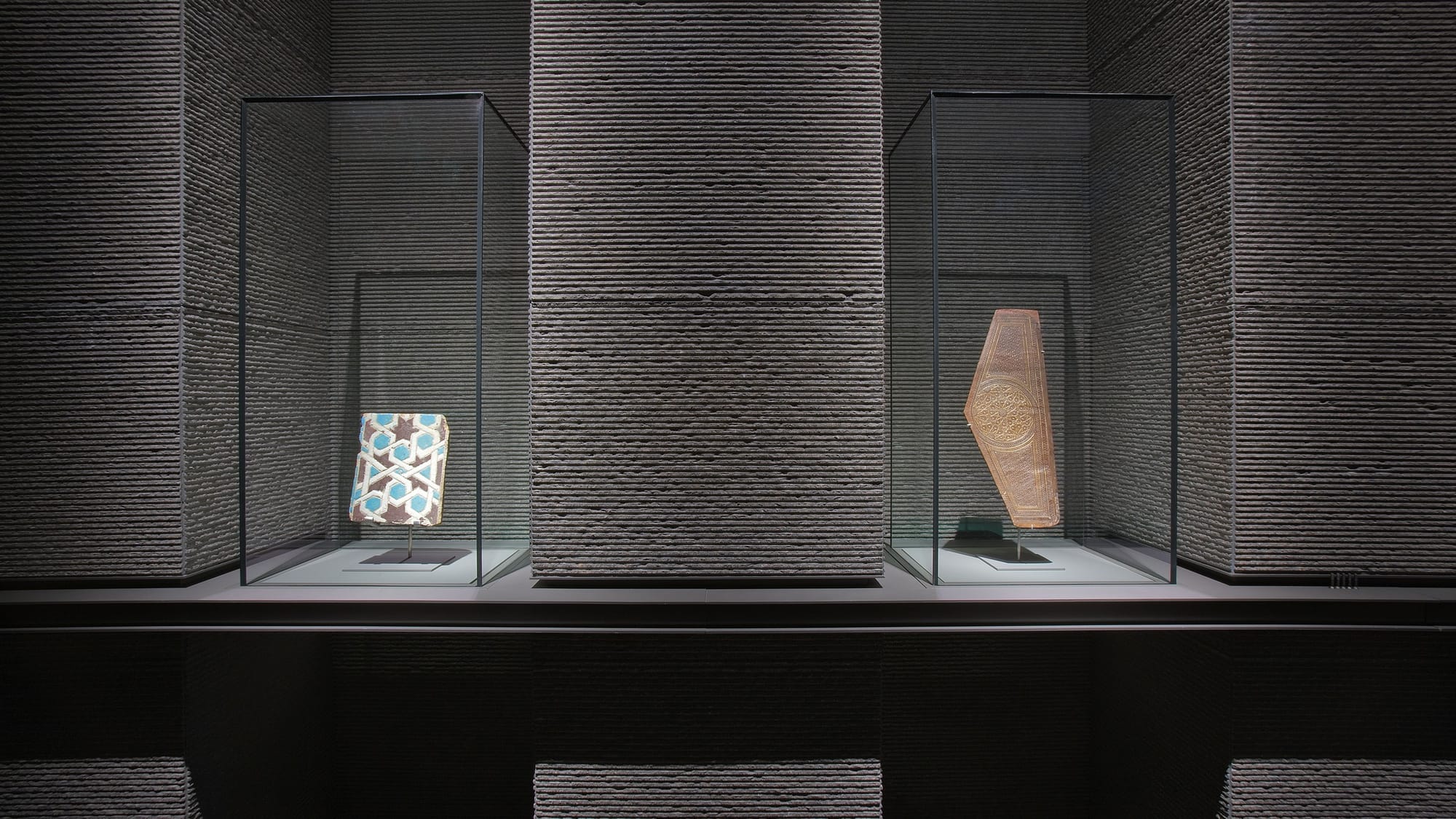
Inside there is a generous 12,500 metres squared of galleries, organised around a towering atrium capped by a dome and with a narrow beam of sunlight descending from its central oculus. The galleries house a permanent collection of 800 artefacts brought to the Qatari capital from all over the Middle East and India. The artefacts date from the 7th to the 19th century and include manuscripts, ceramics, glass, books, metals, textiles, wood and precious stones.
This project has been hailed as an excellent example of determination by the Qatari government to get their country on the map; the museum, along with other museums being planned for the country, will surely do wonders towards establishing the gas-rich state as the regional hub of cultural and historical excellence. Nevertheless, the museum has its fair share of criticism as well. One recurring condemnation of these sorts of museums centres around the validity of the term ‘Islamic Art’ in that it is a category of art in the Western world that pays no homage to the true diversity of works of art that have emanated from Islamic countries. Basically imagine if we used the term ‘Christian Art’ to apply works spanning 1000 years and from such diverse countries as the British Isles via Germany to Russia.
Nevertheless the museum’s collection is mapped to offer a narrative that is tailored to a modern audience, offering visitors to the museum a journey through time, across cultures, religions and eras. It is just a shame that the lighting is not always perfect. Some individual pieces displayed in their own cases are properly lit, giving justice to their brilliance. Other artefacts however do not enjoy this luxury, and one is left with the feeling that more attention could have been paid to the internal artificial and natural lighting.
That being said this drawback does not detract from the significance and splendour of the masterpieces on display in the museum. Some of the most important objects are a page from the Baysunghur Qur’an (a very rare enormous Qur’an manuscript from the 14th century), two velvet panels illustrating wine drinking at the Safavid court of late 16th Century Iran, and a painting of St. Jerome as the Representation of Melancholy, made for the Indian Emperor Jahangir of the 16th century.
A visit to this imposing structure is a must in order to appreciate both the unforgettable works of art and the impressive cultural initiative taken by the Qatari government. The museum opens Sunday, Monday, Wednesday, Thursday and Saturday from 10.30 am to 5.30 pm, Friday from 2.00 pm to 8.00 pm, and is closed on Tuesday. Admission to the museum galleries is free, and tours are available. There is a charge for admission to temporary exhibitions. The museum is located 15 minutes away from Doha International Airport.
www.mia.org.qa