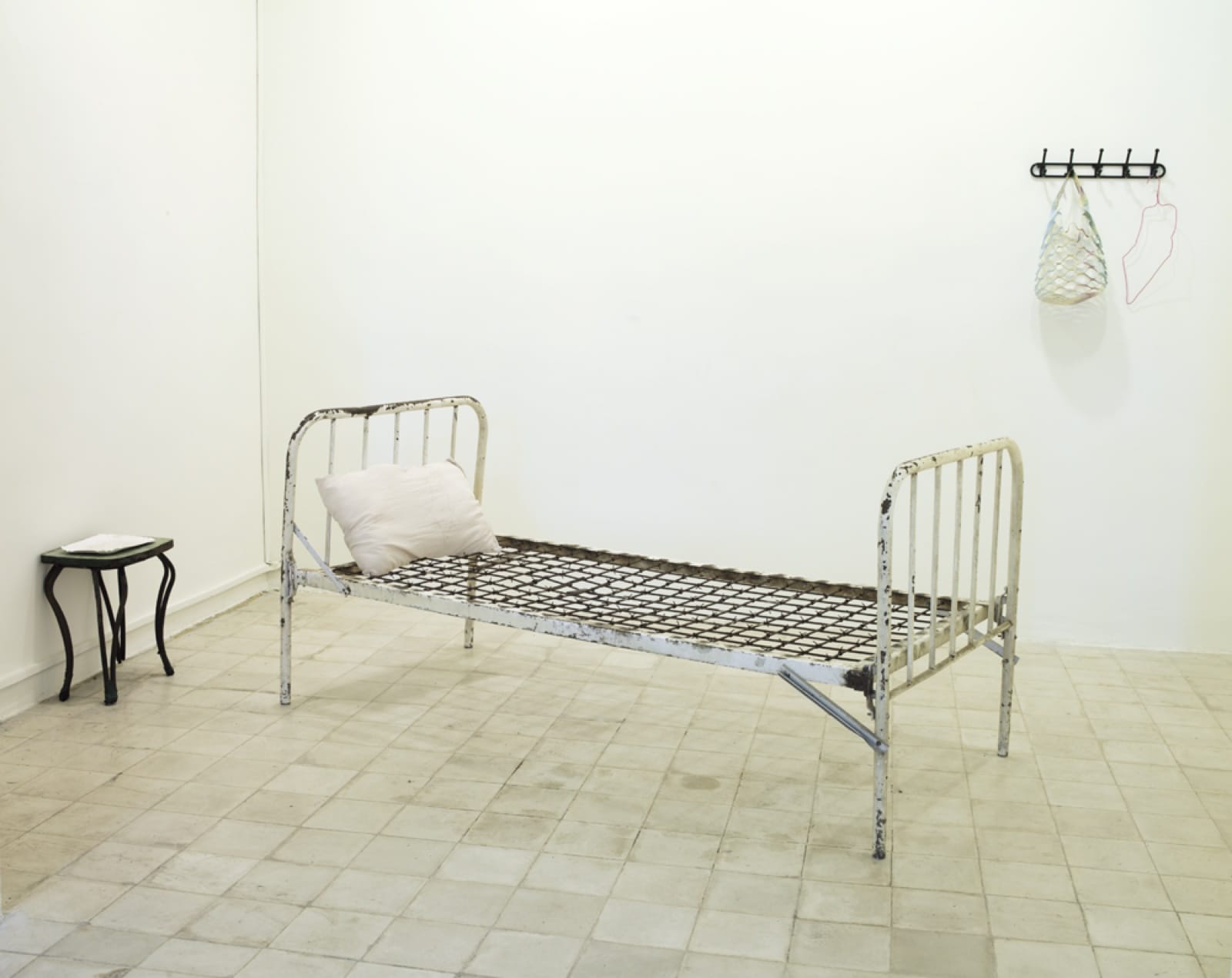
You’re confronted with a small, metal crib. There’s no baby, there’s no mattress. No toys, no pillows. The base of the crib has vanished. In its stead, thin wires stretch across the frame like an egg-slicer, or in any case, something you don’t want to mess with. Don’t look to the walls for help. You’re on your own.
Mona Hatoum, the Palestinian artist behind this subtly macabre confection, prefers it this way. She’d rather you stand there, confused, unnerved, disoriented, than that you seek safety and meaning in a brief wall text, courtesy of the institution.
“I always find it problematic when museums and galleries want to put up an explanatory text on the wall,” she told fellow artist Janine Antoni in a 1998 interview for Bomb magazine. “It fixes the meaning and limits the reading of the work and doesn’t allow viewers to have this very expansive imaginative interpretation of their own that reflects on their experience.”
Hatoum was born in Beirut, Lebanon in 1952 to Palestinian parents who fled Haifa in 1948, one story among the tapestry of dispossession that is the Nakba. Based in London since 1975, she is one of the Arab world’s most influential artists. Few if any Arab artists of her generation have attained her stature: her work has been shown at the world’s top institutions, including the Centre Pompidou in Paris, the Reina Sofia in Madrid and the Museum of Modern Art in New York. Her work, if it must be labeled, fits not-quite-comfortably in the Minimalist and Conceptualist rubrics, but is political in a way that overflows those genres. Its statements, while sometimes obscure or uncertain, are nonetheless undeniably present. In developing her artistic method, which she describes as “bringing political ideas to bear through the formal and the aesthetic,” particularly in her later work, she became the de facto matriarch of a diverse clan that includes the likes of Walid Raad, Zeina Khalil and Rabih Mroueh.
Hatoum never studied politics. She was the daughter of refugees who, on a “brief visit” to London in 1975, was forced into exile due to the outbreak of Lebanon’s Civil War. No, she didn’t study it. She lived it. The politics of her work, therefore, are never approached didactically, but rather felt viscerally. This, she says, came from her experience as a student at the Slade School of Art in the late 1970s, “a very cool environment that favoured intellectual inquiry.”
“But I had this distinct feeling that people around me were like disembodied intellects. It was in opposition to this kind of attitude that I started focusing intensely on the body, first using its products and processes as material for the work, and later using it as a metaphor for society – the social body,” she has said.
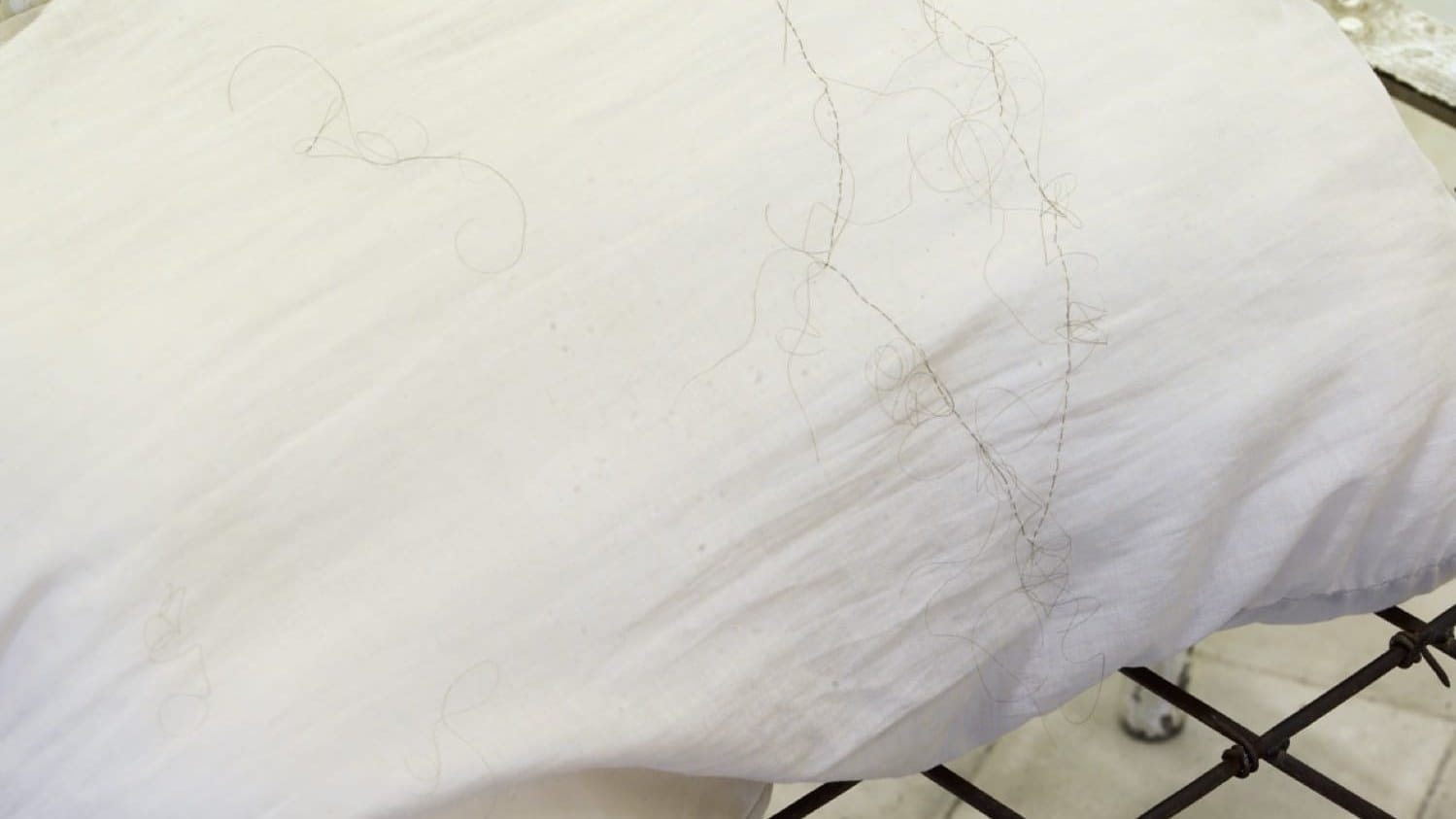
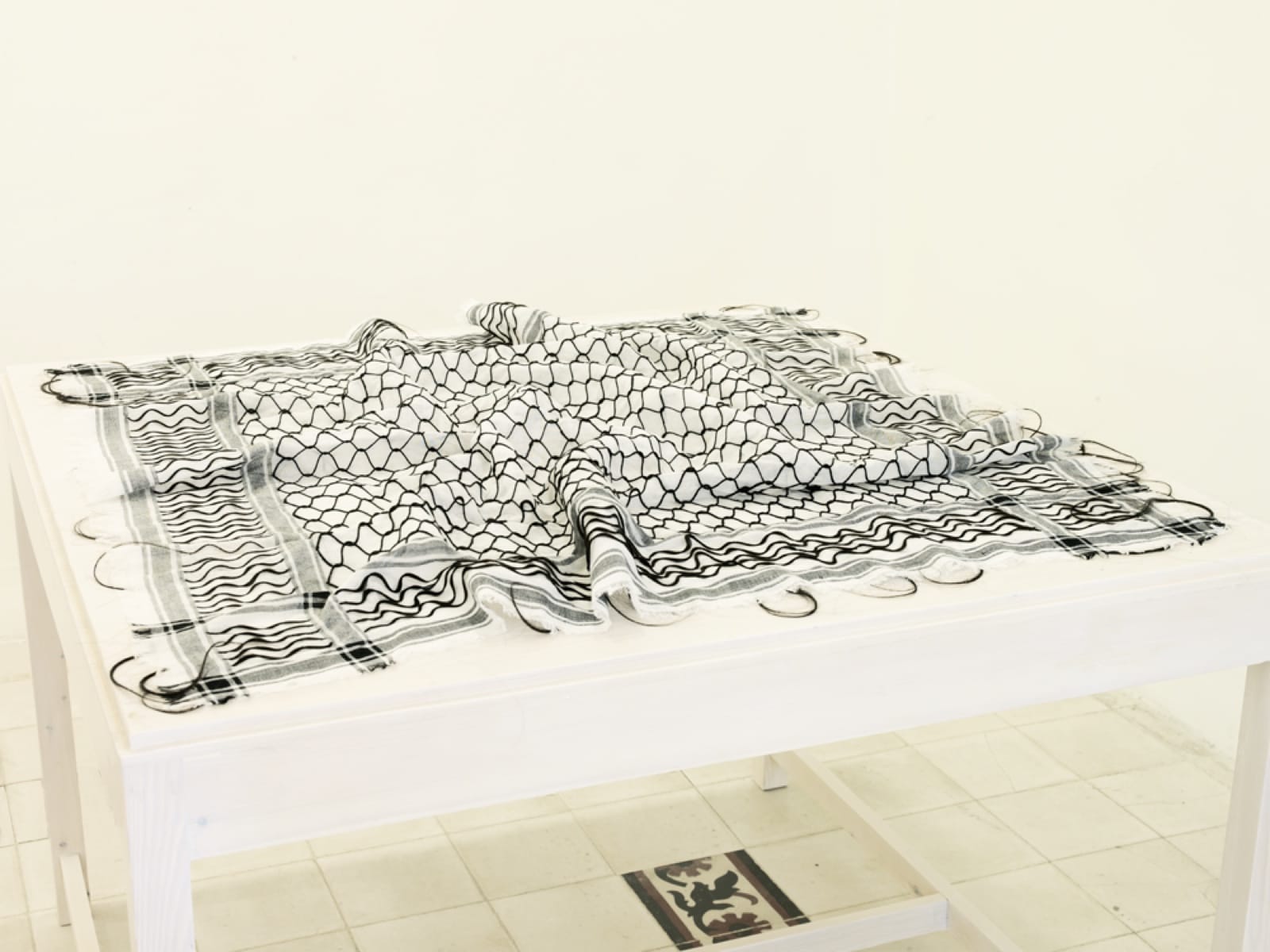
Keffieh (1993 – 1996), for example, is that familiar symbol of Palestinian resistance, Yassir Arafat’s signature lid, but here its checkered pattern is woven with long strands of human hair. The effect is enticing and repellent; the fact that it is dead, possibly germ-ridden human hair is offset by the soft, feminine way the tendrils gently splay around the edge of the cotton fabric, loose curls that beg to be tucked gently away behind an ear. Palestinian-American curator Salwa Mikdadi reads into them, “Through material and form, Hatoum suggests the proximity of the female and male in order to comment on Arab and Islamic social norms and gender roles. Indeed, this piece questions taboos by feminizing a symbol of masculinity.”
Gender was and is a frequent theme of Hatoum’s work, but she is as loathe to cast herself in the role of “feminist artist” as she is to take on the mantle of “Palestinian artist” or “Arab artist,” preferring instead to address notions of isolation, dislocation and marginality – in what has become fashionable to describe as “otherness” – more generally. “I’m often asked the same question,” she has complained. “What in your work comes from your own culture? As if I can actually isolate the Arab ingredient, the woman ingredient, the Palestinian ingredient. People expect tidy definitions of otherness, as if identity is something fixed and easily definable.”
Given that these experiences of otherness are hardly the monopoly of one or other oppressed group, her subtly destabilising approach to identity gives her work a universal resonance. The late Edward Said, an appreciative fan and fellow Palestinian refugee, wrote of Hatoum that “her work is the presentation of identity as unable to identify with itself, but nevertheless grappling the notion (perhaps only the ghost) of identity to itself…No one has put the Palestinian experience in visual terms so austerely and yet so playfully, so compellingly and at the same moment so allusively.”
When encountering the work of Mona Hatoum, you may if you like look for clues among the critics, curators and journalists who have written nearly two dozen books and numerous articles on her. You will be given one small clue – the title of the work – often a pun, or some kind of play on words, that reveals a bemused irony regarding the topic. Jardin Public (1993), for example, a wrought-iron chair featuring a neat, triangular patch of pubic hair on its seat, stems from the common etymology, but radically divergent connotations, of “public” and “pubic.” That nightmarish crib? It’s called Incommunicado (1993), a name that suggests perhaps, an infant’s inability to communicate fully with others and, as Hatoum puts it, an association “with prisoners in solitary confinement.”
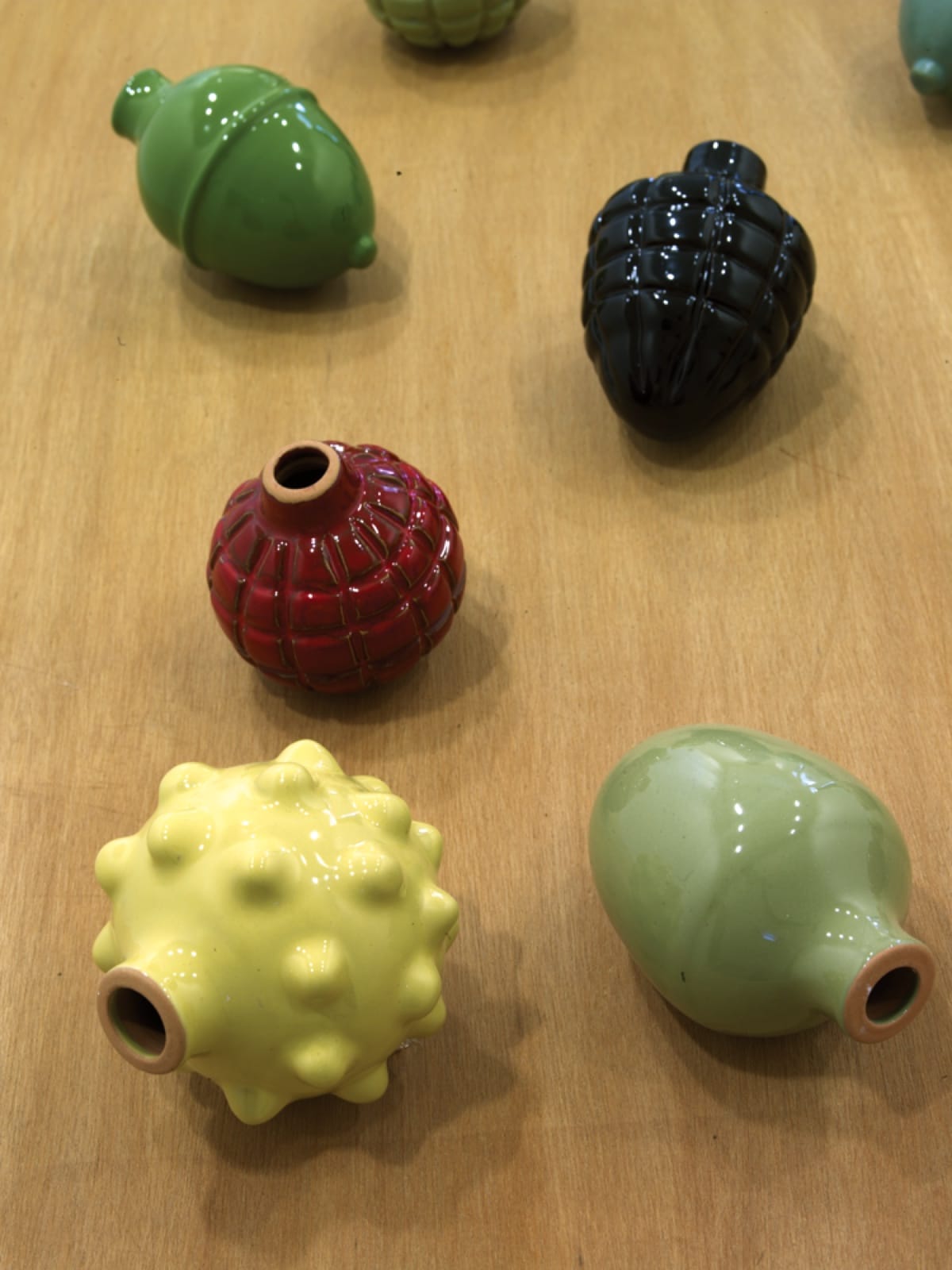
The winks and nudges of the playful titles give a certain grace to the dramatic, urgent nature of the work. One of her more recent pieces, Still Life, completed with the handiwork of a women’s cooperative based in Jordan, was a set of grenades sculpted out of colourful, glazed ceramic, scattered on a large wooden table. In a world rife with conflict, but exhibited in a serene hilltop art gallery in what is perhaps the region’s most stable country, each candy-coloured but menacing bauble boasted a multiplicity of meanings. Made by women, thrown by men. Picked up by curious children. Still Life? With all these grenades, is there still life?