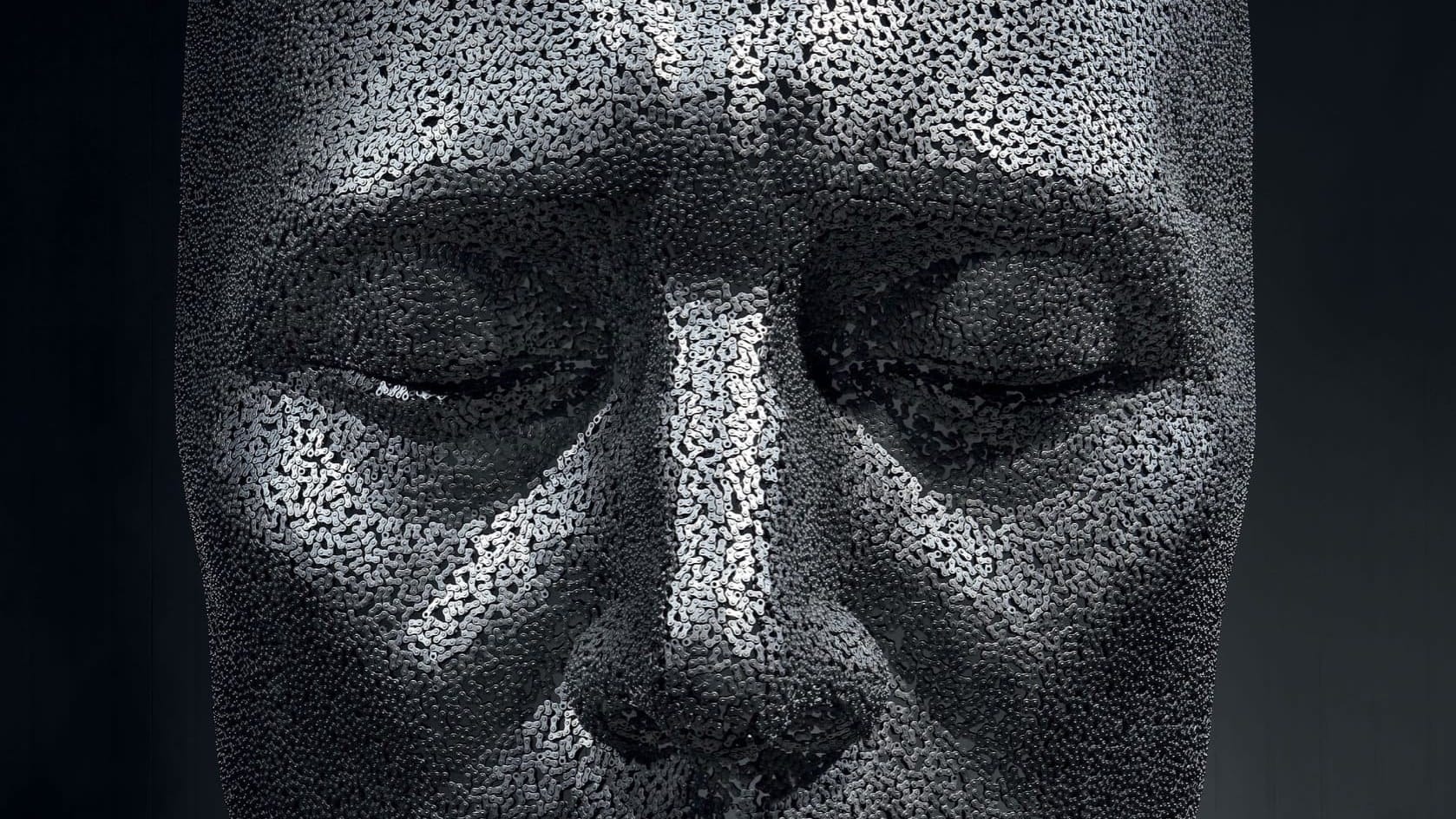
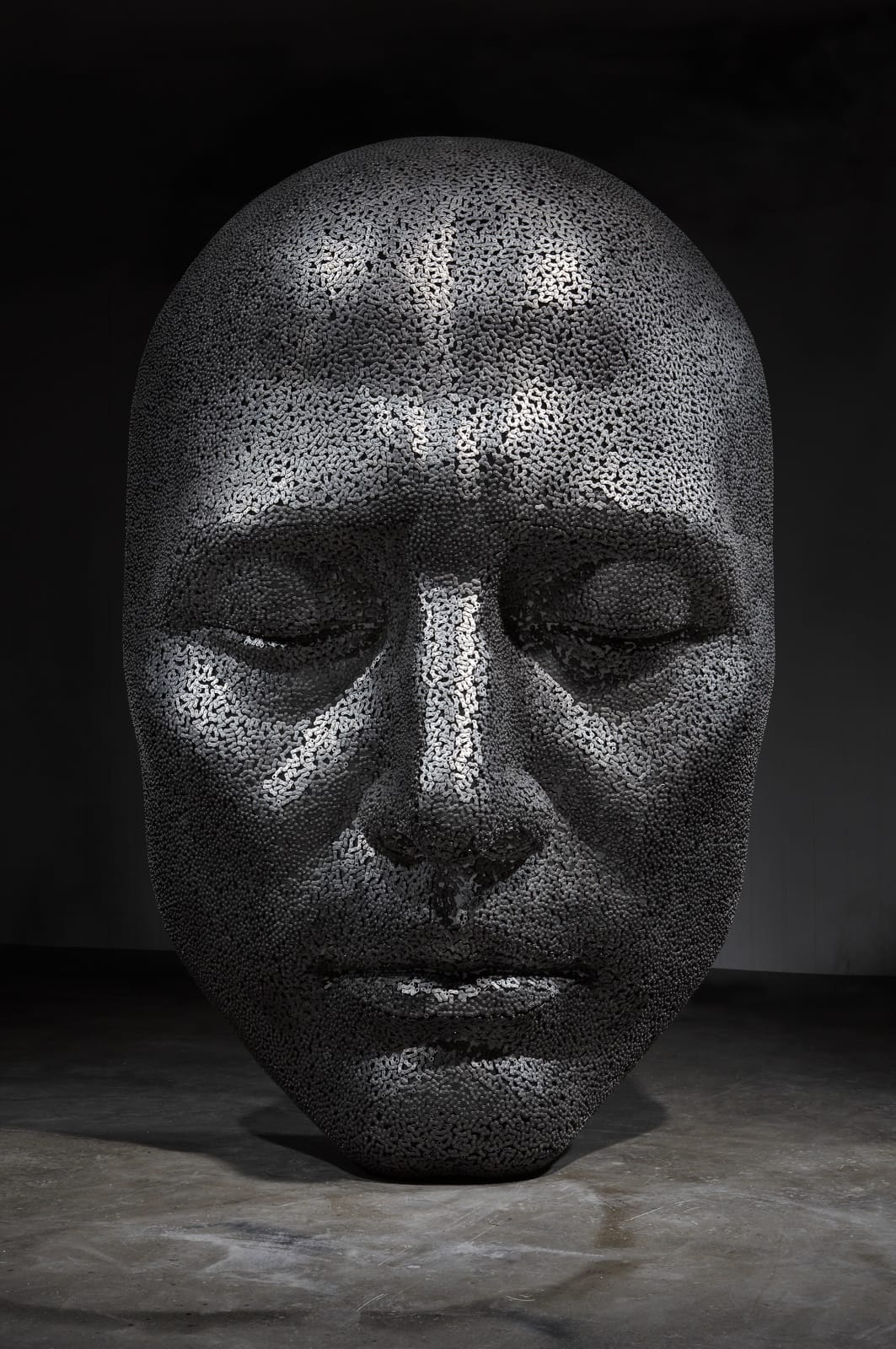
The first time I visited the Opera gallery was last summer, on their opening night in Beirut. I remember that at the time, what stood out wasn’t – surprisingly – the relatively unknown drawing by a pre-Cubist Picasso or the pre-Surrealist Dali painting (which were undoubtedly impressive pieces), rather, the real star of the show was a sculpture on the terrace: ‘Meditation 16’ by Seo Young Deok, a Korean artist I had truthfully, never heard of.
There are a few reasons why this piece was so impressive. The first might have to do with its positioning (it loomed against a melancholic backdrop of old Roman ruins, a strikingly beautiful setting) but more significant were the elements of aesthetics, form and technique at play in the way it was made. You see, this massive, shimmering visage and its brooding stance had all of the elegant stoicism of Rodin’s ‘Thinker’ and, on a closer look, you discover the sculpture was actually formed by thousands of iron-cast bicycle chains meticulously welded together. Their connectivity is both disquieting and harmonious, hard and industrial yet organic and figurative, obsessive and complex yet raw and unpretentious. Proving very popular here, the gallery has sold several iterations from this series.
Remarkably, ‘Meditation’ is but one of Opera Gallery’s extraordinary collection of Korean artworks. “We recently closed Regeneration, an art exhibition in Paris of eleven emblematic Korean artists, most of whom have never been shown outside their country,” says Gili Karev, the Opera Gallery group’s head curator in London (besides London, Paris and Beirut, the group has branches in Geneva, Monaco, New York, Miami, Singapore, Hong Kong, Seoul and Dubai). Globally, the gallery puts on roughly 50 exhibitions a year and Karev is in charge of working with the local teams in moving from the concept phase, or the thematic governing each show, to its final execution on the ground. “The key question is how do you bring art from one place to another; how do you contextualise it?” she continues.
Karev is actually particularly well-positioned to answer this question given her background as an American independent curator and arts writer covering Asia and the Middle East, formerly based in Jaffa, whose parents live in Hong Kong, which is in fact where she first got acquainted with the Opera Gallery, as a writer for Manifesto magazine.
“I’ve always been interested in the East. In university, my degrees were in both English literature and East Asian studies, with a concentration on learning Chinese.” During her research, Kerev noticed that in the contemporary artwork she was looking at, whether from the Middle East or Asia, places where the future was still uncertain, the notion of how to reconcile different identities (political, cultural, national) was crucial. “Hong Kong was going through its umbrella revolution then, for example. In these countries, you cannot talk about just one specific narrative, there’s a whole stratosphere that exists, especially in terms of identity and belonging.”
And when it comes to attaching an identity to region-specific art, if you look at the late 20th century art produced inside Korea, you’ll see that the country gave birth to the Monochrome movement in the 1950s, otherwise known as Danseakhwa, around the same time that Western art was becoming more conceptual in nature and Minimalism arose. Despite the parallels between the two movements, few are aware of Monochrome, even though at a glance, some of its key works could be mistaken for a Rothko, Klein, or Mondrian. However, the pared down and at times abstract expressionist style underpinning Monochrome emerged from a country with a rich, centuries-old calligraphic tradition of painting with minimal colour, one that was struggling with its own post-war issues of national identity under a military dictatorship, so it wasn’t necessarily linked to Western influence. Monochrome is a uniquely Korean phenomenon that engages with a particular history and culture. “Korean art very much stands on its own,” Kerev adds, “Monchrome has a rich history since it was a huge movement, arguably the country’s most significant, and it has re-surfaced today in the art market, bringing with it its own distinct language.”
“Obviously, Korean contemporary art has huge potential. It tends to be less overt, or reactive for the sake of being reactive, and there’s an oversaturation of Chinese works these days,” she continues. “A strong collector base has developed inside Korea as more pieces get into the auction market. We work together closely with the Opera Gallery in Seoul so we already have a solid infrastructure. But we still have to do market research when deciding on which works to exhibit in each gallery space, since we’re addressing different audiences. The artists relevant in Korea aren’t necessarily the same as elsewhere.”
A case in point can be found at the entrance of Opera’s space in Beirut, where Bahk Seon Ghi has suspended hundreds of pieces of charcoal, using invisible nylon threads, to conjure the image of a potted cactus. Appearing as if it was in the process of disintegration, this dazzling piece is called ‘An Aggregation’. The artist has previously used charcoal to create floating staircases, ethereal columns and bulbous forms, alluding to the role of this carbonaceous material in Korean purification rituals, as well as modern manufacturing.
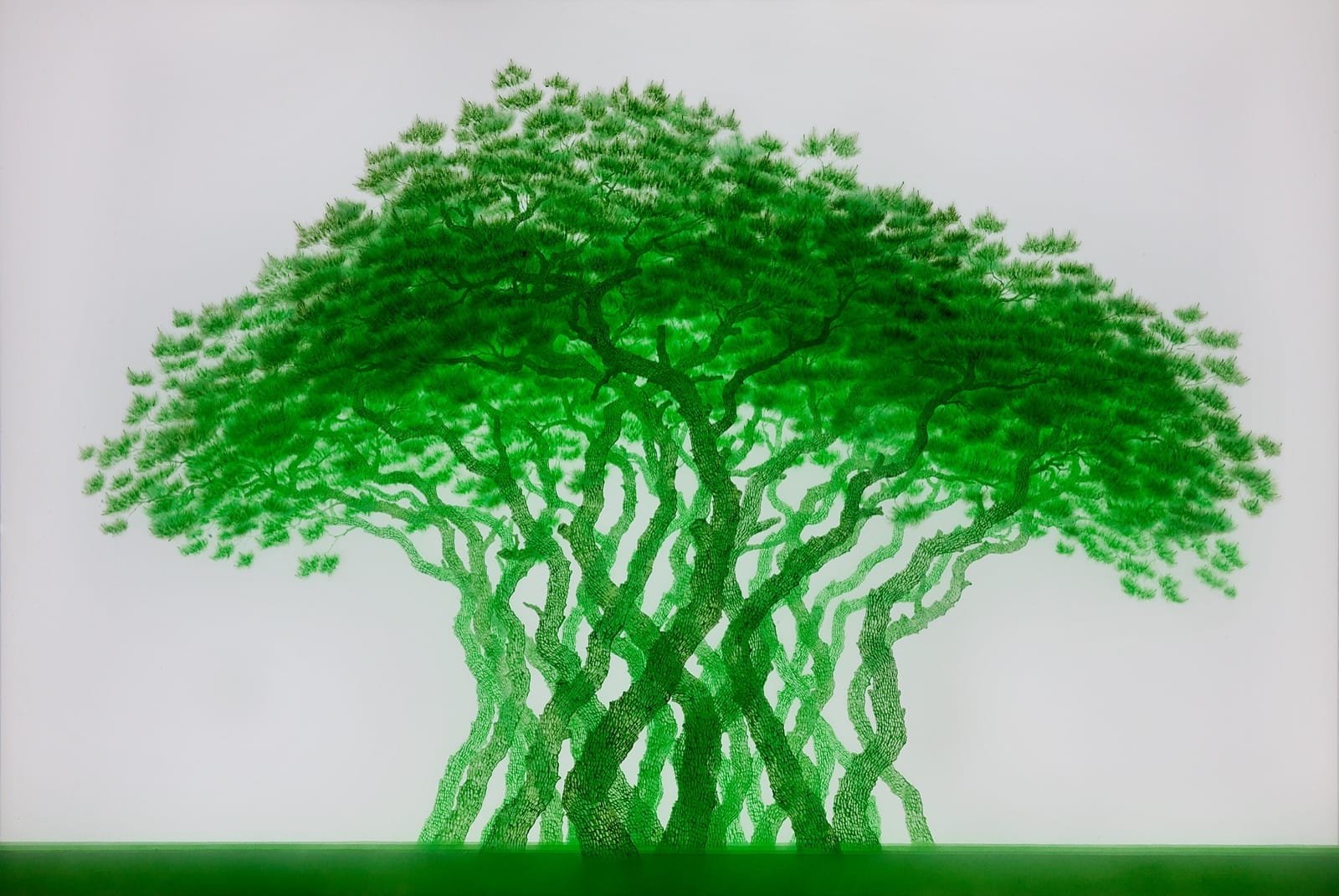
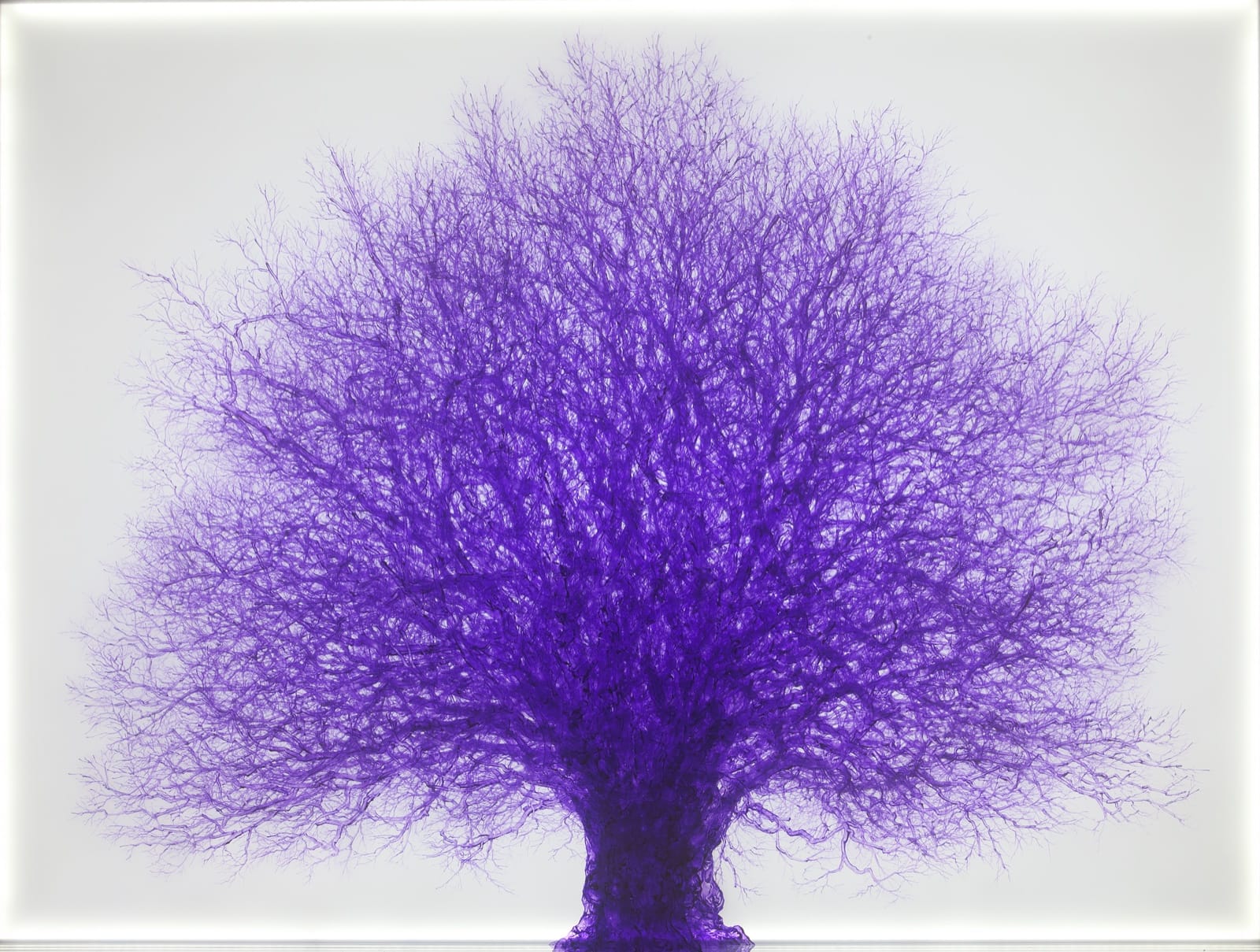
Some of the other works in the Beirut collection, include Son Bong Chae’s ‘Migrants’ (a series of LED-illuminated oil paintings layered on polycarbonate glass that look like photographic negatives of phosphorescent pines) and Lee Jae Hyo’s masterfully manipulated wood sculptures that are both elegant and functional. Both engage directly with the colours, patterns and forms of nature.
According to Kerev, Korean works simply cannot be reduced to one single medium or material. “Take Suh Jeong Min, who painstakingly layers hundreds of hand-dyed Hanji paper from mulberry trees, or Ran Hwang who uses thousands of buttons, pins and beads to make his wooden panels. If you come across one, it simply takes your breath away – it’s not something you see everyday. The only commonality between them is that they are all based on Korean industry. Hanji paper, for instance, is used in the royal homes of Korea, it’s different from something you’d commonly find in China, such as pottery.”
Korean art clearly displays a strong sense of spirituality, reflection and a consciousness of the impermanence of nature that shifts towards an industrial revolution and back again. “As a whole, these works are craft-oriented and yet manage to remain relevant and contemporary at a time when Western art has moved away from the ‘making of’ part of art. ” In cultures such as ours, where the emphasis should be on craft as much as concept, this is no small feat.