The earliest experiments with flying machines, the first basic engine, the invention of corrective lenses, architectural revolutions and slightly less highbrow creations such as high-heeled shoes and coffee shops, the Muslim world has contributed a great deal to the modern world. Much of this has passed into obscurity, but a new exhibition tour seeks to bring these wonderful discoveries back into the light.
Launched in January 2010 and running until June 30th, the Muslim Heritage Exhibition at London’s Science Museum is striving to improve our understanding of Muslim and Arab contributions to science. The ‘1001 Inventions: Discover the Muslim Heritage in Our World’ exhibition is sponsored by the Abdul Latif Jameel Foundation and after London it will go on a global tour to sites in America, Canada and much of Western Europe.
At the opening of the exhibition, Chris Rapley, director of the Science Museum, said, “The thousand year period from the 7th century onwards was a time of exceptional scientific and technological advancement in the Islamic World, spanning China, India, Persia, Africa and Arabia. This is the period in history that gave us huge advances in engineering, mathematics, chemistry and physics.”
In mainstream Western thinking, the period between the 7th and 16th centuries is seen as a cultural and scientific dark age. Yet, it was the golden period of Muslim and Arab invention, critical thinking and discovery. That the Dark Age myth is perpetrated is something that clearly needs to be addressed. As Rapley states, the advances made across the Muslim world were, frankly, astounding and it is to the detriment of future generations that this contribution is not recognised across much of the world.
The core principle behind the exhibition is to highlight the role that Muslim and Arab scholars and inventors played in the advance of science. “Muslim civilisation, covering 1,000 years of history, played an exceptionally important role in the development of our modern world and paved the way for the European Renaissance,” says Junaid Abbas Bhatti, director of marketing for 1001 Inventions, the educational initiative behind the tour.
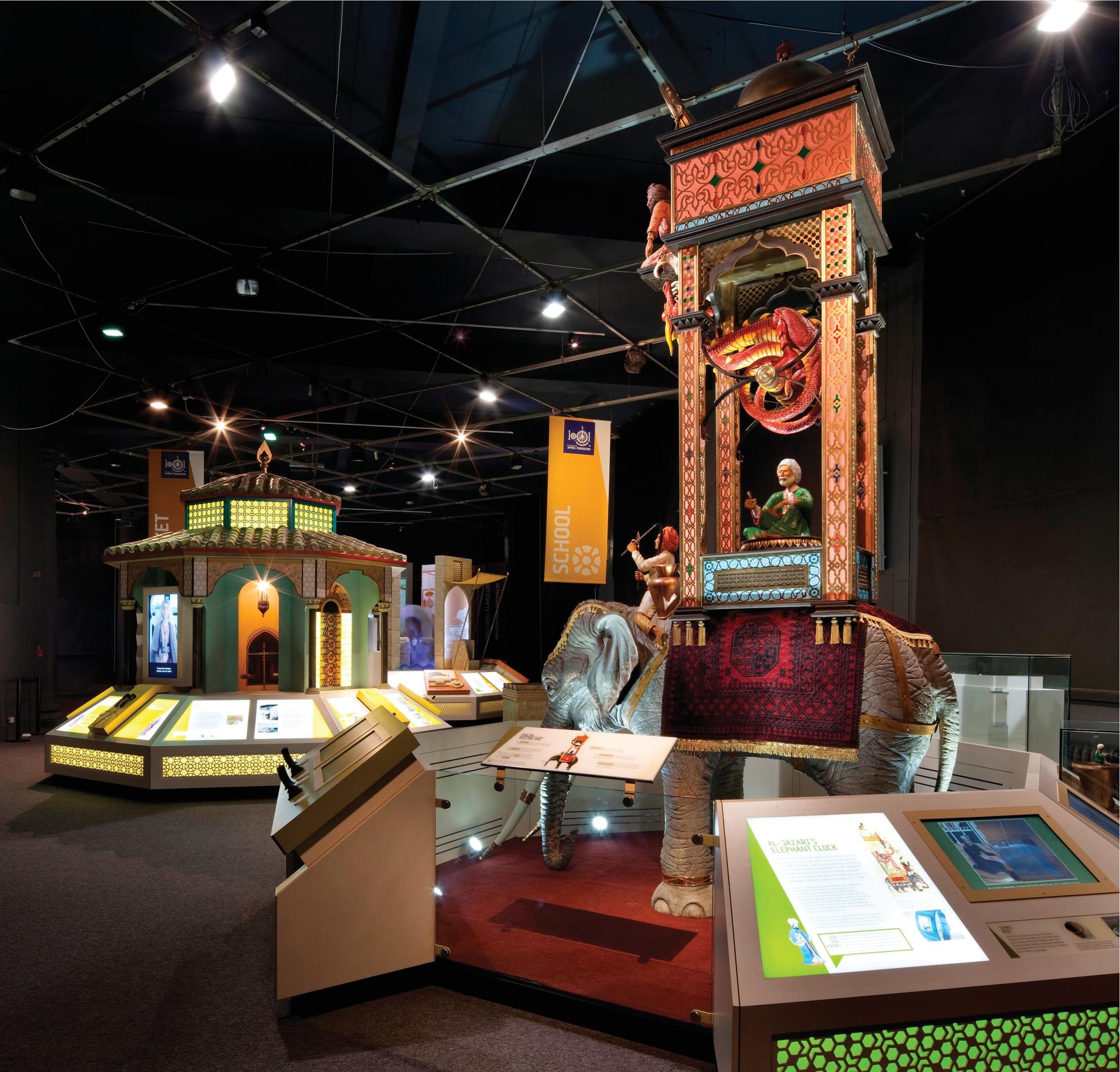
Drawing from a collection of 15,000 objects, 1001 Inventions has created a striking, interactive exhibition covering inventions and inventors from across the Muslim world. The London exhibition covers roughly 1,000 square metres of floor space and is divided into seven zones, Home, School, Market, Hospital, Town, World and Universe, with each zone detailing the advances in a specific area of science. According to Bhatti, the zones allow the visitor to fully appreciate the differing realms in isolation.
With such a diverse collection of objects spanning so many different realms, it is all but impossible to pick out the highlights of the collection. However, the 5-metre-tall replica of the Elephant Clock, a giant clock mounted on a statue of an Elephant, created by a master engineer by the name of Al Jazari in the 13th century, has to be seen to be believed. Incorporating technology from across the world, it is a clear sign of the unifying nature of scientific studies at the time.
The exhibition has embraced the modern, interactive nature of the best museums with relish. A short feature film featuring Oscar-winner Sir Ben Kingsley, a mini-planetarium in which visitors can experience the movement of the stars and many other innovations, including a virtual guide in each of the Zones, make it anything but a staid affair.
The essence of the 1001 Inventions tour can be summed up by considering the field of medicine. The evolution of medical care, including surgery, owes an incredible debt to Abu al-Qasim Khalaf ibn al-Abbas Al-Zahrawi, who hailed from Andalusia. Al Zahrawi pioneered medical research, forging ahead of the rest of the world at the turn of the 10th century, “He was responsible for inventing the syringe, bone saws, forceps and scalpel designs that are still in use today. He was also responsible for pioneering the use of catgut for internal stitching, which was particularly helpful for women who underwent Caesarean operations as they only had to have one surgery,” says Bhatti.
While the general public in the West might be aware that Muslims and Arabs greatly advanced medical science, this awareness tends to be somewhat vague, a nebulous idea that is never fully explored or understood. This exhibition hopes to clarify the role of men such as Al Zahrawi and allow them to take their rightful position among a wider audience. Taking what was previously esoteric knowledge and opening it up to the world can only serve to improve understanding of the importance of Muslim and Arab science.
While many of these discoveries have been incorporated into society for hundreds of years, there are some fields that have only recently emerged on a large scale that are benefitting from Muslim advances. Ecologically sound housing is a growing sector within much of Europe and the US; however, none of this is new when you consider that 4,500-years-ago a typical house in Baghdad was already exhibiting elements of eco-conscious building. Baghdadi houses, incorporating inward-looking rooms which allowed for year-round use without concerns about heating, double-glazed windows, planted courtyards with fountains, thick external walls and features encouraging natural ventilation, were light years ahead of their Western contemporaries.
Examples such as eco-friendly housing, the work of Al Zahrawi and Al Jazari are merely examples of the historical gems on display at the exhibition. With a collection this vast, the only way to fully appreciate the scale of Muslim contributions to science is to descend on the tour as it travels the world. If, that isn’t possible then there is a book to shares the experience. ‘1001 Inventions – Muslim Heritage in our World’ edited by professor Salim Al Hassani, features over 370 pages of illustrations and detailed descriptions of Muslim inventions and contributions to science.
Here at Bespoke, we appreciate the efforts of those who would preserve the heritage of the region, be it in terms of the physical environment, or more ephemeral ideas such as Muslim and Arab thought. Our region’s contribution to science and modernity is undoubted, in such diverse fields as medicine, architecture, astronomy, flight, cosmetics and literature, Muslim and Arab scientists were at the forefront. Our history is something of which we should be justifiably proud and anyone who carries that message to the world deserves our support.
www.1001inventions.com