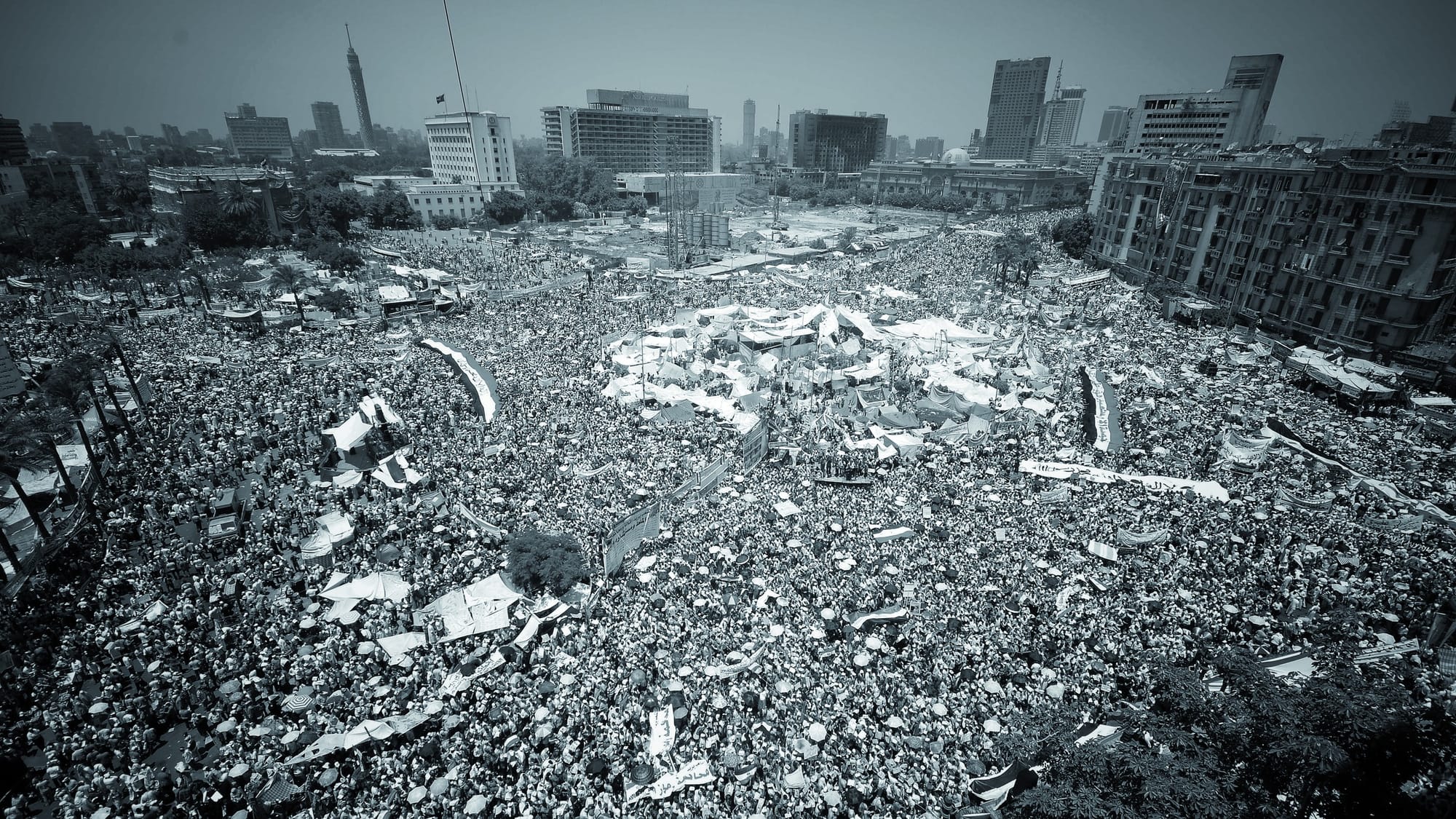
To walk through downtown Cairo, especially along the Nile by Tahrir Square, is to walk through the heart of last year’s revolution. An ongoing reminder of the dramatic events which took place here, these streets are still the spaces chosen for protests, which even today, continue to draw Egyptians back in their thousands.
Tahrir was built in the 19th century by Egypt’s Khedive, Ismail Pasha, who wanted to transform Cairo into a Paris on the Nile. Tahrir Square was originally called Ismailiya Square after its builder but was renamed Tahrir (or liberation) Square after the 1952 Free Officers’ Revolution, which brought General Abdel Nasser to power, ended the Egyptian monarchy and erased the last traces of British occupation.
Next to Tahrir is Abdel Moneim Riyad Square, which sits underneath the vital 6 October Bridge. It is named after a prominent military officer during Egypt’s 1967 war with Israel and a statue of him stands nearby. Riyad is said to have predicted the tactics that would lead to Egypt’s defeat. Killed by artillery fire in 1969 during a visit to the frontline, his death galvanised Egyptians, who poured into Tahrir to demonstrate their grief and support for the remaining military leaders.
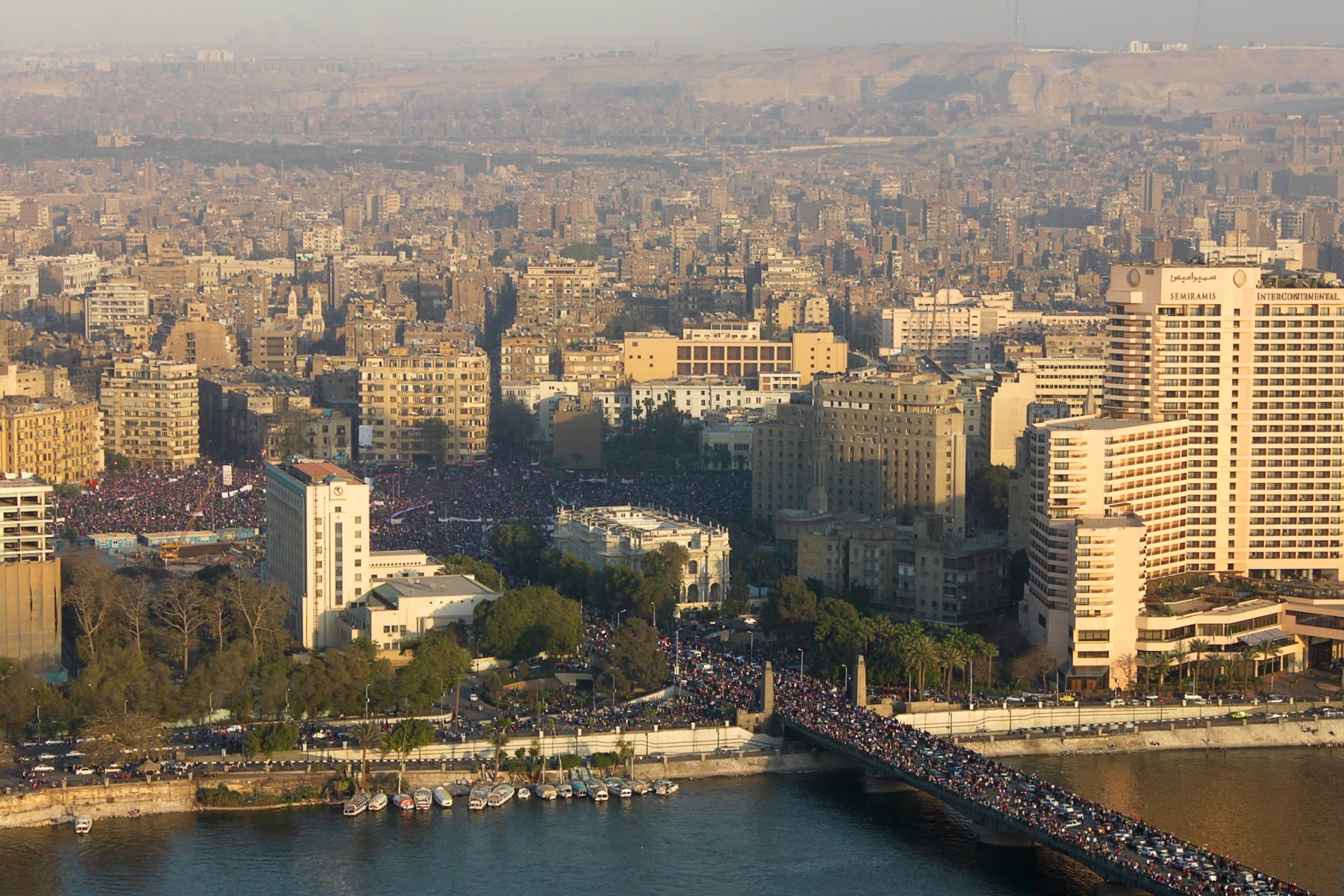
It was through Abdel Moneim Riyadh that, in one of the most infamous moments early in the 2011 uprising, armed men on horseback wearing civilian clothing attacked those camped in Tahrir. They were forced back after hours of confrontation during which protesters used rocks and broken up bits of pavement to defend themselves. The square would be an important frontline throughout the 18 days of the uprising.
On the Corniche side of the square, just next to the Egyptian Museum - amongst many other things home to a colossal statue of the revolutionary pharaoh Akheneten, who overthrew the Egyptian pantheon to instate the world’s first known (albeit short-lived) monotheistic faith - stands the torched remains of the headquarters of the former ruling party, the National Democratic Party and perhaps one day, this site will also be immortalised with a statue or a plaque, for the image of the former president’s party headquarters going up in flames remains one of the revolution’s most powerful.
Further south along the Nile is Kasr el-Nil Bridge, which connects Tahrir with the island neighbourhood of Zamalek and the other side of the Nile. A popular place for leisurely strolls, the bridge was the site of what came to be known as the “Battle of Kasr el-Nil.” Here security forces on foot and in armoured trucks used tear gas, batons and water canons to try to push back thousands of demonstrators attempting to cross into Tahrir Square. Protesters threw the gas canisters into the Nile, and clouds of noxious gas drifted over the water for hours.
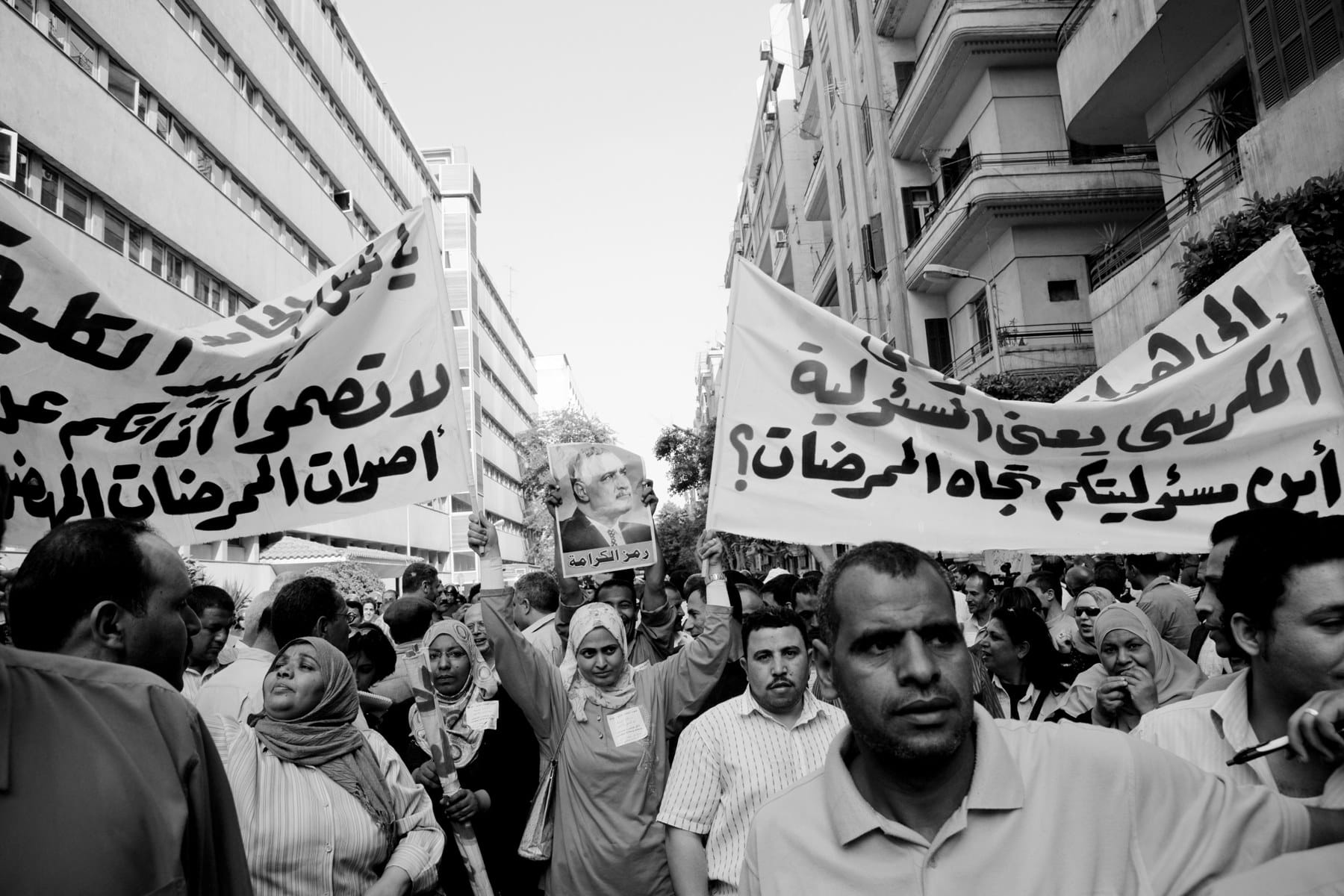
Ten months later, images of the 19th century bronze lions that guard the bridge’s entrance were photo-shopped to be shown wearing eye-patches, an homage to those who suffered severe eye injuries during attacks by security forces The image rapidly went viral. Like Tahrir, Kasr el-Nil, which was built by King Fouad, had a pre-revolutionary name that was changed after 1952.
Not far from the bridge, the Semiramis Intercontinental hotel, with its excellent views of both the Nile and Tahrir Square, became a sort of barracks for journalists during the uprising and the first half dozen floors were barricaded shut, with the lights kept off, for security reasons. Behind the hotel is a statue of Venezuela’s Simon Bolivar, a key figure in the history of Latin America’s struggle for freedom from Spain. The statue, made by a Venezuelan artist, was unveiled in the late 1970s. While then-president Anwar Sadat was not as enthusiastic a supporter of anti-colonial movements as his predecessor, Gamal Abdel Nasser, Egypt still celebrated independence movements around the world. A statue of fellow South American libertador, Jose de San Martin, an Argentinean revolutionary, can be found near the shooting club in the neighbourhood of Mohandesseen.
To the left of the Semiramis is the Shepheard Hotel, one of the oldest in Cairo. A former British headquarters during World War I, the hotel was burnt to the ground in the devastating and mysterious Cairo fire of 1952 and was rebuilt a few years later. The hotel is rumoured to have been the starting point for the 1977 Bread Riots when hotel staff, outraged by the food subsidy cuts passed by Anwar Sadat’s government at the behest of the World Bank and the International Monetary Fund, started the riots in the hotel’s kitchen.
Less than a kilometre south of the hotels is Parliament, which has witnessed numerous protests over the past century. When it opened in 1924, prominent Egyptian feminist and activist Hoda Shaarawi organised picket lines and submitted a list of demands related to women’s rights to the assembly. Shaarawi was the first Egyptian woman to publicly remove her veil. The famous event took place at Ramses train station as she returned from a women’s conference in 1923. Her move shocked many of the women who came to greet her but soon gave way to applause and prompted several others to remove their veils too. A street near Tahrir Square, is named after her.
Shaarawi had been politically active for a number of years by 1924. In 1919, she organised the largest women’s demonstration to then have taken place in Egypt. Around 10,000 women marched from Al-Azhar, the country’s pre-eminent Islamic institution, towards Abdeen Palace, ignoring British roadblocks and orders to stop. The demonstration was part of the 1919 Revolution, led by Saad Zaghloul, which demanded an end to the British mandate.
Zaghloul’s mausoleum, built in 1927, can be found in downtown Cairo near his house, which is now a museum known as Beit el Umma (House of the Nation), and contains the revolutionary’s furniture and other belongings.
Make the final stop on your revolutionary tour the neo-Classical French Imperial style Abdeen Palace. Designed and decorated by mostly European architects and decorators for Khedive Ismail, the famously opulent palace served as government headquarters and royal residence, until the end of Egypt’s monarchy in 1952. Parts are now open to the public and include a number of museums. The royal living quarters, however, are still in active duty and are reserved for the use of visiting diplomats and Egypt’s President.
Curiously, Abdeen has witnessed two almost identical abdications. The first in 1879, when Khedive Ismail left the country to his son and left Egypt for Naples from Alexandria on board the royal yacht Al Mahroussa. The second time, King Farouk was forced to abdicate when the palaces was surrounded by the army during the 1952 revolution. In Alexandria at the time, Ismail’s grandson left the country the same way as his grandfather, bound for Naples on board the very same royal yacht.