“People usually interview me over the internet, by phone, in my exhibitions, but no one has come to the studio before,” says Marwan Sahmarani, the up-and-coming Montreal-based and Lebanese-born artist du jour with a warm grin. Although his eyes crinkle with a 37-year-old’s wisdom, you would only give him 28. His studio is typically disordered: mellow music wafting from an old boom box, a floor slippery from past spills of paint, the smell of varnish intoxicating, walls stacked with arrays of canvases and water paintings, black felt pen on cardboard or paper sketches, and raw materials of every imaginable sort.
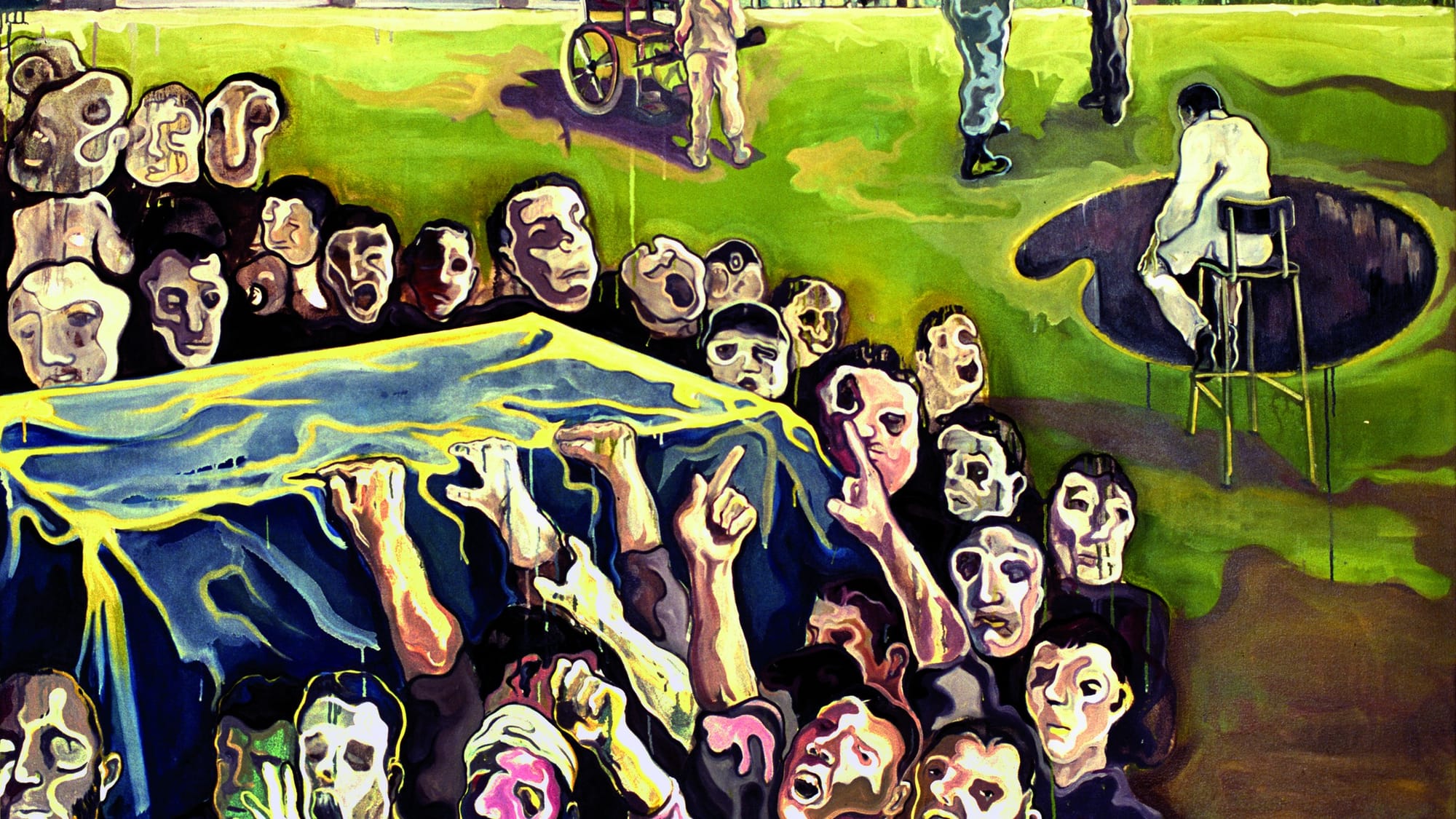
His work is serious, exuding an internal struggle between his eastern upbringing and his western lifestyle, “When you are in exile, you look back to your identity and try to make sense of it. It is fascinating how people have a huge capacity for violence in that region,” says Sahmarani of the Middle East. Utilising two or three mediums in one painting, his meandering political agenda is more than prevalent; an old bicycle wheel holds its place as a warrior’s armour in a historical battle painting from the 2007 ‘Can You Teach Me How To Fight’ series, and a gold mane of synthetic hair serves as a mare’s tail for another 2.5 x 2 metre canvas.
Stray pieces of wood, cardboard, cloth, sponge, tin, rope, and even leaves are waiting to be used. “I love trying a new medium from time to time. I water-paint while vacationing, but I prefer oil to anything else,” he says. “If it is wood, I move the brushstrokes with the wood’s texture.” An intense oil painting called ‘Judith and Holofernes’ tells the story of a princess who saved her people from foreign conquerors by seducing the army leader then decapitating him while he slept – forcing his army to retreat.
“There is always a struggle,” explains Sahmarani, who having graduated from the Atelier Met de Penninghen in Paris, underwent a seven-year hiatus from painting. Combined with the need for a secure job, he was also afraid of being faced by a tabula rasa or empty canvas. “Paris was too expensive, and back in 1995, Beirut was not receptive to my art. Montreal was a safe choice. I was a successful art director with a great position at a prominent advertising agency, but by 2002 it was time to pursue what I truly love: painting,” he reveals with a deep sigh.
Recapitulating those times of internal dilemma, Sahmarani admits that he was risking his livelihood in order to become an artist, but that thankfully, it turned out well. “After a vacation, I get cold feet sometimes, but I remind myself that it is never about getting it right. It is about doing it. Like breathing or walking. It’s not the finality of the painting,” he points out. Sahmarani insists his art is never narrative, but a tearing-apart, interpretation, exaggeration, or satire of what he sees. A sneak peek at his ‘Fisherman’ series, to showcase in 2008, brilliantly reveals the strife of Lebanese fishermen after Israel’s war on Lebanon in 2006.
The meaning in his art can be best understood when viewing Pablo Picasso’s ‘Guernica’, his favourite masterpiece. Although Sahmarani is more of a caricaturist than Picasso, the organised chaos is there. “I tried to cross that single idea of ongoing violence through the years, by using flat tones and hints of subtle colour,” he says. But why go back to the old when there are new battles on the ground? Sahmarani lets out a thoughtful sigh before reasoning, “They are not the same? Yesterday’s battles with different weapons and people.”
Often baroque with Sir Peter Paul Rubens’ vivid colours and sensuality, and other times hinting at Picasso’s pre-World War I synthetic Cubism and Neoclassical Surrealism of the 1920s, Sahmarani’s style is modern but indefinite. “I love dead painters,” he says shrugging, “even if they are modern painters that are dead, I feel this affinity to them.” Sahmarani humorously follows on that thought, “Picasso once said ‘An artist is somebody who wants to perfect another famous painting by doing it himself’. I try to paint something better according to the times I’m living in, but in the spirit of those who inspire me.”
Also affected by his more traditional Parisian tutors, whom he fondly refers to as “old school”, Sahmarani paints his women voluptuous with wide derrieres and loosely exaggerated hourglass figures. But unlike in the Renaissance, their breasts are low, and their faces far from porcelain-doll pretty – their expressions are tired with prominent frown-lines. When asked why his women are not so pretty, Sahmarani lets out a hearty laugh, “What is beauty anyway?” he quips, “the truth is, I really like voluptuous women; the beauty of the form. I deconstruct and deform in order to find what is hidden.”
Although he lives in one of North America’s most cosmopolitan cities, Sahmarani says, “Other unobvious places like Buenos Aires are more mixed than Montreal. Here, people are more tolerant to avant-garde art, but in Beirut, they understand me so well.” A satirical Pinocchio-like ‘Family Portrait’ collection of Lebanese politicians focuses on one face and one hand, “You can tell a lot about someone from the way they shake your hand,” he says pressing his palm to mine. Another series about the time-honoured Lebanese carafe also had Middle Easterners more receptive to his work. “Even though some of my work is far from politics, I bet you the Arab world will subconsciously understand it better,” he says.
Sahmarani believes that most progressive art comes from developing countries in Africa, the Middle East, Latin America, and India where people yearn for change. “Developed countries have a more satisfied bourgeoisie, so art is becoming more aesthetic and less risqué. There are some big names but things are generally mellow. Photography is taking a full toll, and retouched glossy images are everywhere. Authenticity is lacking,” Sahmarani says with disappointment, “there is nothing against the current.”
Sahmarani’s lifestyle is not what you would necessarily call conventional, “I work a lot. A lot! But I love it.” Seeing that his studio is located in a large artsy building filled with small businesses, film production companies, and young designers in Montreal’s French east end, Sahmarani works into the night to avoid the noise. “I start late. I finish very late,” he says with a laugh. But when he gets back home at around 2am, he admits to doing the “normal 9-to-5 people routine like bankers. Some food, some internet and a good hot shower. I am not the mad artist after all, eh?”
Contacts
Marwan Sahmarani
Montreal, Canada
Tel + 1 514 736 0908
HYPERLINK "http://www.sahmarani.com" www.sahmarani.com
Fadi Mogabgab - Art contemporain
Beirut, Lebanon
HYPERLINK "mailto:mogabgab@cyberia.net.lb" mogabgab@cyberia.net.lb
The Third Line
Dubai, UAE
HYPERLINK "http://www.thethirdline.com" www.thethirdline.com