Into the wild
For a truly unforgettable holiday, you must experience Africa's pristine wilderness regions, renowned for diverse wildlife, stunning, often alien, scenery and friendly local guides.
When I set out for the Serengeti I wasn’t sure what to expect. I had already been to the Maasai Mara National Park in the 1990s and was now revisiting the area. I thought in many ways this trip could be different and I wasn’t wrong as it was quite a shock to see the level of experience and professionalism offered by our local Maasai guide and the hotels we stayed in. A lot has changed in the past 17 years, and all for the best.
The country has kept its rawness but has developed an impeccable tourism industry. There are any number of ways to explore the region: a walking safari, by quad bike, soaring over the plains in a hot air-balloon, by boat, on horseback, by night or day, or by traditional open 4x4 vehicles. Regardless of your choice, you’re accompanied by expert locals who know exactly what they are doing and have the safety of their charges in mind.
I ended up visiting the three most famous National Game Parks in Tanzania: Lake Manyara, Serengeti National Park and Ngorongoro Crater. With abundant wildlife and incredibly diverse landscapes, each has memorable, astonishing and unique topography of its own and all are worth a visit. Amazingly, the Serengeti region covers Ngorongoro Conservation Area, Grumeti and Ikorongo, the Maasai Mara National Reserve in Kenya, Maswa Game Reserve, and the Loliondo making up a total of 14 per cent of Tanzania.
I flew into Kilimanjaro airport on a small, regional carrier, Precision Air. The flight was very uncomfortable, besides the humid weather that takes time to dissipate once you are inside the plane, the plane was old and stank. The seats were not only too small but also glued to each other and the hand luggage compartment is smaller than on normal carriers, so travelling light in this part of the world means literally as light as feather. Less is definitely more here.
The roads around the first park, Lake Manyara, are not paved but they are well kept. It wasn’t unpleasant, and it made me appreciate the rawness of the country. Our schedule required an early wake up for a game drive from Arusha to our first park, Lake Manyara. By making the trip by car you see more of the country than if you simply flew direct by private aircraft to the airstrips in the parks. There’s no delineation as to where the game park starts and the city ends, they both seem to dissolve one into the other. As soon as the city becomes less dense, giraffes and gazelles start showing up behind bushes in the course of our way. There are no fences and the main entrances to any of the parks are almost symbolic, a quick stop to pay the daily park fee and you’re in amongst it all.
Driving through small villages and experiencing the roads, the local people and the scenery, this is as authentic an experience as you could wish for. The vegetation is beautiful, and seeing small Maasai villages along the way definitely added a touch of reality to this trip. The Maasai are everywhere and spotting one of them is like spotting one of the animals amidst the landscape, they are fearless and colourful, most of the time roaming about the land tending to their sheep or cattle. The Maasai are very strict with regard to photography, most of them will not allow it and the ones that do will ask for money in return. Most tourists will pay around eight USD to visit a Maasai village and be allowed to take pictures while they perform a welcoming dance bejewelled with handmade beaded trinkets.
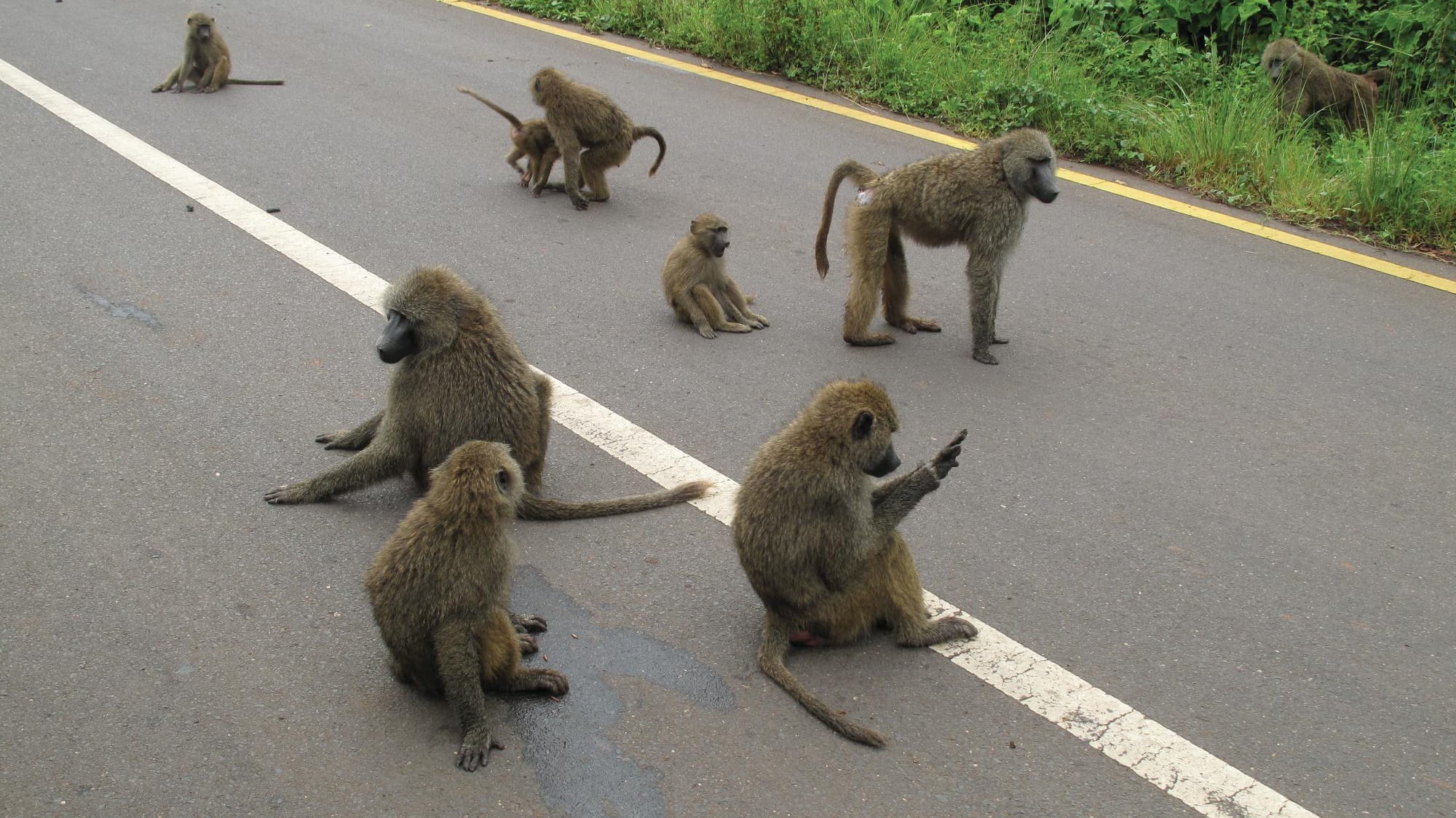
The next stop was Lake Manyara National Park. Once you’re in the reserve a large concentration of animals ramble about freely and calmly. My guide was very informative and would brief me on the bird life, the social behaviour of all animals we encountered, as well as species of plants and their medicinal uses. On the first drive from Arusha to Lake Manyara I was able to spot up close and in abundance elephants, zebras, giraffes, gazelles, a huge variety of birds, buffaloes, wildebeests, warthogs, flamingos, baboons, lions and hyenas.
It was very exciting to see these animals in their natural habitat but this cornucopia of wildlife didn’t quite fit with me, I couldn’t help feeling that Lake Manyara was a zoo and somewhere I would come across the boundaries marked by fences. However, the animals live relatively freely and it’s amazing how intertwined the eco-system is, they all play a role and interact with one another.
The Serengeti, known to the Maasai as Siringitu, meaning endless land, is the most beautiful place on Earth. The breeze is something else here, the plains stretch as far as the eye can see, like the desert, it is bathed with golden-coloured grass that moves like waves in a shimmering ocean. Animals are easily seen black dots that our guide would rarely miss, what looked like stones turned out to be two bachelor cheetahs, we were able to go off road and chase after them for a while. We stopped by an actual giant stone formation where the king of the plain laid sleeping, surrounded by his pride of five lionesses, one protecting her four cubs from our curious eyes.
These 500-million-year-old rock formations can be found scattered throughout the 14,763 square-kilometres of wilderness that forms the Serengeti. Called kopjes, they were formed by volcanic explosions that occurred late in the Precambrian Era. These round rocks, weathered into interesting shapes by the wind, make perfect habitats for small lizards, hyraxes, snakes and the aforementioned lion and his pride as they shelter from the sun.
The following day was spent going around the plain searching for the only animal still left on “my must see list”: the Rhino. It was impossible to find him, but I was lucky to spot three leopards. We went off road to see ostriches and ended up getting lost for a few hours. To cover such eventualities, our jeep was fitted with two tanks of petrol so when one was empty the other automatically came into use although I can tell you that we were relieved to have found our way before it got dark.
The next morning, I left the Serengeti for Ngorongoro Crater. To reach the crater you have to make a descent of 600 metres to the base where all the animals are found. The view from its rim above is just breathtaking: the surrounding walls and the lake right at the middle of the vast crater. The scenery was gorgeous and definitely worth the trip, with an amazing view to the crater the walking safari is certainly a must and although you end up seeing the same animals everywhere you go, the scenery and landscape changes drastically. We finally got to see rhinos, six adults and two calves. Seeing a group of hippos grazing out of the water was also something special.
The crater is a unique habitat sheltering over 20,000 animals. The majority of the residents here look much fatter and bigger than elsewhere as the abundance of food keeps the balance of nature in an almost perfect state. In the centre of the crater there is a lake of alkaline water, which forms something of a flamingo haven. The walls surrounding the bowl are so steep and packed with trees that it is easy approach and see the animals relaxing in the cavity.
Leaving Tanzania was a hard thing. I was once again struck by the beauty of the country and how delicate the natural balance was. I saw any number of awe-inspiring sights and left with one promise to myself, to never travel by Precision Air again.
CONTACT
Hotel Kirawira Camp
1 Kirawira Road
Western Serengeti, Tanzania
Tel: +255 28 262 1518
Lake Manyara Serena Safari Lodge
Lake Manyara National Park,
Tanzania
Tel: +254 20 284 2333
Bilila Lodge Kempinski
Dar es Salaam,
Serengeti, Tanzania
Tel: +255 778 888 093/094
Ngorongoro Serena Safari Lodge
Ngorongoro Crater
Ngorongoro Conservation Area, Tanzania
Tel: +255 27 253 7050
Photographs: Juliana Andrade Vieira