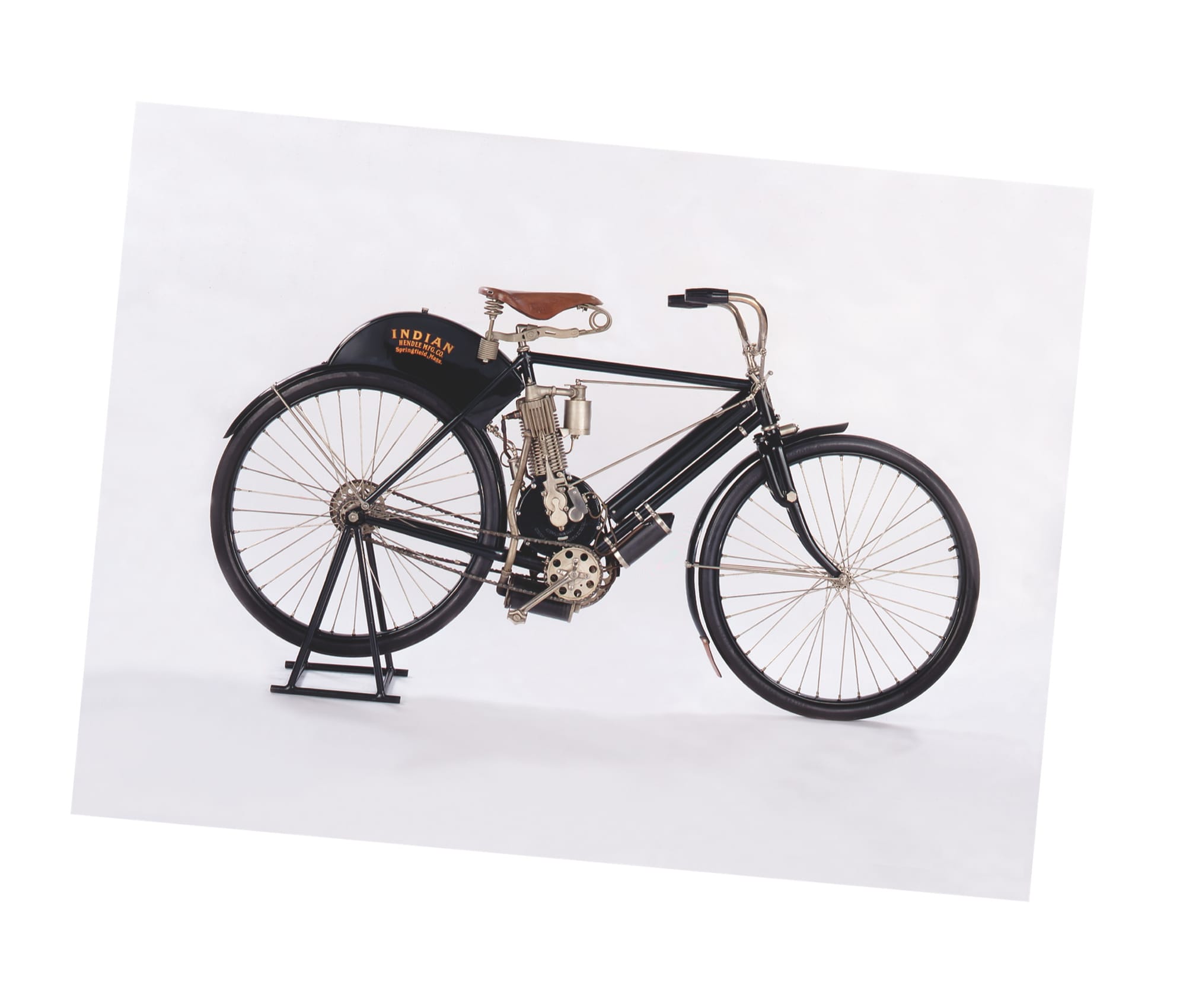
When talking bikes, especially vintage bikes, people automatically think of Harley Davidson, since it is believed to be the oldest bike in the world. It’s a common mistake to make, but a mistake nonetheless. Though Harley has had a longer production line, it is Indian who built the superior bikes which then and even now command a heavier price at auctions.
The Indian Motocycle Manufacturing Company (note the then intentional omission of the letter ‘r’ in motorcycle) was originally founded by two former bicycle racers George Hendee and engineer Carl Hedström. Their first product was launched in 1901 and at 1.75bhp, the single cylinder bike was the fastest vehicle on two wheels. The inaugural machine was soon followed by the Indian Single in 1914 painted from gear to wheels, in a deep red that became the company’s trademark colour. Indian went on to introduce its first V-twin breaking many speed records and achieving much racing success. By 1911, its riders had broken all speed and distance records in the United States of America.
Though Indian designed many bikes like the Single, Model H Racer and Power Plus, two particularly stand out. In the early 1920s, the company introduced the Scout and Chief models, its most famous, and definitely its most successful models. The first Chief model had a 1000cc engine which was later enlarged to 1200 cc. in the 1940s (yes, they were produced that long), the company added the large skirted fenders, another trademark and a new sprung frame (something that Harley could not match at that time). In the 1950s, the V-twin engine grew even larger (1300cc) and the Chief gained telescopic forks, allowing for a smoother ride. The Scout, on the other hand, had a smaller engine (596cc), even though it rivalled the Chief as Indian’s most important model. In 1927, the engine size was increased to 745cc.
However, life for the Indian was not always rosy. It witnessed many ups and downs and barely survived the Second World War. During that period it competed with Harley but could never unseat the Harley Davidson WLA as the bike of choice for the American Army. Harley Davidson just offered a better deal which left Indian in shambles. In 1953, the manufacture of all products was halted, even though in 1940, Indian sold nearly as many motorcycles as its major rival, Harley Davidson. The brand and its assets were sold to Brockhouse and Royal Enfield bikes were imported from England, branded and sold as Indians through the rest of the 1950s.
The bad days continued, in the late 1950s, when another motorcycle company wanted to revitalise the product without the branding, causing it to go into liquidation in 1962. Anything after that period bearing the name of Indian were frauds often using English engines and Italian frames.
Indian bikes are your quintessential vintage mean machine. You’ll find lots of chrome, suicide shifters and kick starters. But you’ll also get a classic styling and its legendary pedigree when bikes were at their most innovative and exciting stages – the US postal office is planning to introduce 85 million stamps commemorating the deep red 1940 Indian motorbike.
But now after so many failed comebacks, the Indian brand is set to be brought back for good by London-based Stellican Limited, a firm famous for reviving old brands. The company heads are keeping mum on the subject – preferring to keep models and strategy under wraps until the first half on 2008. There has been word, however, that in the first year of production, the company will limit the range to the famed Chief model. Also, learning from past experience Stellican will focus on design, engineering and testing so as to avoid failure. One thing can be guaranteed, though, it will be pure and simple riding pleasure.
Contact
Indian Motorcycle Company
North Carolina, USA
www.indianmotorcycle.com