An Elite Sport for the Common Man
First developed by the ancient Persians, polo is thought to be the oldest sport on earth. Initially used as a form of military training, it gradually evolved to become a refined game, perceived today as an elite game played exclusively by gentlemen, and watched only by the ultra-wealthy. But as SERGIO RAMAZZOTTI/PARALLELOZERO/TCS discovered, in Argentina, where it has been embraced by the masses, nothing could be further from the truth.
Words: 1800
Contact: HYPERLINK "http://www.thecoverstory.com" www.thecoverstory.com
Copyright: © Sergio Ramazzotti/ParalleloZero/TCS, all rights reserved
“The ball is the Earth and I am the bat,” said Alexander the Great. He was little more than twenty at the time, but was already king of Macedonia, and this was his reply to Darius III, king of Persia, who had mockingly sent him a gift of the aforementioned items. Darius had suggested he dedicate his time to playing polo, rather than, at his young age, cultivating his ambition to conquer the world. Instead of heeding the advice, Alexander simply conquered the world as if he was playing polo: with speed, strategy, and on horseback.
It was the 4th century BC, and in Asia Minor every soldier worthy of the name was expected to know the rules of polo – a game many agree was the first fully defined sport in history. In reality there were no rules, nor was it mere sport: instead it was a simulation of battle, used to train elite cavalry troops by helping to improve the understanding between horse and rider, the precision of their blows, and the coordination of their attacks. Known as chaugan (in Farsi: “hammer”, or “mallet”), the players’ spirit was closer to that of the Marines than to a sports team: the idea was not to win the championship, but to overwhelm the enemy, as can be seen in the verse of Firdusi, the great Persian poet of the 10th century, who wrote of an epic encounter between seven Persian cavalrymen and their Turkish adversaries that happened many centuries earlier: “The border of your playing field is the horizon… Before all that is left of you is dust, gallop ever faster: the world is yours.”
When Gengis Khan conquered Persia in the 12th century he was so impressed by polo that he made his own cavalry practice daily; and Tamerlane, his successor and spiritual heir, brought his own personal touch to the game, by replacing the ball with the heads of his slaughtered enemies. From the steppes of Mongolia the sport spread quickly: first to Tibet, from where its current name originates (pulu was the name of the root from which the ball was made), then to Afghanistan (where it is still played today using a goat carcass, and where hitting opponents is allowed - it is a tribal battle with a time limit, used to resolve disputes between rival clans, and not infrequently it results in a player’s death), to India, and from there, via the regiments of Her Majesty’s Cavalry, to the United Kingdom.
The British took to the game immediately. For the dimensions of their playing field, they were inspired, somewhat ironically, by that cornerstone of the current “Axis of Evil”, Iran: they copied the size of the enormous Imam square in the centre of Isfahan, which had been constructed for public displays of chaugan during the Safavid dynasty. They also reduced the team to four players, progressively gentrified the rules, and the evolution of the polo was complete: from the steppes to the stables, and from there to the stars, that is to say it became a noble sport, exclusive and snobby.
Polo became so popular among the richer echelons of British society in the latter part of the 19th century that they began taking it with them when they travelled around the world. And nowhere was it embraced more than in Argentina. Taken to that country by English and Irish ranchers and engineers who had emigrated to start new lives in South America, the first official match took place on September 3 1875. From that day on polo has barely looked back in the land of the gaucho. This is a place where the image of the heroic cowboy is deeply revered, and the concept of a game in which men on horseback pitted their wits and strength against one another struck a chord among the local population. More than 130 years later the same spirit lives on, and polo is as popular here as it ever was.
Indeed, it was in the Argentine capital Buenos Aires that I saw my first polo match. It was the final of the Argentine Open Championship, one of the most important in the world, played in a stadium in Palermo in front of twenty thousand paying spectators, and in the shadow (more irony here) of the minaret of the local mosque.
Watching the frenetic pace of a polo match it is easy to get swept up and carried along by the communal buzz of excitement, even though it is sometimes hard to take in something that happens in a flash some 270 metres (the length of the field) away. On the field the game still retains a flavour of a medieval battle from the days of Isfahan. The most vital element is speed: the horses are pushed to their very limits by the players in a dangerous race into their opponent’s half, amid a thundering tangle of legs and mallets. Every so often, an opposing player gets brief control over the ball, and in the blink of an eye the race is reversed. This might last for just a few seconds before a rider on the other team gets the ball back again, and so on. It moves so fast that the whole frenzied mass of animals, men, wooden mallets and ball actually appears to fly a few centimetres above the grass, carried along in a cloud of steam and sweat, buoyed by the enthusiastic cries coming from the excited spectators.
Speed is also of the essence in the paddocks, where riders often have to come in to exchange one horse exhausted by the unrelenting pace of the game for another with fresher legs. The switch takes place in a matter of seconds. In one moment a player jumps off the animal he has been riding, and the next instant he is back on the field on a fresh mount, ready to carry on the game whilst his former charge is led away and taken care of with water, brushes and a massage by the support team who are ready and waiting, working as quickly and efficiently as F1 mechanics at a Grand Prix circuit.
In Buenos Aires the atmosphere in the stands was also much like that at a Formula One race, but with the surreal undertones of a village fête. In one corner, a woman in a white suit lay gracefully reclined on a white sofa in the shadow of a white awning, drinking champagne. The image was straight from the pages of a glossy lifestyle magazine for the rich and famous. Yet standing just a few metres away from her was a stable-hand in a beret, his checked shirt open to the waist and a Gaucho’s knife tucked into his belt. While the woman took delicate sips from her glass, drinking cautiously, almost as if she disliked it, the man took copious swigs of beer from a can, and belched between glugs.
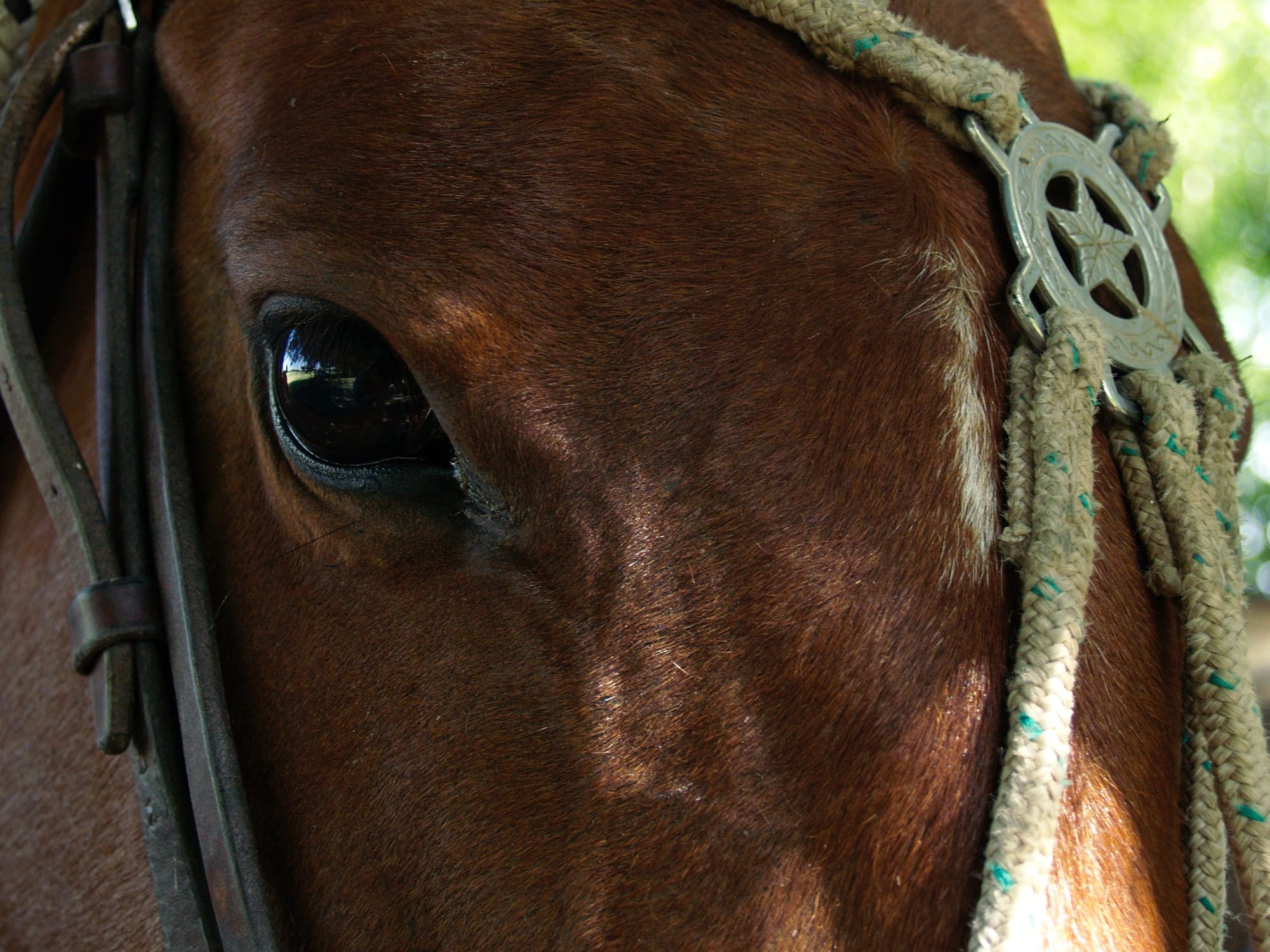
The person accompanying me through this colourful, garrulous and proudly self-referential microcosm was Pete McCormack, the (Irish) agent of Adolfo Cambiaso: son of Adolfo Cambiaso, father of Adolfo Cambiaso, an Argentine national, and, at 32, the best polo player in the world. McCormack had already showed me around the teams’ paddock, where the grooms, fast and efficient like Ferrari mechanics, were massaging the Criolla horses’ ankles. The Criolla are said to be the breed best adapted for polo: small, agile, lean, and with bulging veins just under their thin skin, they walking slightly effeminately with their plaited tails and thick protective socks.
McCormack patiently explained the rules of the game while the Cambiaso team completed their victory. Each team comprises a forward, two midfielders and a defender; the aim is – naturally - to score the most goals; and the player in possession of the ball has priority over the others, something considered vitally important considering the serious risks involved if the horses stumble. Finally he tried to convince me that polo is after all just a sport, and not, as is often said, exclusive and snobby: “They will tell you: those 20,000 people watching in the stands. They are people from all walks of life; the same people who next Sunday will be in the football stadium cheering on Boca Juniors.” But then, fatally (his passion betrayed him), he let slip the words: “In our world there is a saying: once you begin playing there are only two ways to stop. One is to go bankrupt; the other is to die.” And this in some way seemed to contradict his assertion that polo was sport of the people: if you go bankrupt it doesn’t stop you playing football.
Cambiaso is a living embodiment of polo: a young fit man, extraordinarily photogenic, he fits perfectly into the role of popular national hero, plays for charity, stops to sign autographs on the street, and according to his agent, does not possess a credit card. “I have always hated the idea that polo had to be a sport for gentlemen: bags of shit,” he told me. This was honesty on the part of a man who allegedly receives five million dollars a year in sponsorships (McCormack neither confirms nor denies this), and lives on a ranch outside Buenos Aires, on land bought “from his mother” - a sharp, shrewd woman with an air of “Dynasty” about her – where he keeps an estate worth tens of million of euro that includes among other things a stable of more than four hundred racehorses.
The bottom line is that, in Argentina, a man on a horse is a completely natural concept (Martín Fierro, the national epic poem, contains the lines: “nothing else is necessary/for he that has a stable/than the poncho, the knife/the horse, and his duty”), and by association a sport practiced by men on horseback is less exclusive than elsewhere. Thus, when Cambiaso speaks about polo, the millionaire leaves his body, leaving only a man in perfect harmony with his environment. When I asked him whether in polo it was easier to train the horse or the human, he told me: “It all depends on predisposition. There are horses that take to the game more than the men, and on the field they chase the ball without any need for guidance. This is polo: when you and your horse become a single entity.” This happened too, I imagine, in the time of Alexander the Great.
ENDS: 1800 words
WARNING COPYRIGHT NOTICE: © The Cover Story and its contributors.
You have received this text for review purposes only. Please do not forward this document or use it for any other purpose. If you wish to purchase text rights for reproduction or reference please contact TCS or your local TCS agent. Using this text in any way without permission will be considered a breach of copyright and may result in legal action.
WARNING COPYRIGHT NOTICE: © The Cover Story and its contributors.
You have received this text for review purposes only. Please do not forward this document or use it for any other purpose. If you wish to purchase text rights for reproduction or reference please contact TCS or your local TCS agent. Using this text in any way without permission will be considered a breach of copyright and may result in legal action.