The Jaguar Land Rover Group is an automotive conglomeration that makes sense. Individually, the two brands have a long established reputation that predates the relatively recent turbulence in their combined histories. Despite not being owned by a British firm for nearly a decade, both have managed to remain quintessentially British and almost impossible to confuse with the competition. Issues over company performance aside, they’re hallmarks of the British motor industry both on and off the road.
Which explains why the group’s purchase by the huge Indian TATA Corporation last June didn’t sit that well with me at the time. Undoubtedly, TATA know how to make money but the only automotive connection I was aware of was their release of the TATA Nano; the world’s cheapest car. Not exactly the type of vehicle I imagine even they would herald. It was with this in mind that that I approached the release of the 2010 models of the Range Rover Sport (RRS) with a little trepidation. The RRS is now available in the Middle East, but flying into Edinburgh before it’s launch, and waiting in the reception room at a local hotel for the rest of the press to arrive, it was weighing on my mind; What impact would the new owners have had on this giant of the utility vehicle market?
The answer is: Not a lot and none of it bad. In fact, the Land Rover staff said they had been pretty much left to their own devices. Whether the acquisition is just too recent for TATA to have started meddling yet or whether TATA knows not to mess with a good thing, Land Rover has produced a great vehicle. The Range Rover Sport remains arguably the definitive luxury sports utility vehicle, and definitely the best luxury vehicle for off-roading. I had a day driving the RRS both on and off the road in fantastic conditions and my regard for it has grown considerably.
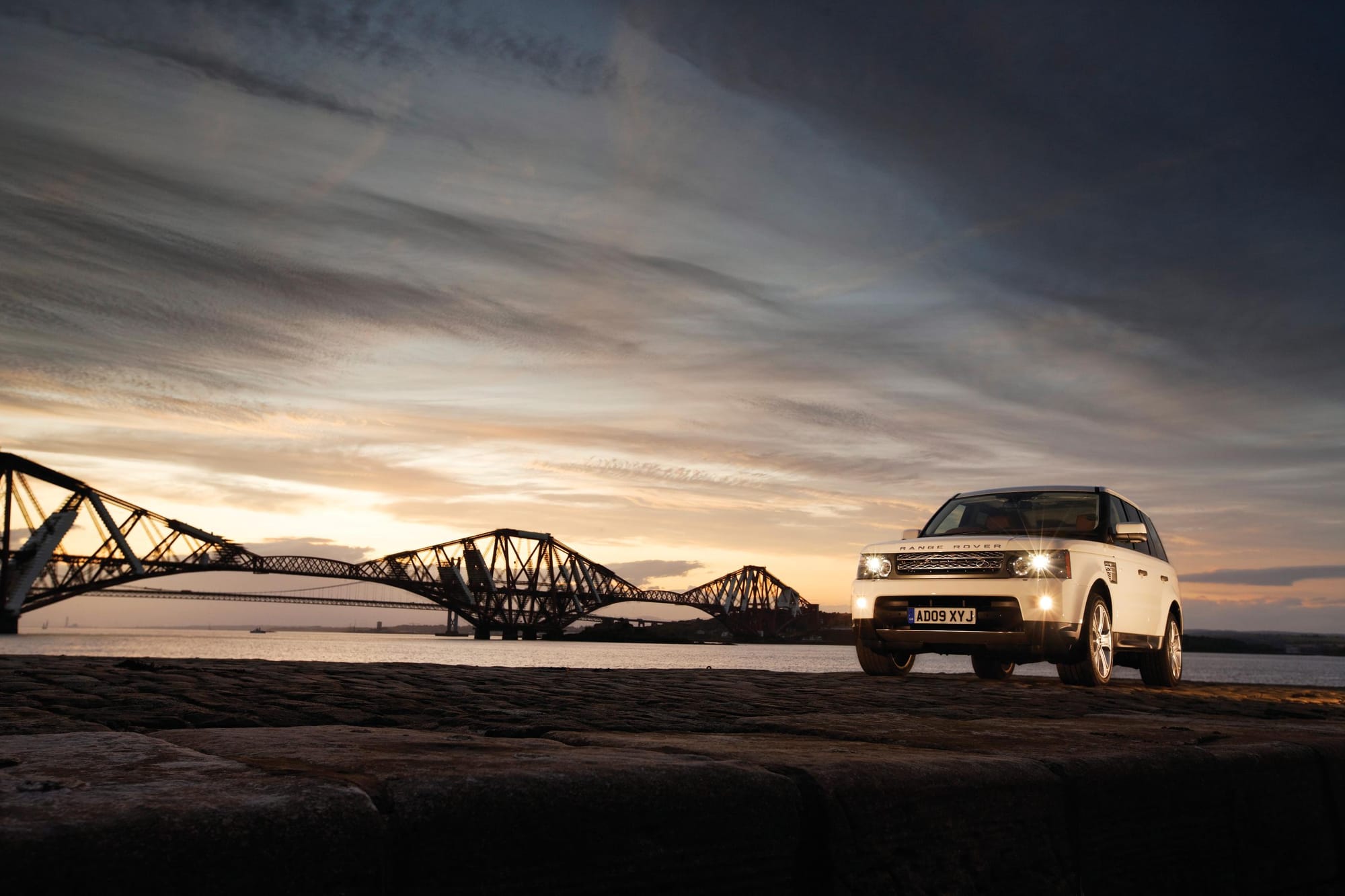
Cosmetically there haven’t been many changes and Land Rover was keen to point out that this wasn’t an exterior design overhaul. There are a few minor detail adjustments and some extra luxury details. Some people will take exception, others won’t, but most are accounted for by minor differences in taste. The front LED-detailed lights - think Audi headlights - are definitely good.
It’s inside and below the bonnet that the changes are considerable. Some of these changes are design driven, while most have been brought about by technological advances. Both elements of the Jaguar Land Rover Group have had the opportunity to work together since Land Rover was purchased by Ford in 2000. Now, separate vehicle-based lines of development are supported by teams working on vehicle technologies, such as the drive-train and suspension, across the group’s fleet. This allows lessons and advances to be learned throughout the group and incorporated universally, at the first opportunity. Not only does this save money but it means customers get the best advances from these fantastic brands in vehicles with either badge. All of the changes on these two new additions are good, some are great, and the on and off road routes selected by Land Rover gave us the chance to fully appreciate them.
The beautiful hills in the Scottish Borders offer the types of road you wish you could drive every day; combinations of fast winding main routes and single lane tracks in equal measure. Each provided us a variety of cambers, corners and road surfaces to challenge car and driver. It was surprising that both cars were the measure of the challenge and amply compensated for those behind the wheel. Although the on road performance of the RRS has always been strong, the latest offering has raised the bar yet again.
The Range Rover Sport boasts improvements in drive and dynamics and has seen three completely new engines added to its portfolio. For diesel users there is a new 245 hp 3.0 litre TD-V6 to complement the existing, and highly regarded, 272 hp 3.6 litre TD-V8. In addition, the RRS shares a new 5.0 litre naturally aspirated V8 that’s appeared elsewhere in other Land Rover models for 2010. However, it also has a new 5.0 litre supercharged V8 that delivers 510 hp and 625 Nm of torque; improvements of 29 per cent and 12 per cent over the existing 4.2 litre engine. All achieved whilst reducing fuel consumption by around six per cent to 15l/100km and emissions by seven per cent. If you’re going to get an RRS I don’t know why you’d settle for anything other than this engine. It’s impressively powerful and delivers instantaneously. It feels incredibly quick for a vehicle this size and flew past everything I wanted it to, when I wanted it to, not three seconds later.
It feels controlled too. All the RRS models have had improvements to their dynamics but some are exclusive to the supercharged version. The existing Active Ride Control is supplemented by a new Roll Stability Control system and an Adaptive Dynamics system that predicts conditions and alters the damper settings in each wheel according to measurements taken 500 times a second; Better than this though is the addition of a road-focused ‘Dynamic’ setting to the Terrain Response System, used to configure vehicle settings. This noticeably tightens everything up and gives a far more responsive ride at high speeds. New brakes designed in conjunction with Brembo, with six piston opposed callipers on 380mm ventilated discs (front) on the supercharged version, ensure impressive stopping distances.
The RRS is still a world-beater off-road. It is testament to the versatility of the vehicle that untrained journalists were able to take the same RRS they had driven hard over 100km on winding A Roads, cross the River Tees (a not insignificant river about 70 metres wide) and then complete a challenging cross country circuit, all with minimal direction and only the flick of a switch. Though, whether you’d want to put your baby across the ground we did is a moot point – you’d certainly need a good valet service at the other end.
I have had a little cross-country driving experience and what is so great about these vehicles is how easy Land Rover has made it. Anyone can do it. The award winning Terrain Response System has been improved and now includes a ‘Sand’ setting in addition to the four other surfaces it caters for. Simply by a flick of the dial the vehicle becomes optimally configured for the terrain you input. You can even watch the suspension raising, wheel alignment and diffs locking on the central console screen as you barrel across the countryside. Clever features such as ‘hill descent’, which slows you under control when descending steep slopes, mean it is all accomplished safely, with little experience required.
The improvements aren’t just limited to driving performance. The interior’s been touched up and the attention to detail and nature of the finishing is very good indeed. Everything is soft to the touch, the wood finishes are luxurious and all the buttons, switches and dials speak of quality. The console layout and dashboard have been well redesigned, cutting down the number of buttons by around half. The dash has a nice five-inch TFT driver information screen. The central screen has some great touch screen functionality that I can say without hesitation is truly intuitive, and should you feel the need to flick quickly to key functions without the touch screen, there are several useful shortcut keys below. As well as control over the two rear passenger screens, with DVD or other functionality, there is a USB and iPod interface fitted with all models which is the best I have seen and the Sat Nav is equally as good.
As with many luxury vehicles, though perhaps not something you’d expect from a Land Rover, the RRS has five fitted cameras: two front, two side and one rear. I was initially sceptical of their usefulness. However, they proved more than handy when manoeuvring the vehicle through tight spaces, especially off road, where you might not be able to see large rocks or other objects. And although I was unable to test it, they provide a very good ‘tow assist’ function allowing you to not only hitch up a trailer but also see its path in reverse on the screen in the console.
What does all this mean? Well, the Range Rover Sport retains it’s traditional off road capability and remains the leader in the off road class. This was to be expected and, I was informed, is a pre-requisite of the Land Rover product development criteria. But it’s the, already great on road performance, that’s taken a clear leap forward. The breath of capability of the vehicle is phenomenal. It is a catch phrase that the Land Rover staff harp on about, but it is manifestly true. Here you have a vehicle that can outperform its rivals on the road and absolutely leaves them for dead off it.
Would I buy one? Yes. If you want a car with some serious on road performance and luxury then the Supercharged RRS has it all. You’d struggle to find something better on the road, perhaps an X5 or Cayenne, but if you even suspect you might be tempted then why compromise? Besides it just looks more manly. The RRS is the top of the Land Rover line, it’s a hybrid, mixing considerable off road capabilities with impressive on-road performance.
Able to handle itself equally well on a motorway or a mountain track, the RSS is the car for all occasions. You’ve got the luxurious interior and stylish lines to take care of the film premier, allied with some raw power and advanced engineering to deal with the rough stuff. Power, performance and elegance all rolled into one, the RRS is the best in the world when it comes to off-roading, and isn’t a slouch on the road either.