The hills around Valencia created a stunning backdrop to the recent launch of the Aston Martin Rapide. Tiny villages ensconced among twisting roads and steep-sided cliffs formed the perfect conditions in which to put the latest offering from Buckinghamshire (by way of Austria) through its paces. As the first Aston Martin to be made entirely outside of the UK, as well as being a departure from the two-door maxim that has served the company so well in recent years, the Rapide represents a new chapter in the company’s history.
When we first heard of the mutterings about a four-door Aston concept car, back in 2006, I wasn’t sold on the idea. These days, Aston Martin is, without question, the quintessential British sports car, it’s right up there with anything the Italians or Germans have to offer. Note: I said sports car, not a saloon, not a touring car, a sports car. But here’s the Rapide, a four-door standing in diametric opposition to all that is Aston Martin. Only, the company has produced four-doors before, with the Lagonda and original Rapide, however, it’s been around 20 years since the Gaydon-based firm last dabbled in this market. Needless to say, it was with more than a little trepidation that I set off for the South East of Spain.
We were introduced to the car by Aston’s director of design, Marek Reichman. As he walked around the gleaming display car, running his hands over the bodywork, describing the sinuous curves, remarking at how the headlight casing sat flush with the grill and side paneling, my concerns seemed to melt away like early morning mist. The car is simply beautiful, with smooth, contoured lines, scooped out accents and detailing that beggar’s belief.
Aston Martin has brought the four-door touring car concept bang up to date with their styling and approach to their latest lines. The stylistic continuation, from the Vantage and DB lines, is clear to see in the Rapide. The Aston design heritage of recent years has seamlessly transitioned to the Rapide, this is clearly an Aston Martin, there’s no mistaking the evolution of the company’s style.
The rear side panels, containing the wheel arches, give a visceral, muscular appearance to the rear quarter of the car, almost as if it’s waiting to spring into life, without detracting from the overall elegance of the vehicle: It’s clear that there’s power hidden beneath the sleek curves. The bonnet is trademark Aston, a sharp, almost shark-like curve down to the grill highlighting the oval headlights on either side, all sitting flush with the side paneling.
It was almost tempting to forget that the Rapide is a four-door touring car, the second set of swan wing doors sit comfortably within the refined lines. The doors lift both up and out when opened, giving a little more space for hopping in and out of the back and keeping the doors well clear of high curbs. Nevertheless, the size of the vehicle is cleverly disguised by the styling. Lines that begin at the rear panels curve alluringly toward the front, unifying the entire design.
It’s not until you open the doors and boot that the extra space becomes apparent. It came as something of a surprise, there’s useable space behind the back seats, with the boot coming in at a respectable 317 litres, not as large as that of the Porsche Panamera, but still more than adequate. There’s a pop-up bulkhead between the boot proper and the back of the cabin, meaning that you don’t have to use the entirety of the boot whenever you go to town. At the push of a button the rear seats collapse, opening up an impressive amount of space, suitable for suitcases, skis and the like.
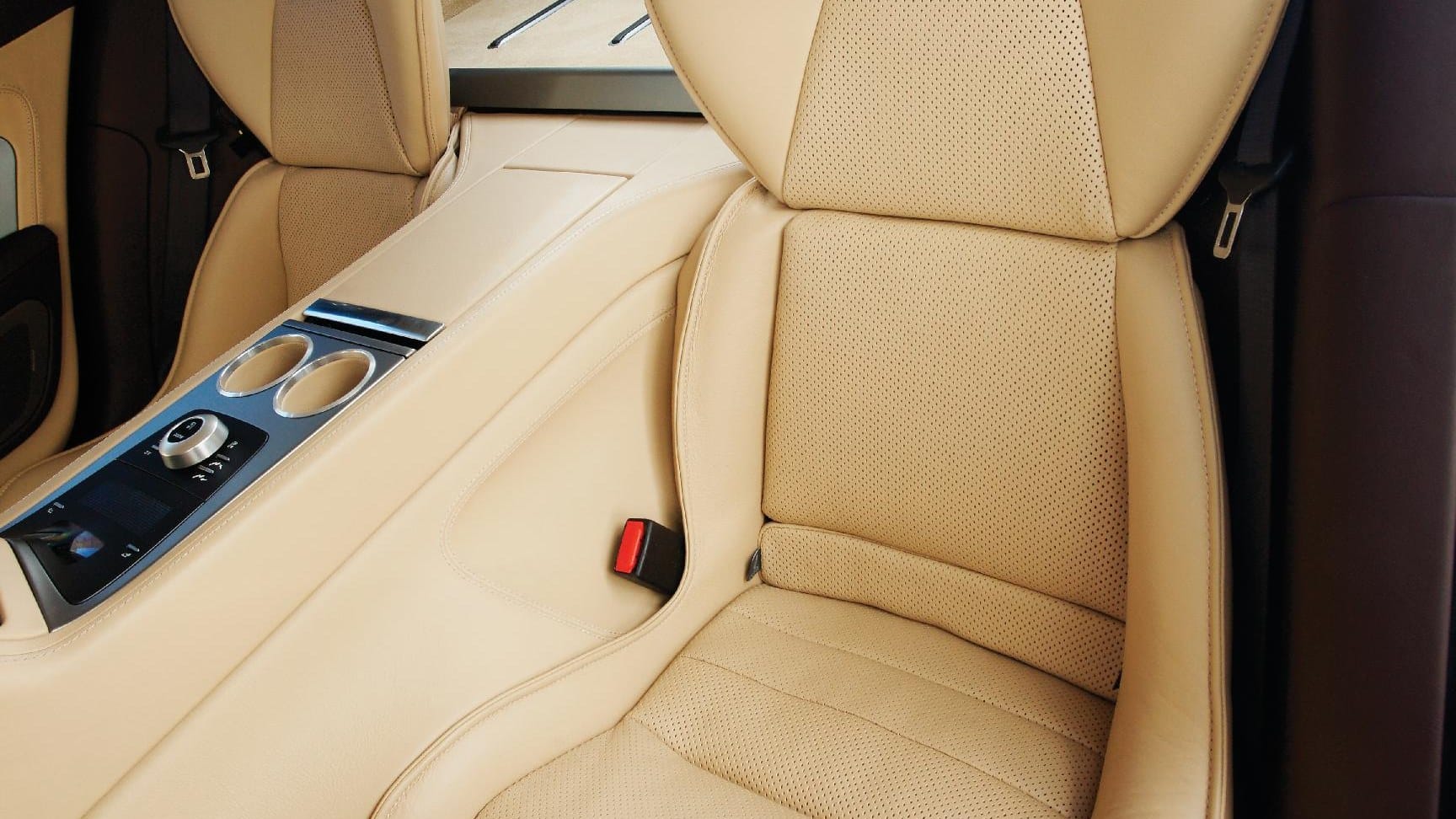
The interior of the Rapide is, as you’d expect, a cut above the rest. Reichman highlighted the grab handle for use by passengers. One piece of hand-stitched leather, one piece of brushed metal, the entire handle is hand assembled and, when your passenger has calmed down and let go, it snaps back into position with a satisfying “thunk”. The attention to detail that has gone into the interior clearly remains a hallmark of the Aston Martin brand.
That evening, over dinner, Reichman explained how the interior of the car was entirely customisable. He claimed to be able to cover the seating in any material, or leather of the customer’s choice, from rare types of cattle to deer leather to things altogether more exotic. He then went on to explain that the roof of the car was covered in a synthetic material that closely resembled suede, but that was impervious to oil and residues that would mark natural materials.
The degree of customisation is impressive. You haven’t got quite as many decisions to make when compared to a Rolls Royce (Bespoke Issue 20), but there are options galore. There are seven alternative finishes to the interior, including mahogany, Birds Eye Maple and Olive Ash Burl options, a rear-seat DVD player, a cigar holder and ashtray and personalised sill plaques and any number of upgrades to various features.
Not that the interior begs to be played with, anything but. However, the degree to which you can make this car your own is impressive. After talking to Reichman I left with the impression that the only limiting factor is the imagination of the buyer. The temptation might be to go the whole nine yards when ordering your Rapide, but I would be wary of overdoing it, there’s a certain elegance about the interior as it is, by all means, change the wood inlay, have a personalised plaque, but why tinker with every last detail?
The Bang and Olufsen BeoSound system delivers crisp, pitch-perfect sound throughout the car. The volume and balance are automatically adjusted depending on how many people are with you by means of sensors on the seatbelts. While the aesthetics of the speakers might not please all, I’ll get to that later, there’s no questioning the quality of the sound produced by the system – the bass was suitably meaty, the treble balanced, and the overall acoustics of the cabin meant that there was very little, if any, distortion be you in the driver’s seat or sitting in the back.
With the introduction over, we finally got our hands on the vehicles the following morning. Inserting Aston’s now signature crystal key into the slot in the central column produces a non-too-subtle rumble as the V12 turns over and the electrics spring into life. Happily settled, reaching forward and pressing the “D” button on the dash slides the car into drive and you’re away. There’s something about the sheer power and noise created by a near-six-litre V12 starting up that elicits an almost childlike sense of excitement among even the most jaded of drivers. It’s altogether a very satisfying, modern and refined means of starting up.
Heading out of the city and into the surrounding countryside, we trusted in the onboard GPS and marvelled at the smooth ride quality of the Rapide. Cocooned within the leather interior, the world began to speed by as we hit the motorway leading toward the twisting roads of the Valencian hills. The car has an impressive turn of speed as we demonstrated by tearing past any number of BMWs and Mercedes on the way to our lunch stop.
It was at this point that I realised there was a problem. A very large problem. Simply put, the Rapide was so good, so understated in its delivery of power, speed and comfort, that it’s difficult to think of how to explain the experience. It’s not that I don’t appreciate the engineering and design behind the Rapide, how could you not when the four-door tourer you’re sitting in does 0-100 km/h in a fraction over five seconds and has a top end of around 303 km/h? It’s not that, it’s just that it does it so well, and with such laid-back nonchalance, that harping on about it seems, well, vulgar.
As we exited the motorway and headed onto the smaller side roads, it became apparent that the Rapide delivered the goods in terms of performance as well as luxury. Flicking the rear mid-mounted ‘Touchtronic 2’ gearbox down a gear resulted in instant power, if you had a mind, and I did, to deliver something of a kick as you downshifted, you could do so easily. Overtaking was a breath of fresh air as the Aston flawlessly transmitted the power as and when you needed it, meaning that irksome HGVs flew by in a blur.
The sharp, coiling mountain roads we encountered later on in the day put the handling and breaks of the Rapide to the test, and they passed effortlessly. The Rapide features Aston Martin’s first foray into dual cast break systems. Weighing around 20 per cent less than traditional all-iron systems, the mix of iron and aluminium also reduces wear and is hidden behind 20-inch alloy wheels. All this meant that the breaking was responsive, enabling you to take corners at speed without fearing for your life. Despite the twisting, narrow roads, the drive quality remained first class, whether entering a corner a little too fast, or feathering the brakes as you approached a flying column of cyclists, driving the Rapide is a forgiving experience. After several hours behind the wheel in various conditions, I was looking forward to the next stage in our trip and gnashing my teeth at the prospect of a rest stop.
Overall, the Rapide was an excellent drive. I did have two complaints, both rather minor and both regarding the interior. Firstly, at over six feet tall, the back seats were a touch cramped; folding myself through the rear door and into the back row was something of an exercise in contortion. That’s to be expected, but you shouldn’t plan on cross-country tours without sparing a thought for your passengers. Secondly, the Bang and Olufsen speakers, while delivering great sound quality, might not appeal to all. When not in use they’re almost hidden from view on the top of the dash, when the music’s blaring, they pop up into view and detract somewhat from the overall appeal of the driver’s compartment. It’s definitely a matter of taste, some will like the modern, minimalist styling, others won’t. Personally, I found them a little incongruous with the overall design.
The Rapide is an excellent touring car. It’s got the performance you’d expect from an Aston Martin and the luxury elements to go with it. Certainly, purists will have their back up at the idea of a four-door Aston, but that’s to be expected. Clearly, there’s no way this car competes with the Vantage or DBS in terms of explosive power, but then it’s an entirely different beast. While other manufacturers have created touring cars that resemble mere hybrids of their sports car range, Aston Martin’s latest offering maintains the style you’d expect from the Gaydon-based firm, while charting an altogether new course.
For what is, the Rapide is the best on the market. The firm set out to create the most beautiful touring car in the world, and they haven’t disappointed. Is this a classic Aston? Yes and no. It’s got all the style, refinement and class you could wish for in a car. Yet, this isn’t a regular three-box saloon; rather it’s something altogether new. But if you’re looking for the raw, almost visceral power of the two door models you’ll be disappointed - the Rapide is altogether a more relaxed vehicle. Nevertheless, it just might be the finest touring car we’ll see for some time.
SPECIFICATIONS
Aston Martin Rapide
Price 199,950 USD
Power 470 bhp
Engine 5.9 litre V12
0-100 km/h 5.3 seconds
CONTACT DETAILS
Montana Motors
Riffa, Bahrain
+973 1 766 9999
Premier International Motors Group
Alghazali Road
Safat, Kuwait
+965 182 4242
Mana Automotive
Verdun, Beirut
+961 1 77 10 00
Horizon Automobiles
Doha, Qatar
+974 594 4111
Haji Husein Alireza
Jeddah, Saudi Arabia
+966 2 642 3509
Haji Husein Alireza
Riyadh, Saudi Arabia
+966 1 493 4444