The prospect of commercial space travel has been written about for years, with many dismissing it as nothing more than a flight of fancy. No pun intended. The logistics involved in taking tourists out of Earth’s atmosphere didn’t just seem difficult or costly, but insurmountable. But Branson isn’t a man to ignore a challenge and if, there’s commercial viability in something, he’s interested in taking it as far as he can. Especially when people say it can’t be done.
It all started in July 1969, when Branson, aged 19 at the time, watched the first moon landing with his family. There and then, he determined that one day, he too, would experience space travel. Of course, he wasn’t the only hippy in the 1960s with an imagination but this dream refused to go away. Still, short of training with NASA astronaut, there was the question of how he would do it.
Chatting with Buzz Aldrin (as one does) in 1995, he got onto the subject of commercial space travel. Both agreed that the only way to make it viable, as regards safety and commercial concerns, would be to launch a spacecraft from the air rather than the ground. The following year, U.S. entrepreneur Peter Diamandis announced he was offering a 10 million USD cheque for the first non-governmental organisation to launch a re-usable manned spacecraft into space twice within two weeks and the “X Prize” (now known as the Ansari X Prize), was born.
Branson was galvanised. Setting up Virgin Galactic, he began to explore the logistics of space flight. Designs came and went, each appraised with keen interest. As luck would have it, Burt Rutan, whose company was already designing Virgin, a plane capable of circumnavigating the world on a single tank of fuel, was also competing for the prize. And it was through him, in 2002 that Branson found the technology he had been seeking since 1969. Two years later, Branson announced his plans to take thousands of paying passengers into space and launched a website inviting future space tourists to register. Demand was so heavy, it crashed the site. Branson was clearly onto something.
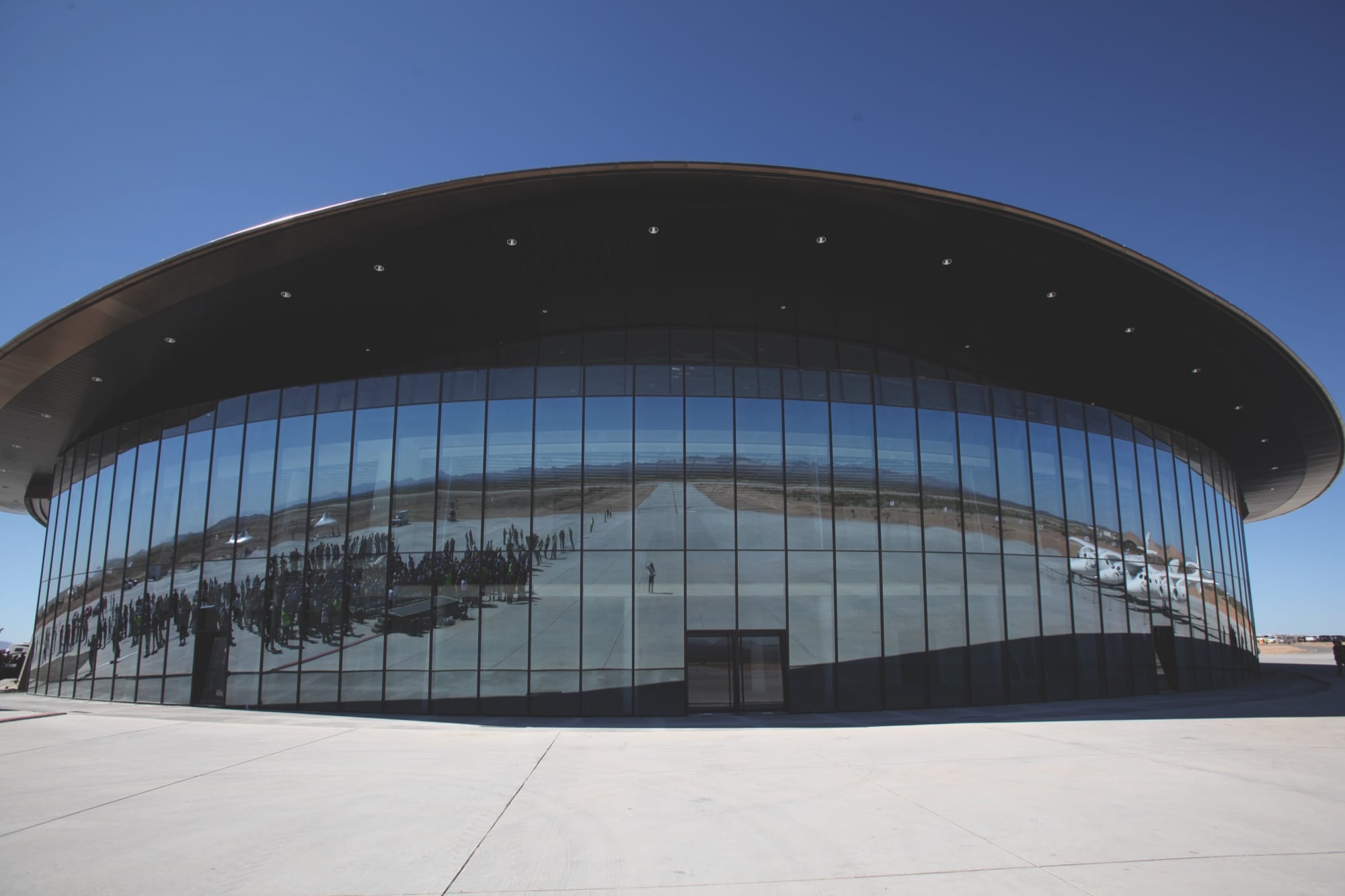
And so it was that earlier this year, I found myself standing outside a stunning, Norman Foster-designed hangar in the middle of the desert, about an hour’s drive from the town of Las Cruces in New Mexico. Named Spaceport America, it is from here that Virgin Galactic passengers will eventually be heading into low-earth orbit.
The day of my visit, the sky is entirely bereft of clouds but the heat is bearable because we happen to be almost two kilometres above sea level. Apparently, this is quite handy when it comes to space travel. “We get the first mile for free,” an obviously important American drawls, when I ask him why the site was chosen.
If you'd care to drop 200,000 USD for a two-hour excursion to the edge of outer space, for now this is where you need to be heading. I say “for now” because Branson has big plans to spread the operation further around the globe and Abu Dhabi, having played a key role in bringing the Spaceport to fruition (by keeping the cash flow steady) will also have one of its own. Not surprisingly, several Arab nationals have already signed up for the initial space flights, and who can blame them? Ever the adventurer, Branson will be the first to make the trip, accompanied by his two children, Holly and Sam.
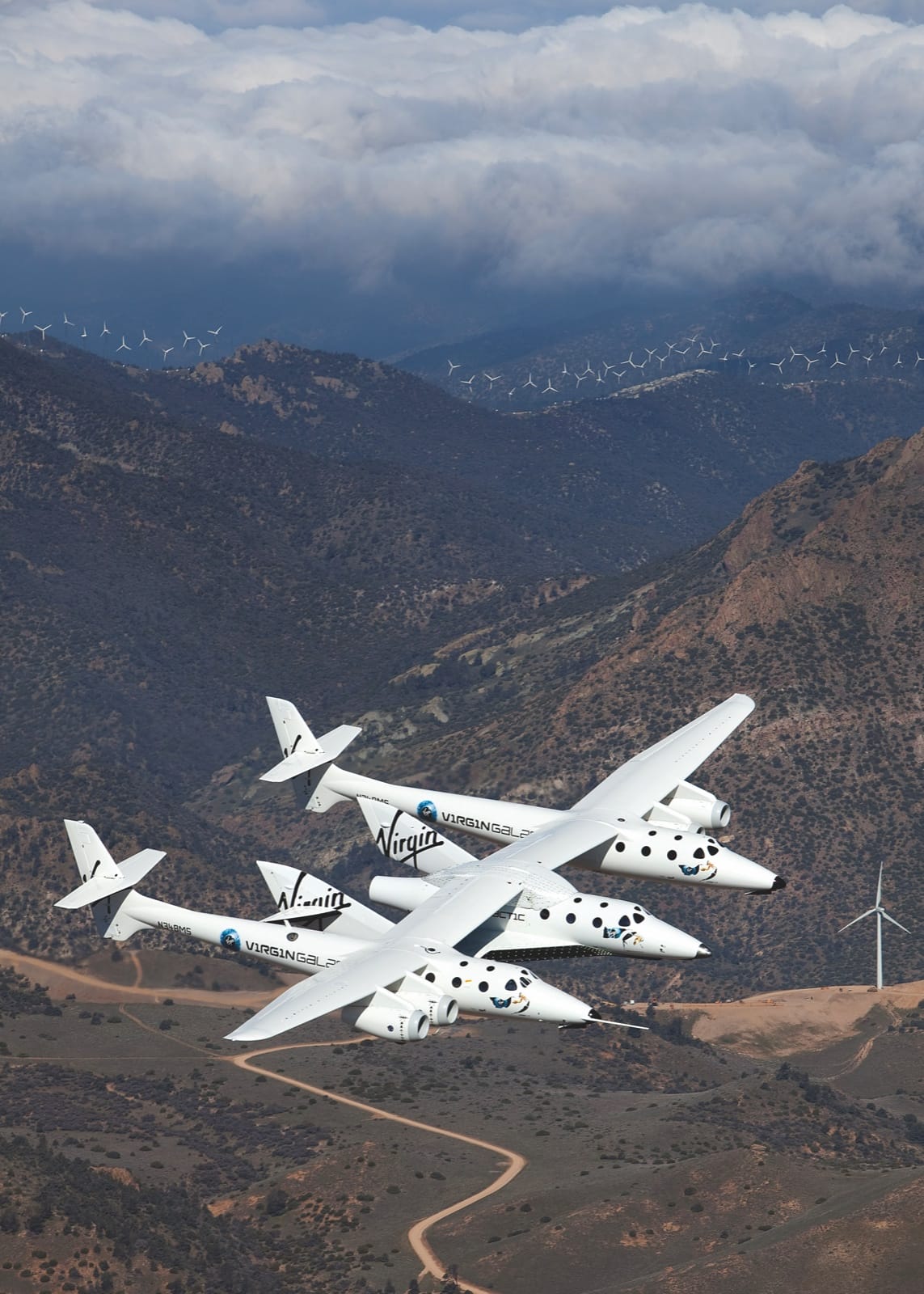
I’m given a guided tour around the facilities and told that the runway is some 3 kilometres long and that for now, the ship must take off from and land at, the same location. When the spaceship, which looks like a miniature, more modern Space Shuttle, is released from its carrier, the pilot ignites a hybrid rocket, which sends it hurtling at Mach 3 towards space. Space officially starts 100 kilometres from the surface of the earth and the ship reaches a height of 110 kilometres, or thereabouts, officially making each of its passengers an astronaut.
They’ll also experience weightlessness for a full six minutes if they unfasten their safety belts, For those too timid to float, the view out of the window will surely be worth the price of the ticket alone. They will be high enough to see the curvature of the Earth as well as the frighteningly thin band of perfect blue haze that is all protecting our fragile planet from the void. As that band is under threat from the very people it protects but maybe, perhaps the 520 fully paid-up passengers currently waiting patiently for their three hour journey will return with the message that while Branson is right to call Virgin Galactic “the key to a new dawn”, we must all do more to keep our beautiful blue planet intact. After all, with only one home we can (currently) live on, it may be nice to get away but it must be even nicer to know you can still come back down.