Assembling an experienced team of curators and conservators, the highly esteemed Louvre invited some of the most imaginative architects in the world to propose ideas for their new Islamic arts department. With support from Saudi Arabia, Kuwait, Oman and the Republic of Azerbaijan, the USD 125 million project took a decade to develop and continued under the patronage of three different Presidents of the French Republic before being inaugurated by François Hollande this past September.
Peering down on this futurist structure from inside the Palais Louvre, you will see the changing light bounce off its rounded, golden mesh roof, which undulates like an unsettled sea. The shimmering surface seems to float within the ornate walls of the 19th century Visconti courtyard. Natural light seeps into the towering glass walls, illuminating the exhibition space from all angles. To control the light’s intensity, a layer of a metal honeycomb diffusing material was added to the interior mesh.
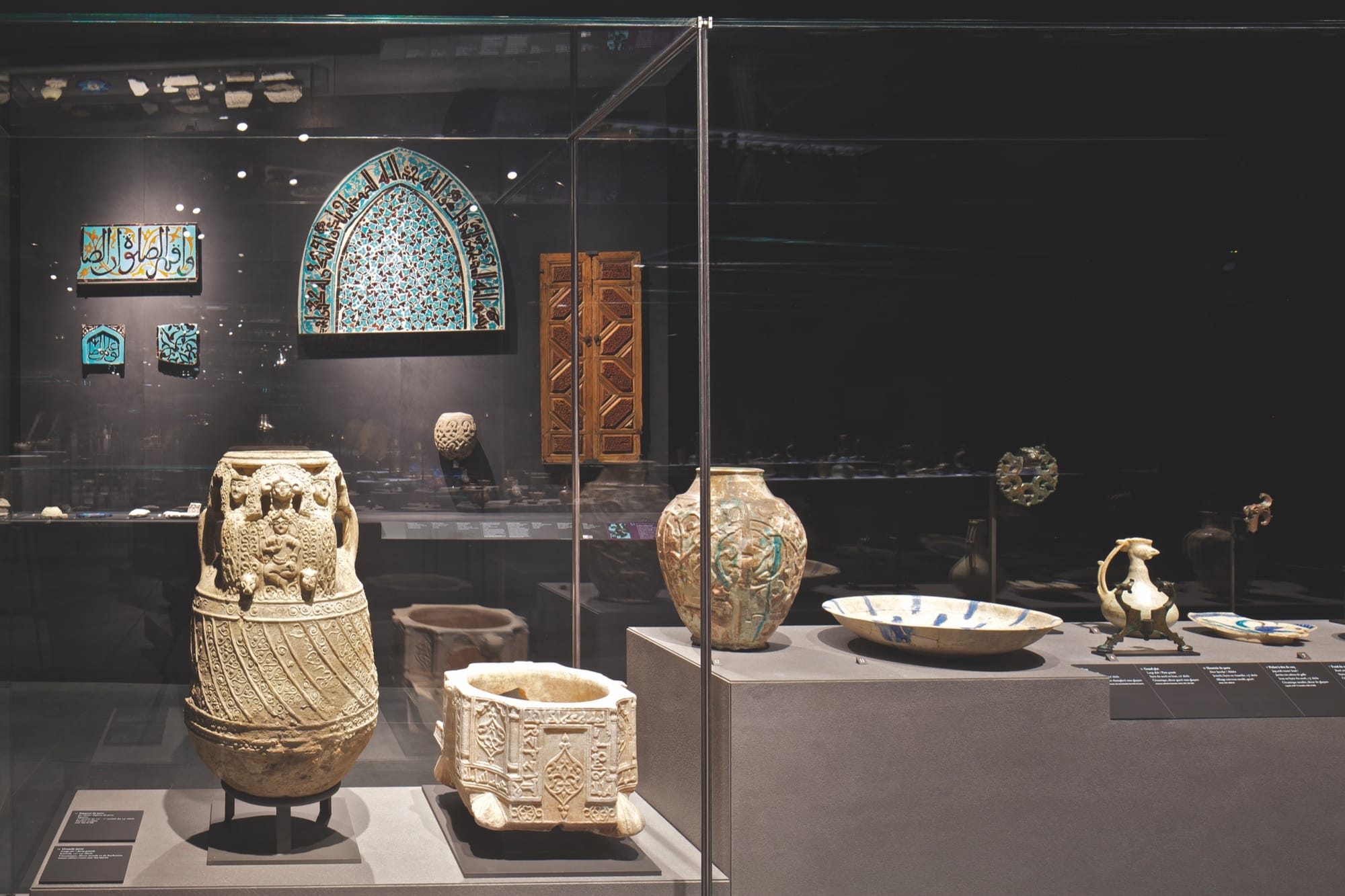
The winning proposal implemented by Rudy Ricciotti and Mario Belleni blends both mathematical complexity and modernist simplicity. The sculptural roof is made of 8,000 tubes that were cut and numbered according to an intricate plan ensuring the exact angles that would later form the rounded surface. A 57-metre crane was assembled in the courtyard to lift the tubular structures into position. The building is a perplexing visual anomaly that resembles a floating scarf drifting in the wind, a sensory experience from all angles, that doesn’t stop at the architecture for the newly opened gallery displays more than 3,000 pieces from the 18,000-piece collection, itself a combination of 14,000 of the Louvre’s acquisitions and around 3,500 works on permanent loan from the Musée des Arts Décoratifs. Overall, the corpus of artworks, from the Mamluk-era stone porch reassembled in-situ to the numerous Ottoman-era ceramics, grapples with over a thousand years of history from the 7th to the 19th centuries and spans three continents.
Interactive maps, multimedia displays, and several audio listening stations help situate visitors in time and place. For Sophie Makariou, head curator of the department, it was most important that museum-goers would not feel intimidated by what they did not already know. “We take the audience by their hand and try to keep them,” she explains, “and in my opinion there is no better way of doing that than by telling a story about a collection.” In this case, the story is organised chronologically, guiding the viewer through the major changes and conquests that resulted in the expansion of the Islamic civilisations.
One of the department’s most exquisite pieces is the Baptistère de St-Louis, a mid-14th century metal basin made in either modern day Syria or Egypt, its exact provenance being unknown. From its physical characteristics, researchers believe it was made during the reign of Sultan al-Nasir ibn Qalawun. Intricately engraved and adorned, it was also used to baptize King Louis XIII, and other French nobles, hence its current name.
Makariou’s personal favourite is one that engenders more bewilderment than historical fact. Although quite tiny for the amount of detail inscribed on its 16cm high by 11.8 cm wide body, the Pyxide d’al-Mughira is engraved with images that have captivated a number of academics. It is sculpted out of an ivory tusk dating back to 968 AD, Spain. “When you take a sharp look at it, it is very strange,” Makariou says. She pauses and points to one of the engraved figures in the container’s centre. “What is the meaning of this strange image of people stealing eggs from a falcon’s nest while being bitten by dogs?” She smiles and adds that this confusion is exactly what makes the Pyxide such a masterpiece. Unable to hide her fascination for the object’s figurative carvings, Makariou continues, “It’s a very mysterious set of images. You could spend your whole life on it and you’d never understand. It’s amazing in its quality and beauty.”
Housing one of the most elaborate collections of Islamic art in the world, with an abounding diversity in form and origin, this ambitious addition to the museum represents a more unified vision of the past and present. As we end our interview and I get up to retrieve my coat, Makariou adds, “I do think that you can use history to understand the present, and when we give [the visitor] the historical and intellectual keys they need, people will benefit from them.” Through undeciphered images and long forgotten secrets, many stories are still waiting to be told. Thanks to this new addition, artworks that have never been catalogued or restored since their acquisition have been properly preserved and classified and will serve as a portal to the past, for generations to come.
WHAT The new Islamic Arts department
WHERE The Louvre in Paris
DETAIL The largest single donor was Prince Alwaleed bin Talal
WHY This fabulous new department took over a decade to develop, requiring an investment of 125 million USD but it provides a much-needed showcase of one of the West's most extensive Islamic art collections.