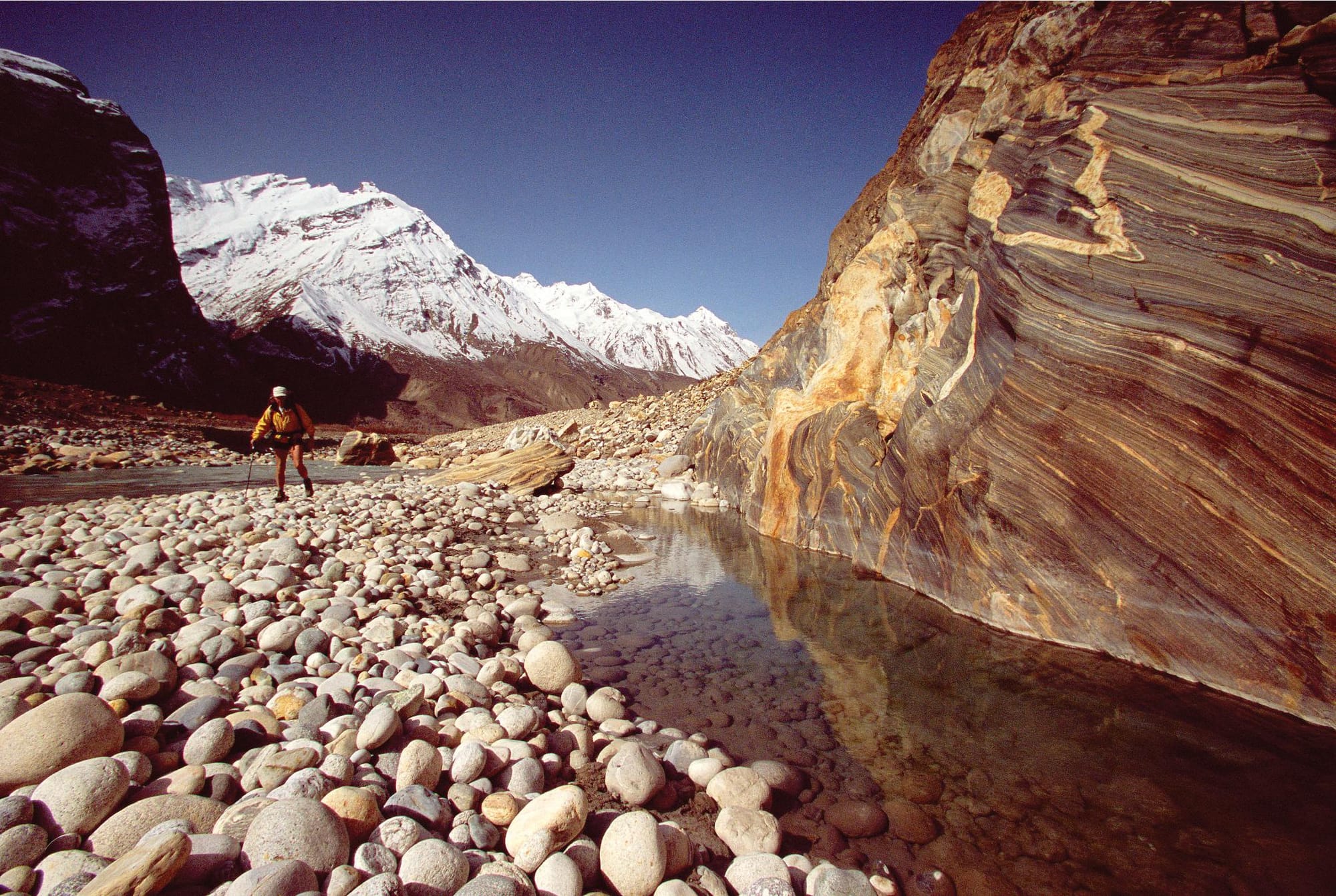
Writer and photographer: Colin Monteath / hedgehog house / TCS
The Savage Mountain
For 20 years, its slopes have been the site of a battlefield, due to the quarrel between India and Pakistan. Prone to dangerous storms and avalanches, many have died climbing its treacherous peak. Bespoke however, took on the audacious challenge of skiing K2.
As my ski skins gripped the crystalline surface, the heavy sled lurched into motion. My lungs heaved in the thin raw air. Drained from the exertion, three companions followed in my tracks; we searched for the easiest route through the deep snow. At 5,000 metres, pulling a laden sled up the 60 km long Baltoro glacier was sheer hard work. At this pace, it would take forever to reach K2.
I have been addicted to expeditions in Asia since 1980, but I’ve never been to the southern side of K2. I did, however, approach the mountain from China in 1994, completing the first ascent of a 7,300-metre peak, Chongtar, opposite K2’s awesome north face. That was quite the adventure, requiring camels to cross the dangerous Shaksgam River that flows from the highest peaks.
Unlike the Chongtar trip, this expedition did not aspire to reach a summit. Instead, we simply wanted to travel through Baltistan on a route first explored in the early 1900s by Francis Younghusband, Dukeof Abruzzi, Martin Conway and the Italian photographer Vittorio Sella. Most importantly for me, skiing all the way to K2 was another pilgrimage to gather imagery that can be used to help preserve wild places.
The choice of partners is crucia. My first preference was my neighbour in Christchurch, New Zealand, Geoff Gabites. An experienced Himalayan climber, Geoff had been on four expeditions to the Karakoram. Geoff’s younger brother Mark, and Jef Desbecker from Queenstown, may have had no previous experience in Pakistan, but their strength and enthusiasm as skiers proved vital to our success.
Straddling the China-Pakistan border, K2 is more remote than Everest and, being eight degrees further north, is often much colder. Long known as ‘The Savage Mountain’, it has generated a fierce reputation as a magnet for dangerous storms, often trapping climbers in the upper camps, and with disastrous consequences. In marked contrast to the 100 or more climbers who annually scale the Tibetan and Nepalese sides of Everest (as many as 60 on one day!), not a single climber has topped out on K2 for the past three years. While more than 2,000 have reached the summit of Everest since 1953, only 196 have climbed K2. Reinhold Messner, who completed the fourth ascent of K2 in 1979, becoming the first to climb all fourteen 8,000-metre peaks, dubbed K2 as the ‘mountain of mountains’. K2 is definitely no place for part-time, mail-order mountaineers.
We timed our trip for April when it would be cool and the snow ideal for skiing. Preferring to experience a sense of isolation, we shunned the use of sat-phones and websites. Instead, we were going to rely on our own pulling power, travelling as a self-contained unit in the hope of not encountering others on the glacier. Sleds were the key to our independence. Long poles hinged to the front keep the sled from capsizing or running over the skier. Despite detailed preparation though, sleds persist in having a devilish mind of their own. Sled hauling is best suited to those with short memories, a high tolerance to pain and no access to huskies.
Winding through a gorge above the Indus River, it’s a two-day drive from Islamabad to Skardu, the capital of Baltistan. Cableway bridges span the rapids, surrounded by tiers of apricot trees in blossom. Winter snow still lay low among the jagged foothills. From Skardu, a hair-raisingly narrow jeep track led to Askole, the last village before the glacier. As we represented the season’s first expedition, villagers were eager to carry loads for us and I enjoyed sharing laughter and sweets with them at rest spots.
We sent the porters back upon deepening snow, arranging to reunite with our liaison officer Haji Baig in a month, when we would have crossed the Gondogoro La, a 5300-metre pass that leads to the Hushe district. We started to load the sleds, somewhat daunted by the task ahead.
Even though we craved solitude and saw no other climbers on the whole trip, we were never truly alone. Throughout the winter, Pakistani soldiers huddle in camps that stretch up the Baltoro to 6,300 metres on Conway Saddle, close to their Indian Army counterparts on the Siachen glacier.
Since 1984, Pakistani and Indian troops have been caught in a dispute over high-altitude territory in Kashmir. This confrontation has resulted in some 3,000 killed from gunfire - though, more commonly, deaths occur after crevasse falls, avalanches and altitude sickness. Thankfully, a brokered cease-fire has held since 2003.
Hissing snowflakes skittered off my parka as Goro II, a cluster of soot-smeared plastic igloos emerged through my fogged goggles. Hunchbacked ravens moped about like undertakers, pecking on garbage. Soldiers in grubby white camouflage jackets welcomed us. We were plied with tea and vigorous conversation about the recent defeat of the Pakistani cricket team by the Indian spin attack, a sore point even up here. I have an abiding memory of forlorn-looking soldiers with guns over their shoulders plodding along in knee-deep snow. War on the icy top of the world must seem a strange affair, especially if you hail from the burning plain of Punjab.
Concordia, an extensive snowfield at the confluence of the Baltoro and Godwin-Austen glaciers, is a sacred place. In awe of the 8,000-metre giants Gasherbrum, Broad Peak and K2 above us, we camped there for a week as our bodies adjusted to the altitude. For days on end, snowstorms hampered our movement. Finally, after long bouts of reading, card playing and debating our strategy, the weather cleared. We exploded from the tents. Excitement buzzed as we dug out the sleds. The gateway to K2 was open.
It took three protracted forays before we found a route suitable for towing sleds. The light was so poor that it was like navigating inside a ping-pong ball. Now in bright sunshine, we skied up to a spectacular campsite under Broad Peak. Access to K2 seemed assured. But as is so often the way among big mountains, complacency is a poor companion.
We skied in silence under K2’s Abruzzi ridge, humbled for achieving a goal, which from the outset had been far from certain. Suddenly, our feeling of success was shattered. Just when we thought we were safe, Geoff disappeared, swallowed by a crevasse. He had punched a neat hole through the layer of snow masking the crevasse. Left in disbelief, we knew all too well that we had left our rope and crampons at the depot earlier, confident there wasn’t any need to lug the rescue gear. Quick to react, Jef and Mark lowered what cord we had with us down to a rather distraught Geoff. As it turned out, he had only plunged four metres before wedging in the parallel-sided slot. After much heaving, Geoff flopped out onto the surface. Suitably chastened, we clambered up to a memorial cairn for those who have perished on K2.
Over the next week we skied further up into the Vigne, a narrow glacier that leads to the Gondogoro La, and our hoped-for rendezvous with Haji. Pinned down by storm in our top-most camp, we became anxious that this would create a lethal cocktail of avalanche danger on the pass. Reluctantly, we backed off, skiing helter-skelter, our sleds almost airborne behind us. The long slog home without porters had begun.
I left from Pakistan with a resounding appreciation of the hospitality, humility and kindness shown to us by its Islamic people. At every turn Pakistanis opened their hearts, not just to us as foreign guests, but to each other, often complete strangers. Soaring over the vast melting pot of Central Asia, K2 remains a shining beacon of hope, even in its deadly promise.