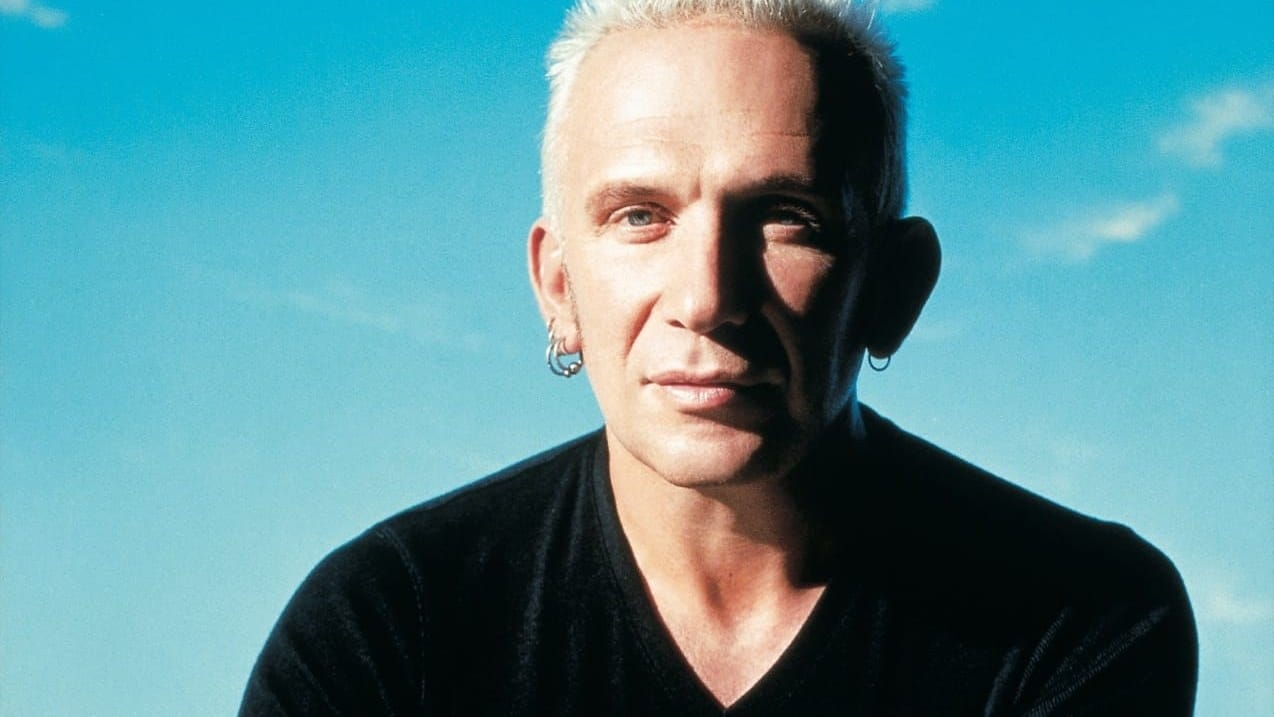
As he enters his sixth decade, Bespoke looks back at the never-ending rise of Jean-Paul Gaultier, the Frenchman who completely challenged fashion’s boundaries beginning with a single, iconic cone bra and a corset. Fashion, as we know it, has never been the same.
Right now, a sprawling museum exhibition entitled ‘The Fashion World of Jean Paul Gaultier: From the Sidewalk to the Catwalk’ is trundling its way across the U.S. and Europe. Its namesake and creator, 59-year-old French fashion designer Jean-Paul Gaultier, was very concerned that it not be as ‘dry’ as a normal museum exhibition. “I wanted something very, very alive,” he said of his show recently. “I didn’t want something dead - a museum can seem dead, the clothes are very old, it’s like a funeral.” Thus, the resulting carnivalesque exhibition couldn’t be further from a morgue: 140 of his pieces combine in a tornado of life and colour, from mermaid dresses to Chinese satin, to outfits shaped like a skinned leopard to, of course, a sea of mariner stripes, which is a running obsession in Gaultier’s work.
But what did we expect from the fashion world’s ‘enfant terrible’? Today, Jean-Paul Gaultier, who wryly admits that sometimes, “interviews can be like psychotherapy,” as playful as always, he also confesses: “At my age, I prefer to be ‘enfant terrible’ than ‘enfant sage’, I think I’ll have to become a ‘vieillard terrible’ soon.” This is the man whose name is synonymous with the muscle-bound sailor-shapes of his perfume bottles, the addictive UK nineties TV show Eurotrash, and, of course, Madonna’s unforgettable cone bra (first fashioned on one of his childhood teddy bears). This same man once made a dress out of bread – way before Lady Gaga brought her meat to the party. Perhaps the most celebrated male fashion designer of our time, we still expect Gaultier to shock us, to shatter conventions - and then to break them even further.
Gaultier’s impact on our every wardrobe began as early as 1952, when he was born in Val-de-Marne, France. Raised an only child by an accountant father and office clerk mother, he was particularly close to his mother’s mother, Marie, who soon became his first muse. An eccentric widow and ‘wellness counsellor’, she advised female clients to dress better in order to improve their lives, thus first introducing Gaultier to the power of fashion. His flair for design blossomed as his skill for sketching scantily-clad women helped him to win over the school bullies who had previously only prayed on his flamboyant idiosyncrasies: “It was like a passport,” he said. “I realised if I sketched, people would smile.”
Surprisingly, Gaultier never studied fashion. Instead, he threw himself into the scene head first – barraging already-accomplished designers with his drawings. Pierre Cardin took the first bite, hiring him as an assistant in 1970. “I loved how Cardin was never scared to change things at the last moment. He had people from all over the world working in his studio. It was a real melting pot,” Gaultier says. Jacques Esterelthen took him on in 1971, followed by Jean Patou later that year, a more traditional French designer. In 1974, Gaultier then returned to Pierre Cardin to manage a boutique in Manila. Gaultier talks about how privileged he was to have had “that freedom” of entering the fashion ndustry at such a young age, and with self-training his first teacher. “I owe my vocations to the cinema. When I was about nine years old I saw a French film from the 1940s, ‘Falbalas’ by Jacques Becker, which is set in a couture house. There was a fashion show in the film and that is when I knew what I wanted to do when I grow up. I wanted to be a couturier and present fashion shows.”
By 1976 and with apprenticeships completed, Gaultier was ready to take on the world with his own ready-to-wear collection, after much encouragement from his life partner, Francis Menuge. His first show took place in Paris Planetarium, with nine models showing off bizarre creations made from materials as varied as placemats, upholstery fabric, and the famed biker-jackets-meet-tutus. Gaultier established his DNA right from the very beginning: a passion for questioning notions of acceptability and decadence, to challenge, as he stated in press recently: “the question of what is beautiful and what is not beautiful.”
In 1985, he introduced ‘man skirts’ – far before David Beckham threw on a sarong in the nineties. While the world saw this as a ground-breaking statement on men’s sexuality, Gaultier explained that his inspiration was in fact national dress such as kilts, and uniforms, such as a waiter’s pinafore. “It is never actually a provocation. I didn’t do a skirt for men because I wanted to provoke but because I felt that the time was right. I was working on my first collection for men in the early 1980s and I noticed that the men’s attitudes were changing. One of my models came back from his holidays wearing a sarong. I just felt that it was the right moment to put men in skirts. The same goes for the corset. I started working during the 1970s when the feminists were burning bras, but suddenly by the end of the decade, I noticed that my girlfriends were wearing bras again – sometimes just a jacket with the bra underneath. They decided that they wanted to be seductive but on their own terms.”
The Gaultier brand reached yet another level in 1990, a pinnacle displayed brazenly on Madonna’s chest in the shape of one extremely dangerous-looking iconic cone bra. “I was a real fan of Madonna,” Gaultier explains. “I loved her music as well as her ‘personnage’. I loved how she was the director of her own appearance. When I saw her first concert in Paris, I said to myself that she should have asked me to design the stage costumes. I thought I would have done them better. Two years later, when my PR told me just before a prêt-a-porter show that I have to call Madonna back, I thought someone must be playing a joke on me. But three days later, I asked if it was true and to check, I did call the number. And it was her, in person on the line. “She answered, ‘Hi Gaultier…’ And the rest is history.”
Gaultier and the world’s biggest female pop star were mutual fans before they actually met; when they did, the result was a stunning tour wardrobe designed by Gaultier. The range included a number of ‘corset dresses’: an undergarment that, back then, had never been worn as such on a stage. Debate then erupted over whether corsets were empowering or demeaning (or unhealthily tight). Gaultier’s stock value followed a similar volcanic trajectory, resulting in him becoming firmly and officially established on the world’s radar.
More showbiz assignments included costumes for films, such as 1997’s ‘The Fifth Element’ (for which he won the French version of an Oscar), Pedro Almodóvar's 1993 ‘Kika’ and Peter Greenaway's 1989 ‘The Cook, the Thief, His Wife & Her Lover’. “When I create my collection, I write the script, I do the casting; I am a director in a way. When I work in films there is a director and I try to create costumes with their vision in mind. I have been very fortunate that I could work with the directors that I admire like Peter Greeneway, Luc Besson or Pedro Almodovar. ‘The Skin I Live in’ is my third collaboration with Almodovar.” Beforehand, in 1988, Gaultier strayed from one art to another and released a dance track entitled "How To Do That", which was swiftly remixed by DJs as eclectic as Norman Cook and Mantronik.
Unfortunately for the busy designer, in direct opposition to his astronomic career rise, the early 1990s also marked a time of great personal difficulty as his long-term romantic and business partner Menuge passed away due to AIDS-related diseases in 1990. Today Gaultier still states that he will never again be as close to another person: “He and I did something together,” he stated. “We did my company. It was like our baby.” Gaultier even considered retiring from the fashion world altogether at the time.
Fortunately, the spritely Frenchman ultimately decided to not only stay in the fashion game, but to launch his own haute couture range, as Menuge had always urged him to. “I started in haute couture with Pierre Cardin and than at Jean Patou. I knew that I will come back to it one day,” he told Bespoke. Despite entering a notoriously tough market, Gaultier excelled in it, relishing the creative freedom, snaring Nicole Kidman as one of his first clients and introducing the world to one of the first men’s couture ranges.
Bursting out swinging, Gaultier launched his own perfumes in 1993, of which Le Mâle, housed in a bottle the shape of a man’s torso and encased in a tin, remains Europe’s biggest selling men’s scent. The designer was then made artistic director of prestigious women’s ready-to-wear at Hermès in 2003, a position he held successfully until his departure to ‘concentrate on his own projects’ last year (reportedly ‘expedited by the 2010 death of former Hermès ceo Jean-Louis Dumas, who had championed the designer’, according to fashion press at the time). Gaultier’s only comment of that experience is: “It was a wonderful and rich experience. I did it for seven years and I was privileged to work with their ateliers and their savoir-faire.”
The main point, however, appears to be that Gaultier swam strong through the rough tide of recession (even launching his own line in men’s make up, ‘Monsieur’ in April 2008 – because that’s what men need in a financial crisis…), with the rumour mill now whispering that Puig, the parent company of Carolina Herrera and Paco Rabanne, may soon be adding the Gaultier house to its powerful portfolio.
Yet it’s clear that beyond business acumen, Jean-Paul Gaultier the man and the brand is based on an ethos that every society needs, whatever the financial climate: the idea that boundaries must be constantly pushed and pulled, that fashion should be informative, creative and fun, and that there’s no reason whatsoever why a man who dresses Marilyn Manson can’t also clothe Kylie Minogue - or combine smut and fashion on late-night TV, yet also pack out prestigious museums across the globe. He even recently interviewed Lady Gaga: “I have enjoyed enormously interviewing Lady Gaga but I don’t think that I will start a new career as a TV presenter.” In short there is little we should not expect from Gaultier, that is until he finds his next fixation.