Mario Testino began his life as the eldest son of six children in a middle-class Peruvian family. Before he moved on to London and New York in his 20’s, his outrageous sense of style often got him in trouble in his home country, as he has revealed: “I couldn’t take public transport the way I dressed – imagine David Bowie walking in Rome. Well, I wasn’t David Bowie, but the way I looked was quite flamboyant… I grew up in a society where you were supposed to fit, whereas today men are supposed to be. They can be anything they want… In my time, to wear an earring for a man was shocking. I moved to London in ’76 and of course dyed my hair pink and had two earrings on one side. I went back to Peru and it was quite a shock! I think people like David Bowie were the precursors of this changing of opinion. He could wear a dress and full makeup, but he was married and had a child. It was the mentality [previously] that if you did that, you probably were gay. I’ve never been one to like that definite opinion of anything; I quite like the ambivalence.”
It’s funny how times have changed. Today, David Bowie doesn’t feature in Testino’s latest oeuvre with plucked eyebrows and glittering eye shadow, instead he’s dressed smartly in a white suit, playing an imaginary keyboard. “I believe men have changed. I feel that men are more open to ideas and possibilities,” Testino says.
And it is precisely this shift in the definitions of masculinity that this Vogue and Vanity fair photographer is searching for in his book Sir, as well as adding to the repertoire that he’s celebrated for: his shots of Kate Moss and Naomi Campbell or Madonna and Lady Gaga, his regular commissions for the British royal family – think of his explosive 1997 Vanity cover of Lady Diana before she died – not to mention his ad campaigns for prestigious fashion houses like Gucci, Versace, Calvin Klein, Dolce & Gabbana, Salvatore Ferragamo and Michael Kors.
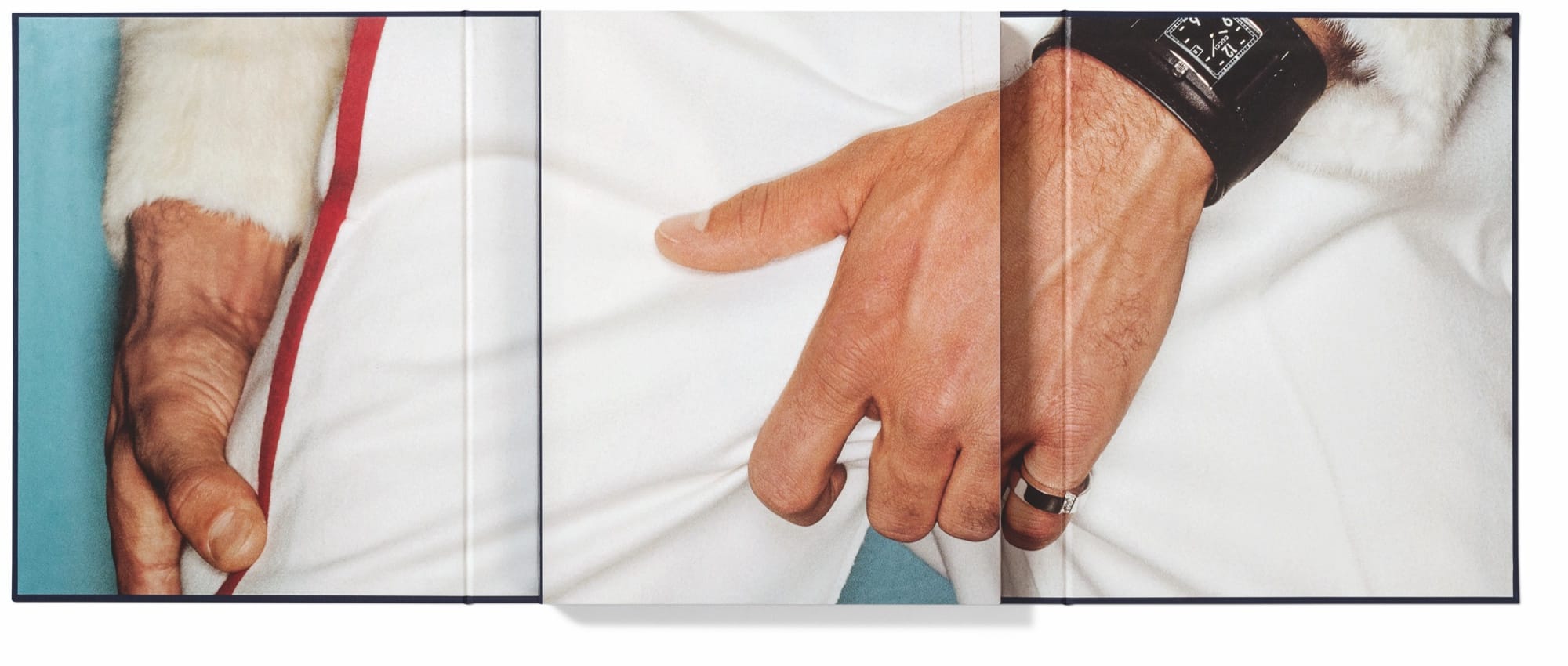
Here, his 300 photographs document the rich and famous but also the everyday man. You’ll find lesser known as well as previously unpublished portraits of personalities ranging from Yves Saint Laurent to Andy Warhol and Jay Z (in a Prince of Wales check suit), a Peruvian man from the Cusco mountains in traditional garb, Josh Hartnett in fake eyelashes and smeared, bright red lipstick as well as Orlando Bloom planting a kiss on David Beckham’s cheek at a Milan party. As a visual essay, it’s flamboyant and daring, candid and playful, irreverent and curious, and features Man in a variety of guises, from the dandy gentleman to the macho, the fey and the hippy. “They’re all about trying to define men in general. I did the cover of the book with a cloth, to give it a sort of elegance. Then you open it and it has this picture of a guy touching his crotch. It’s like, ‘Bang! I’m a man!’ And then we put this metal cover because I thought I quite like the mix—we can be soft and nice, and you can be tough at the same time. Why does one have to choose?”
In Testino’s signature style of prompting his models to leave their inhibitions behind, and sometimes, their clothing too, Testino also elicits certain reactions from the men he photographed, such as Mick Jagger and Keith Richards locked in a friendly embrace in an LA hotel room. Testino describes this image as a defining moment “because I managed to get something out of them that was very intimate and personal. There is something about the two of them, they have broken the rules of style and masculinity. I have such a respect for them. Along with David Bowie, they were probably the first ones I looked at; they just follow their gut.”
Limited to 1,000 copies, each Japanese cloth-bound edition of Sir comes in a metal slipcase, looks as handsome as its subjects, and reads like a conversation on maleness. In tracing this evolution of masculine identity, Testino may have succeeded in changing his own image as a photographer as well.