I clearly remember how I first learned to tell time as a child, it was with the grandfather’s clock that tick-tocked in our living room. To encourage me, my parents offered me a plain, yet sturdy Timex that I proudly wore for many years.
Then came the manned space missions and all the intensive media coverage of Omega watches flying to the moon, strapped on astronauts. I learned that while watches should be able tell time accurately, it was also their performance and reliability under difficult conditions that’s a good measure of value in this industry.
My horological education continued in my dentist’s office, of all places. Rushing back late from a golf game one day, before scrubbing for his first afternoon appointment (with me) Dr. Nolan came to apologise and his wrist gleamed with gold. “Wow!” I exclaimed, staring at his watch. He told me it was a Rolex Oyster Perpetual Day-Date.
“What’s that little bubble on the crystal?” I asked. “It’s called a ‘Cyclops’ and it magnifies the date by two and a half times, for easy reading.”
“Is it all real gold?” I asked, breathing out loud.
“Yes,” he laughed, adding quickly. “Now you’re going to think my fees are too high.” Passing by a Rolex shop on my way back home, I understood what he meant.
But I was on a mission. I wanted to know how the brand came to fetch such prices. This is a brand that produces over 2,000 watches a day, enjoys revenues of around 5 billion USD a year, and controls almost a 15 per cent market share of the Swiss watch market (a figure comparable to that of the entire Swatch Group). During my research, I also discovered that among its breakthroughs and patents, in 1926, Rolex had invented the first airtight, waterproof watch (the appropriately named Rolex ‘Oyster’), followed by the first self-winding system for wristwatches in 1931 (a ‘perpetual rotor’), which paved the way for the Oyster Perpetual Datejust that’s now the pillar of the Oyster collection. It’s also obsessive about quality control. Everything is still made by hand but there are triple checks before and after their movements are sent to the Swiss Office of Chronometer Control (COSC) for certification. They even re-test their movements for accuracy after they are cased for several days while simulating wear before they are sent out to retailers.
But it took Kiri Te Kanawa to really raise my level of emotions for the brand. The first time I saw the image of my favourite opera singer wearing a Royal Oyster Perpetual Lady-Datejust as part of a testimonial campaign in Time magazine, I was floored by the beauty of both the singer and the timepiece.

Rolex has a long history of such associations with successful personalities in the fields of culture, sports and exploration. I think almost everyone has identified with, or aspired to own, at least one of their watches in the same way I did with Kiri.
Prime Ministers and Presidents from all over the world have owned Rolex watches. Test pilot Chuck Yaeger wore one (Oyster) in 1947 when he broke the sound barrier for the first time ever, Sir Edmund Hillary when he climbed Everest in 1953, as part of the first British team to do so, and Paul Newman (Chronograph Daytona) in 1955, when he raced at the famous Daytona International Speedway in Florida. Fast-forward to 2012, and James Cameron had one (Deep Sea Special) when he plunged with the Deepsea Challenge expedition to 10,908 metres below sea level, in the Mariana Trench in the Pacific. And that was hardly unusual for as early as 1960, Rolex wanted to prove it was more than a pretty face, so they attached an experimental Rolex to the arm of a submersible, and it re-emerged, undamaged, after sustaining the pressure of 1 tonne per square metre.
But, as I had seen with my dentist’s watch, there is much more to a Rolex watch than technical performance. There is this question of… well, gold. From the very beginning, most of the Rolex Oysters came equipped with gold bracelets. Sure, when you have a hermetically sealed case to protect the movement, you’ll also need a waterproof bracelet. So it’s not that more resistant leather bracelets weren’t proposed, joined later by steel and platinum. In fact, this year Rolex launched its patented Oysterflex – a comfortable, flexible, waterproof bracelet moulded with elastomer, for its Yacht-Master line but still, the majority of the bracelets are in 18-karat gold.

In our collective memory, due in great part to a brilliant brand communication strategy, a Rolex watch is immediately recognisable thanks to its Cyclops, its crown on the dial at 12 o’clock, its familiar round shape, and most especially, its wonderful metal.
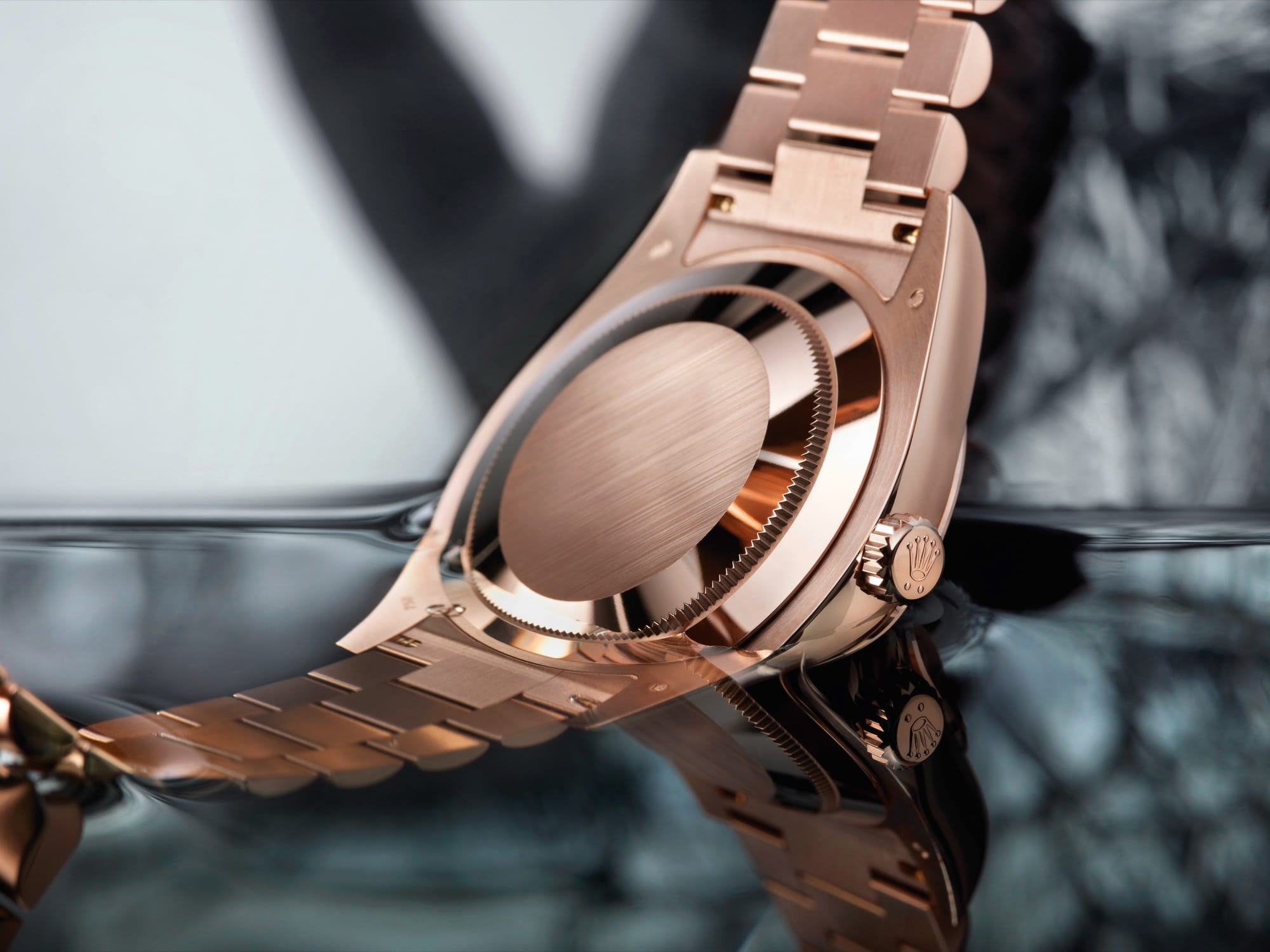
If you like yours in stainless steel then you’ll be interested to know that since 2003, Rolex is the only watch company that went to great lengths to move their entire steel production to 904L steel, a stainless steel with a slightly higher nickel and chromium content that’s resistant to chloride, a potential cause for pitting and corrosion. For those who are more partial to gold, you should know that Rolex makes its own: 24k gold comes into the factory and the in-house foundry turns it into 18k yellow, white, or Rolex's Everose gold (their non-fading version of 18k rose gold).
Personally, I think that wearing a Rolex enhanced with a gold case and a gold bracelet has been, from the beginning, the key to recognition of belonging to a members-only club, a sign of exclusivity, a status symbol shared only by successful individuals who can afford it, and who don’t mind showing it. And for someone as discreet as myself, I must admit that, as with love and faith, I have had my ups and downs, my doubts and apprehensions, my temptations and my hesitations, before succumbing to the obvious. The one thing I do know is that I want a Rolex Oyster, and I’m going for the gold.