It’s rare to find unanimity in the automotive industry but that’s what we’re currently witnessing among the big manufacturers, who are universally moving towards the electrification of their model line-ups. Admittedly, there have been a number of false dawns for the EV over the 106 years in which man has been mass-producing cars, starting with the Studebakers of the early 20th century and ending with the Fisker Karma, by way of GM’s ill-fated EV1. But, thanks to the plummeting cost of batteries, times have changed and electrification is finally viable – albeit there are still questions to be answered regarding the environmentally hazardous recycling of used batteries. But we’re at a turning point nonetheless, and while sceptics can say electric cars still only constitute one per cent of automotive sales, they’d be missing a critical factor, which is of course growth. You see, BloombergNEF foresees a 40 per cent increase in the number of EV sales in 2019, with 2.6 million units worldwide, and that kind of rapid tech evolvement hasn’t been seen since the inception of the iPhone. Let’s not forget that when the iPhone came out in 2007, it was Nokia and Motorola who were the dominant forces in the world of mobile phones, but market share ended up meaning nothing to those two firms when they were faced with a game-changing product – it’s a lesson that has certainly not been lost on the big automakers.
BloombergNEF goes on to predict that, of the total EV sales, China will account for the lion’s share, with 1.5 million units forecast. Europe comes next with just under 500,000 sales. North America then follows with 425,000 deliveries, while Japan and South Korea should combine for a solid 100,000 sales. You’ll no doubt have noticed that the Middle East – home to the world’s largest oil reserves – does not even feature on the global radar yet, but that didn’t deter Audi from debuting their brand new E-Tron in Abu Dhabi of all places. Of course, their choice of the UAE’s capital wasn’t all that leftfield when you consider that it’s also home to Masdar City, the pioneering sustainable, low-carbon community that was once supposed to serve as a ‘greenprint’ for future urban planning, and that’s exactly where our journey with the E-Tron began.
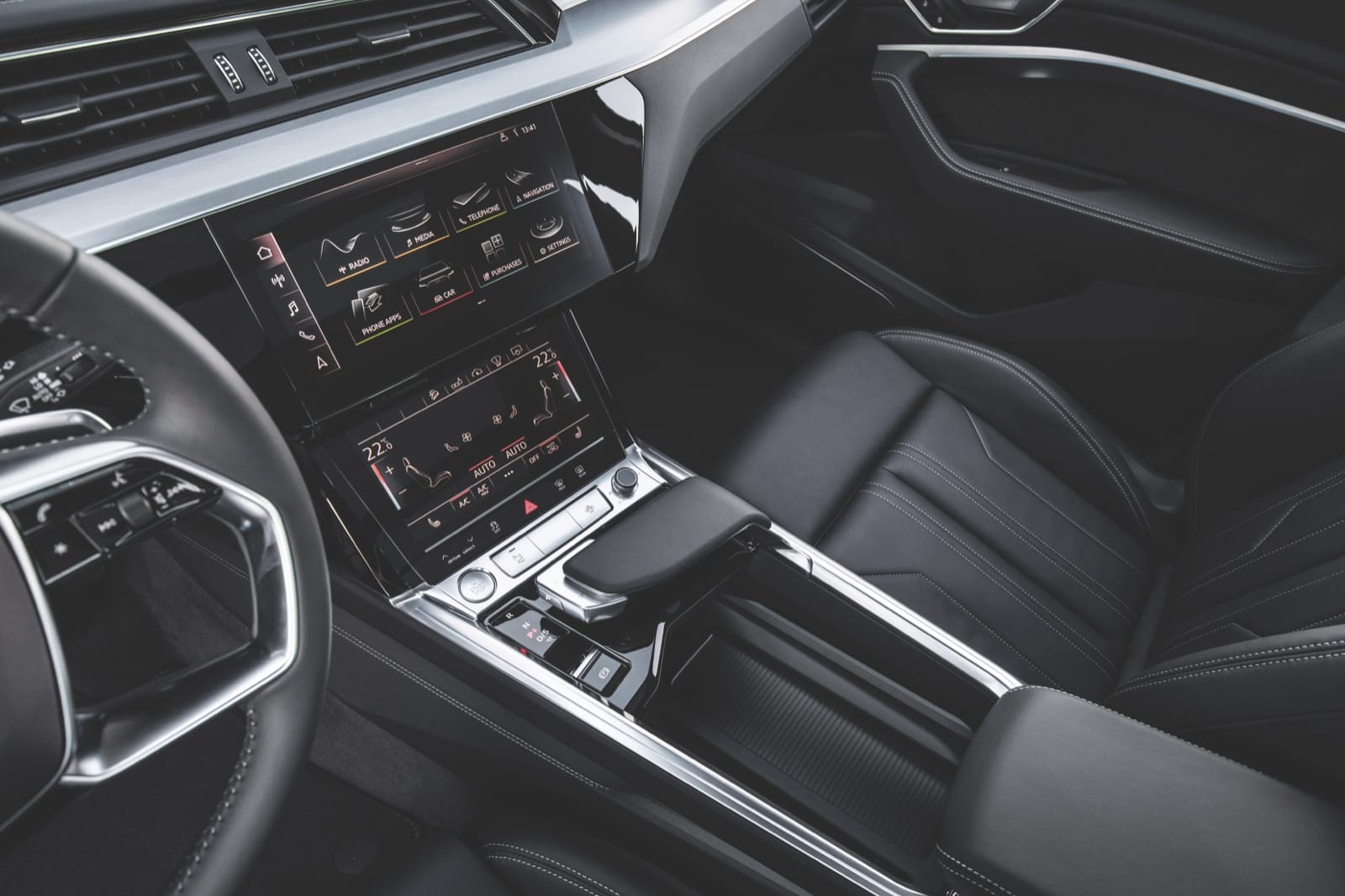
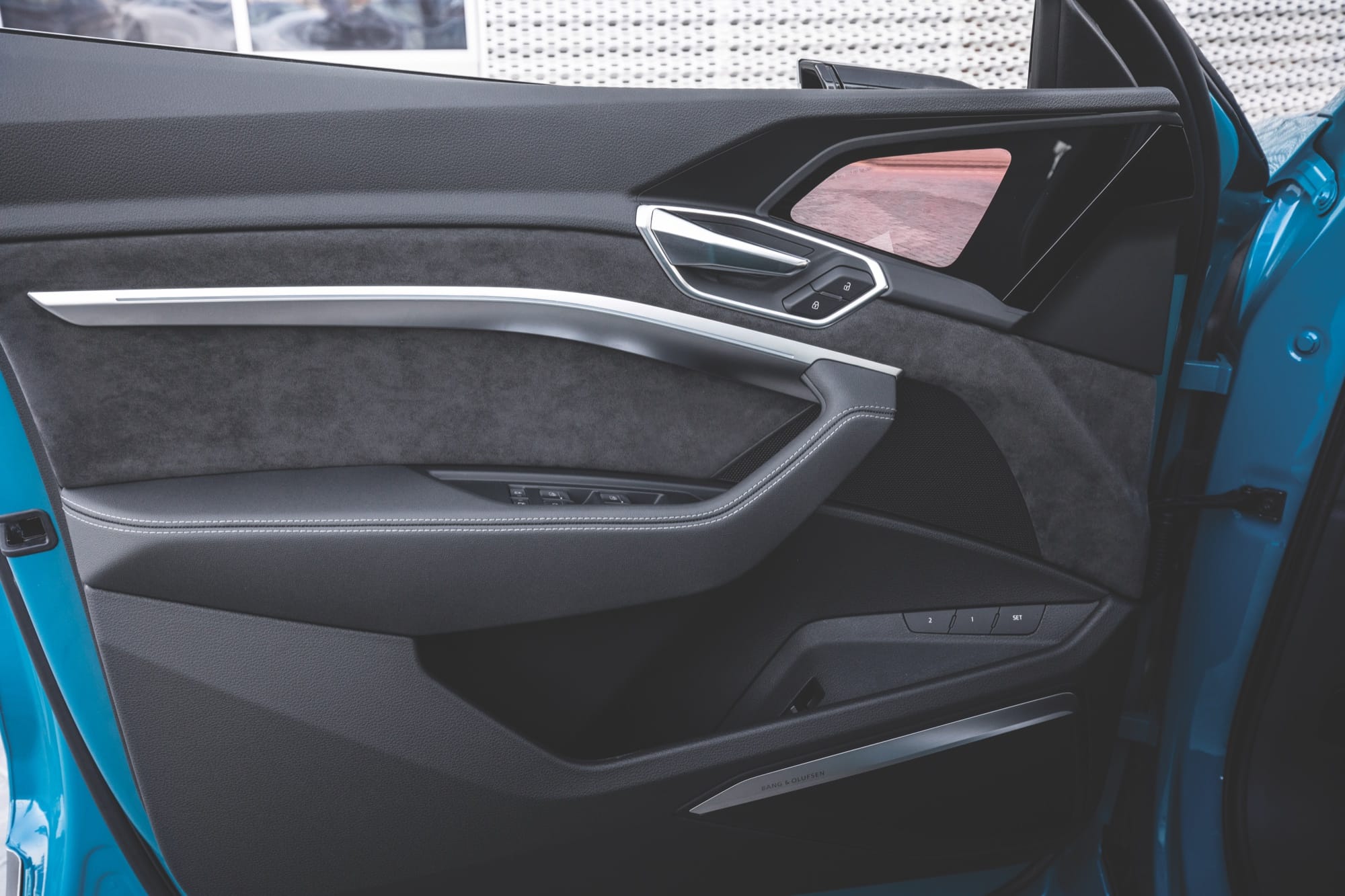
Surprisingly, even parked up against the banked sides the Masdar Institute’s library building, reflecting every angle of the car back at me as I approached it, the E-Tron looks conventional. Then again that’s the whole point apparently. Ingolstadt engineers attending the global launch explained the amount of work that went into making the car look and feel familiar. (Audi figured that was what was needed to get early-adopters into an EV). From a packaging perspective, the E-Tron is smaller than the Q7 but notably bigger than the Q5. Its power comes by way of two electric motors – one at the back (165 kWh) and one at the front (135kWh) – and 700 kg of liquid cooled batteries located in between them. The batteries (which are by the way guaranteed for 8 years or 160,000km) are split into 36 modules, each containing twelve 60 Ah cells, and hidden under the cabin floor, so as to keep the centre of gravity as low as possible. Interestingly, because the batteries are built into watertight aluminium casing, they actually contribute to the car’s torsional stiffness. Total output is 402bhp with 664Nm of torque, and while performance is decent in terms of a 5.7-second zero to 100km/h sprint time, the real USP of the E-Tron is its fantastic 400-kilometre range. With that kind of usability, the E-Tron should seamlessly fulfil the needs of almost all customers, easily handling medium-distance commutes, school runs and weekend trips to the mall, cinema and everything in between. For journeys beyond 400 km though, you’ll need to stop and charge. And, the fastest way to do that is via a high-speed commercial 150 kW DC station, which will fill to the 80 per cent mark in just 30 minutes. Home charging is another matter though, as the average household runs on 3kW, which means you’d need 31 hours to fill your E-Tron if you just plug into the mains. So Audi recommends you get your local electricity company to install an industrial 11kW 400 volt three-phase outlet, as that will fill you up in 8.5 hours, the average time spent in an overnight parking.
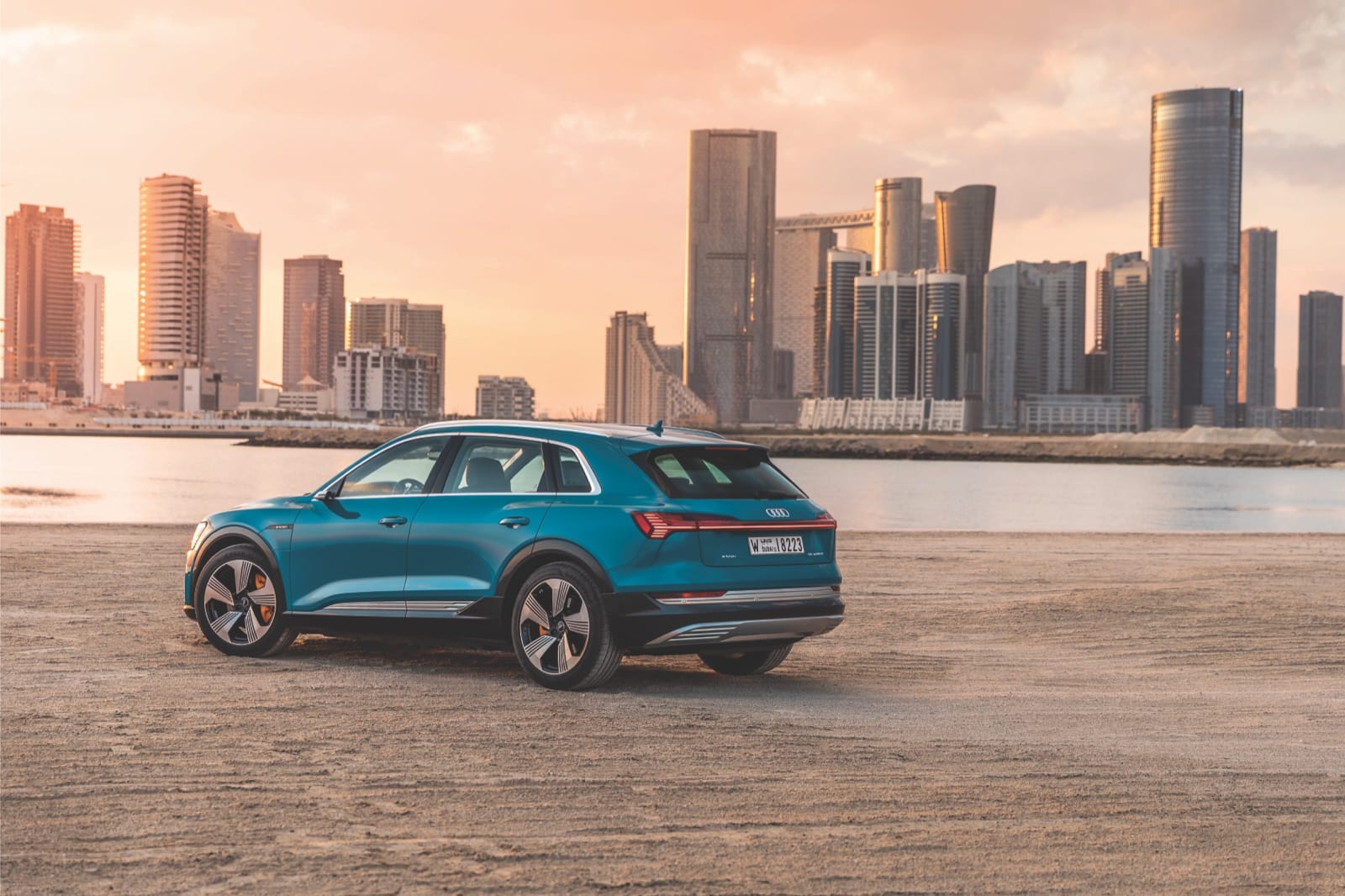
So with the walkaround complete it was time to take the E-Tron out and my first impression was one of quiet tranquillity. It’s really nice not having any sounds or vibrations come from an engine, and the instantaneous torque you get from an EV never stops being fun. I’m told Audi had to do a lot of work on sound insulation as apparently customers become way too aware of unwanted sounds once you remove an engine. It’s not quite a Cullinan-level of silence but what I really appreciated about the E-Tron is its ability to do it all in comfort and peace. And what I mean by that is pottering about town, off-roading at Al-Ain Zoo or even enjoying a blast up Jebel Hafeet. Plus with room for five passengers and 600 litres of luggage space in the boot, there are no obvious compromises.
Well, that is except for its price, which equates to a fully loaded Q7. But even so, the E-Tron makes a compelling case and will no doubt convert a number of car owners to electrification. But as I ended my day behind its wheel, I couldn’t help thinking of Masdar. That too was an ambitious project, having started out with the aim of being the world’s first carbon-neutral city, boasting 1,500 green energy businesses and a combined workforce of 110,000 but 13 years later and only a fraction of the project has been built – less than 5 per cent of the original six square kilometres –just 1,500 people work there (with just 300 living on-site) and it’s not even fully carbon neutral. In fact it’s pretty much just an extension of Khalifa University now, but despite all that, Masdar is not so much a failure as it is part of an evolutionary process. Likewise, as smart and as capable as the E-Tron is, technology moves fast and a decade from now we may well look back upon at the E-Tron as a rather quaint first effort. But so what. Right now, it represents a massive step forward in the evolution of the electric car.