For many women, it’s a sight they can still conjure with perfect clarity: their first lipstick. Not the designer kind, but – for much of the Middle East – a green, slightly kitsch, wonderfully eccentric bullet. You’d find it in the back of pharmacies or by airport tills: emerald in the tube, pink on the lips. For a young girl in Saudi Arabia, it felt like alchemy. For the woman she became, it was the seed of a business.
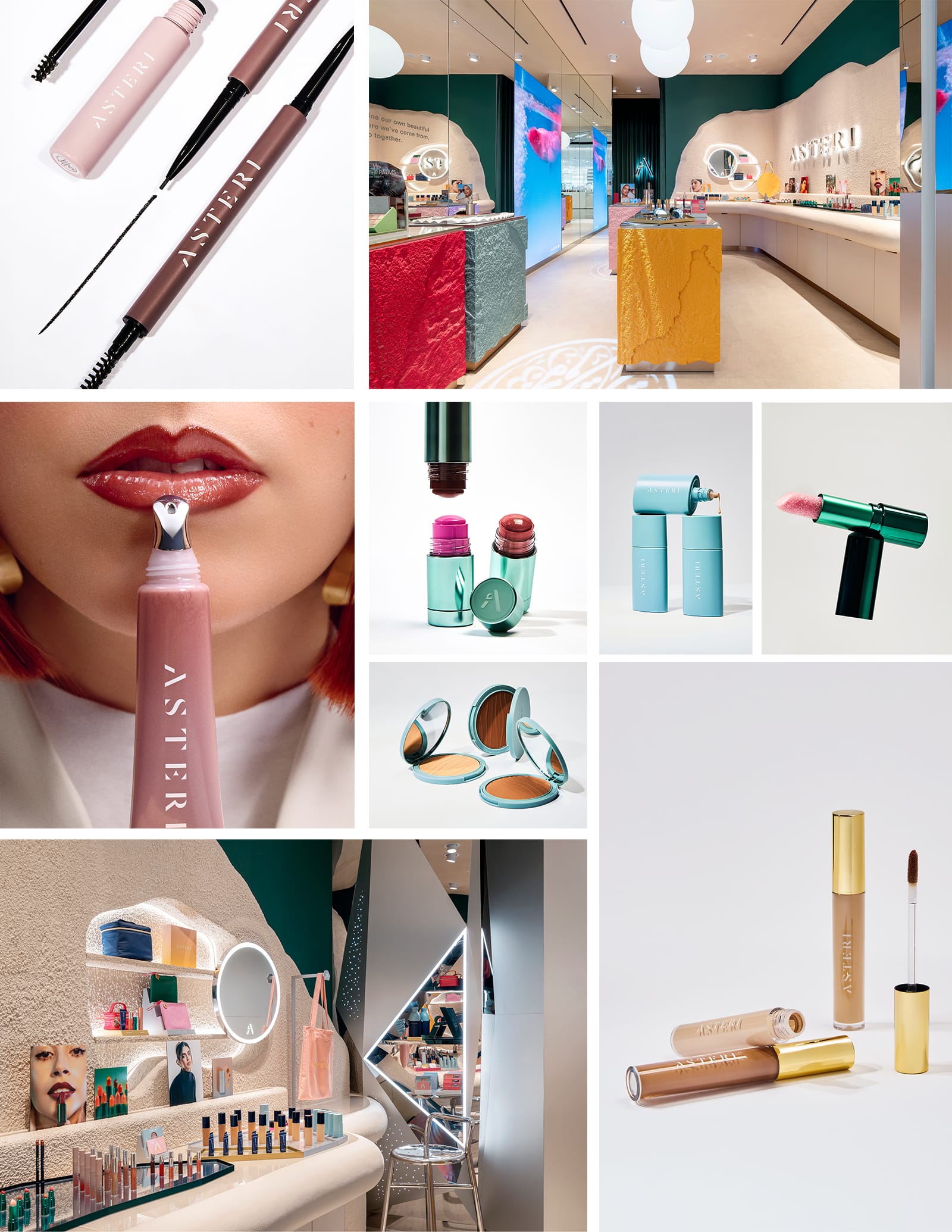
“I used to buy that lipstick when I was young,” recalls Sara Al Rashed, founder of Asteri. “My friends and I would call it the ‘magic lipstick’ – the bullet was green, but when you applied it, it mysteriously became pink.” When she launched her own brand years later, she went straight back to that memory. Asteri’s Legacy lipsticks sit in sleek metallic green cases – a grown-up echo of that childhood thrill – and each shade is named after an Arab woman: Monira, Sara, Hala, Ghada, Layla, Salma, Abeer and more. The magic now isn’t that the colour changes; it’s that the story begins at an Arab girl’s dressing table and moves outward.
On paper, Asteri is a sharp play in a huge market. By the end of this year, global make-up is forecast to reach 50 billion USD; fragrance, 65 billion USD; skincare, more than 150 billion USD. Women in the Arab world – particularly in the Gulf – are among the highest per-capita beauty spenders anywhere. Against that backdrop, the rise of homegrown brands feels inevitable. Huda Beauty has already shown what one regional powerhouse can do. The obvious move would be to follow that script.
Al Rashed wasn’t interested. “My initial aim when founding Asteri in 2021 was to address the fact that most international cosmetic brands think Arab women fit into a single stereotypical mould – dark hair, thick eyebrows and the desire to cake on make-up,” she says. “This idea that if you powder your face enough it’ll last longer in hot weather is wrong.”
It’s personal as much as strategic. “I grew up with a lot of acne problems and whenever I’d apply make-up it would get worse,” she recalls. “That’s why I created Asteri to be on the borderline between cosmetics and skincare – meaning it’s in no way bad for your skin and even contains ingredients that are beneficial.” The goal is make-up you can put on in the morning that feels “breathable and light” yet survives a Riyadh afternoon – a promise that will resonate with anyone who has watched their foundation vanish in the baking heat.
It sounds like something a seasoned beauty executive might claim, except Al Rashed isn’t one. She’s a trained architect, more familiar with blueprints than blush. You feel that background throughout Asteri, from the precise, considered packaging to the way she talks about “experience” rather than “counter space”. Even the name – from the Greek for “star” – suggests a cross-border gaze: a Saudi-born brand that assumes its customer travels.
Her premise is deceptively simple: modern Arab women are working, travelling, raising children, darting between scorching streets and sub-zero office air-con. They don’t all want, or have time for, a full-beat glam up every morning. “We wanted products that are fit for a modern woman who wants to apply make-up quickly and easily and look good on the go, even in hot weather, while still looking natural,” she says.
“Natural”, here, is not just a moodboard; it’s a laboratory constraint. Asteri doesn’t merely flirt with clean beauty – it follows its strictest interpretation. Every product is vegan, with no animal-derived ingredients, no known sensitisers, no added perfume, no carcinogens, no microplastics, no hormone disruptors. Packaging is recyclable and, as Al Rashed puts it, “as sustainable as possible” – refreshingly plain language in a sector where “eco” is often more aesthetic than action.
All of which sounds very now, until you try to make a great red lipstick under those rules. “There’s a reason why your MACs, Diors and Chanels stayed on the beaten path,” she says, with the dry humour of someone who has read too many lab reports. “Achieving a vibrant red or brown is almost impossible without cochineal” – pigment from crushed insects. “Animal-derived products have become the norm in the industry – beeswax, squalane, exosomes and so on – therefore it takes a lot of time and effort to come up with a plant-based replacement.”
In other words, where the industry has decades of shortcuts built on animal by-products, Asteri has thrown them out and still demands long-wear performance. “When you apply Asteri, it almost feels like you’re not wearing anything at all, yet it lasts throughout the day, without the need to apply multiple layers,” she says – a quiet rebuttal of the idea that Arab beauty must mean maximalism at all costs.
The key for Asteri is the way our stores are designed, the level of service, the experience with our salespeople. You get a lot of free services, something that’s normally reserved for places where you’re spending thousands.
There is, however, a paradox. For a brand that talks proudly about “A-Beauty” – Arab beauty as a coherent category, the way we now discuss K-Beauty – not a single product is manufactured in the Middle East. “I wish we could produce in Saudi Arabia but there isn’t the scale to do it here yet, so our make-up is fabricated between Italy, Germany, Korea and Japan, and our skincare is made in Switzerland. We produce in specialised centres,” Al Rashed says matter-of-factly, “and then ship to our logistics centre in the Kingdom.”
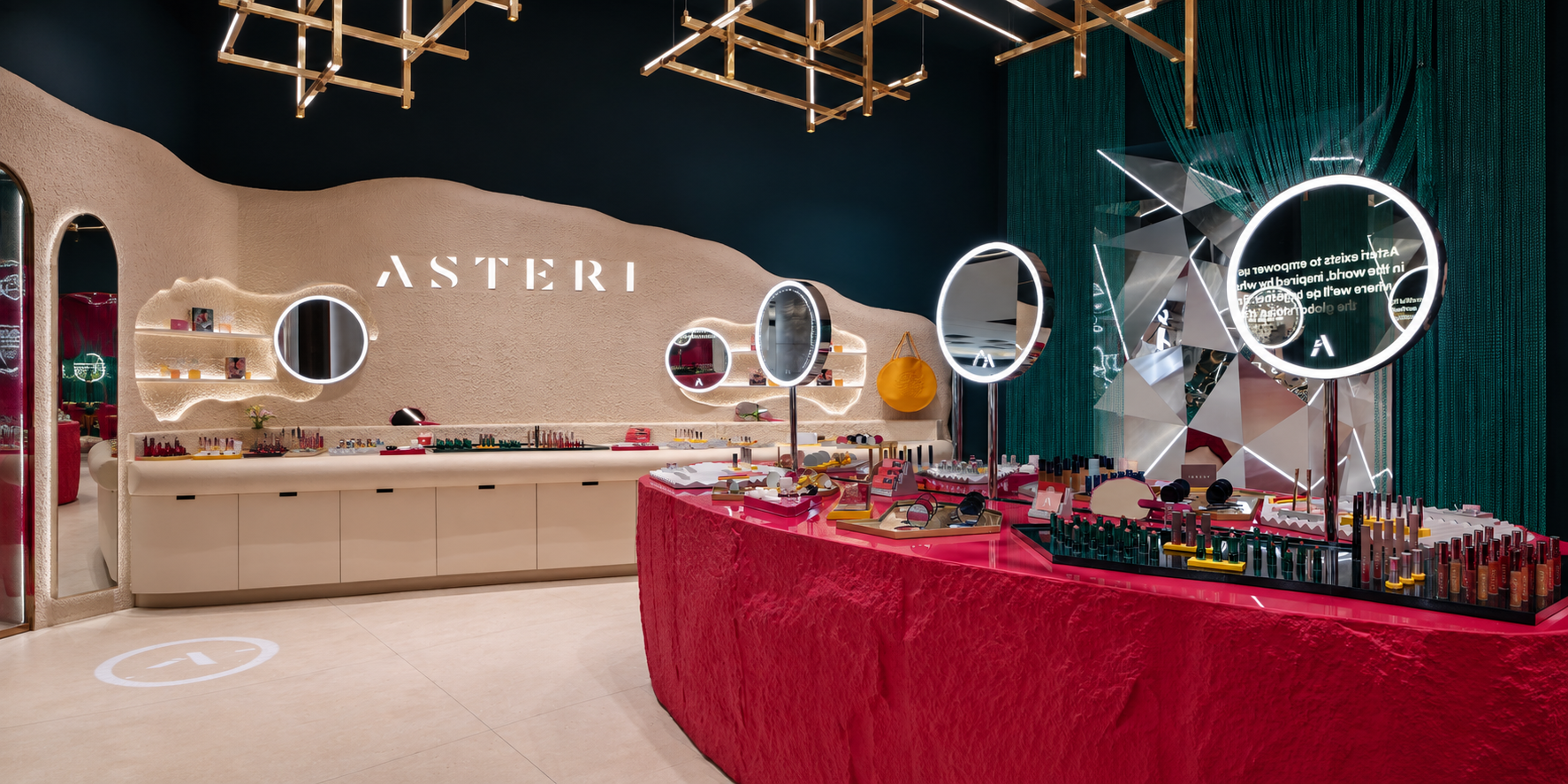
The Arab-ness lies elsewhere. Asteri is Saudi-founded and Saudi-owned, headquartered in Riyadh with almost 40 staff in the main office and another 60 across its stores. And, even if the products are made abroad, the way you encounter them is distinctly regional – and quietly subversive. Asteri began as a direct-to-consumer brand before quickly moving into bricks and mortar. It now has 13 standalone stores across the region and, as a kind of coming-of-age, its first travel-retail spaces in two terminals at Riyadh’s King Khalid International Airport – beauty’s equivalent of making it into the Champions League.
“We like to call ourselves inexpensive luxury,” Al Rashed says. “The average price is 30 USD, so we are certainly affordable – not in the way of L’Oréal or Rimmel – but we are in and amongst Huda Beauty, Benefit, Tarte, and actually more affordable than them too.” The real flex is the way you’re treated. Walk into an Asteri shop and you’re offered coffee, water, time. “The key for Asteri is the way our stores are designed, the level of service, the experience while trying or discussing our products with our salespeople. You get a lot of free services, something that’s normally reserved for Hermès boutiques or places like that where you’re spending thousands.”
And, where most beauty counters will cautiously do half your face, Asteri will do the whole thing – free. “We offer a full free make-up service in our store so you can try all the products, think about them and hopefully come back and purchase them later.” It’s indulgent from a margin perspective but entirely logical in a culture where being exceptionally warm and generous is so deeply rooted.
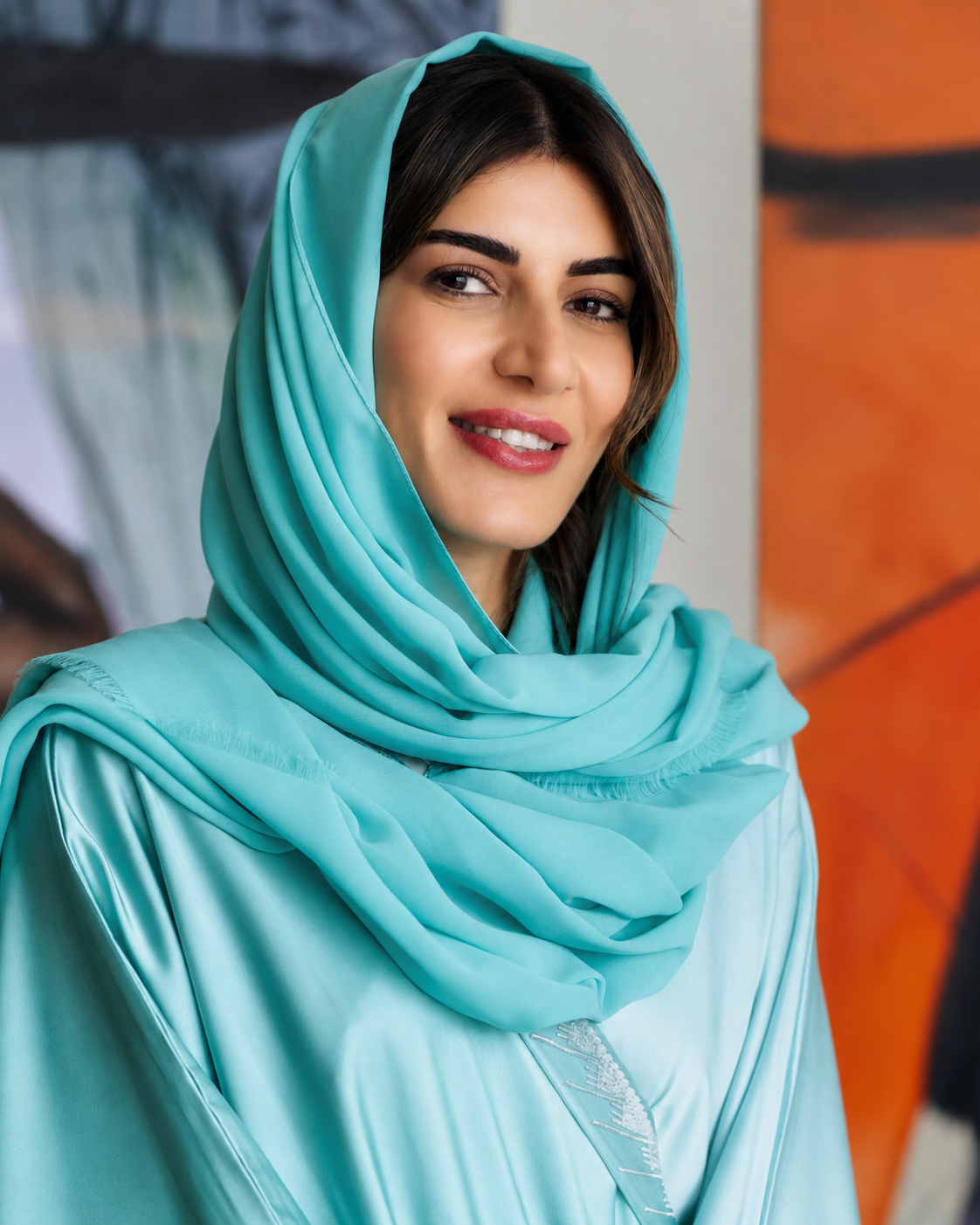
Behind the soft lights and green bullets, the operation runs more like a consultancy than a passion project. “We start by looking at trends – what’s working, what’s lacking in the market. We do research, forecast reports, then we sit together and brainstorm; we develop an innovation funnel,” Al Rashed explains. Each product begins with a tight brief – what it must do, which ingredients are banned, its price range, its packaging – which then goes out to suppliers. A single partner is chosen; samples arrive; testing and tweaking begin. “The process from idea to product launch typically takes around two years. We aim for 18 months but some products, like our Desert Mist setting spray, took two and a half years to develop.”
The journey hasn’t been frictionless. “We faced so many hurdles along the way,” she says. “For starters, most European manufacturers didn’t even respond to us when we started out. They had this elitist attitude towards us, like, who are you?” Persistence – and access to one of beauty’s most lucrative regions – eventually changed that. The sharper snubs came closer to home. “When we tried to penetrate multi-brand stores and high-end malls within the region, we faced identity rejection because we were Arab. They would give priority to foreign brands and put us somewhere in the back.”
The irony is stark: Western houses happily mine Arab aesthetics – kohl, oud, “desert” campaigns – while a Saudi-owned label is politely nudged to the rear. “And of course, I have had to circumnavigate many barriers along the way because I am a woman leading my own company,” she adds. “Everyone knows retail is a very male-dominated sector but alhamdulillah, we have managed to overcome a lot to get to where we are now and we will continue to do so.” There are no “girlboss” slogans stuck to the mirrors; the politics is in her presence.
Ask which global brand she admires and her answer is immediate: Hourglass, the American label that went fully vegan in 2020. Like Asteri, it’s known for high-performance makeup-skincare hybrids. Unlike Asteri, its products weren’t built for women commuting between desert heat and deep-freeze air-con. Still, that’s the benchmark she has in mind.
Next comes fragrance and a new climate test. “We are about to launch in the UK,” she reveals. “This represents a big investment for Asteri and it’s personal for me, not just because London is like a second home, but because breaking into the UK means you’re visible to a global audience. And it also gives us a validation.” That validation won’t be a single glossy launch party; it will be hundreds of small moments, like when a well-informed Chelsea girl picks up a green lipstick called Layla, scans the INCI list and thinks: this feels… different.
For Al Rashed, though, the ambition extends beyond a few counters in Zone 1. “My dream is that ten years from now there’s a global appreciation for what we like to call A-Beauty, or Arab beauty, in the same way people recognise Korean cosmetics and their K-Beauty.” On the surface, it’s another term waiting for a trend deck. Look closer and it’s a question of who gets to define beauty culture and who merely consumes it.
You don’t have to care about serums to see what’s at stake. For decades, Arab women have been the clients – the “strong Middle East performance” tucked into a European luxury group’s earnings call. Asteri is part of a new wave recasting them as authors. Somewhere in that neat row of green bullets is a straight line from a girl entranced by a colour-changing lipstick to a founder insisting that Arab beauty isn’t a niche to be mined, but a star – an Asteri – tracing its own trajectory.