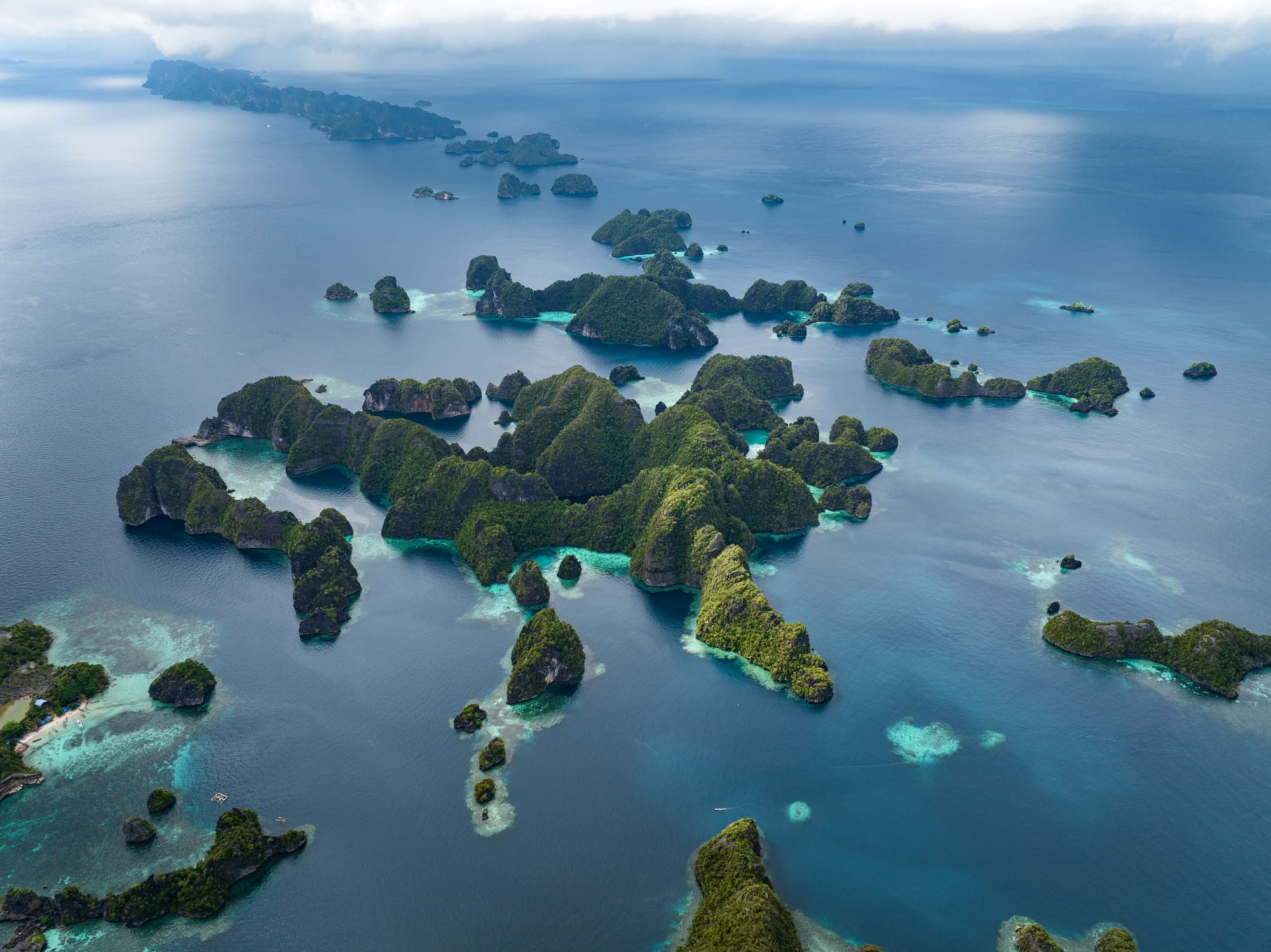
Silence is an endangered luxury. We kid ourselves with noise-cancelling headphones and wellness apps, but genuine, all-encompassing quiet – the sort that presses softly against your eardrums – is rare. It’s precisely that kind of silence that arrives as the Lamima’s tender engine dies and we drift into a hidden lagoon, ringed by limestone karsts that plunge into topaz water. No traffic, no playlists, just a few sacred kingfishers and your own heartbeat.
We’re in Raja Ampat, one of Indonesia’s most fragile maritime reserves and, increasingly, its most coveted. At the far eastern tip of an archipelago of some 17,000 islands that stretches 5,000 kilometres across the equator, it is a refuge from Asia’s urban cacophony. Despite its remoteness, Raja Ampat has quietly become catnip for eco‑tourists and high‑net‑worth escapists who like their adventures with a side of champagne and carbon offsetting.
To get here, you fly to Sorong, a sleepy port in Southwest Papua that feels like the end of the line. From the airport, the newly anointed cast of this particular expedition emerges: well-travelled couples in fresh Gore‑Tex, Rimowa cases gliding over cracked concrete, all bound for an armada of liveaboards and private charters that fan out across the region between October and April.
Raja Ampat – “The Four Kings” – is a 4.6‑million‑hectare UNESCO Biosphere Reserve and the beating heart of the Coral Triangle. More than 1,500 islands; the highest recorded marine biodiversity on Earth; 75 per cent of the world’s coral species; manta rays, whale sharks, turtles, and villages where oral tradition still trumps Instagram. If David Attenborough designed a destination and then outsourced the hospitality to a superyacht broker, this would be it.
And there is, frankly, only one way to do it properly.
A Superyacht in Sailors’ Clothing
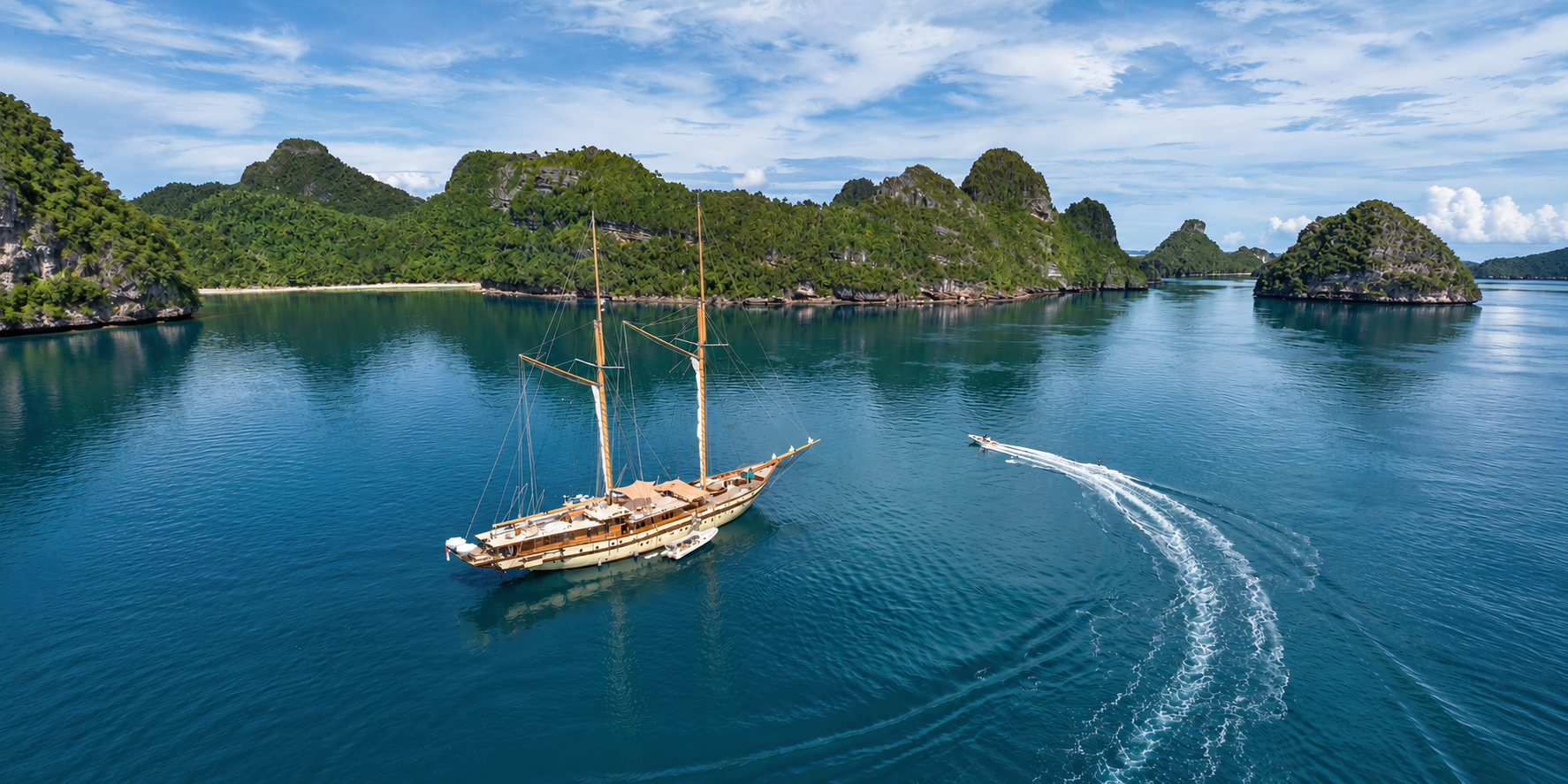
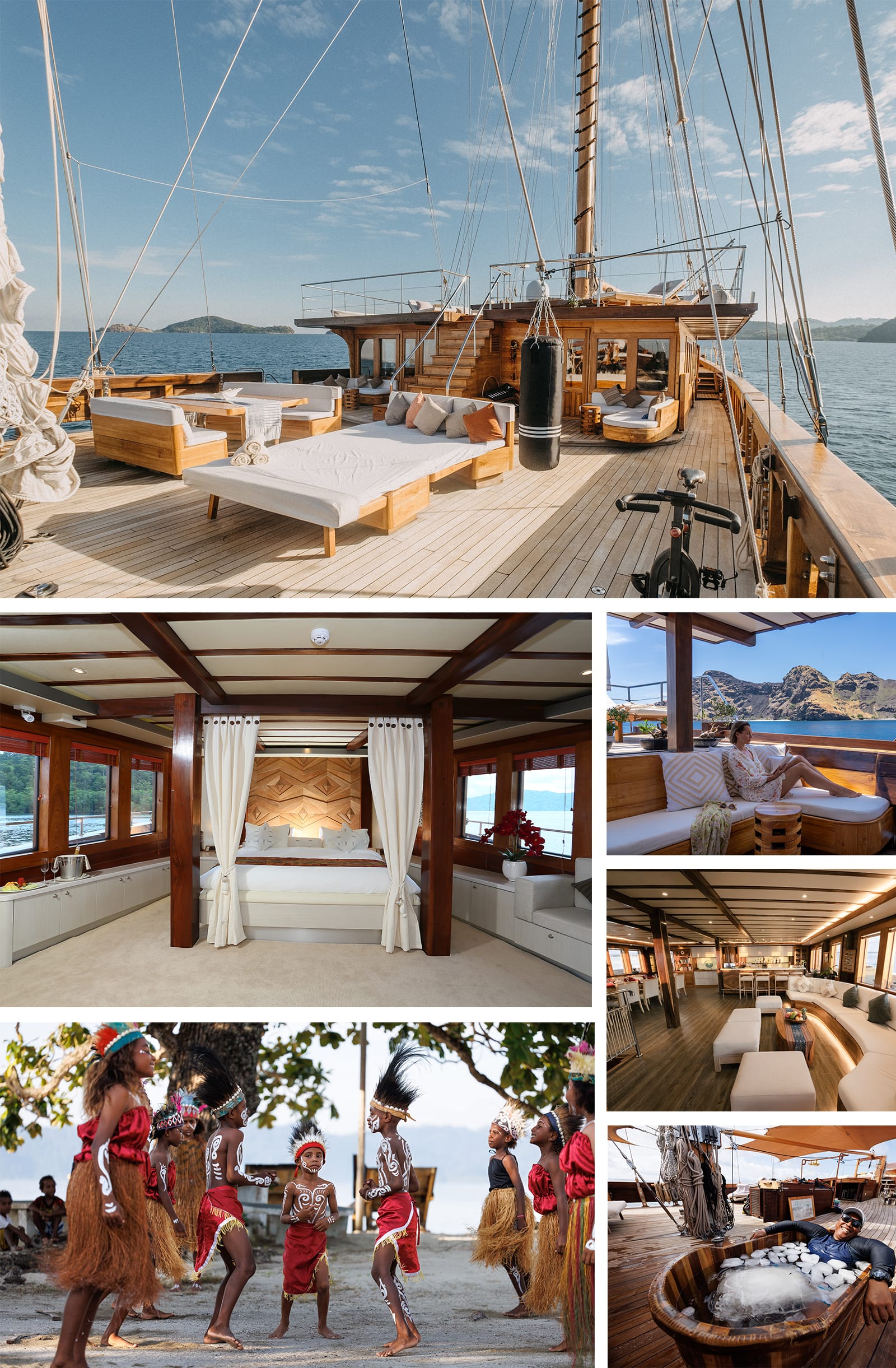
There are island homestays and perfectly decent dive lodges, of course. But if your idea of roughing it is a slightly under‑chilled martini, you board Lamima. At 65.2 metres, she’s the world’s largest wooden sailing yacht: a phinisi on growth hormones, built in ironwood in South Sulawesi in the spirit of Indonesia’s historic spice traders, then quietly stuffed with every modern comfort a discerning fugitive from reality could reasonably demand.
Launched in 2014, Lamima has become shorthand among expedition agents and yacht brokers for 'Indonesia done properly.' She sleeps just 14 in teak‑lined suites, including a main‑deck master cabin with the sort of picture window that makes you question every life choice involving real estate. There’s Starlink for those who insist on bringing the 21st century with them, a massage cabana tucked discreetly at the stern, and so many toys below decks – jet skis, kayaks, paddleboards, full dive set‑up – that the temptation is to spend the week playing, rather than simply gazing.
A crew of 20 choreographs the theatre: therapists, dive guides, bartenders, deckhands who materialise with dry towels before you’ve even thought to be cold. Among Indonesia’s phinisi fleet, Lamima isn’t just another yacht; she’s the grande dame.
Misool Mornings
After a night’s crossing we arrive in Misool, in southern Raja Ampat, long before the sun deigns to appear. On deck, over inky seas and strong Sumatran coffee, the horizon slowly reveals a scatter of islands that look as though a distracted god dropped a handful of emeralds into navy silk.
With us is Jen Martin, head of expeditions at EYOS, the outfit behind Lamima’s charters and the people you call when your bucket list involves heliskiing in Greenland or sending a submersible into the Mariana Trench. “Isn’t this just amazing?” she murmurs, in the understated way of someone who is paid to be professionally unflappable and is nonetheless clearly smitten.
Within the hour we’re in the tender, nosing into a lagoon so still it could be poured glass. Some guests step elegantly onto paddleboards. Others (myself included) slither less elegantly into kayaks and drift across coral gardens that rise towards the surface like outstretched hands. A near‑vertical ladder leads to a razor‑edge viewpoint above twin lagoons; the climb is punishing, the view absurd, the descent greatly improved by the knowledge that the yacht below is serving breakfast.
Back on Lamima, we refuel on mangosteen, rambutan and wickedly addictive salak; Papuan coffee from the Jayawijaya Highlands; and bubur ayam, Indonesia’s answer to chicken soup for the soul. It’s a reminder that while you may be gloriously off‑grid, you are emphatically not camping.
Adventures, Curated
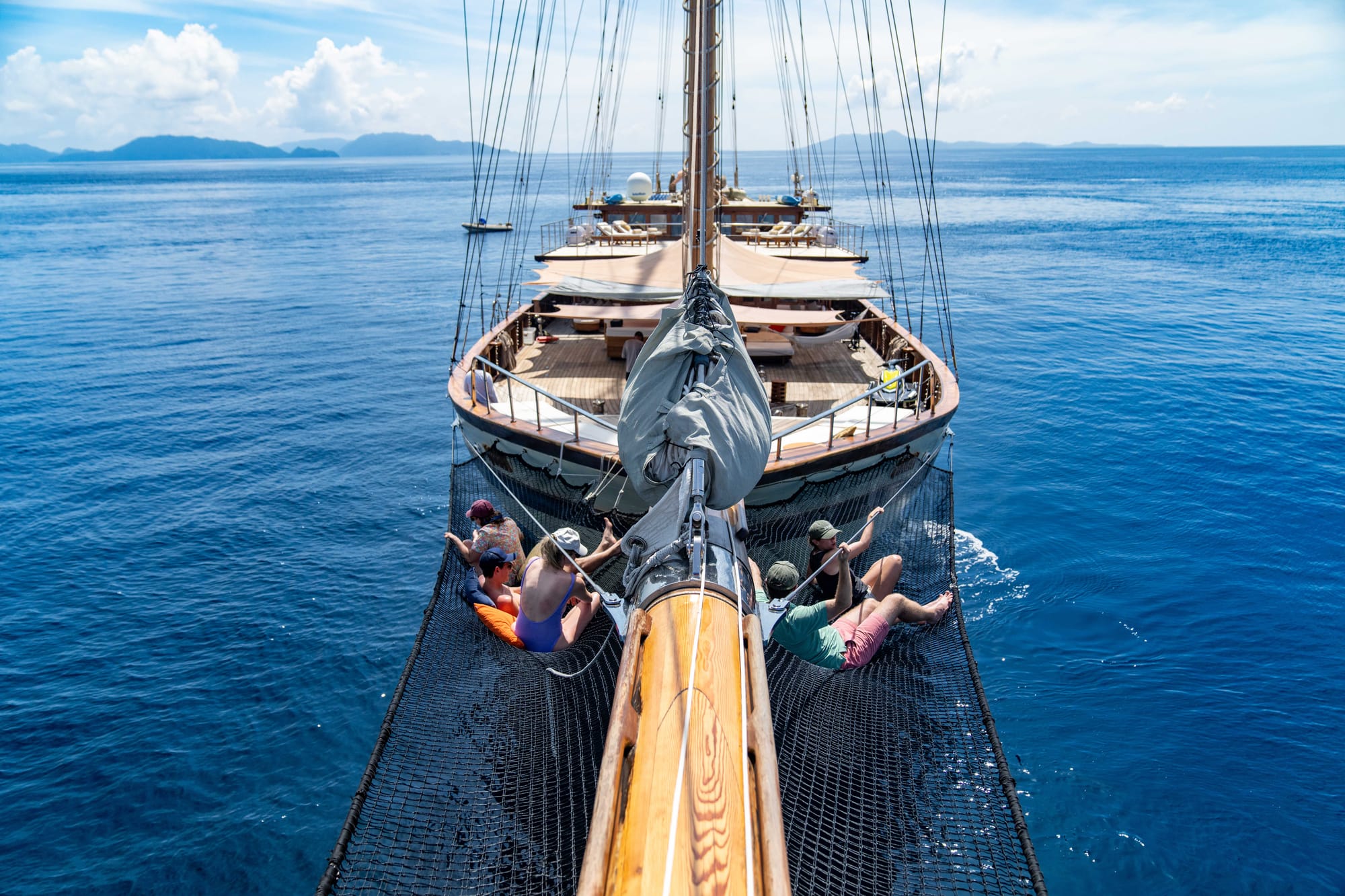
Raja Ampat itineraries dance to the rhythm of weather and currents, but a week aboard Lamima in Misool and central Raja Ampat feels less like a rigid schedule and more like a series of beautifully staged vignettes.
There are jet‑ski runs through deserted coves and hikes through Warkesi Forest in search of the red bird of paradise. On Karawapop we tackle 600 steps to a lookout over its heart‑shaped Love Lagoon; at Lenmakana Lake we slip into brackish water to snorkel with thousands of stingless golden jellyfish that move like slow champagne bubbles.
At Tomolol, a cathedral‑like sea cave, we form a silent kayak convoy behind Lamima’s builder and manager, Dominique Gerardin, and slide into the darkness. Headlamps pick out stalactites hanging like arthritic fingers and the occasional dozing horseshoe bat. When we kill the lights, the sensation is of floating in space, your paddle the only proof that gravity still applies.
Another dawn finds us heading for a fishing bagan, a floating platform where a pod of Indo‑Pacific dolphins – 50 strong and insufferably pleased with themselves – performs high‑speed aerobatics around us, feasting on bait fish tossed into the water by grinning fishermen. You could pay for a marine park in Florida and still not get this show.
Below the Surface, Above Expectations
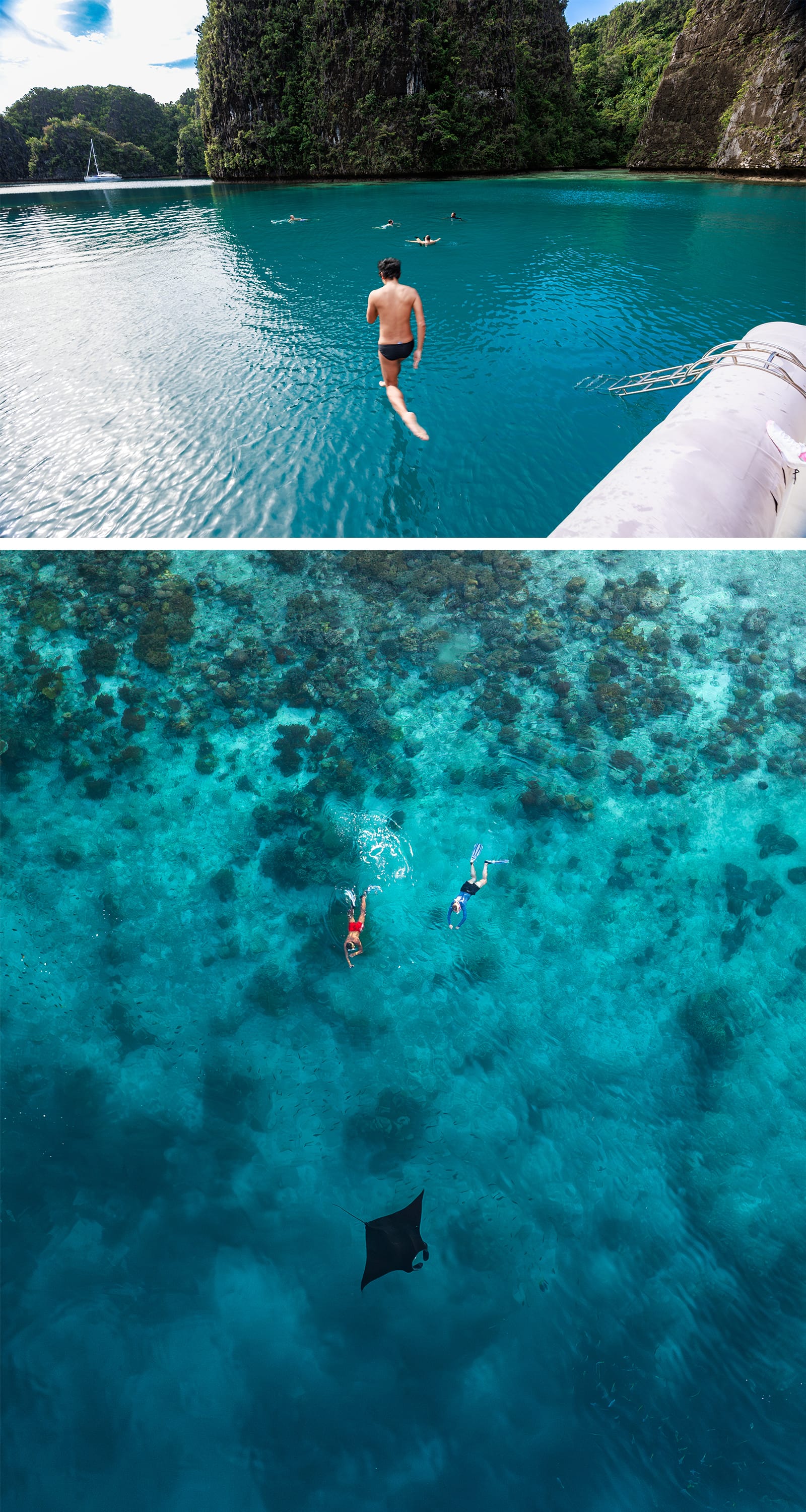
Raja Ampat’s true calling card is under water. Dubbed the “Amazon of the Seas”, it offers divers a daily onslaught of the ridiculous. With guides Ali and Martinez leading us into the blue, we sweep through Boo Windows, whose twin swim‑throughs frame Napoleon wrasse and white‑tip sharks like a living gallery; Four Kings, a set of submerged pinnacles draped in soft coral; and Manta Point, where, if the currents and your luck align, more than 20 giant mantas queue up for cleaning like regulars at a Mayfair barber.
Surface intervals are hardly a hardship. There are Balinese massages on the upper deck, sun loungers, and – for the masochistically inclined – a teak ice bath that delivers a surprising reset after jungle hikes and heroic numbers of Negronis.
People, Not Just Postcards
For all the natural theatrics, it’s the human encounters that anchor the trip. One evening the crew – from Java, Bali, Papua, Sulawesi, Sumatra – don traditional dress and perform dances beneath the stars, turning Lamima’s upper deck into a crash course in Indonesia’s cultural sprawl.
The next day, on the island of Kri, we meet the young researchers of the StAR Project, who are quietly rewilding endangered zebra sharks. In Jacuzzi‑sized tanks, foot‑long pups streak in circles, their spotted bodies catching the light like fine silk.
Later, in the village of Aborek, home to around 300 people, schoolchildren perform a dance dedicated to the white‑bellied sea eagles that patrol Waigeo’s mountains. Dominique, who first arrived here 13 years ago by dugout canoe, is welcomed back like family. As the drums fade and the children dissolve into giggles, the village chief announces, almost off‑hand, that the mantas have arrived.
Moments later, we’re in the water off the village’s white‑sand beach, finning alongside three vast rays – locals, not exhibits – their wings brushing the surface as the sun sinks behind them.
That evening, as the anchor chain rattles up from the depths and the sky bruises from violet to black, martinis appear as if on cue. We toast the mantas, the jellyfish, the children, and the improbable privilege of a week in a place that still feels, in the best possible way, pre‑internet.
True silence, it turns out, doesn’t feel like absence. Out here, on a wooden yacht beneath a southern sky, it feels like the one luxury we’ve almost forgotten how to want.