Geoffrey Wheel is as pleased as punch. Cracking jokes and making puns as he leads us around the stairways, back passages and public areas of Muscat’s glittering Royal Opera House, the technical director exhibits the pride of a parent as he talks about the project he’s worked on since its inception. “I’ve travelled and worked all over the world,” he says, adding that he left a career at that other Royal Opera House, the one in Covent Garden, to move to Muscat, “and I’ve never seen this kind of opulence before.”
Well, not this side of the demise of European monarchy anyway. Opera began life in the courts and for most of its history, was a royal affair. The ROHM continues in the same tradition, an opera house that is stately and literally, fit for a king.
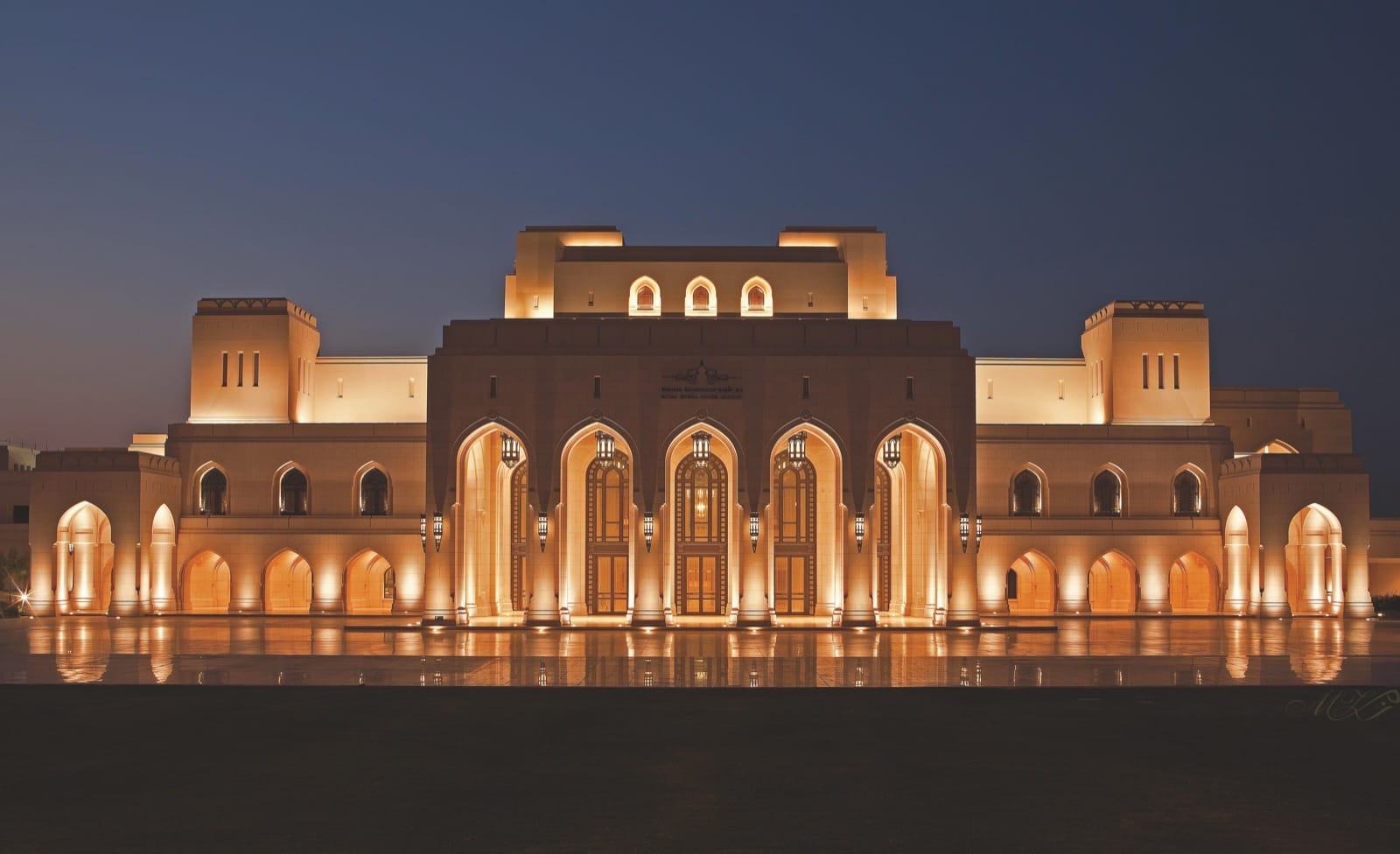
When seen from the outside, the ROHM looks like it could be a palace, set in 80,000 square metres of manicured gardens in the Shatti Al Qurm district. Designing in a style that for want of another tag, could be called Omani Modern – just enough tradition to look authentic, just enough modernity to be international - WATG, the Honolulu-based architectural super-group best known for high-end hotels and luxury resorts, has coloured the interiors in a concerto of cappuccinos, rich browns and creams, set off with splashes of gold (door handles), sparkling crystal (chandeliers) and rich reds (carpeting). The majestic palm tree-lined piazza with its colonnade and arched entryways is finished in glittering limestone stucco. Inside and out both wood and stone are beautifully carved, the latter inlaid with subtle patterns in coloured stone, the former sometimes gilded.
The performance schedule is no less impressive. The inaugural event on October 14th was a lavish production of Puccini’s Turandot conducted by legendary tenor Plácido Domingo and equally legendary director Franco Zeffirelli. This stellar start was followed by a solo night with Domingo, intended as a tribute to the Sultanate. Internationally acclaimed soprano Renée Fleming with the Royal Philharmonic Orchestra, the American Ballet Theatre’s regional debut of Don Quixote, Andrea Boccelli, Yo-Yo Ma, the London Philharmonic, Scala Ballet, Riham Abdul Hakim’s tribute to Oum Qulthoum, Lebanon’s Magida Al Roumi and St. Petersburg’s Mariinsky Ballet Company with Swan Lake. If the list already reads like a classical music lover’s dream, the artistic directors promise there is much more to come. If the rapid ticket sales is any indication, early booking will be essential.
The ROHM isn’t just designed to be pretty. Or to be a white elephant. Royal patronage or not, it intends to be a working house and as the audience for opera is somewhat limited in the region, British consultants, Theatre Projects have created a space capable of handling almost any kind of performance; ballet, theatre, symphonies and recitals, live music, dance, musicals, lectures and when the massive hidden screen is lowered, 3D film screenings.
Effectively, the ROHM is many buildings or spaces, in one. Intelligent and multi-purpose, it can be radically reconfigured with the flip of a few switches. The stage can be extended over the sunken orchestra pit for theatre or dance performances or simply to expand seating capacity. The first column of boxes is retractable and the wood proscenium can be raised into the roof, enlarging the stage to a width of 22 metres. There’s even a stage behind the stage that houses an enormous German pipe organ, designed by Philip Klais from Bonn. Set on rails, all 500 tonnes of it can be rolled forward, replacing the stage with an adjustable acoustic shell specifically designed for musical performances. “You don’t see the mechanisms,” says Wheel, pointing out carefully concealed rigging points, speakers, projection units and trapdoors as we walk around, “but they’re all there.”
It isn’t until we enter the auditorium, though, that the house reveals its full glory. From the floor, rows of plush red armchairs, interactive display screens built into their backs, rise in classic horseshoe configuration in three vertiginous tiers with boxes at the front on either side of the stage. The Royal Box is directly opposite the stage on the second floor. Though it can seat just over 1,000, the auditorium is intimate. Even from the very back row, the stage is close enough to enjoy without opera glasses and when it is extended, front row spectators will be so close to the action that as Wheel puts it, “they’ll almost be able to shake hands with the performers on stage.”