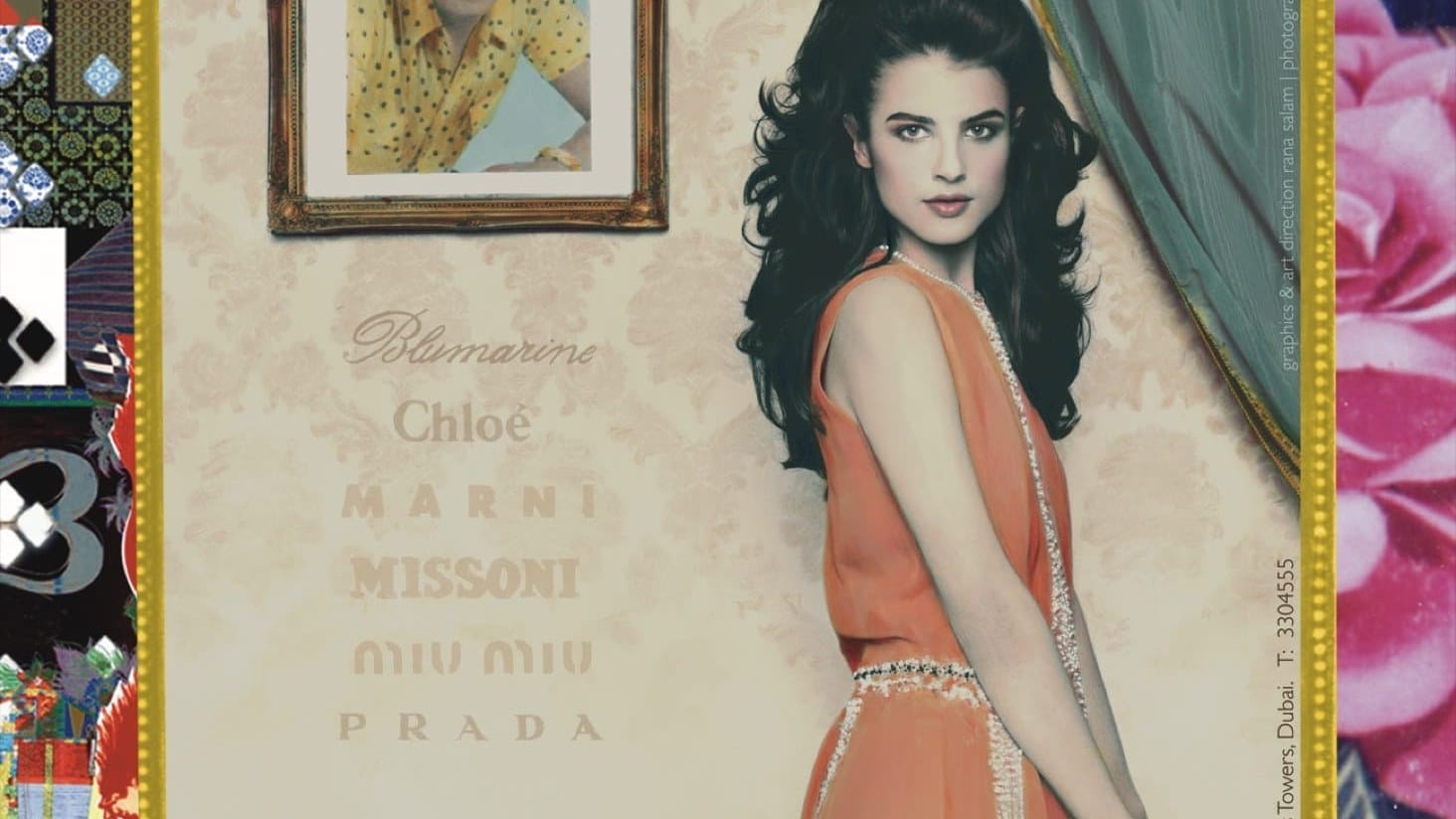
Rana Salam is one of the top graphic designers to emerge from the Middle East. Her work celebrates Middle Eastern popular art and culture by merging vibrant Arab imagery with the latest technology to create a unique vision of graphic design and art direction.
Her business card, a foldout, ten-inch (CONVERT) long turquoise and pink miniature work of art, reads “Welcome to the world of Rana Salam.” If the card, featuring pictures of pop art brooches of the Egyptian singer Um Kulthoum and chunky, floral-printed plastic bracelets against a background sprinkled with stars and butterflies weren’t enticing enough, the woman herself is surely the ultimate advertisement for her world. On a recent balmy Beirut afternoon, she swooshed into an elegant café in Saifi Village, clad in a chic Martin Margiela coat, trailed by her husband Keith, an expert on African cinema and consultant to Europe’s top film festivals, and her breathtakingly adorable son and daughter, Ilo and Ona, and proceeded to feast on croque monsieur, salad and tarte tatin, all the while making this journalist roar with laughter. Who wouldn’t want to live in the world of Rana Salam?
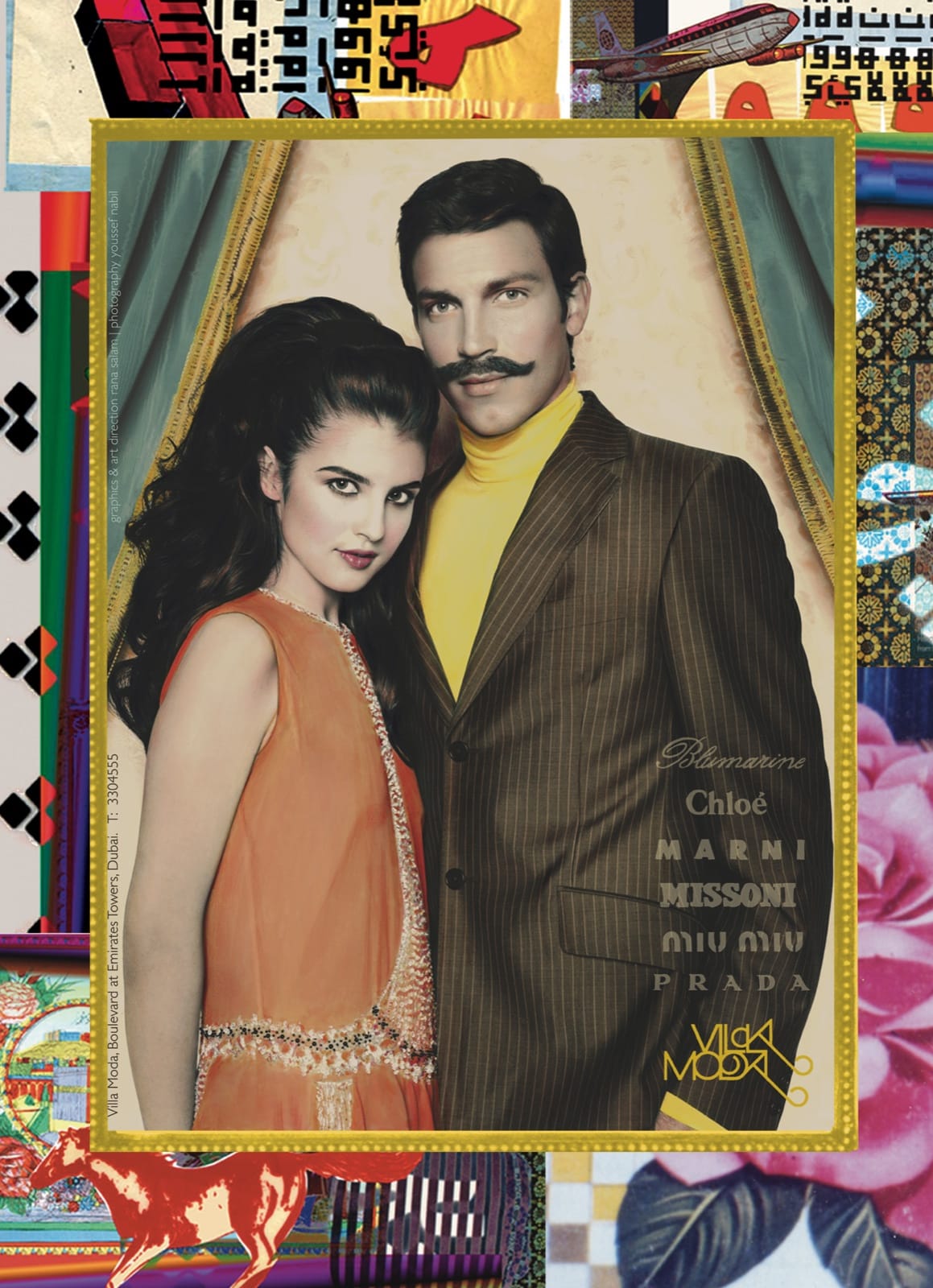
Salam, 40, is one of the top graphic designers to emerge from the Middle East. Her work combines imagery and graphics plucked from sources across the Arab world, both self-evident (movie posters) and unlikely (candy wrappers) and recurrent motifs like butterflies and floral prints. Her clients range from the Victoria & Albert Museum in London to trendy restaurateurs in Kuwait, with significant experience in the retail sector, including brands like Villa Moda, Paul Smith and Harvey Nichols.
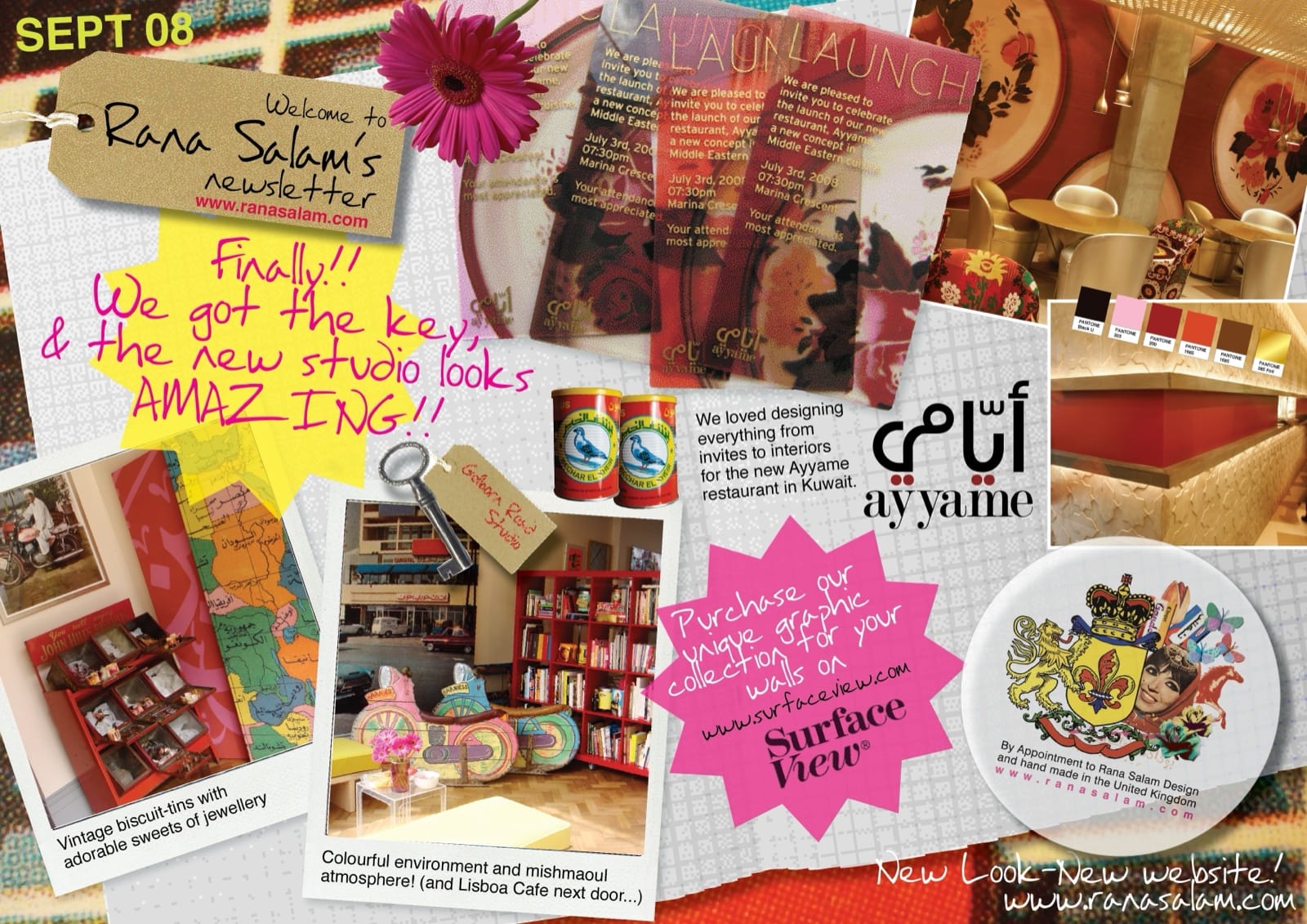
Now based in London, she runs a convivial storefront studio on Golborne Road, a street just off Portobello Road that is home to Portuguese cafes known city-wide for their custard tarts, antiques dealers, a Moroccan fish grill, and the Maramia Cafe, a favourite haunt of London’s Arab expatriates. Until last year, she and two assistants worked out of her three-bedroom house in Acton, handling big-name clients such as Liberty, the London department store, in a home office she describes as “tiny. TINY!”
“Tiny” is not a word that merits any lasting association with her; she is a tall, voluptuous woman, with grand ideas, a big mouth, and a huge heart. Born to an architect father (the modernist Assam Salam) and a professor mother, she was always encouraged to explore her creative side. As a child, her father outfitted her bedroom with a huge bulletin board, to which she affixed the visual references that subconsciously formed the core of her aesthetic: Hubba Bubba gum wrappers, Fiorucci graphics, and other bits and bobs of 1960s kitsch and Americana. She never enjoyed school much, preferring to stand out in other ways: being the first girl in Beirut to ride around on a moped, in 1984, for example, or painting “Grease” logos onto t-shirts and selling them to her friends.
“Back then, emulating American culture was the cool thing,” she said. After high school, she went to Central St. Martin’s in London to study design, because at the time there was no graphic design education in Lebanon. She continued her studies at the Royal College of Art, where her friends included the soon-to-be-renowned Ghanaian architect David Adjaye. But at the time, everyone was merely making their art.
“The people at art school had fathers who were butchers. They were just instinctively artists,” she says. “The anonymity of London was a big luxury,” she continues, reflecting on the intimacy of a city like Beirut, where she is engaged in endless greetings and salutations every time she ventures to a public space. “People forget how valuable that is.”
When her advisors at the Royal College of Art told her to do her master’s thesis “on something that you know,” their advice took her back to Lebanon. It was 1991, and the war had just ended. Her father, driving her around Beirut, gestured to the streets. “Embrace this,” he said. “Look at it.”
She took him literally, researching Beirut’s visual street culture during the war for a thesis entitled “Beirut: Design under Civil War.” In learning about how street culture made use of imagery and materials, the methods of adapting and recycling, she came to appreciate the efficiency of re-designing old images and posters, of re-valuing the old.
“They do this for survival, rather than art for art’s sake.” She also got to know street artists such as Hawarian, who lived in the Armenian neighborhood of Bourj Hammoud.
After collaborating with Adjaye on the Soho noodle shop Soba, her first big commission was at Harvey Nichols, the iconic Knightsbridge department store. How did she get that? “I knocked on the door!”
She so impressed them with her portfolio and ideas that they gave her a window; she called Hawarian and had him do a massive mural, exposing his art to thousands of posh Knightsbridge shoppers. She calls it her proudest moment.
“It was exporting Middle Eastern culture to London.” And in that way, she says, design “can be much more powerful than art. It’s better than any exhibit – design is seen by millions.”
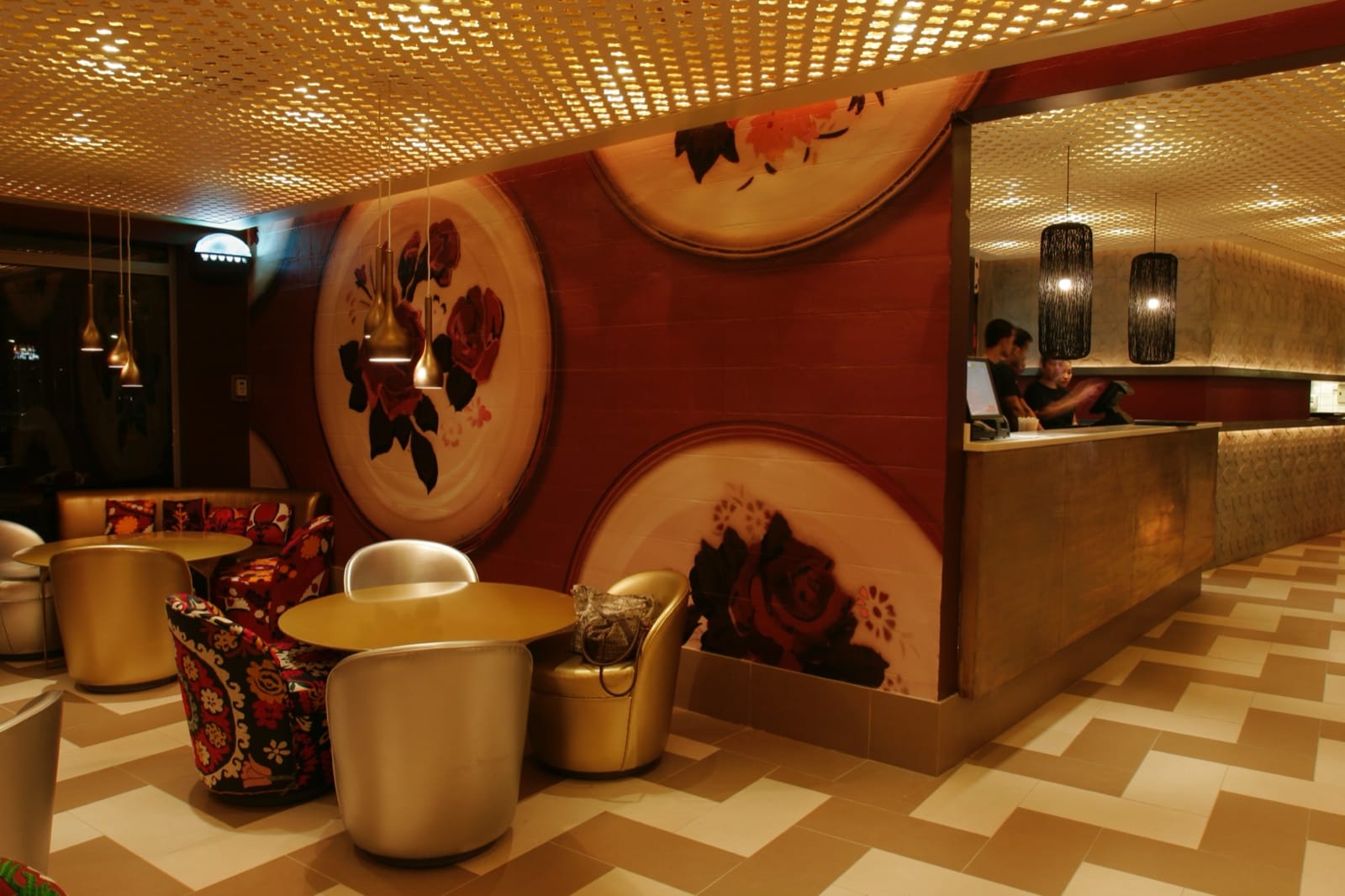
From there, her career exploded, and her signature aesthetic, which has evolved over the years, broadened to include new modes of application. For one of her recent projects, Ayyame restaurant in Kuwait City, she was initially asked to do the menu. After meeting with the owners, a sophisticated mother-and-daughter team, it was decided she would do the whole restaurant, down to the uniforms and the matchboxes. She was influenced by the Kuwaiti souks, and her perception of the Gulf as a trading crossroads, between China, the Middle East, India and Africa. “Applying my vision to three dimensions, having to handle the materials – this was extremely challenging.”
Salam has also launched a costume jewellery line, currently limited to brooches and bracelets, but has plans to take it further. When she says “world of Rana Salam,” she means it: she envisions adding bags and wall graphics, anything so “people can have a sliver of the vision,” she says.
Does she see any downside to her cheery, colourful, easily consumed representation of the Middle East? Is, perhaps, her vision something close to an over-simplification, a Warhol-esque reduction of a complex culture? She counters that in fact it’s the opposite, that she’s made people appreciate what before was looked upon as junk, things like Chiclets boxes or Ras al-‘Abd chocolate wrappers, by glamorizing it and selling it for hefty prices. “I’m allowed to do it because I’m Arab,” she adds. “I’m proud to say I was a pioneer, one of the first to capture and to celebrate Arab popular culture. I made people value it.”
It’s not the only vision of the Middle East, she says, but “It’s my Middle East. And people come to it because it’s my Middle East, it’s my own little world.” Welcome to the world of Rana Salam.
Rana Salam Design,
50 Golborne Road,
London, England
Tel: +44 208 968 9743
www.ranasalam.com