I have a grating respect for Rabih Hage. He’s managed to successfully avoid my attempts to meet him. Which is pretty impressive as I am quite persistent. I even drop by his gallery unannounced but he’s not around. His PR has told me that Hage is too busy to do an interview in person. In fact he can’t even manage a phone call. But he will answer questions by email if I send some… through her. I implore her that surely a big interview piece with the top luxury magazine in the Middle East is worth a one-on-one chat but to no avail. I find out where he lives and start to stalk him… Ok not really.
So email interview it is then. Still, what I do manage is a trip to the impressive Rough Luxe in London’s King’s Cross. It is a boutique luxury hotel that Hage has recently conceived and designed, that has been hitting the headlines over here for it’s blend of past and present - it’s ‘rough’ and ‘luxe’. And when I get there, I don’t want to leave.
Rabih Hage, the Beirut-born, Paris-educated and London-based Lebanese architect-designer extraordinaire, has carved out some career for himself. After graduating from the Ecole des Beaux Arts in Paris in 1991 he was involved with landmark building projects in France including the TGV Train stations at Paris Montparnasse and Nantes. He then took a different track renovating castles and old buildings for private clients turning ruins into something interesting. In 2004 he won the British Interior Design Association’s (BIDA) Interior Designer of the year. Today he lives in London, runs a gallery and design studio on Sloane Avenue, and works on interior projects from the “inside out” bringing architecture on a human scale and adding furniture “that is art.”
The Rough Luxe is possibly his most interesting project to date. An unnamed client owned a property in what was once an extremely rough part of London, with junkies and nightwalkers hanging out next to the chip shops, on street corners and outside the train station. Today this central location is slowly being smartened up, with the dazzling Eurostar terminal at St Pancras, a splendid new concert hall at Kings Place, and new restaurants and galleries all near by. What better place to create a new hotel? Hage got the call.
The result is a small boutique guesthouse in a listed 1850s building consisting of nine-rooms – some with en suite bathrooms, some sharing – all luxurious, intimate and comfortable but with a difference. It’s as if parts of the place have been left unfinished, or at least it seems that way.
“I was always interested in designing a hotel because it is a place where you can have a new experience based on the location, and your mood, and the other guests,” Hage explains. “The idea of creating spaces that can accompany different moods and experiences has always been interesting to me.”
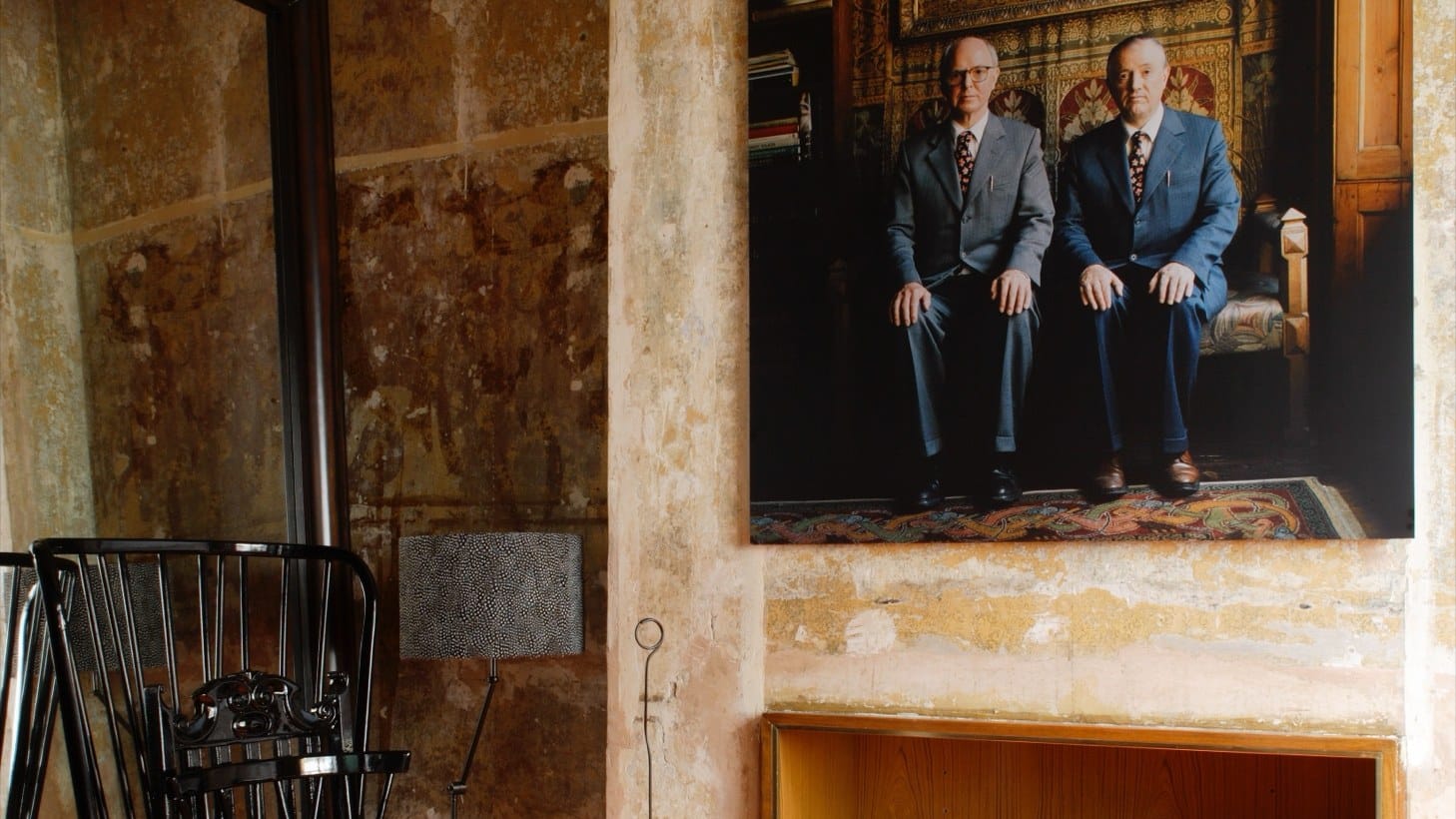
Hage sees the Rough Luxe then as a project of ‘urban archaeology’. And indeed it is – a blend of partially sanded surfaces, bare floorboards, chipped paint and rough edges mingled with gloriously opulent contemporary wallpaper and modern art plus high-end furnishings. There are walls where years of paint and paper have been left partially stripped, a mess of colours and textures revealing layer by layer the history of the Georgian building. These deconstructed walls then celebrate past occupants of the town house but contrast with the present day facing chic contemporary papers on opposite walls or giant murals and photographs of Italian palazzo interiors by photographer and artist Massimo Listri. The whole feeling is one of spaciousness and opulence in what is in fact a relatively small space.
“I was inspired to create the hotel like this by the location of the building in an area of London that is a little bit ‘rough’ but that’s now changing into an area that is more exclusive, and its history as a grade II listed building, protected for its historical value,” Hage says. “So it is a space to experience luxury in a rough area. It ended up as a project of contrasts and it provides a unique and comfortable experience.
“A luxury hotel doesn’t need to be covered in gold and white marble. It’s more about the exclusivity of the design and the emotion it evokes.”
He has a point. But what really makes the ‘luxe’ part is Hage’s eye for furniture, art and design. The beds, mattresses, linen, crockery and cutlery are of the finest quality – “I was an ‘extreme customer’ at a recent auction at the Savoy Hotel,” Hage says.
The dining room features a solid wood dining table made out of timber salvaged from Brighton pier, a ceiling trompe l’oeil photograph of the Cupola di San Lorenzo, and a plaster chandelier by French designer Patrice Gruffaz. Opposing this elegant past is work of art titled ‘This is Shit’ by Daniel Baker featuring the words ‘this is shit’ embossed in italics on a chipped silver background. The contrast between contemporary and past is memorable.
There’s what Rabih calls an “amusing stress buster” installed tucked away in a random alcove, an Anger Release Machine by the designers Yarisal and Kublitz. There’s a library of diverse books for guests to read and share. In the summer there’s even a small outside café space to get away from the hustle and bustle of King’s Cross.
In one bedroom there’s a crocodile print on the bed’s headboard, in another there’s a recycled stand alone copper bath tub and a ceiling light also from the Savoy auction that was once an emergency corridor light.
“If something is old but works why replace it,” is Hage’s philosophy.
The beauty of the place lies in this element of discovery and the fact that is not like every other five star central London hotel. The more I see of the Rough Luxe my admiration for Hage grows. It is rich without ostentation and that’s nice in this credit crunch era where high-end luxury seems more than a little exuberant. A nice touch is the lack of flat screen televisions or DVD players, instead there are tiny 80s TV sets with no remotes.
Perhaps it’s this final element of wit and playfulness that makes Rough Luxe work so well. It’s a warm, beautiful concept and one that guests have really responded to says Hage.
“The response has been overwhelmingly positive, everyone seems to understand the philosophy, the humour, and feels comfortable in the space both physically and intellectually.”
I couldn’t agree more. And Rough Luxe is just the beginning. Hage and his mystery client intend to develop the Rough Luxe brand in unusual dwellings around the world including a cowshed in St Moritz and a bodega (a wine cellar) in northern Spain.
“We have many hotel projects in the pipeline that though they will not have the same aesthetics will have the same philosophy,” he says. “It’s all about the value of experience over material.”
Of course, hotels and interiors are just part of Hage’s work. The gallery in Chelsea is his other main priority, and as well as showcasing Hage’s own work is dedicated to discovering new talents.
“Our current exhibition is called Living with Collectible Design. It’s an exhibition consisting of a series of displays that explore the notion of living with collectible design,” says Hage. “In stark contrast to the current trend of displaying collectible design in a ‘white cube’ perched high on a pedestal, elevating objects beyond their recognised domain, Living with Collectible Design presents real life scenarios featuring collectible objects as part of our day-to-day living.
“We are currently working on an exhibition of tree houses and will feature an exhibition of a new talent in September.”
Hage not only gives such young artists a chance but also incorporates their works into his own interior design schemes “melding function and aesthetics” as he puts it.
As an authority on Collectible Design, Rabih also acts as a consultant to collectors. He is a certified workaholic. I wonder when it all started for him, when he knew what he wanted to do.
“I was seven years old and always sketching and then I sold a drawing to a friend at school,” Hage answers.
Simple as that. What would he do if he weren’t an architect/designer/artist?
“I would try my best to become an architect/designer/artist,” he says.
Easy. Who are his artistic inspirations?
“Takashi Murakami and Francis Bacon.”
Of course they are. The Japanese wunderkind whose work ranges from cartoon paintings to quasi-minimalist sculptures to giant inflatable balloons to performance events to factory-produced watches, T-shirts, and other products and the unique twentieth century figurative painter. Contemporary, pop culture mixed with highly stylised bold artwork – wholly reflective of Hage’s work in his own field.
I ask Hage if, being Lebanese, he would ever return to Beirut and work there on a permanent basis. The answer is a resounding no.
“Not really. Why would I? I can go there anytime. I wouldn’t work there unless I was invited and my creative ideas were completely accepted,” he says reflecting an obvious dissatisfaction with the lack of freedom of expression in his mother country, which might not be entirely deserved. “However,” says Hage, “If anyone has proposals I would love to work with them.”
On the strength of the outstanding Rough Luxe hotel, someone should take Rabih Hage up on his offer.