Don’t get me wrong, I am not all that courageous. Of course I was a little worried about going to Yemen. There are often security alerts and the US embassy had been bombed only a few weeks before my trip. In all honesty I did not think I would get the visa but I tried anyhow.
The visa process is a strange one and you must take an HIV test amongst other rigorous requirements. But, after all was said and done, it worked out and I had been approved. It was then time to decide if I was really going or not.
Fundamentally and deep within I believe (perhaps naively) that I am an explorer. As a consequence of that I stuck with the plan and went for it despite the unyielding disapproval of all my friends.
During my trip I found the Yemeni people to be very traditional and tribal but they have a very respectful society. A traveller is gladly received here and although I was quite often nervous, I never felt in any direct danger. Of course you would do best to keep your wits about you. There have been several incidents involving the tribal kidnapping of foreigners - usually to draw attention to their grievances against the government. But the good news is that hostages were normally always well treated and released unharmed – that is until one incident in 1998 in which, for the first and still only time, the hostages were killed.
That being said below is a transcription of my diary during my visit to Yemen.
Day 1: Sana’a
Arrival at Sana’a International Airport
Hotels - The Taj Sheba Hotel & Mövenpick Hotel Sana’a
Thank God I was wearing a veil and abaya on the plane as I was the only foreigner and one of the very few women onboard. Not that it did much to convince the Sana’a Airport customs official of my virtue. He was certain I was visiting the country for ulterior purposes, “Braziliya enti? You come here to work at the hotel!”
A defiant defence later, I made my way through the airport towards the arrivals area where I came upon a barrage of men. It was a positively daunting sight. There were over a hundred of them, all jostling for position; each wearing the futa (the traditional Yemeni skirt) with precarious daggers strapped to their waists. But as I approached further I noted that they were much friendlier than their appearance suggested. Their machismo diminishing as they warmly greeted their arriving loved ones. The salutations involved kissing each other four times back and forth, two kisses on each cheek, with a rubbing of noses in-between before they would then touch together their right feet. It was my first real insight into the dichotomy of the enduringly tribal Yemeni people.
Strangely my first impression of Sana’a was that that it had certain similarities to Aleppo, Syria. It was a false impression, as though the two cities are rich in history, Sana’a is unquestionably unique. In point of fact this city is unlike any other I have ever visited and I was keen to see more. However, as it was 3:30am I headed for the Taj Sheba, an aged hotel within walking distance of the Old City.
Upon arrival I understood why the immigration official was so contemptuous. Men from neighbouring Arab countries swarmed around the hotel lobby, each one escorted by a foreign working girl. Fortuitously I couldn’t stay at the Taj Sheba as I had not made a reservation and the hotel was full. My lack of planning was a lucky break as I ended up staying at the Mövenpick instead. The darker and older Taj Sheba may be better located but the big, new and light Mövenpick more than makes up that.
Before my first day was over I was to have one more Yemeni baptism of fire. There was a group of local men standing on the street outside the Mövenpick all of whom had their faces covered with black and white scarves. They too wore skirts, topped with a long blazer and of course, around their waists, hung the traditional Yemeni dagger, the jambia. But what caught my attention was the sight of several of them nonchalantly holding intricately detailed yet highly intimidating guns. More than ever, I feared being alone on this trip.
Day 2: Sana’a
Shopping at Souq Al Nelh
Visited the Old Town and Masjed Ali Abdallah Saleh
Sana’a is a very beautiful place and the weather is just delightful at this time of year [end of October]. The city is actually located on a plateau at an altitude of 2,200m and mountains, notably Jabal Nuqum and Aiban, surround us. Today I was keen to see more of the Old City so I asked the hotel for a taxi. The affable concierge instructed me to keep my abaya and veil on at all times so as to not give away my identity. Even he described Yemen as, “a dangerous country.”
I did try my best but with a huge professional camera strapped around my neck it was not long before passers-by started yelling, “Welcome to Yemen.” I could only laugh at the futility of my efforts.
Actually the locals proved to be a wonderfully welcoming people although the women here were a hard-nosed lot whose only end game seemed to be selling me bread. I tried in vain to buy some in return for their permission to take a photo but no one accepted those terms, even though they were veiled after all. It was a funny haggle for at first they would become irritated and proclaim that their integrity was not for sale but in the end they would always acquiesce.
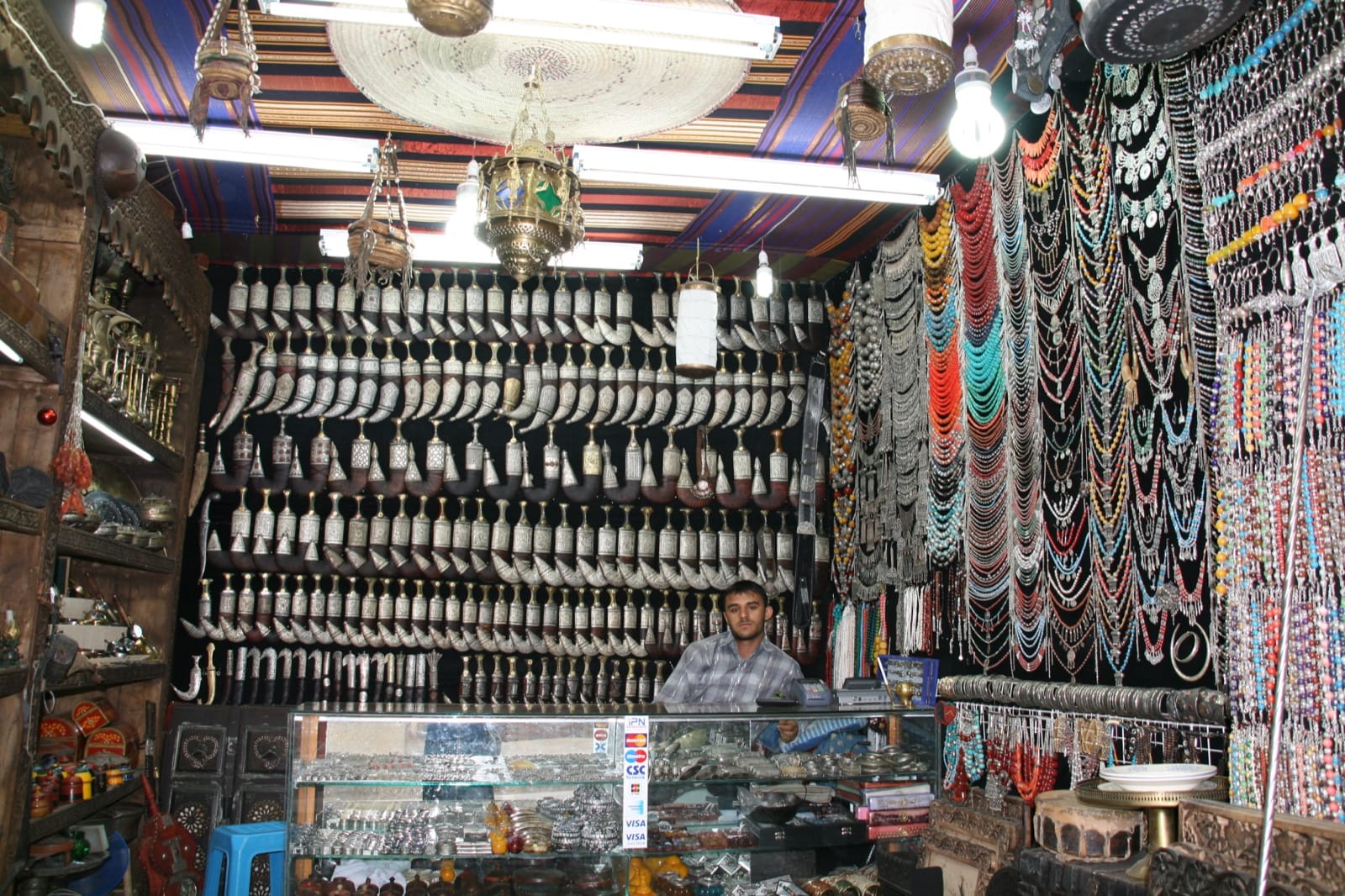
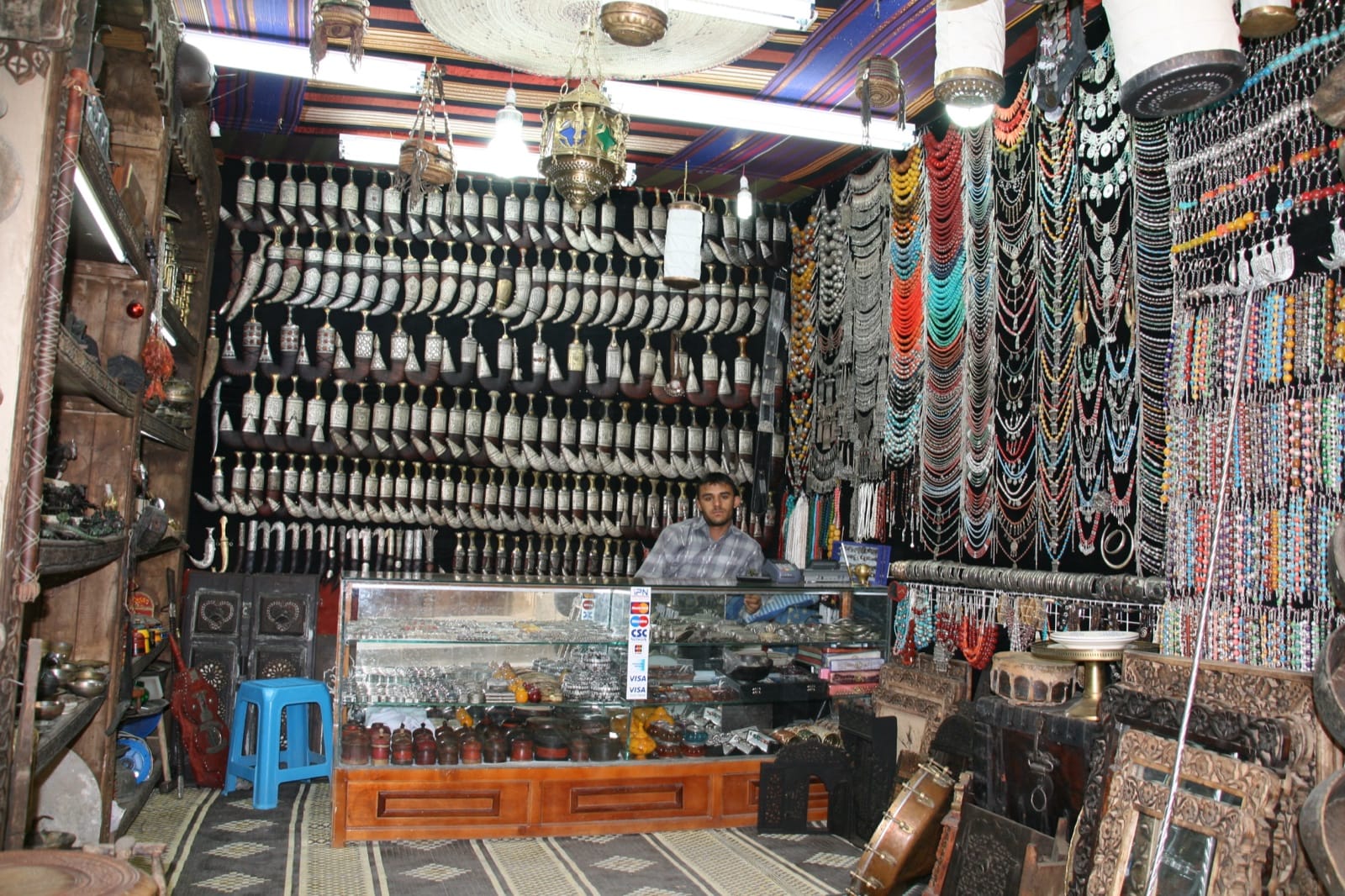
Principally, the souq sells antique silver trinkets and artefacts that are beautifully handcrafted with semi precious stones, along with some animal skins and of course, the good old jambia dagger.
Everyone here, without exception, is chewing on khat that has been stuffed on one side of their mouths. They pack in so much that it looks like they have a ping-pong ball hidden in their cheek. As if that was not enough, they are either clutching on to a further branch or they have a plastic bag in hand full of additional loose leaves. (Khat is basically a traditional Yemeni plant that contains an amphetamine-like stimulant that gives a sense of euphoria). Strangely no one seems to smoke in Yemen. The locals prefer the khat and everyone old enough to walk is contently chewing on the stuff as they roam around the streets.
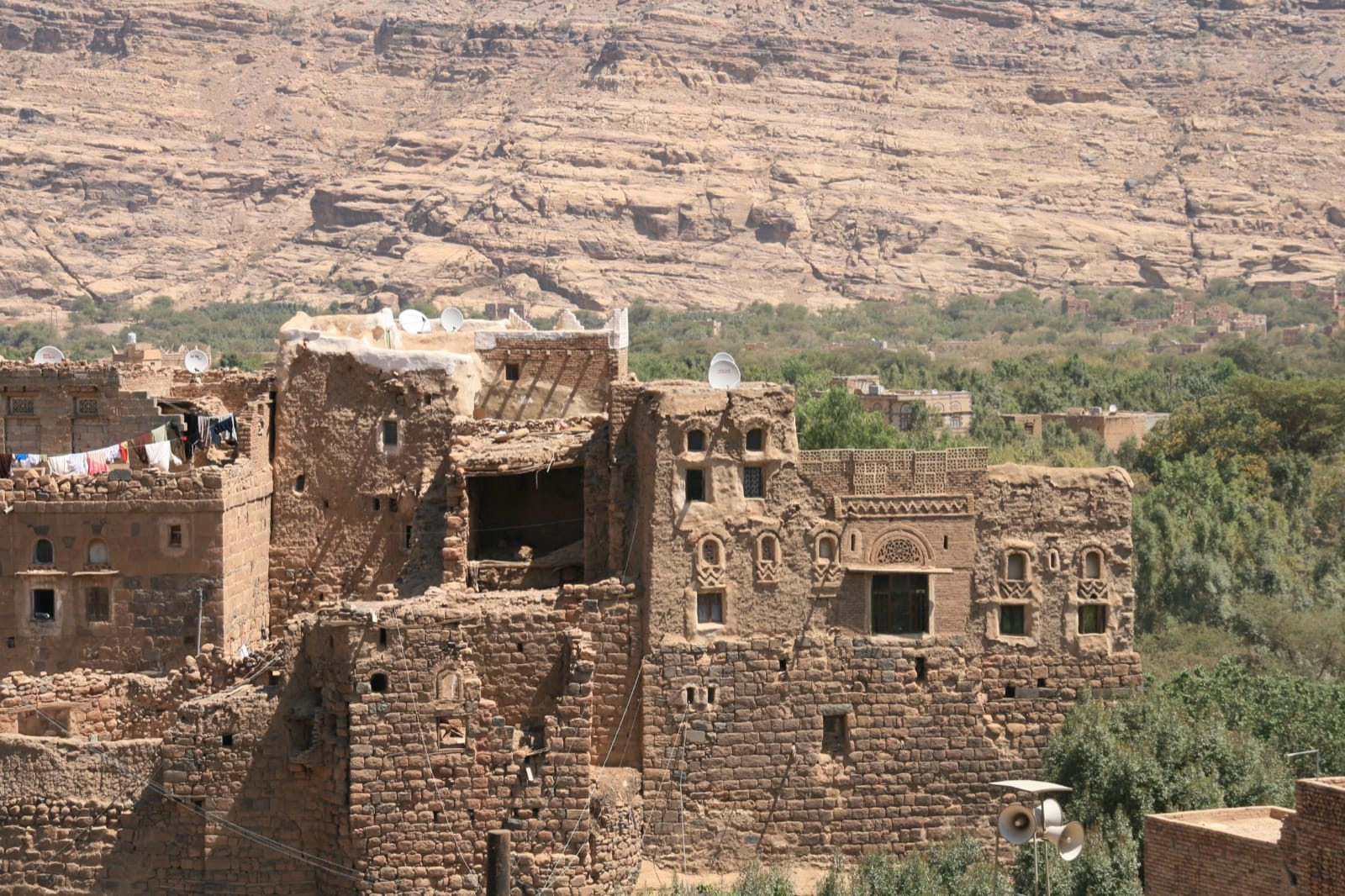
I was starting to grow rather fond of Yemen. Architecturally it is truly breathtaking. While much of the Southern Arabian Peninsula embraces modern concrete and steel, Yemenis cling on to their brick-and-gypsum buildings. It lends a wonderfully exotic gingerbread appearance.
I thought today was a good day. My fears and preconceived notions were fading and I was enjoying interacting with the locals. I was quickly getting to grips with their way of life. Funnily enough, it turned out that the daggers they wear are largely decorative. Rather like the Scots who wear a sporran around their kilts, the Yemenis wear a jambia to adorn their futa. It is equivalent to a tie for a Westerner. I went to bed that night feeling rather foolish.
Day 3: Sana’a - Wadi Dhahr – Sana’a
Visited Dar al Hajr in Wadi Dhahr
Ate dinner at Al-Shaibani Restaurant in Sana’a
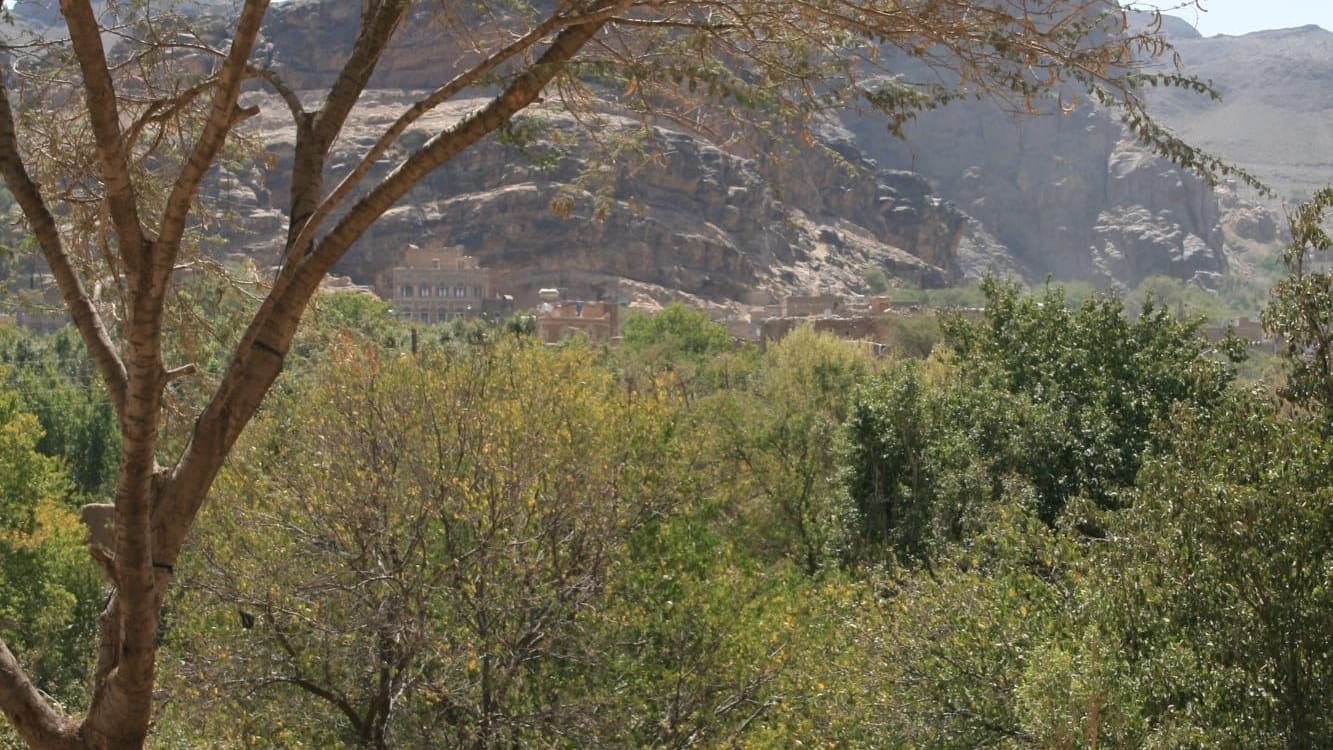
I had the chance today to go 30km northwest of Sana’a. Here there is a wadi on the river Dhahr. The town is fittingly called Wadi Dhahr and I had been dying to go there to see the famous, historic bastion called Dar al Hajr or Rock Palace. This palace, built atop a rock, is made entirely of mud and minerals and Imam Yahya Muhammad Hamidaddin originally owned it. He succeeded his father in 1904 (at the age of 35) in becoming the Imam of the Zaydis before eventually being crowned King of all Yemen in 1926. Imam Yahya was shot in 1948, and was succeeded by his son Ahmad bin Yahya. In 1962 Amhad bin Yahya died a natural death and was briefly succeeded by his son Muhammad al-Badr who was to be the last King of Yemen.
The cab driver that accompanied me on my journey spoke no English although, surprisingly, I was able to communicate with him quite well using my limited Arabic. The road is entirely unpaved so the ride is insufferably bumpy but the natural landscape more than makes up for it. The destination is after all an extraordinarily picturesque brick and gypsum built village.
The women of Wadi Dhahr were much easier to talk to. It might have been because I was less inhibited but it was more likely a curiosity in the Brazilian alien. I was welcomed kindly and later allowed to watch a traditional male tribal dance. Basically the men get in a circle and dance around, both clockwise and anticlockwise, while waving their daggers about. It was amusing and intriguing to say the least.
I found the people here to be exceptionally generous and hospitable despite their obvious poverty. There seems to be so much beauty and goodness here. It is such a shame that so many people are unaware of the splendour of Yemen.
Later in the day and back in Sana’a, a friend of mine took me to one of the best local restaurants called Al-Shaibani. Do not judge by appearances, as the food is quite exceptional even if the décor is not. Our meal, which we ate entirely with our hands, consisted of haradha (minced meat with pepper), marag lahm (meat soup), hurs (multi-layered bread cooked in a clay oven, a manfa), haradha (mince meat with pepper), barbequed fish, zahawuk (a tomato sauce with cheese and pepper) and aqda (an omelette-like fusion of meat and vegetables). The most notable aspect of the restaurant was the kitchen that had three manfa ovens around which the bread bakers put on a show while preparing the food.
After dinner we strolled around mainly along the same road as the restaurant, Hadda Street. I felt extremely comfortable. There is something about the night in Sana’a that lifts the tumult of the day.
Day 4: Sana’a
Visited the Old Town, the National Museum, the Jewish Quarter
Ate lunch at the Burj Al Salam Hotel
Witnessed a local wedding
Today was not such a good day. My newfound appreciation of Yemeni magnificence was quickly reassessed during my early morning tour of the Old City. I was looking to buy some souvenirs and was politely being accompanied by my cab driver. Just as we entered a small artisan boutique a commotion erupted outside. To my horror I caught a glimpse of some ‘decorative daggers’ being swung around. Men, women and children were screaming at full pitch. I hurriedly sought cover under the shop’s counter but strangely the fight dissipated as quickly as it had erupted. With the danger over, I asked the driver to take me back to the hotel. I would buy my souvenirs another time.
Once I had built up the courage to head out again I decided to visit the National Museum of Sana’a where I was surprised to discover many locals, both men and women. Ancient artefacts are neatly arranged according to each region of Yemen. Unfortunately the descriptions were a little too brief and sometimes there weren’t any at all. I enjoyed the general section that exhibited historical displays of Yemen’s clothes, architecture, accessories, coins, guns and weddings. The highlights of the museum were three statues that had been reinstated from the Louvre.
After the museum I headed over to the Jewish quarter. It was a fascinating place and I learned to what extent these people are generally considered second-class citizens. The sights include two synagogues. And it turned out that this was the best place to buy souvenirs as it is the Yemeni Jews who fabricate all the beautiful handcrafted jewellery and daggers that are sold all over town.
After that I headed back to the Old Town. Once there I met a local 12-year-old boy who generously offered to act as my tour-guide. He took me to a four star hotel called Burj Al Salam which was right in the midpoint of the Old Town. Apparently it was the only hotel in this quarter that had an elevator but it was the amazing 360-degree views that I really appreciated. If anyone is looking for an authentic and charming place to stay, this is definitely the place. As we sipped on tea and ate our modest lunch the boy recounted his life story and how he had become the primary breadwinner of his family following his father’s death. He had an extraordinary command of the English language.
The boy seemed to be well known and respected around town. But somehow though, the mix of his immaturity and my naivety found us attending a traditional Yemeni wedding. Surrounded by rows and rows of men, chewing khat and listening to music, I anxiously congratulated the hosts, took a few lousy photos, and respectfully retired.
Day 5: Sana’a – Thula – Sana’a
Ate lunch at Al Kheema restaurant
I find it very difficult to understand or accept the ways men and women interact in Yemen. Though there is an underlying dignity and respect, it is a blind conformation to old and unchanged tribal practices. As a Brazilian woman in Arabia, our contrasting worlds are in stark contrast. I wish the women here had my freedom to err and to grow in whichever direction without constraints. Perhaps I am exposed to a world that is at times indecent and dangerous, but at least it is new and ever changing.
Today I was heading for Thula, which is about 45 km from Sana’a. After passing many khat plantations within the expansive desert, I decided to stop at a restaurant where I had to eat in the family section. There were no tables, no chairs, no cutlery and my dish was served on a piece of cardboard on the floor. The good part was that I tried eating the popular Salta dish, which is only served at lunch and comes in a clay pot. It consists mainly of lamb meat in a stew that is eaten with bread.
Thula is a picturesque village of 8,000 inhabitants built on a cliff, surrounded by magnificent hills. The gates of the walled town still stand in good nick seeing as they are 1,200 years old. The locals are very friendly and I was invited to another wedding, this time on the woman’s side.
I was ushered into a building made of clay that had noticeably tiny windows. After climbing many medieval steps and clambering through some narrow and low passageways I was led into a small and overcrowded room filled with veiled women. Even though we were all women, there were only six who felt comfortable enough to unveil. Everyone was seated on the floor except the bride who rigidly sat on a chair in the extremity of the room. She was covered in henna, her hair was up and it had been ornamented with jewels. She was dressed in a sleeveless golden gown, wearing a choker-like long gold necklace. Everyone sat around listening to three women orchestrate Bedouin songs to the beat of drums, while two others danced to the melody. I had been told to leave my camera behind which was probably a good thing as the bride looked sad and the guests too serious.
Day 6 & 7: Sana’a - Shibam - Kawkaban - Al Dhahar - Badia – Sana’a
Lunch at Al Hamida in Shibam
Visited all the villages listed above
The Old Walled City of Shibam is an incredible looking place and since 1982, has been safeguarded as a UNESCO World Heritage site. Many people refer to it as the ‘Manhattan of the desert’ as the buildings here are in fact the oldest skyscrapers in the world. As far back as 2,000 years ago the inhabitants were embracing the principle of vertical construction in order to protect themselves from Bedouin attacks. The tallest building in the city is the mud-brick minaret, which stands over 53 metres tall. I ate at Al Hamida, which is a very popular restaurant with locals and tourists alike. The food is not great but this was by far the nicest looking restaurant I’ve been to so far. The owner Hamida is quite a character and she is said to never leave her restaurant.
Kawkaban is a very short drive from Shibam up a covered and very steep road. It is actually possible to walk the journey and certainly the views from this altitude (2,800m) make the walk a good option. Kawkaban is a fortified citadel that was used by Yemeni Kings in the past and its name literally means two planets after Kawkaban’s two palaces that were decorated with an assortment of precious stones. There is only one way in and one way out of the citadel but before you do leave make sure to try the Kawkabanian coffee Qahwa Qisher as it is quite distinctive.
On the way back we passed through the villages of Al Dhahar and Badia that seemingly thrive off the trade of khat. Apparently the best khat crops come from here and you can find sellers under almost every tree.
Day 8: Sana’a - Aden
Stayed at the Sheraton, Aden
The trip from Sana’a to Aden is long but it should not have taken as long as it did. I calculated that it would take no longer than five hours seeing that the distance was only 400km. We left at 7pm but I had definitely not taken my khat-chewing driver into consideration. We ended up cruising at under 40 km/h for the entire journey. And even worse was the fact that we had to keep topping at checkpoints along the way. I soon came to understand that we could get by much faster if I covered my face and fiddled around with my abaya when the policeman’s flashlight was directed at me. In the end the trip took us 8 long hours and I was exhausted when we finally entered the city at 3a.m.
Frankly, I probably would not have bothered making this trip if I had known that Aden was so ugly. Not only that but the weather is intensely hot and damp that sweat is just a way of life here. I think I shall leave tomorrow.
Day 9: Aden - Al Mukalla
Stayed at the Holiday Inn in Hadhramout
Today I set off to Al Mukalla, the capital of the Hadhramout province, and the fourth largest city in Yemen. What we thought to be a checkpoint in the middle of the barren desert was actually Ethiopian and Somali illegal immigrants wanting to hitchhike. They were armed to the teeth and did not seem in the mood for talking. I instinctively covered my face with the veil, and watched anxiously as a scene unfolded before me. As they approached us they managed to get one of the backdoors open whereupon a fiery exchange of words took place between them and my driver. I was not able to understand what was being said but all of a sudden my driver hit the gas and made a bolt out of there. I was convinced that they would shoot in our direction, but thank God no bullets were fired.
Upon arriving to the town, it began raining heavily. Al Mukalla, I found, is very much like Aden. Nothing to see or do – and the architecture is nothing to write home about, although the port of Al Mukalla has been around for centuries and it is still active today.
Day 10–13: Al Mukalla
Stayed at the Hadhramout Hotel
Although I was not mad about Al Mukalla I had to stay for two reasons. The first was that I planned to go to Socotra next and there were only two flights a week there. Secondly, the rain showers had turned into a full on monsoon. Roads were flooding, many people had died and even when the storm moved up north, the water still came pouring back from the valleys bringing with it a lot of sediment that further blocked roads. A black out began at 5pm on my first day and it lasted the entire night. The Holiday Inn is supposedly the best hotel in town but I do not understand how. It had an awful stench, bad service, tasteless food and it was in complete disarray.
The weather was remained dreadful throughout my stay here – I had never witnessed anything like this before. But luckily I did not stay at the Holiday Inn throughout my stay in the city. I ended up trying the Hadhramout Hotel. The bad news was that this 4-star hotel was falling apart in areas but the good news was that in every other respect it was superior to the Holiday Inn. Thankfully there was no smell, the food was fresh and the service was exemplary from the friendly and well-educated staff.
Thanks to the staff at my new hotel I was finally able to secure a ticket back to Sana’a and even though that meant that I could finally get home I was very sad to not get a chance to visit Socotra. This small archipelago of four islands, about 350 km off the south coast of Yemen, is a supposed paradise with unparalleled biodiversity. I’ll save it for my next adventure.