It’s five pm on a Thursday in the outskirts of Kuwait’s sprawling capital city. Most locals are heading home but for Hussein Salmeen, work is just getting started.
This weekend, the 38-year-old Kuwaiti is building a motorbike. He’s got everything he needs to finish the job - a large sheet of metal, a steel chassis, a fuel tank, a pair of wheels and a welding torch. “I like to assemble and disassemble things. It's an addiction,” he tells me.
Salmeen is not the only one with a love for bikes in Kuwait - it’s becoming more common to see motorcycle riders in leather jackets cruising down the empty desert highways that stretch across this tiny, oil-rich Gulf nation. America’s pop culture, everything from fast food to fast bikes, spread through Kuwait on a large scale following the first Gulf War in 1991.
But it’s still rare to find mechanics in the Middle East who build motorcycles themselves. One exception is Kuwait Choppers, the small company Salmeen launched twelve years ago, one of the few boutique garages for custom-made motorcycles in the Gulf.
“We build bikes as our main thing,” says Salmeen, who is originally from Kuwait City. “Also we customise, airbrush, do the leather tooling and can modify almost everything. If you can think it, we can do it.”
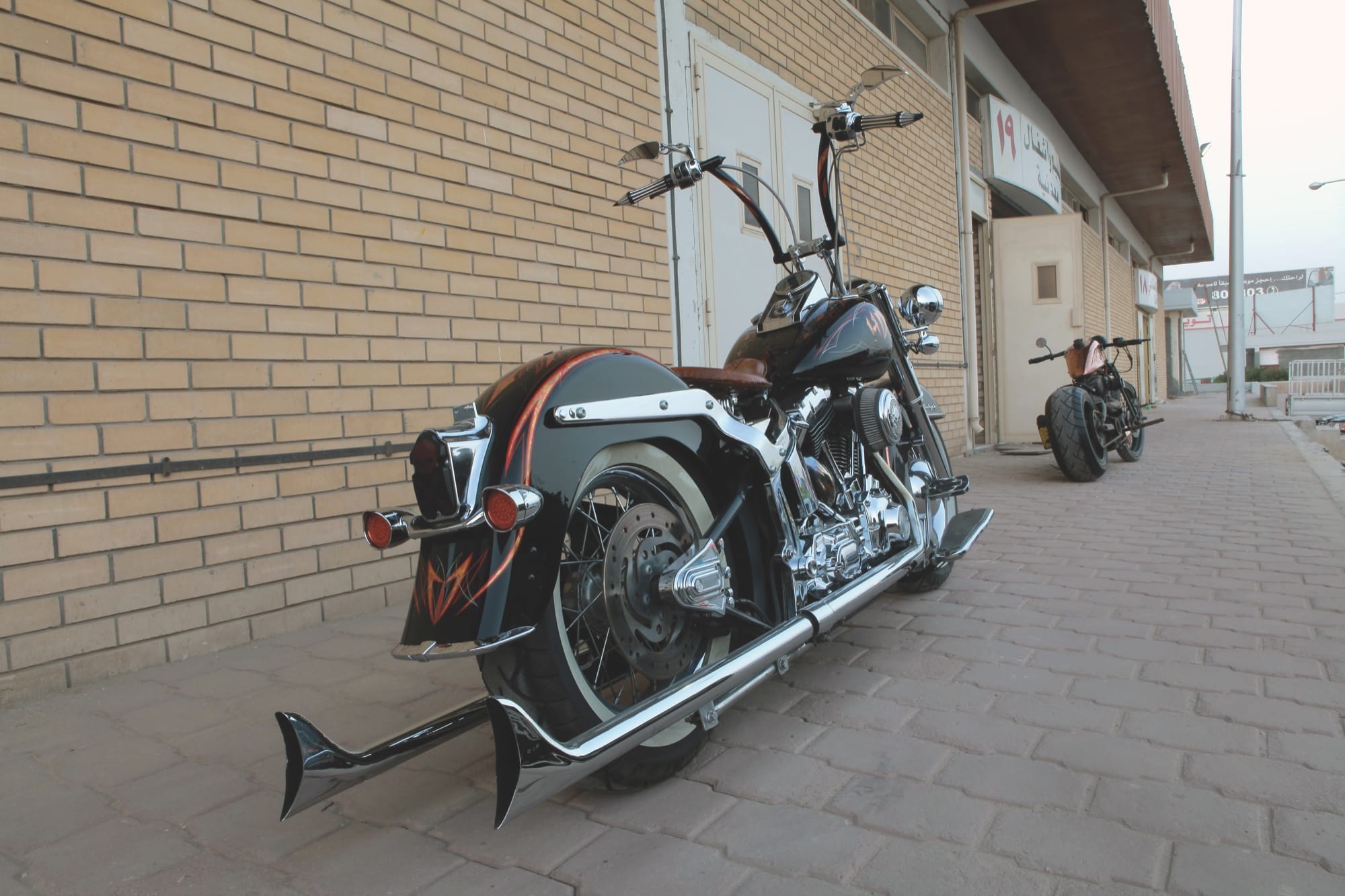
Many heavyweight motorcycle enthusiasts go to Kuwait Choppers to get their factory-built bikes ‘chopped’, modified to reflect their personality and style. Customers bring in imported bikes - usually Harley-Davidsons - and leave with the same bike, just enhanced to new specifications.
Handlebars can be extended to change the lines of the bike and increase wingspan. Coloured lights add flare to its underbelly. Exhaust pipes are refitted to make more noise so that both bike and rider get more attention in the street.
Inside the tiny one-room garage, there are nearly a dozen modified bikes, including a dual-engine Harley refitted as a ‘street fighter’, with a shortened tail and exposed engine. There’s also a Harley Road King sporting hub-less wheels - one of the first of its kind to hit the roads in Kuwait.
Salmeen also paints “weird” designs for bikes and accessories - whatever inspires him - like a helmet airbrushed with skulls and bright red roses. Most of his ideas come at night; he keeps a notebook by his bed to record thoughts when they pop up. “I consider myself a mechanic, but it's more like an art actually.”
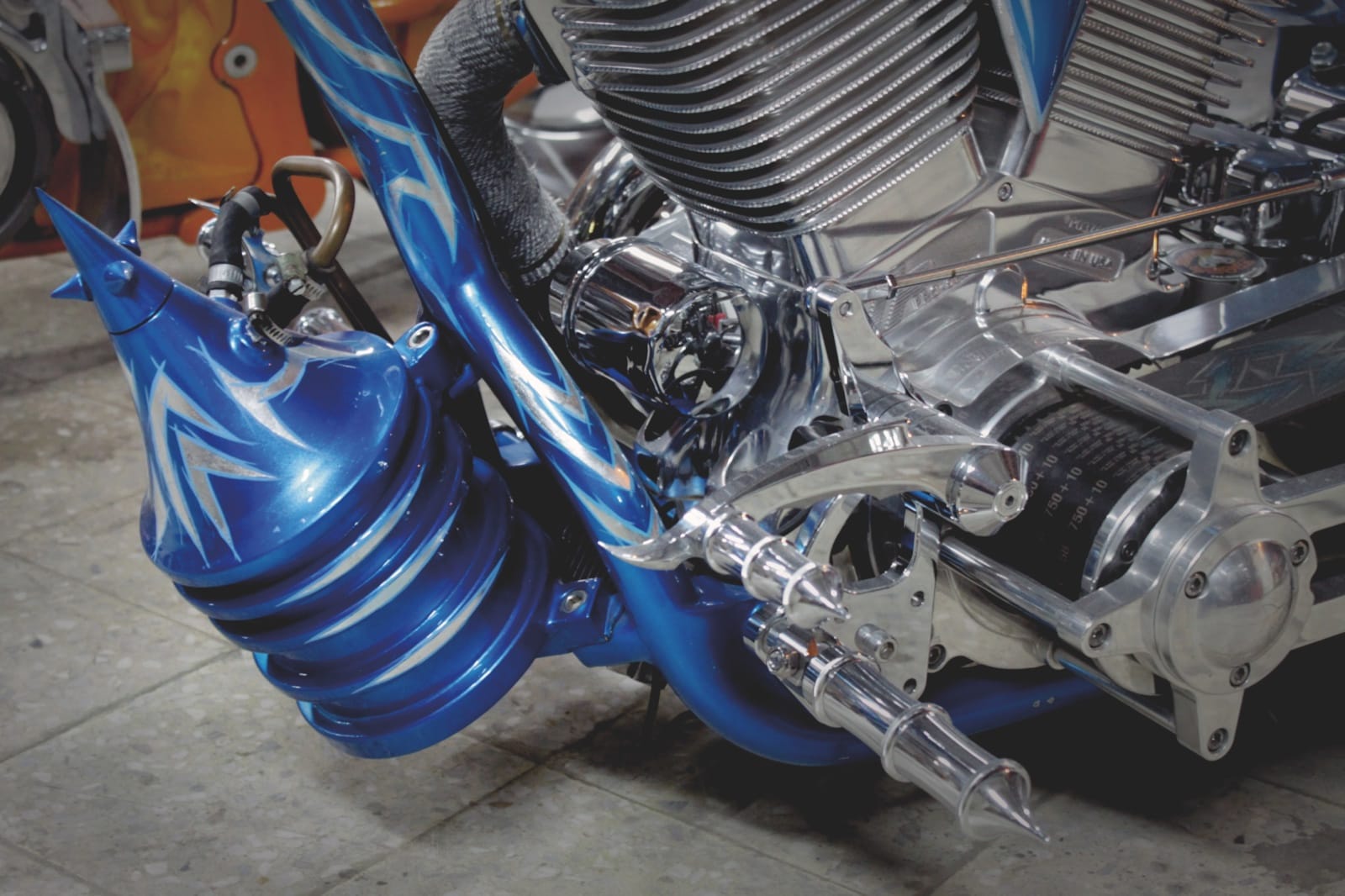
His favourite is a 2005 Harley Sportster, painted sapphire blue with silver streaks airbrushed up and down the sides. The seat was modified with a handmade leather cushion, emblazoned with the word ‘Judge’ that hydraulically lowers the driver to be closer to the road.
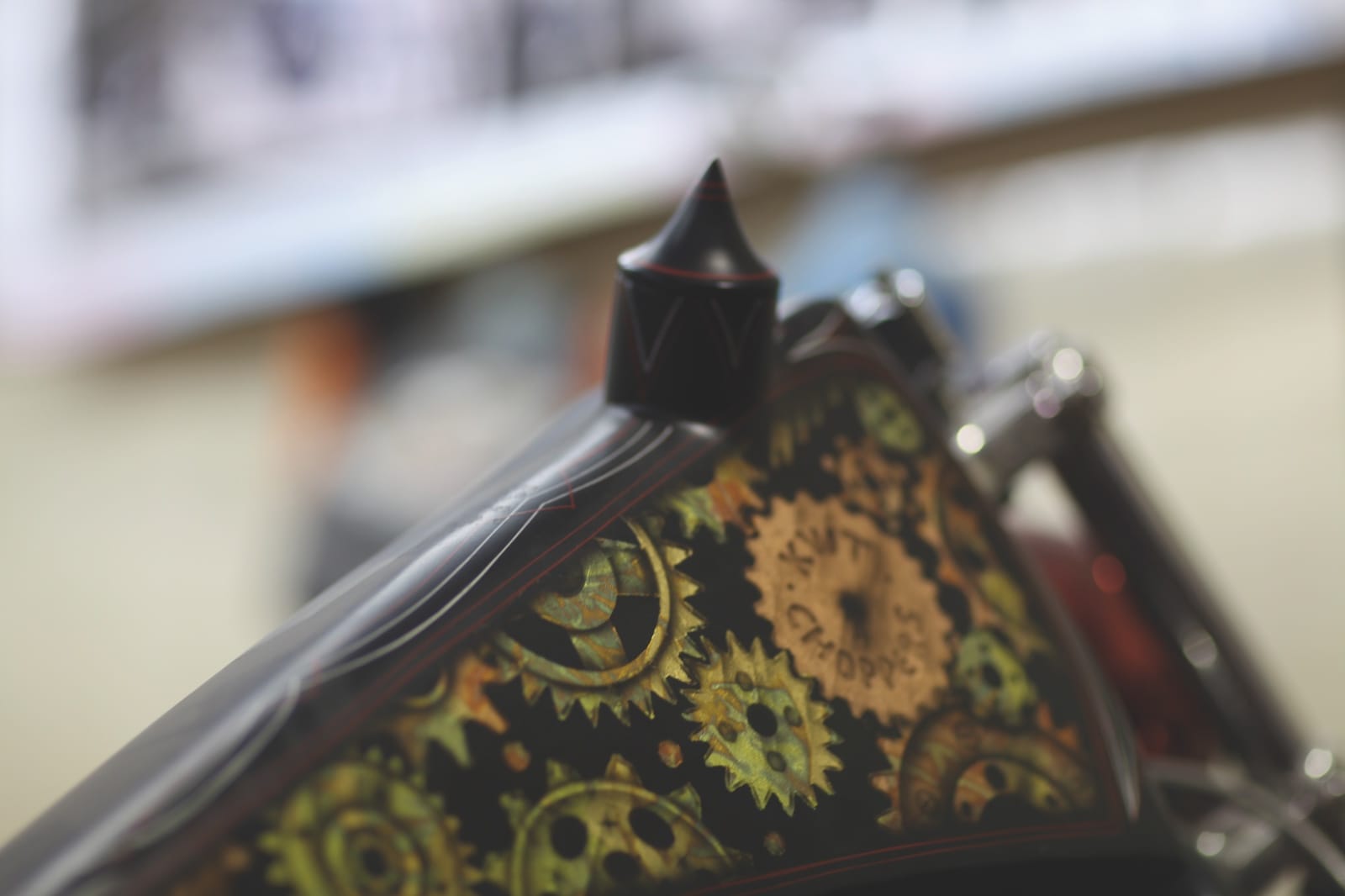
“I named this bike the ‘Judge’ because when I first started, no one believed that a young Kuwaiti could build bikes,” Salmeen continues. “I wanted people to know that no one can judge me but God.”
A mechanical engineer who spent a decade studying and working in the United States, Salmeen fashioned his company after Orange County Choppers, a New York-based garage made famous by a reality television show of the same name broadcast on the Discovery Channel.
Arabic aside, Salmeen’s shop could easily be mistaken for a chop shop located off a highway in East Los Angeles. Kuwait Choppers is an all-male affair, staffed with between one and five mechanics and two airbrushers, depending on the day.
The garage has vaulted ceilings, yet quickly fills with smoke, as a welder in the back of the room solders a fuel tank to the chassis of a new bike. Customers and other onlookers loiter curiously around the mechanics, hovering over the bikes as hammers hit iron. It’s cacophonous and somewhat chaotic but everyone enjoys the work. “There’s no better feeling than beating a piece of metal into submission,” says Mishal Abdallah, a mechanic wearing a grease-stained Harley-Davison vest.
Salmeen’s shop is always full of customers, but he admits the flow is not enough to quit his day job. Kuwait Choppers is - for now, at least - a place for his ‘family’ of like-minded biking enthusiasts to gather and celebrate their craft. He hopes to expand the shop into a full-fledged automotive factory able to produce its own line of made-in-Kuwait motorcycles because, at the end of the day, the chopped Harley-Davidsons he sells are still Harleys.
What Kuwait Choppers needs to produce their own brand is for the government to issue their own vehicle identification numbers, something Salmeen says is easier said than done. Like most of its Gulf neighbours, Kuwait, has no domestic automobile production and the state will not easily issue a Kuwaiti their own vehicle numbers, which are used internationally as a standard to track a vehicle’s make, production date and other details from the manufacturer.
“We're still using Harley frames. The reason is because I can't get the VIN number to build bikes here in Kuwait,” Salmeen explains. He thinks that will change one day and by teaching younger Kuwaitis the craft of motorcycles, he is hoping to inspire others to join their crew. An independent line of motorbikes under the Kuwait Choppers banner would definitely put the country on the automotive map, he adds. “I want to do something for my country, Hopefully we'll have future builders, more people will learn and this will be a legacy.”
Jon Jensen produces ‘Inside the Middle East’ on CNN International, which airs monthly www.cnn.com/ime