Until the door actually opened, I was starting to think I might just have rung the bell to a typical Parisian apartment. Now that I’ve crossed the threshold however, I find myself in a bustling yet intimate atelier filled with intricately made shoes. The sound of knocking wood echoes as artisans tap away at wooden lasts, moulding them to the form of their clients’ feet. There’s an entire wall with hundreds of these lasts and behind it, is one of three rooms with hands at work – each largely represents the three major steps of traditional, handcrafted shoemaking.
“It’s a little meeting between modernity and tradition,” quips Patrice, master shoemaker who, I imagine, is my Virgil as I, Dante, descend into what would be – if I were a man – both a hellish and a heavenly addiction: bespoke Berluti shoes. “It is true; it’s a line that you cross. Then after, yes, it’s a little bit like a drug.”
There are shoes everywhere, in rich patinas, with skins from shark, box calf, veal, ostrich, python, alligator and horse or, even the rare elephant. There are city boots, casual weekend shoes, formal business shoes, hunting shoes, black tie event shoes. There’s even a certain moccasin called the ‘Andy’, named after none other than Andy Warhol, who used to be a Berluti client.
In my eyes, these varying styles might represent fashion boundaries between work and play, weekday and weekend but it’s somewhat different at Berluti. As artistic director Alessandro Sartori tells me a few days later on the phone, “More and more, I find that men appreciate fewer boundaries between formalwear and sportswear. While I don’t dislike the full sport or the full classic look, it’s really nice when you have a beautiful classic blazer worn with sports pants. Or, a very nice suit and a beautiful pair of sports shoes. This is the case with our sandals too,” he says, referring to a new line of footwear made exclusively for the Middle Eastern market. “We played with sportswear details like the stitching, the buckles and the finishing of the leather. It’s a product blended with a classic idea of a beautiful shape, the comfort of a lightweight summer shoe and those sporty details.”
Evidently, what interests Sartori is the style of the man, and not menswear categories. Former creative director of Ermenegildo Zegna, Sartori joined Berluti in July 2011. Not long afterwards, he had already established himself as Alessandro II, second to the Italian founder, Alessandro Berluti, who had made his way to fin de siècle Paris and established the luxury footwear brand in 1895. The eponymous ‘Alessandro’ shoe remains emblematic to the house today, where fourth generation Olga Berluti still designs.
2012 marked the beginning of a major transition for Berluti. Under Antoine Arnault, son of LVMH’s CEO Bernard (Berluti was acquired by the group in 1993), Berluti launched its ready-to-wear clothing and accessories line. And there were more changes that year, when quintessential Parisian tailor Arnys came into the fold and began producing bespoke suits under the nomenclature ‘Berluti by Arnys’.
“To create the Berluti style, the whole,” continues Alessandro, “we had to play with worlds where there are fewer boundaries, where the elegant and chic attitude are in the centre. The world of stylish men, not fashionable, yet also not too conservative is more about the freshness of the look, more about the attitude than the age. This kind of man with a type of craft, attitude and chic, wearing colours – sometimes even colours that aren’t easy, like burgundy, deep green, violet, bright blue, beautiful dark yellow, cocoa – belongs to the DNA of the brand.’
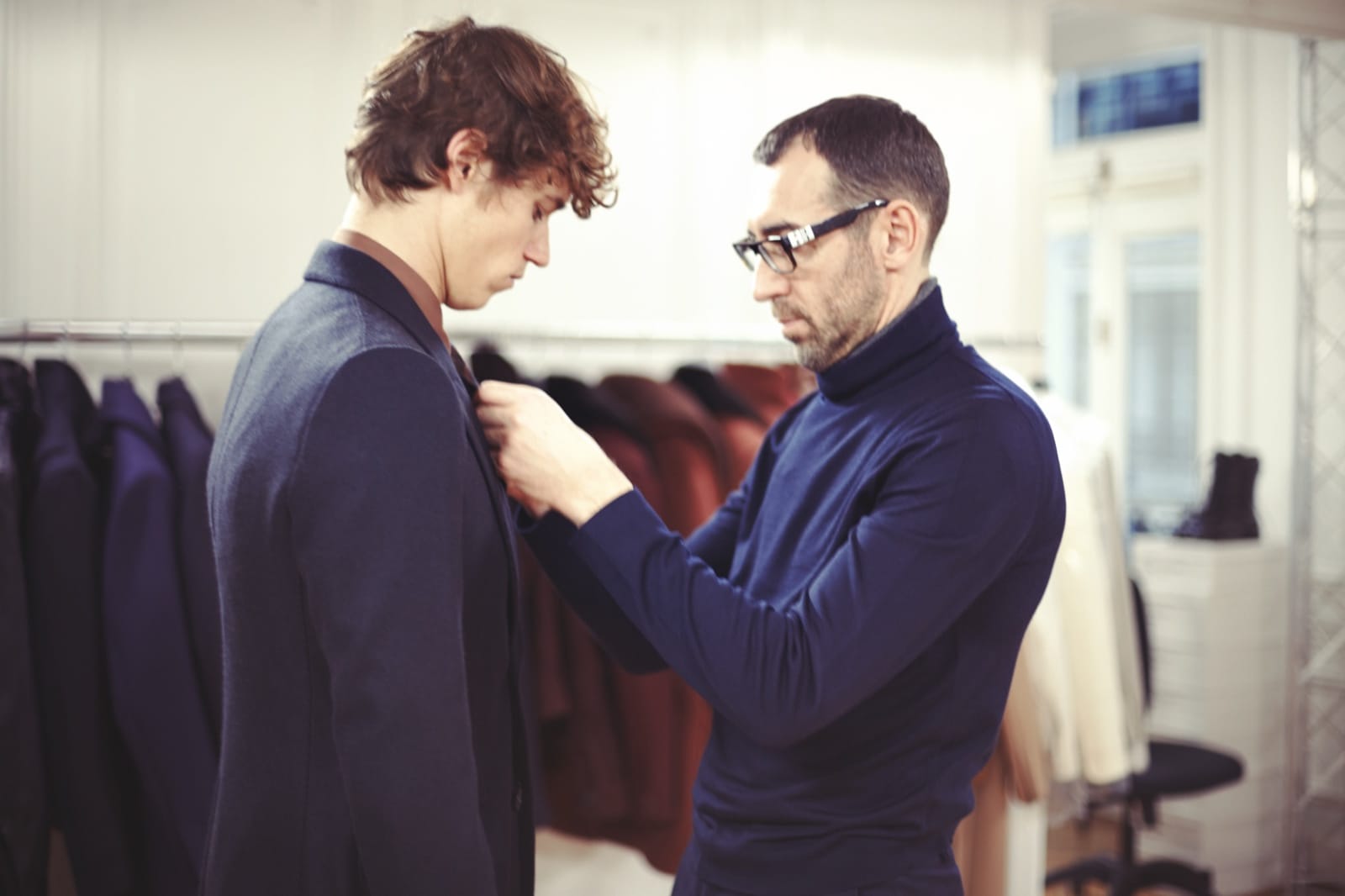
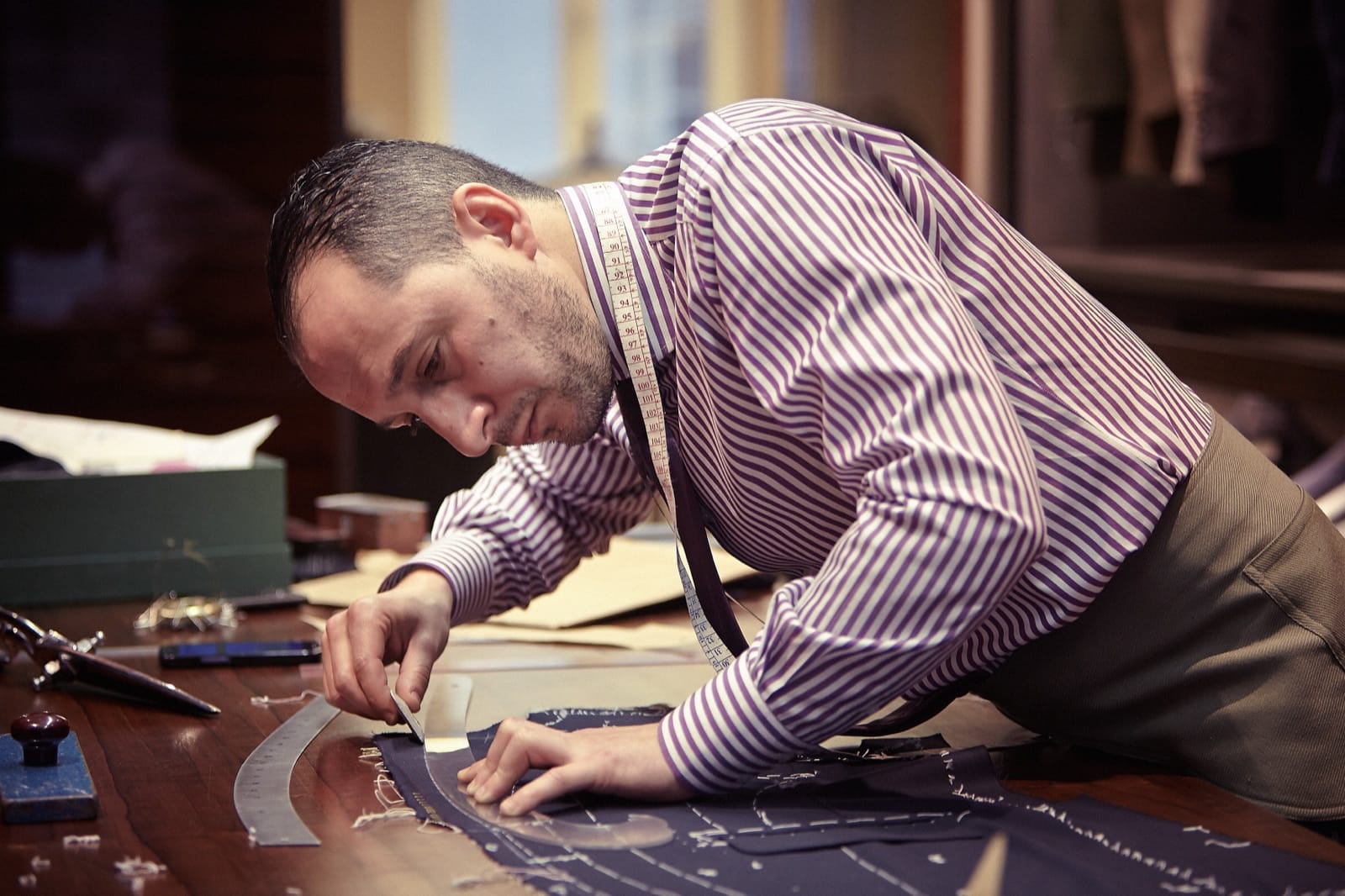
Cross the Seine and you’re in the grand Berluti flagship on 14 Rue de Sèvres, which was formerly Arnys – a Left Bank landmark for the dapper gentleman. Clients such as Orson Welles, Jean Cocteau, Le Corbusier and Jean-Paul Sartre once passed through these doors. On the second floor, you’ll find the bespoke tailoring services. “I can answer your questions at the same time as cutting,” declares the ever-busy 34-year-old master tailor, Karim Rebahi, leaning over his table, chalk and shears in hand, a measurement tape dangling from the neck. Here, there’s the shrill sound of working metal and the rumple of cutting cloth instead. The atelier behind us deals with client orders from Japan to New York. We may be chez Berluti but the way that these garments are built from the inside is distinctly about Arnys craftsmanship.
For Alessandro, this ‘whole Berluti man’ isn’t imagined or conceptual, but something he came to understand by studying both Berluti’s and Arnys’ clientele over the decades. “They came to bespoke fittings with their own attitude and world, bringing their own spirit into our atelier. I wanted to keep in mind the experience that the customer was trying to have.” Alessandro explains how he was amazed when looking through the order books in Arnys’ archives, “They were filled with notes on fabrics, models, sizes and the customers’ ideas, needs and problems. Going to the tailor is like going to a friend [or a doctor]. Basically, he sees everything about your body.”
Back at the shoemaking atelier, similar vestiges of the past remain, with an entire hallway lined with about 3,000 wooden lasts representing nearly ten years of work, a small fraction of the full archive. “We follow everything, the year, the order, the artisan. Even in 20 years, we’ll know what artisan touched what part of the shoe.” Clients too, can keep track of their personal archive, as each shoe comes with a cloth bag and a leather label, in the same coloured patina as the shoe, as well as a matching leather box with a photo of the shoe on the outside.
There is an eight-month wait for a new client ordering a pair of bespoke Berluti shoes and approximately four months for a returning client. “We aren’t here to follow trends, we do timeless,” concludes Patrice. And, the timeless takes time.
He shows me one of the atelier’s tools, a medieval-looking machete that, with the control of precision hands, shaves the wooden last to form. “It seems barbarian but we can be extremely precise with this tool, which allows us to approach the volume of the foot as closely as possible,” he explains. “It’s the beginning. The secret of each shoemaker. Mastering this fabrication step defines the house’s entire style.”
Forget head to toe, Berluti styles men toe to head rather, in a true portrait of modernity, and an ultimately bespoke finishing.
WHAT Berluti
WHO Headed by Artistic Director Alessandro Sartori
SINCE 1895 but reborn 2012
WHY Sartori joined Berluti during a time of transition, as the brand was launching its first ready-to-wear line and adding the tailor Arnys to its repertoire. Despite its claim to fame being bespoke shoes, Berluti’s vision of craftsmanship has not been lost on the various facets of its business today.