In 1977, my father took me to the cinema to see ‘The Spy Who Loved Me.’ I was five years old. About halfway through, I was transfixed by what went on to become one of the most iconic and audacious scenes in cinema history, as a Lotus Esprit was driven off the end of a Sardinian jetty and into the Mediterranean sea before morphing into a submarine.
Hovering above was a helicopter – a Bell 206 JetRanger – although not for long. But before Roger Moore deployed a small missile to blow that chopper out of the sky, it had already become ingrained in my subconscious. So much so that, when my dad bought me a Corgi model of that Lotus, I moaned until he purchased a JetRanger to keep it company.
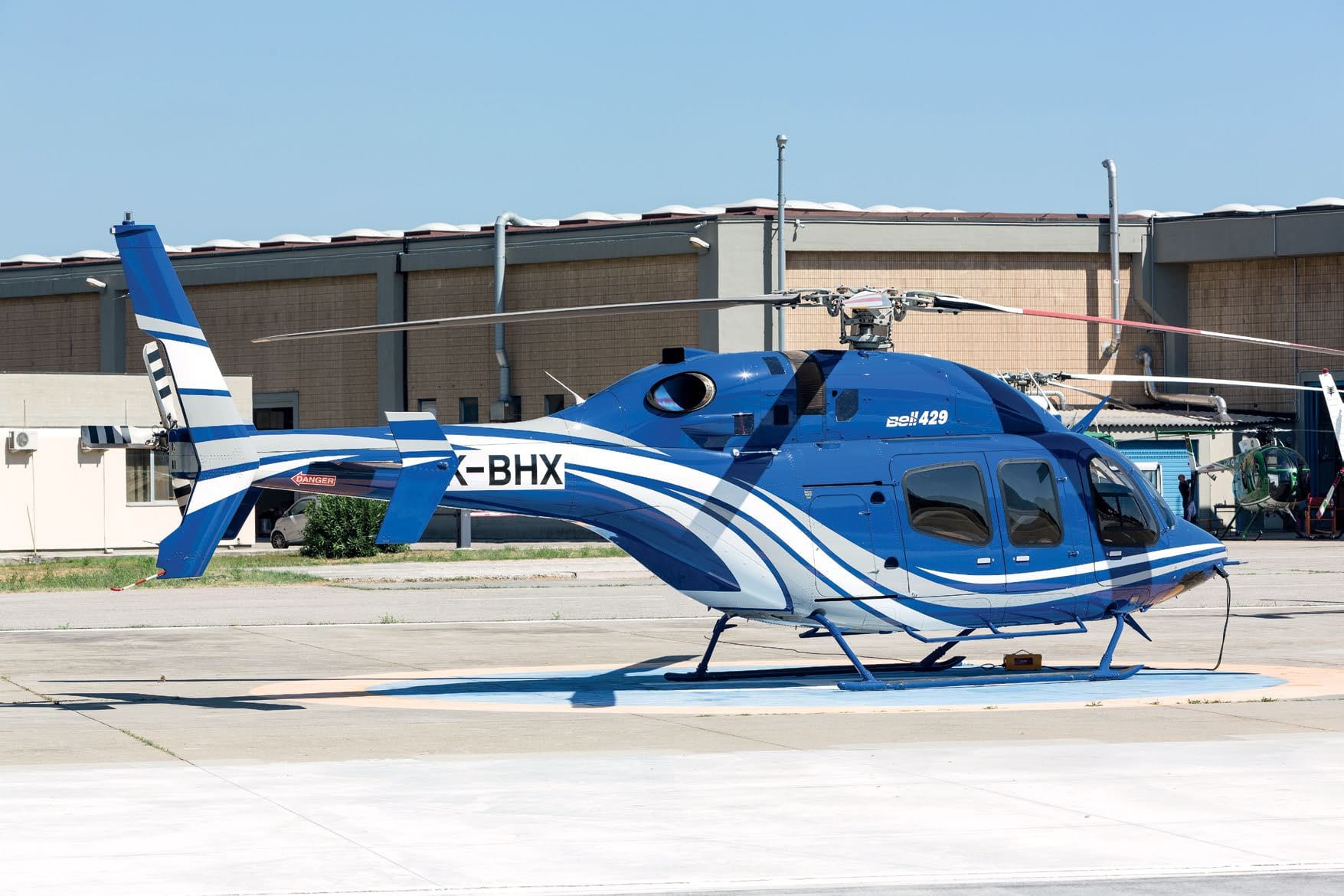
From its introduction in 1967 until its discontinuation in 2010, the JetRanger served as reliable transportation for many organisations around the world and its long fuselage made it ideal for use as an air ambulance. Naturally, it also became the darling of the rich and famous as an exclusive mode of personal transport – something that Bell, an American rotorcraft manufacturer, is very much capitalising on today with its recent 429 ‘GlobalRanger’ model, which still looks remarkably like the one I fell for as a young boy.
Steve Suttles, Bell’s managing director for the Middle East and Africa, says there’s only so much anyone can do with helicopter design, which is why this shape has remained intrinsically unchanged – and that’s just fine with me. A Texan (Bell is headquartered in Dallas Fort Worth), Suttles explains to me during their Dubai launch that Bell’s main client base has always been military but that the commercial side of operations is really starting to gather pace. “During these times you need a balanced portfolio,” he says, “and we’re experiencing increasing demand from commercial clients and in this region, the VVIP product is doing extremely well.”
It’s the VVIP 429 that I’ve come along to experience and still, I find myself stifling my child-like enthusiasm as I walk towards what remains an evocative piece of machinery. I’ve travelled in a number of helicopters all over the world but this is to be my first time in a Bell of any description.
As its door opens, I’m immediately hit by the rich aroma of fine leather hides – a heady, luxurious smell that practically screams ‘expense’. “The aircrafts we make are very well suited to VIP and VVIP customers,” adds Suttles, “and this means we can customise interiors to practically any specification. If you want the inside of your helicopter to match your Rolls-Royce, we can do that.”
I climb aboard and take my seat (many configurations are permissible, naturally) and marvel at the fit and finish on display. Some of Bell’s other larger models can accommodate 16 passengers but today’s aircraft has seating for four and it’s ideal for housing the requisite DVD screens, centre consoles and all the rest that today’s well-heeled expect at all times. Ambient lighting and other comfort settings can be made using a tablet and the glazing can turn opaque at the touch of a pad – something that will no doubt be advantageous in the arid climes these things will operate in over here.
The 429 is incredibly powerful, which helps it overcome the weight added to it with these sorts of luxury add-ons. And carbon fibre is becoming increasingly important in modern helicopter construction, for strength and lightness. As we take off for our flight around Dubai’s outlying areas currently under development, I am absolutely dumbfounded by the refinement I experience.
But what of the sound? In all the helicopter flights I’ve so far taken, one thing has been a constant: noise; unsurprising, when you consider the mechanisms at play just above your head. But surely if this is to be a credible VVIP mode of transport then there would need to be a sense of peace and quiet? “You’re right,” Suttles says. “And the interior you’re about to experience is as state-of-the-art as it gets right now when it comes to noise insulation. You can have a conversation in the back of this helicopter without a headset.”
Granted, there’s still a bit of vibration, especially during take off, but it quickly dissipates and yes, I can converse with my fellow passengers without using a headset intercom and, remarkably, without shouting. The efforts Bell has gone to in order to reduce vibration and noise are extraordinary and fully merit the luxury tag – it’s the Rolls-Royce of helicopters in more ways than one.
“The smoothness of the 429,” Suttles tells me, “makes it ideal as an air ambulance. There’s plenty of space behind this cabin, in the tail section, for medical equipment and a couple of people, but when we land you’ll see for yourself just how smooth it is – ideal while tending to anyone who’s injured.” He’s right, too since the landing is far and away the smoothest I’ve ever experienced.
Once on the ground, I clamber out and am told all about the construction of its rotor blades and how the engines are connected to the tail rotor, how it’s incredibly stable even in extreme weather conditions and how the pilot’s cockpit is an exercise in design minimalism. But I don’t care – I’ve just taken a flight in the most luxurious helicopter on the market and, to my mind anyway, it’s still a JetRanger. While it’s good sense to never meet your heroes, today I feel that Bell’s legacy is unimpeachable – what a fabulous flying machine this is.