The Pearlstein Gallery in Philadelphia’s Drexel University is wrapping up an exhibition entitled, “Raw to Refined: String, Tape, Sponges and Vinyl” when I meet Mark Khaisman. He’s one of the four artists featured.
“I like to peel things,” the Ukrainian-American tape artist tells me. “It’s an unconscious thing, peeling to the point of no origin.” We’ve been talking in the building’s lobby for some while before he voices this penchant of his.
Well-known internationally, he speaks in the blithe mode artists adopt to explain how they make their livelihood and gently mocks himself and his critics, real and would-be. “In art, you are always facing confusion. At some point you know what you’re doing, then you face the world and you have no idea what you’re doing,” he says, laughing.
Khaisman’s journey into fine art was multi-faceted. Raised in Kiev, he enrolled in the Moscow Architectural Institute in 1982, where he delved into Paper Architecture, a conceptual movement that was more about designing structures than building them, led by Russia’s avant-garde. This revived movement – a precursor had existed in the 1920s and 30s – based on the advancement of structural ingenuity, consequently shifted his interests away from practical architecture toward contemporary art and the suggestiveness of images.
After his studies, Khaisman worked in Moscow as an art director of 3D puppet animations. He and his wife went to the United States in 1989. But contrary to what it might sound like, the reason for this emigration was independent of the pivotal upheavals that were beginning to reshape the U.S.S.R., as he begins to explain to me. “I identify with Western culture and tradition but in fact, the reason we came to the United States was because my wife needed fertility treatments, not because we wanted to move. We found that this country gave us the best opportunity to have children and I could also move in a new direction.”
Khaisman jokes that his wife, also an artist, is a steady source of both aesthetic friction and inspiration in his life, before adding that that shortly after leaving his country, he had reached a kind of crossroads, requiring him to shelve, at least for a while, his artistic plans. Purely by accident, he deems, he wound up being employed at the Willet Stained Glass Studios.
“I had no experience at all but I ended up with a pretty long career in stained glass design,” he continues. “Working with an easel and artificial light introduced me to the blending of light and shadow, which eventually led me to the techniques I use with tape.”
For a man who admits feeling lucky to be in his position, Khaisman realises that his relatively late entry into the contemporary art world also enabled him to formulate his ideas more deeply. A decade ago, aged 45, he hadn’t seriously pursued art in years but his work in stained glass design, a profession he had never anticipated, pointed the way to the medium through which he could communicate his ideas.
“I discovered that there is sensibility in the material of tape. I found it to be much more relevant to our culture than glass,” he says. “It reflects everything in human nature from practicality and banality to democratic techniques, used one way or another, in everyone’s tactile experience.”
While there is a dose of populist transgression in the choice of using packing tape as the raw material for his art, Khaisman’s aims are set more spontaneously. He favours the ideal of simplicity in his approach, relating it more to the gestures evoked by his images than to tape as both material and medium. This is based on what he calls the “suggestive precision” needed to craft the vivid nuances in his images.
“What I treasure most is achieving this shift,” he explains. “Something happens, more than an image or meaning. The value of the art is triggered through the gesture it does not complete itself.”
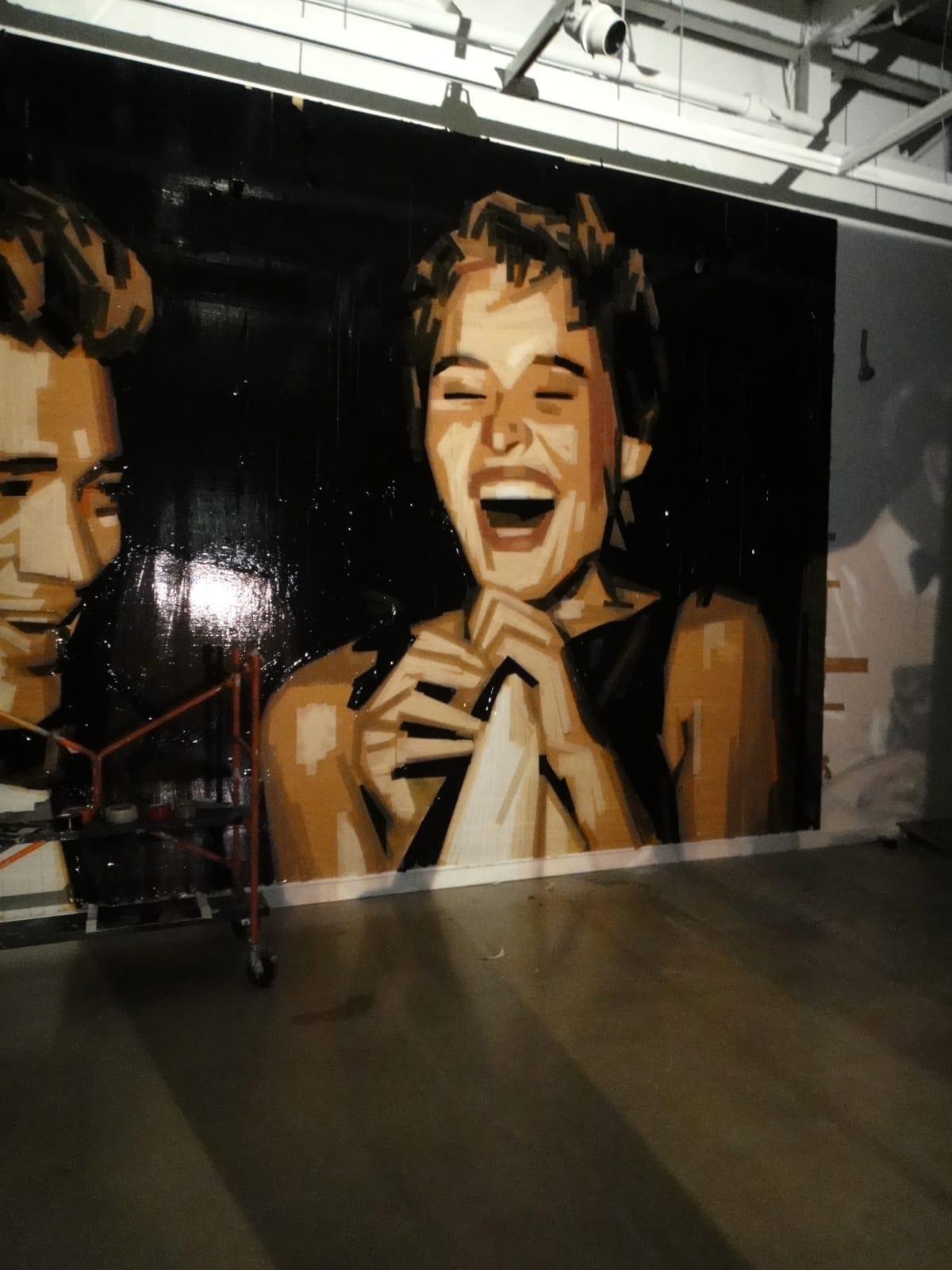
If that sounds confusing at first, a perusal of the sprawling display along the far wall of the Philadelphia gallery adds some clarity. Khaisman’s centrepiece is so large that it effectively transforms the tape into oil paint. It’s a reproduction of a famous black-and-white snapshot taken in 1955 of Hollywood stars James Dean and Ursula Andress, laughing while out on a date. As Khaisman and I discuss his work, a woman strolls out of the gallery and introduces herself. Her father is a photographer, she says.
“Those smiles in that picture,” she raves, “it’s so hard to capture the moment of a joke like that, even as a photographer. It’s such a beautiful, unguarded moment.”
Khaisman thanks her for the compliment. “Yet this picture was not ambiguous at all,” he quickly adds, “it’s just two young people out together. Happiness was documented.”
What shines most brightly in this image is its mix of cultural iconography and gesture. For Khaisman, this is an identifying characteristic of contemporary art. Networked into our visual memory, these images beckon us to become participants in the artwork’s authorship.
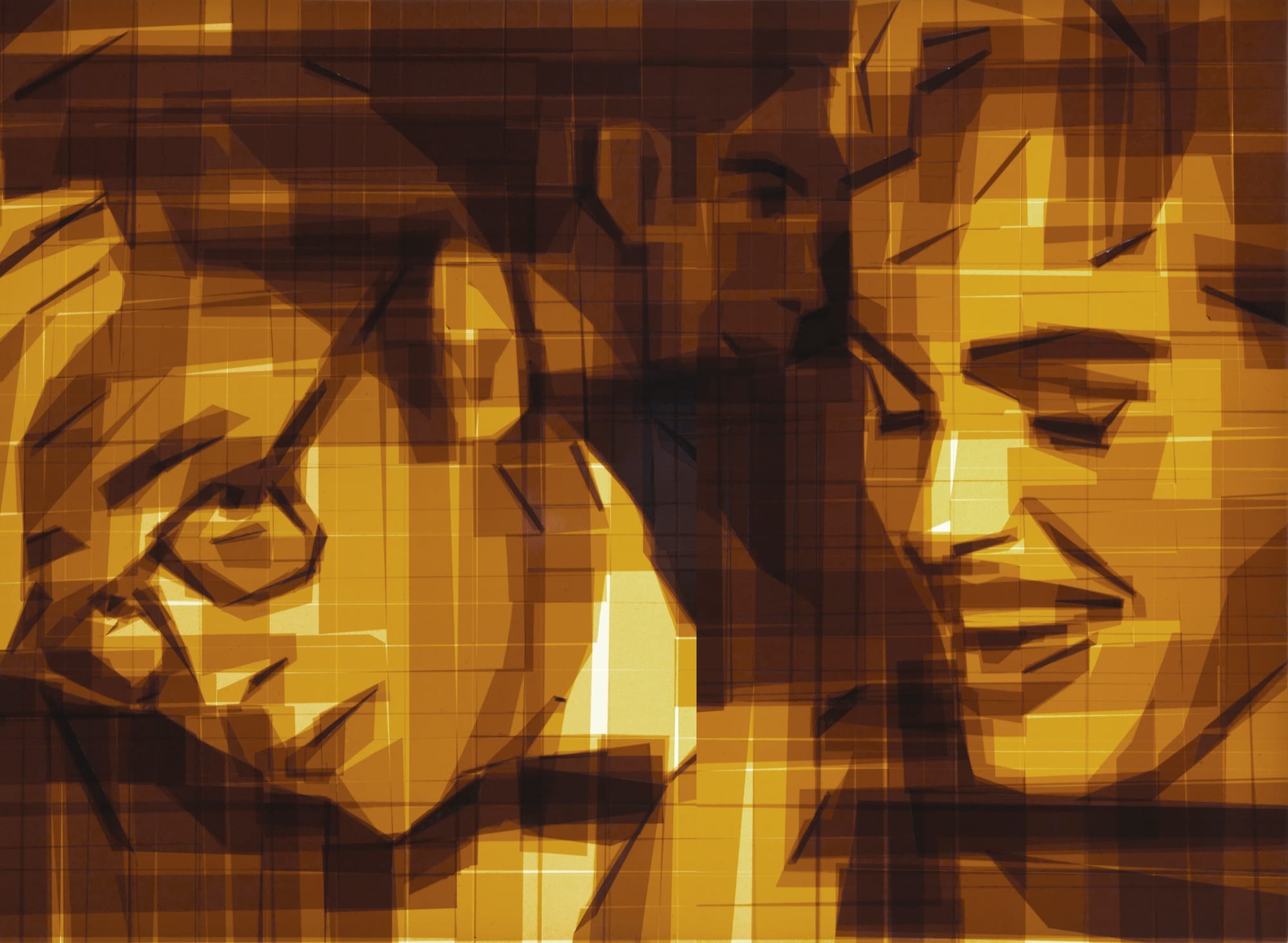
“I think of what I do as post-digital in relation to art,” he explains. “It’s a hand-made experience, a materialisation of virtual things.” Khaisman likens the appearance of his pieces to low-resolution JPEGs or rather, to images reprocessed out of pixilation altogether. Typically byproducts of technological culture, his subjects induce a state of apprehension both preceding and advancing from the contexts in which they were conceived originally.
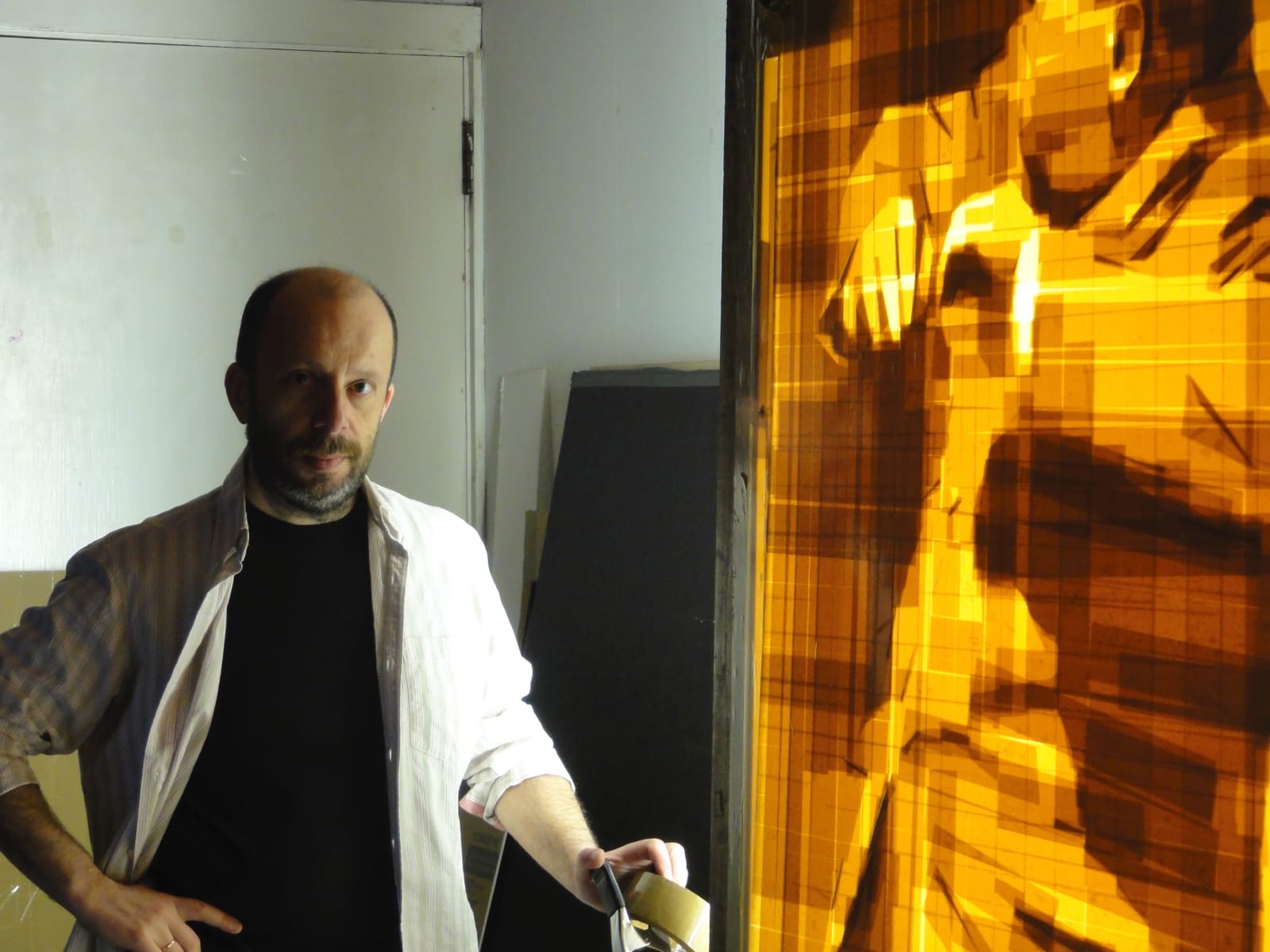
“Early on, before DVDs, I used to pause VHS tapes,” Khaisman says, referring to his practice of picking stills from movies, usually film-noir classics. “This was always interesting to me because when a film was paused, it was like it was stuck but trying to go, jittering between past and future without a present, just an unstable tension.”
It is the presence of this tension in his work that shapes its exploration of our cultural fixations. From status symbols, like his Birkin bag series to the stylised actors he grafts onto light boxes, Khaisman’s images exemplify the elastic temporality that informs our multi-layered understanding of today’s world. There is a blurry romanticism in his work that renders familiar feelings strangely alien, yet inviting.
“I don’t really like emotional images,” he says. “I prefer ominous figures presented as if in a game of chess, like pieces in a frozen battle.”
Because Khaisman’s images glow with suspense, their stakes and possibilities in turn ascend. Whether dramatic or mundane, his works confront us with the dilemmas of illusion, luring us into his game, to push ‘play.’ And like the title of one of the films from which he’s drawn instructs: don’t bother to knock.