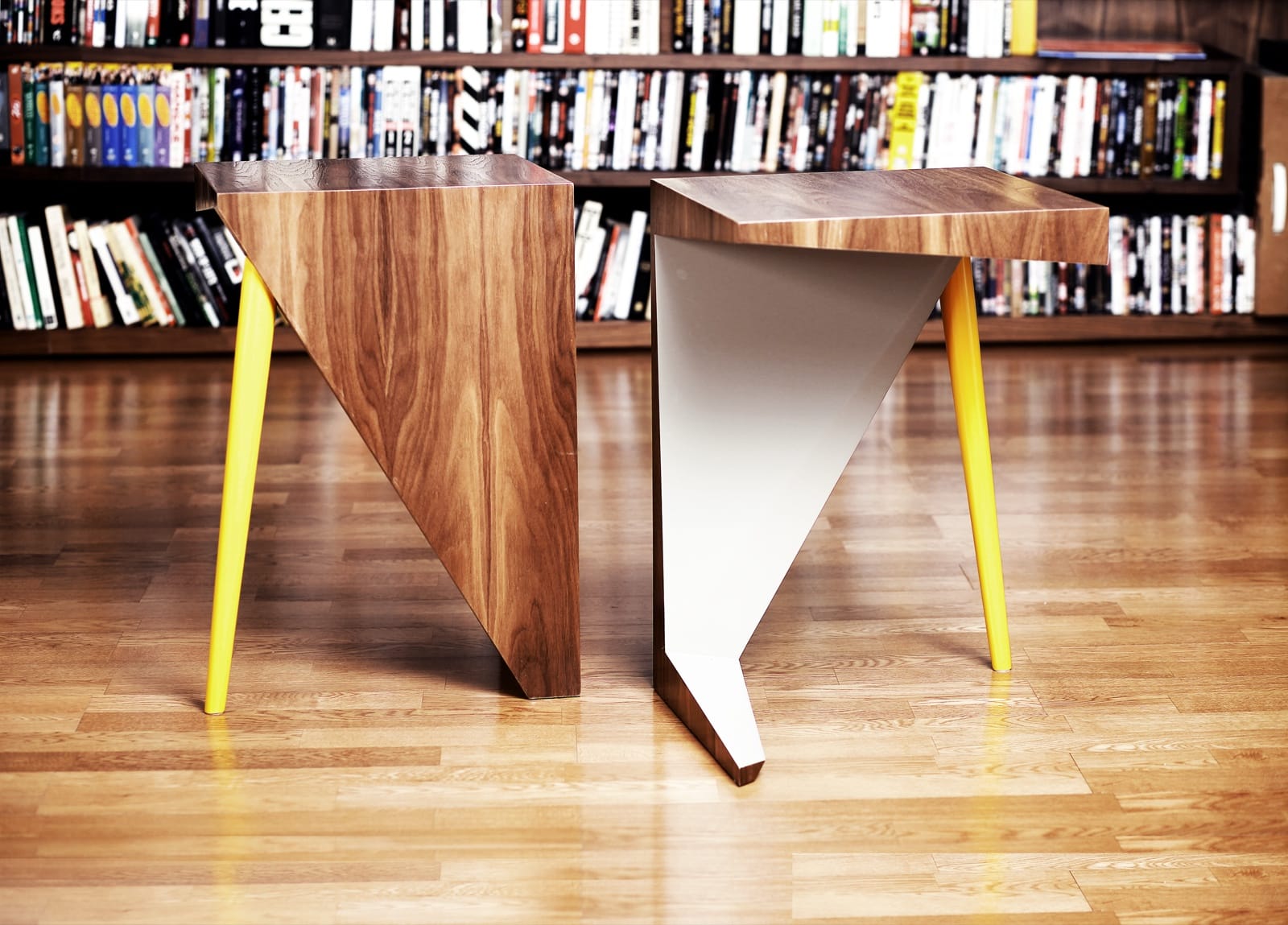
At first glance, Fadi Sarieddine’s furniture seems brutal. It has hard angles - sawn-off diamond planes stretched and reattached to create crystalline shells for coffee tables and beds, work desks and bars. His creations take on dimensions that seem antithetical and heavy, or somewhat impractical in the spaces they inhabit. But the more you look, the more magnetised you become. The angular composites of crazy origami surfaces seem to follow their own lines, like the first architectural doodles of something experimental.
Then you see what they can do. Touch leads to play, play elicits conversion. If the lopsided bookshelves and fallen-over cabinets seem ungainly, a panel or cupboard shifts, and clean console becomes a slick bar top with side drawers that reveal decanters and flutes. A jet-black coffee table yawns from its centre, revealing racing red insides and more nooks, more crannies. Suddenly, we’re not talking about static furniture any more.
Like all self-respecting designers, Sarieddine doesn’t like the idea of being boxed in by any foregone ‘isms’ but he concedes to being a fan of Jacques Herzog and Pierre de Meuron, Philippe Starck, Jean-Marie Massaud and Jean Nouvel for what he says is their elegance, angles and playfulness. “The guideline for me is storytelling,” he tells me. “My pieces aren’t purely functional. They have a theatrical dimension to them. They invite you to interact with them, to engage. You first see minimalism but what appears to be minimalistic starts to unravel. Things start to pop out. It’s like a Transformer, in a way.”
There have been viral videos going around recently, of a company that produces innocuous looking home furnishings that ping and swivel to reveal altogether new pieces of furniture – cabinets and shelving, full-length beds and sofas with hidden storage, all falling out of a wall or out from under a chaise longue. To compare Sarieddine’s works with this sort of utilitarian shtick would be a mistake. His furniture is more about the change of moods and transformations that suit them elegantly. “Those things are very, very functional and they concentrate on the mechanism which dictates how they look. In the process, they lose their soul. I obviously use mechanisms but I always ensure there is a sculptural dimension. Hence a piece of furniture can also serve as sculpture.”
That’s certainly an accurate description of his work. Sarieddine’s pieces of wood look like they’ve come straight out of a design symposium. Part-architecture, part-concept prototype, these sleek and modular creations have been tempered for spaces that want to make a statement. There are shocks of neon planes to obliterate the greys and enamel whites. There are also standout elements in the gestalt; a bicycle wheel on an office desk or a bar surface that twists in a wave to become a suspended wine rack. And cabinets and racks that slide about to redraw the lines of furniture that a moment ago seemed anchored. In one example, a series called Plug-In Beds, side-tables and lights can be removed or attached on a whim, to the main bed frame. “I want to respond to the now,” he says of this edgy aesthetic. “Technology has plug-in elements to it, so I don’t see why furniture should be left behind.”
If there’s one thing Sarieddine is obsessive about, it is that none of his commissions should be bereft of this playfulness or interactivity. Having just completed the redesign of global courier company, Aramex and a revamp of runaway startup success, Just Falafel, Sarieddine says he has no intention of straying from his philosophy of minimalism and storytelling, just to secure a client. “We are not a commercial studio that will take on any project,” he explains. “The client has to want to use my furniture. But I don’t believe in this elitism that says I know more than the client. It is a fine balance between what the client wants and my signature style.”
Sarieddine is also guided by a notion of environmental responsiveness, which, contrary to what it might sound like, isn’t to do with an eco-chic. Coming of age during the war in Beirut, he remembers having seen a football stadium that was used as a refugee camp, with cows grazing on it. “So it was being used for something decidedly different from football. When a country is at war, everything is anarchic. Wheels were used to block roads and sandbags became part of the architecture. Chairs weren’t used to sit in but to reserve parking spots. This meant that I started to dissociate elements from their original functionality. Unconsciously, the relationship between function and form started to break, and this affected my approach to design.”
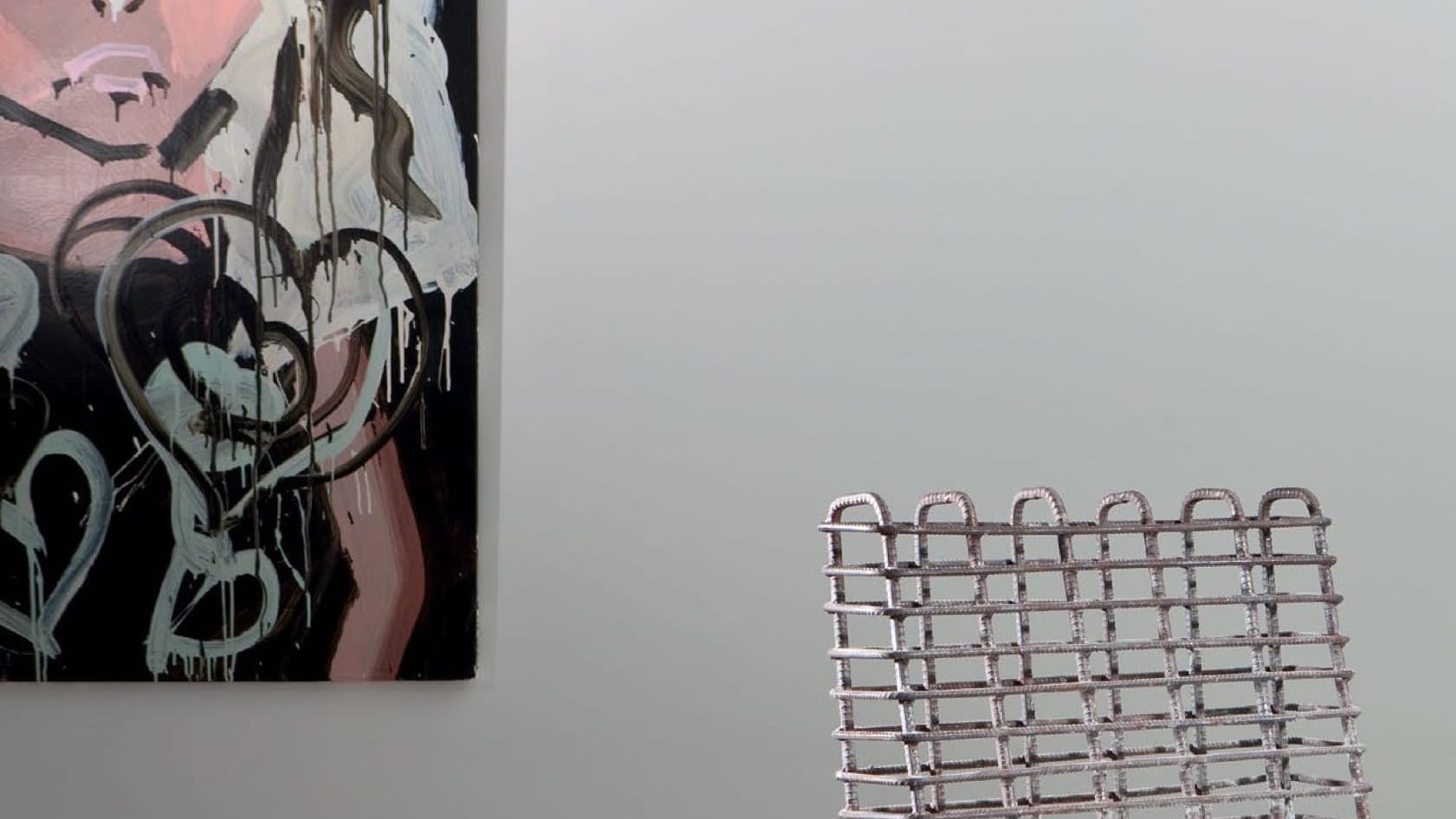
Summing up this thought for me, he then refers to a famous painting by Surrealist painter, René Magritte. It is the one of the pipe, which bears the quixotic scrawl ‘Ceci n’est pas une pipe’ or, ‘This is not a pipe’. An expression of this philosophy actually won Sarieddine an award when he created ‘Dubai Syndrome’, an unforgiving chair made from a block of concrete with a metal rebar as backrest. It was a comment on the ubiquity of concrete in the city where Sarieddine now runs his practice and on the structural material that is ever-present but also physically separate from people in their everyday lives. “I wanted to bring it closer to people. Wood or stone isn’t any softer, so I thought why not make a chair out of this basic material? It’s perfect for the outdoors.”
In fact, it was work on another award-winning structure that first diverted Sarieddine’s attention to working in furniture design full-time. “I was always interested in furniture,” he explains, “but as architecture is the mother of all design, I opted for that.” Designing the Xanadu Hotel in Bodrum offered the young architect its own challenges. “They did a lot of value engineering,” he continues, “which is doing away with all the designs the client felt did not add value to their project. This happens a lot these days. The architect used to be the real maestro. Now it’s the developer and the process is polluted by engineering and cost planning. This is what drove me away.”
Today, Sarieddine’s eponymous studio is busy finishing up designs for the interiors of the largest gym in the Middle East, at Dubai Sports City. Spanning a cool space of almost 5,000 square metres, it’s not bad for a design firm run by Sarieddine, his wife and two other interior designers. “I thought it would be a quiet summer but it hasn’t been,” he adds.
As our conversation draws to a close, I ask Sarieddine if I’ve got everything. He says he thinks I have, before leaving me with a final thought. “My furniture is like a book. A book by itself has a very pure shape. But it unravels. My furniture is about shape and function. Each user rewrites its story because everyone uses it in a different way.”