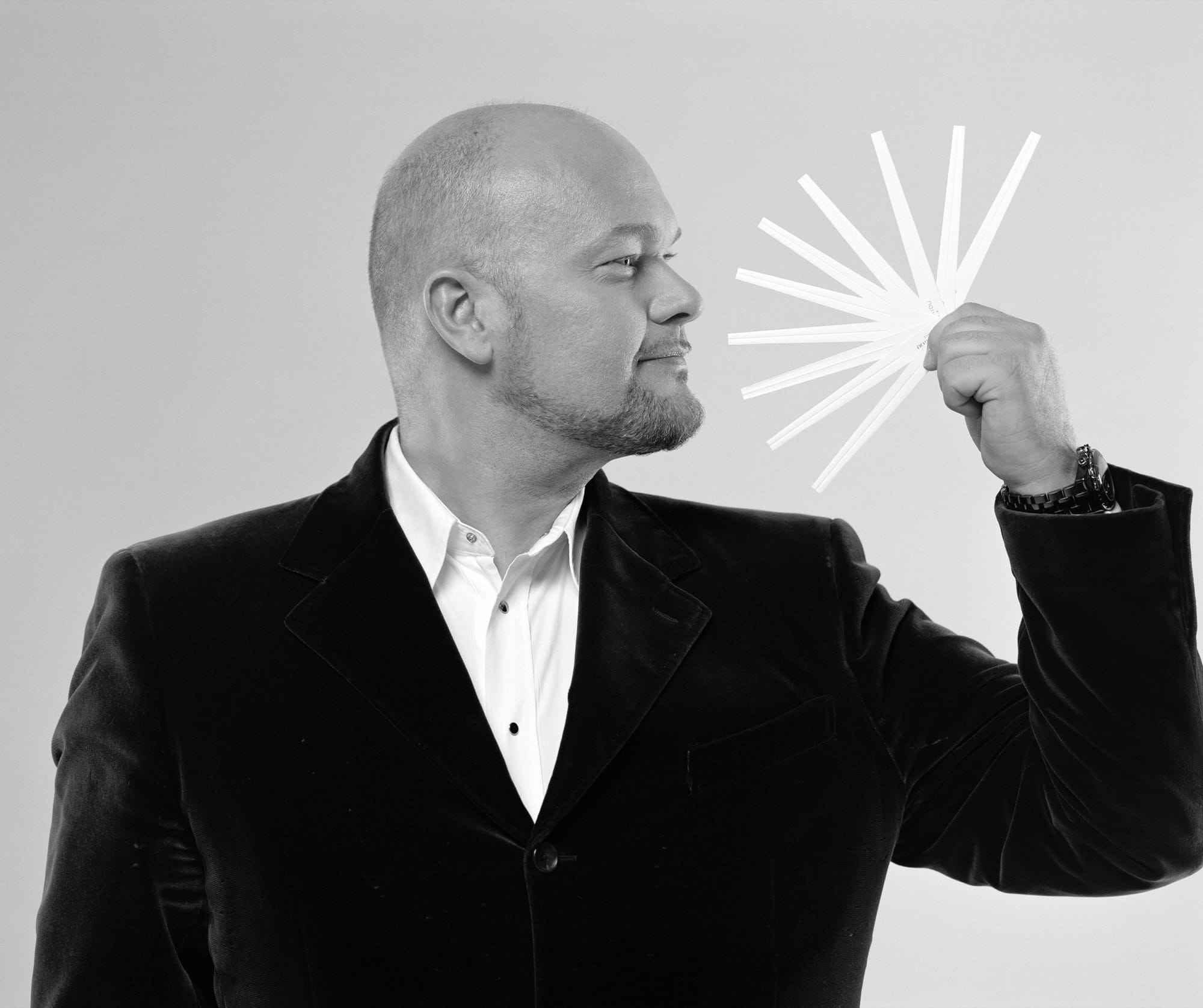
It’s not everyday that you can make a career out of having an astute olfactory palette. In fact, only three of the world’s perfume houses make bespoke perfumes – Cartier, Jean Patou and Guerlain – and only the first two can boast an in-house master perfumer. So the opportunity to actually become one of these revered ‘nez’ does not come around very often. But when long-time friends Cartier’s Mathilde Laurent and Jean Patou’s Jean-Michel Duriez were contacted to be noses, they couldn’t have been more smitten.
Laurent’s life in Paris, Normandy and Corsica, and Duriez’s childhood visits to the Northern Amiene region of France, influenced their olfactory schooling thanks to an “awakening to nature” as they put it. A witty man, Duriez recounts how as a child he would visit little perfumeries and ask for samples – not just for their fragrance, but also for their fancy bottles. His first naïve experiment saw him cropping mint-leaves and rose petals then adding alcohol, “Hopefully, my perfumes smell better today,” he jokes. In turn, Laurent remembers Corsica’s fig and amber trees, “I never knew I’d wind up being a perfumer, but – at the same time – I always did,” her husky voice lively with enthusiasm.
Laurent was scooped up by Jean-Paul Guerlain following a spell at her (and Duriez’s) alma mater ISIPCA Versailles. Eleven years later Cartier recruited her to become its nose in 2005. In a similar way, Duriez started at a suburban company and later joined an Asian corporation whose perfume lab operated from Paris. Following Duriez’s stints for fashion tycoons like Yohji Yamamoto and Lacoste, he was handpicked to become Jean Patou’s nose in 1997. Duriez brought back the House of Patou’s vintage perfume bar; only this time the master perfumer isn’t just a bartender that blends perfume-cocktails – on the spot – from 12 essences. The process is a more intricate, timely, and personal one.
Whereas Laurent sits with her clients for three hours and has them verbalise their olfactory life-story, Duriez takes on a field-work approach. Duriez’s client is first taken around Paris by limousine, “To smell the air, visit spice markets, patisseries, pastry shops, charcuteries, and clothing stores,” he explains. Laurent prefers to give her clients utmost privacy and only asks for the facts. “We sit in my clean air office and chat. That way, I don’t risk my client smelling something that could divert them to choose a fragrance that isn’t right for their persona,” she explains. Truth be told, many of us enjoy whiffs of a particular scent – like orange blossom – on someone else, but will never feel right being in it.
Duriez and Laurent meet with their clients somewhere between three and ten times over the course of a year, in order to fine-tune the perfume’s sketch into a truly wearable one. So as not to damage their noses, the master-perfumers jot down every ingredient then their assistants see to the mixing of the perfume sketch. In Duriez’s case, the sketch is served at the perfume bar in a cognac glass, whereas at Cartier it is served to the client in a stylised bottle. Those “sketches” are akin to “fittings” that test if you could truly wear the perfume, rather than have the perfume wear you out! “With perfumes, you have to be meticulous with your ingredients, but to discover novelty, you have to be playful in life,” explains Duriez.
Laurent, an iconoclastic character, agrees, “I keep playing with and breaking traditional ingredients, until I feel that the client is in love with the perfume. The second we reach that point, I just stop and order that it be packaged in two 500ml bottles”. Duriez jokes that if he doesn’t set a twelve-month limit for his haute-perfume quest, neither he nor the client will quit trying to better the sketch. At Patou, the perfume comes in a one-litre Baccarat crystal bottle that looks like an ice cube and weighs 14kg. Seeing as the bottle is too heavy to be carried, it also comes with two smaller 90ml and 15ml purse-size refill-bottles in Goyard vanity cases.
And although it takes 10,600 jasmine flowers and 28 dozen roses to produce an expensive perfume like Henry Alméras’ Joy for Jean Patou, today’s bespoke perfumes are more expensive and their ingredients are even rarer. “At Cartier, we don’t factor in the price of the rare ingredients; it’s the price and time it takes to make the creation,” says the passionate Laurent. Duriez concurs that it is not so much a problem of money, but a new proposition that people aren’t yet ready to digest. “People pay double that amount for a flashy car, but in light of the ready-to-wear culture, bespoke perfumes are a niche concept,” he says. Apparently, Jean Patou owns land in Grasse, an area close to Cannes where the company grows its own flowers.
Speaking of expensive perfumes, Laurent believes that there is no such thing as cheap perfume. “The one you love is the perfect one for you. Take The Body Shop’s genius White Musk perfume, although it is affordable, it is very difficult to find such a knot in other perfumes,” she says romantically. Duriez agrees, “A perfume is a companion. It’s like marrying someone – a loyalty.” But what about people that marry too many perfumes? “It depends, do you want to send the same message about yourself to people, or do you like to promiscuously pleasure your nose with different scents?” Duriez quips.
“As a rule of thumb, ground-zero of your scent palette is when you smell your clothes,” says Laurent, who rarely wears perfume, let alone a bespoke one. Duriez also prefers to stay aroma-free, “As a nose, it is too pretentious to wear bespoke perfume. It’s like when a shrink wants to treat themselves. It doesn’t work this way; he has to see another shrink,” he laughs. Agreeing that perfume is a delicacy that shouldn’t overshadow the wearer, Laurent and Duriez avoid commercial scented products and only wear perfume on holidays.
Both their offices are scent-free and far from the labs where their assistants see to the perfume mixes. “Our assistants are a crucial part of our job. My husband is my partner at home and my assistant is my partner at work,” jokes Laurent, who says that she has made a bespoke perfume for her husband, but that her children are far too young for it. Having recently given birth to a second baby-girl, she insists that the hallucination of smells during pregnancy is bogus, “If anything, your ability to smell is heightened,” she says.
The worst place to choose a perfume is at a Duty Free or fragrance store. “The pollution of odours is so intoxicating that the nose can’t catch a perfume’s real scent,” explains Laurent, “I feel bad for people who work there because they must be exhausted from the smells.” According to Duriez, the nose doesn’t need to be cleaned up, as it is at the same place that you breathe, so you can’t really disconnect the two functions. “If your nose disconnects, it is not your nose that’s tired, it’s your brain that’s tired,” he points out.
Contacts
Cartier
XXXX
XXX
XXX
Boutique Jean Patou
Paris, France
Tel + 33142920722
HYPERLINK "http://www.jeanpatou.com" www.jeanpatou.com