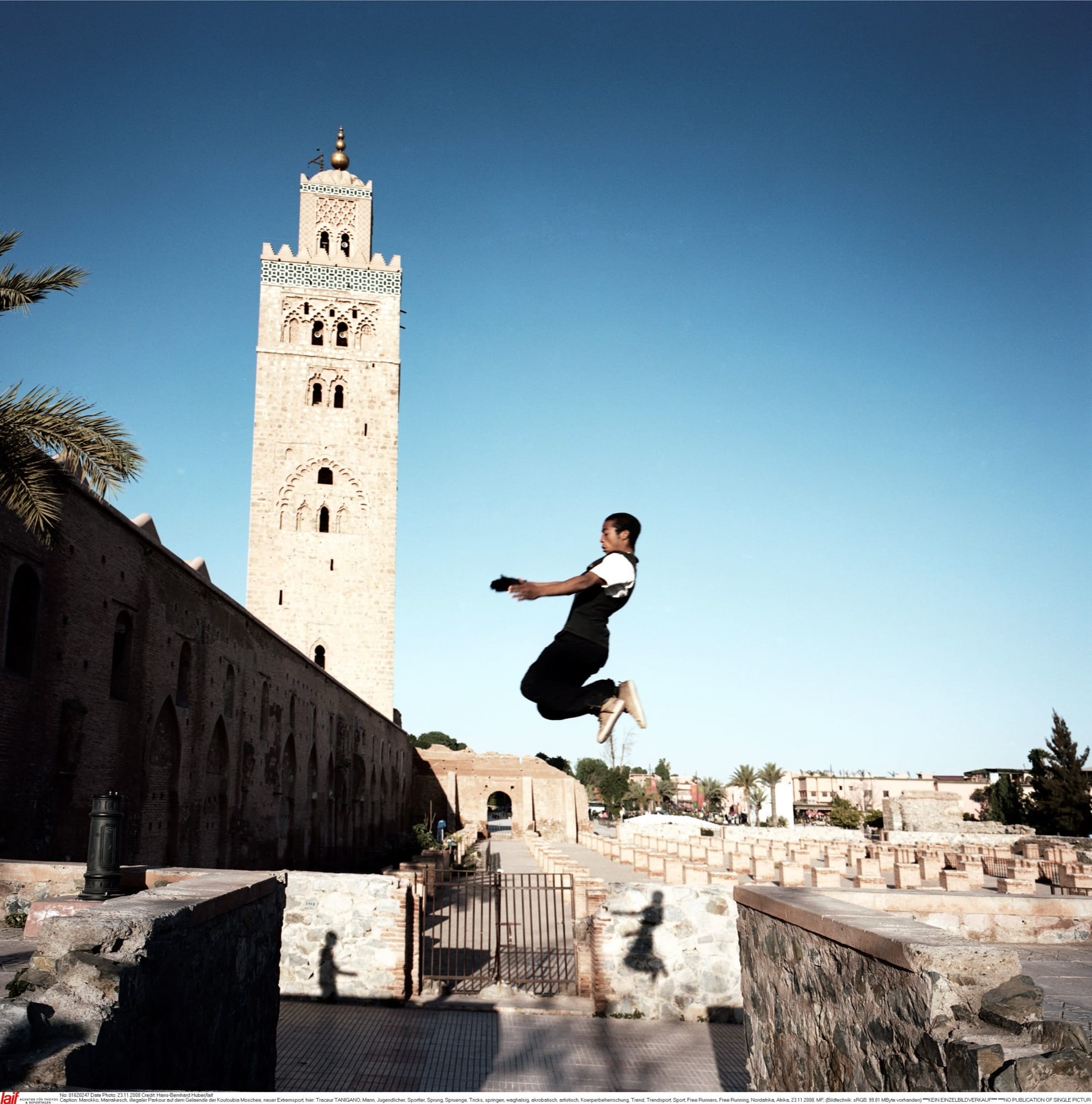
Thirty degrees in the shade, in a dusty, noisy, overcrowded city. Marrakesh is an exhausting place, even if you’re just wandering leisurely around its labyrinthine lanes and squares. But doing parkour here? This must be one of the most difficult places in the world for the traceurs – the people who participate in this sport - not to mention the fact that the city’s best locations for stunts also happen to be government buildings where parkour is banned.
Parkour is the ability to move in a straight line from A to B, surmounting any obstacles that happen to be in your way – fences, railings, walls, whole buildings even. The idea is that you should flow like water over these barriers. Practitioners call themselves traceurs, which some link to the word “bullet” on account of its unstoppable movement.
This form of urban acrobatics caught on in cities around Europe and across the world but seldom grabbed the attention of the press, and always remained on the edges of mainstream urban sport. But things started to change in 2001, when a disagreement among the founding members led to a split, which catapulted the Parisian traceurs to stardom and made parkour one of the most exciting cultural phenomena of the 21st century. Europe was merely the first step and now parkour is alive and well in our region, having arrived via the gateway that is Morocco.
The crews of Marrakech have names like ‘Parkour Tigers’, ‘Cats Dark’ and ‘Parkour-Kech’. Most of them have by now uploaded clips of their stunts to video-sharing sites that are being copied by kids around the world. In April of this year, the country held its first International Parkour Day. The Moroccan Federation of Urban Sports organises such events to promote and bring greater visibility to urban sports such as rollerblading, skateboarding, parkour and BMX’ing. The event was attended by traceurs from across Europe and attracted considerable media attention.
Morocco is still a country in which people tend to be shy about doing any kind of physical sport in public, but urban sports have taken off in recent years. In the evening, when the sun sets at seven and the heat of the day loses its intensity, young people emerge in parks, congregate around residential buildings, warehouses and large government buildings to perform their stunts.
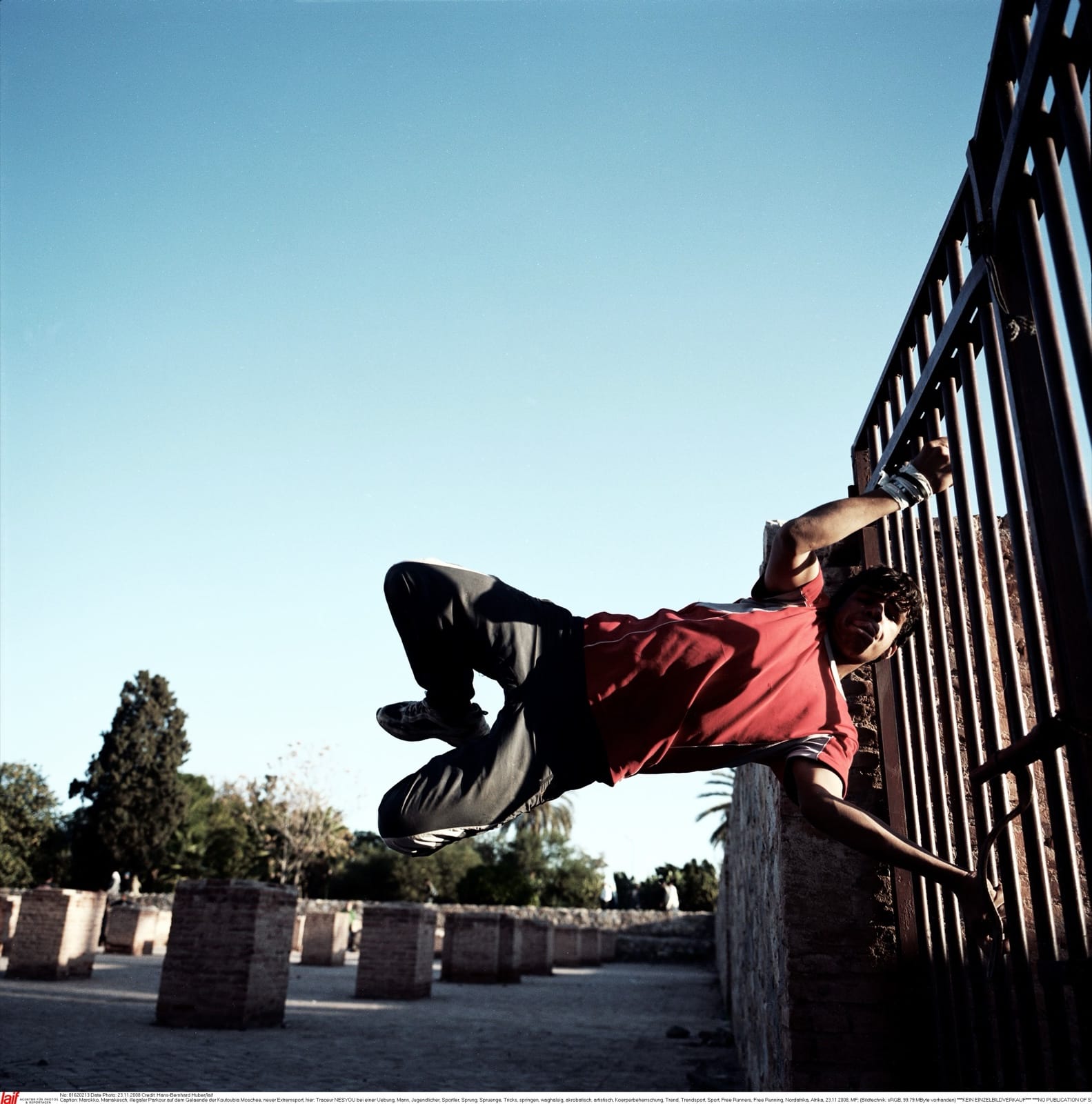
While other crewmembers of ‘Parkour-Kech’ concentrate on their moves, Tanigano keeps a look out. As soon as the coast is clear, he gives a signal and the traceurs begin: cat balances, double kongs, speed vaults, 360 wall runs, palm spins and flags among the ancient walls, the palm trees and official gates. There is real tension in the air, but these young Moroccans are not anxious about their stunts.
The reason for this excitement is the choice of location: they are free running at one of Marrakech’s governmental buildings. Here parkour is illegal. The sun is setting, the workers have long gone, the bureaucrats are otherwise occupied and most people are having dinner. Nesyou has sprained his hand, or torn a ligament, he’s not sure. A hand spin that went wrong. Nothing serious, he assures us. Certainly nothing that could stop him free running through the city’s parks and grounds.
Isn’t it a bit disrespectful, I ask Gadinaro, after he has demonstrated an amazing balancing act, followed by a somersault from the gates of the building’s front courtyard; this is, after all, a government building.
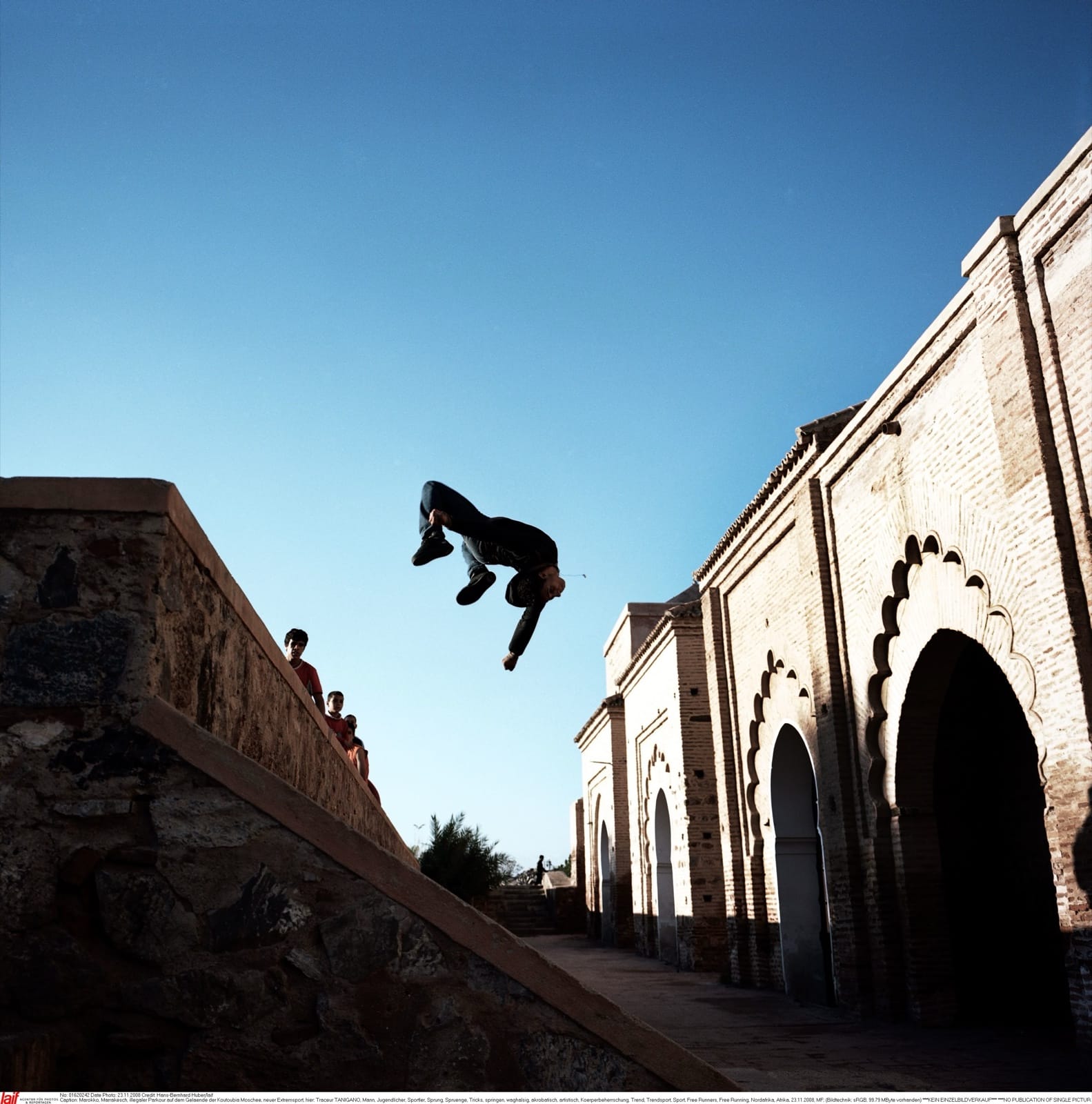
Gadinaro, Mohssin and the others just give me blank looks. Why should it be offensive? They are not doing anyone any harm or damaging the property. It’s a way of life, says Achil, the youngest in the crew who’s been doing parkour since he was a child. He is now a member of one of the most respected crews in the city. Young kids are trying to copy the ‘Parkour-Kech’ group who are now idols in the eyes of the city’s youth.
The seven young men that make up the gang are all from poor families, like most of Morrocco’s traceurs. Urban life is in their blood, so it’s only natural that they have developed such survival skills in their urban environment. These youngsters know every inch of their city; they know the best locations to perform their tricks – and how to avoid being caught by the police while doing them.
“Impossible is nothing!” says Tangiano. He’s quoting a common philosophy among the city’s youth. They may come from impoverished backgrounds, but parkour makes them believe that anything can be achieved: “I really believe that in this life we can be anything, make anything happen if we put all our energy and our heart into it...” Though most of these youngsters can barely read or write, their language is filled with phrases of hope: “Look to the stars and the heavens”, “Make all your dreams come true”.
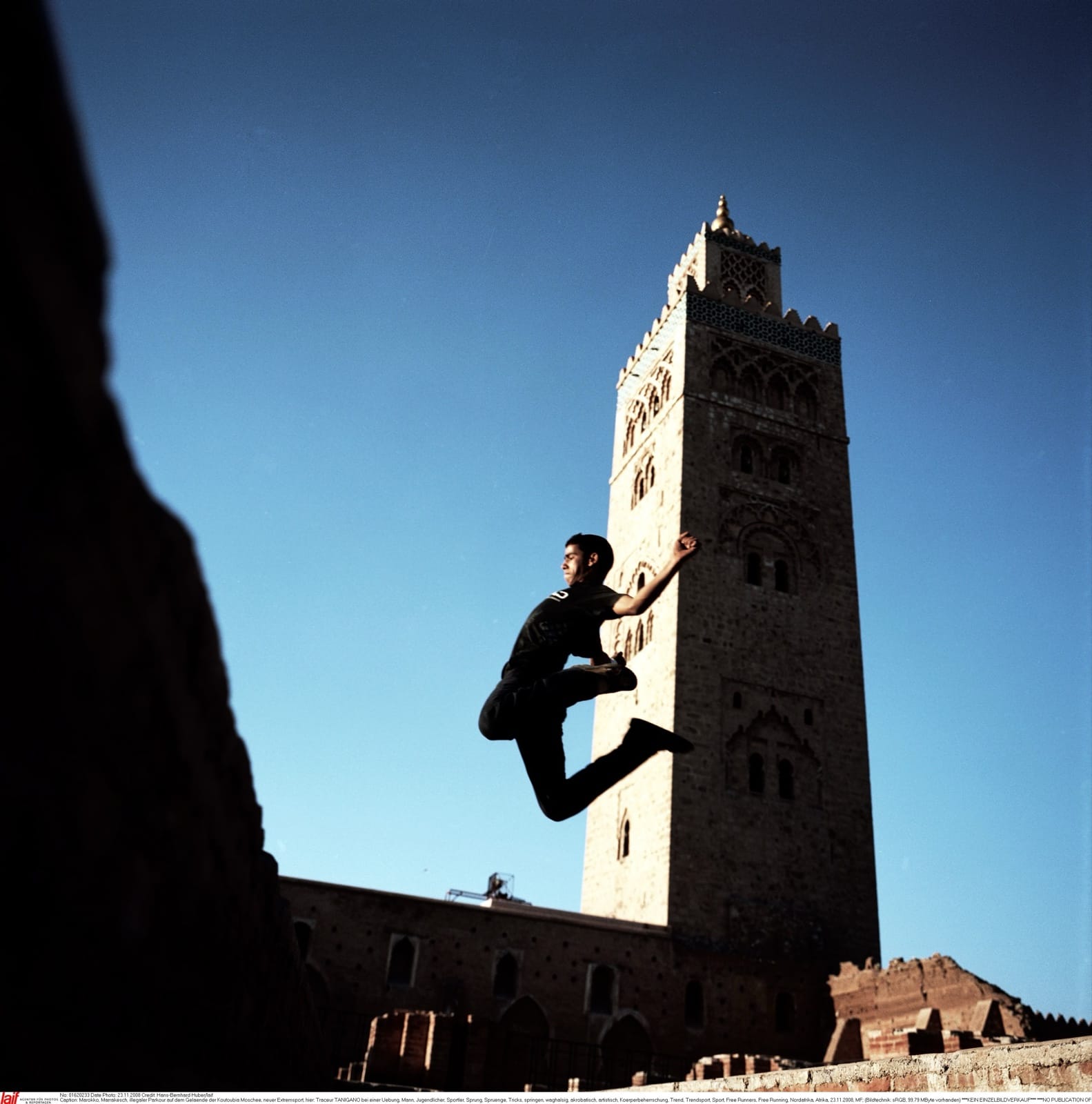
The Kech-gang and all their “family members” have turned city life into an art form, a sport, a way of looking beyond the dirt in the streets and concentrating on their own spirit. They look out for one another. Morocco is gripped by parkour-fever: from Marrakesh to Casablanca and Agadir. It’s a sport that doesn’t cost anything to do, you don’t need any special equipment and it promotes communal awareness.
Though there are a number of standard moves to help the traceur approach an obstacle, the idea behind parkour is that you develop your own style, your own particular form of moving over, along, and under obstacles. As everyone has different strengths, it makes sense that parkour should place emphasis on individuality. The standard moves are really just a start – something to be adapted and refined, and everyone will do it differently. There are no objective criteria for judging the most efficient way to jump over a wall – everyone will have his own personal way that is most efficient for them.
Suddenly, as Tangiano is about to perform a flag, a shrill whistle blasts out from the direction of the Djemaa el Fna. Yesou, Achil, Gadinaro, Mohssin and the others disappear, leaving not even a cloud of dust. These are, after all, masters in the art of movement. It takes only seconds and the courtyard of the building is deserted. Seconds later a policeman comes running around the corner, blowing his whistle. The overweight man is panting heavily and struggling to catch his breath. He looks around, trying to spot the traceurs, but sees no one. The sweat is pouring down his face. He takes a handkerchief out of his pocket and wipes his soaked brow. He never really expected to catch any of the traceurs. He couldn’t, even if he tried. That was why he blew his whistle – to scare the youngsters away. He knew that by the time he got there, the traceurs would have long gone.