At the end of January we flew to Geneva to attend the 25th instalment of the invitation-only Salon International de la Haute Horlogerie. For those unfamiliar with the show, the SIHH was created by Richemont as an antidote of sorts to the circus of Baselworld. At the start it included just five brands within 4,500 square metres, but it has blossomed tremendously since, and this year there were sixteen companies in attendance, of which eleven and a half are now part of Richemont, the half being a joint venture with Ralph Lauren, spread across 40,000 square metres of very slick presentation space.
Naturally, it was not all sweetness and light, and the 1970s Swiss watchmaking crisis remains firmly in the memories of most. Some of the latest worries include a decline in wholesale demand in China, the threat of deflation in Europe and the undetermined repercussions of low oil prices. Yet the biggest question on every manufacturer's mind was to what extent the strong unpegged Swiss franc, which now has parity with the euro, will affect their profit margins.
The great news for our region, if you will allow us some chest-thumping, is that the rest of the world is wising up to our importance. The Middle East accounted for 1.87 billion dollars of Swiss exports, whereas China only mustered 1.76 billion. Take into account that our population is but a fifth of theirs and you will see that, though they might boast a larger number of luxury buyers, we have the ability to dig deeper into our pockets. This is why Swiss watchmakers now look upon us when they want to sell their most rarefied creations.
There was a definite theme of slimming down. With Jaeger-LeCoultre, Chopard and Zenith getting in on the act, we are seeing a clear rise in the popularity of ultra-thin watches, though no one has been doing it longer or better than Piaget, which has been at it since 1957. The other surprise came from Montblanc, which, beating Apple to market, became the first brand to combine smartwatch functionality with the beauty and integrity of a Swiss mechanical timepiece, recognising a synergy rather than a rivalry between the two worlds.
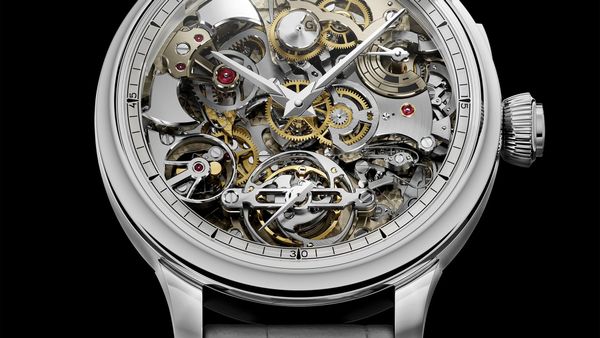
Among the show's most ambitious complications, Jaeger-LeCoultre made the moon-phase mechanism the centrepiece of its new releases. The maison explained that a regular moon-phase watch will be off every two and a half years and a perpetual calendar every 122 years, so it set about finding a better solution: an ultra-accurate moon-phase version of its multi-axis tourbillon that will only deviate by a single day every 3,887 years. A. Lange & Söhne, meanwhile, marked the 200th anniversary of founder Ferdinand Lange by subtly redesigning its twenty-year-old Lange 1, while unveiling a minute repeater that took five years and six patents to develop.
Anthony de Haas, director of product development at A. Lange & Söhne, explained that the brand never works to an agenda or a target date but thinks in terms of projects, many developed in parallel, with the team meeting once a week for open discussion. The hallmark of a Lange watch, he said, is perfection, even in the smallest details. There are only twenty watchmakers in the world today who can create a grande sonnerie, he noted, and on pricing he was candid: a complication can look expensive until you factor in seven years of development and a year to build a single piece.
Janek Deleskiewicz, artistic and design director at Jaeger-LeCoultre, described the house as a traditional manufacture of technically gifted watchmakers, deeply rooted in la Vallée de Joux, whose core principles are innovation and neoclassicism. The Reverso, he pointed out, is probably the world's oldest iconic watch, yet the aim is never to rely on a single line. You buy a Jaeger-LeCoultre, he said, because you identify your own character with that of the watch; the brand has succeeded if a buyer sees themselves every time they look at it.
If there was a single lesson from this anniversary edition, it was that the upper end of watchmaking has rarely been healthier or more inventive, even as the wider industry frets over currencies and demand. The brands that thrive are those making the rare and the exclusive, confident that for every truly remarkable piece there will always be a collector willing to dig a little deeper.