The excitement was building before our charter flight even landed in Brescia, northern Italy. The cabin attendants were handing out little Porsche branded sponge cakes, and the murmur of the motoring journalists that surrounded me seemed to shift up a gear as we caught a first glimpse of this beautiful part of Italy from 3,000 metres.
An auspiciously perfect landing later, I was looking forward to what I hoped would be a memorable speed date - 24 hours with the latest additions to the revamped Porsche 911 range, the Targa 4 and the Targa 4S.
This was a special occasion. You see, the 911 has always been my innamorata and although I have driven several before, it has never been as a critic or at an official world launch. Don't misunderstand me, I have many dream cars but there has always been something special about the 911. It is arguably the best everyday sports car you can buy. Of course this is undoubtedly the reason why everyone, from Steve McQueen to David Beckham, has owned one. But in spite of its ubiquity, I have never ceased to desire one. I mean who could resist an iconically beautiful sportscar, especially one that has withstood the test of time so well that it has barely changed over the last 40 years.
Once we hit the tarmac there was no waiting around for baggage, just the odd "bongiorno" from here or there and, before I knew it, we were on our coach headed for the hotel overlooking Lake Garda. If ever there was an ideal setting for my fling with the 911, this was it. As picturesque as a Francesco Zuccarelli painting, here we were at the foot of the Alps in the most jaw-dropping of backdrops made all the more special by those enticing, meandering country roads that stretched as far as the eye can see. The fact that we were just a stone’s throw from the city of Verona – the setting of the story of Romeo and Juliet, actually helped in lending a certain gravitas to this high-octane rendezvous.
Thirty minutes later we finally arrived at the hotel. As I was completing the checking in process I caught a premature glimpse of what was in store for us. Just beyond the Venetian glass doors were two dozen Targas. I dropped what I was doing, left my bags at the reception and eagerly approached the pack. Perfectly laid out, colour-coordinated, from dark to light with the Targa 4's on the left and the 4S's on the right. I immediately singled out my target - the yellow 4S. Strange choice I know, for it is historically Italian cars that look best in yellow but as I was so far from home I felt I could get away with being a little more brazen.
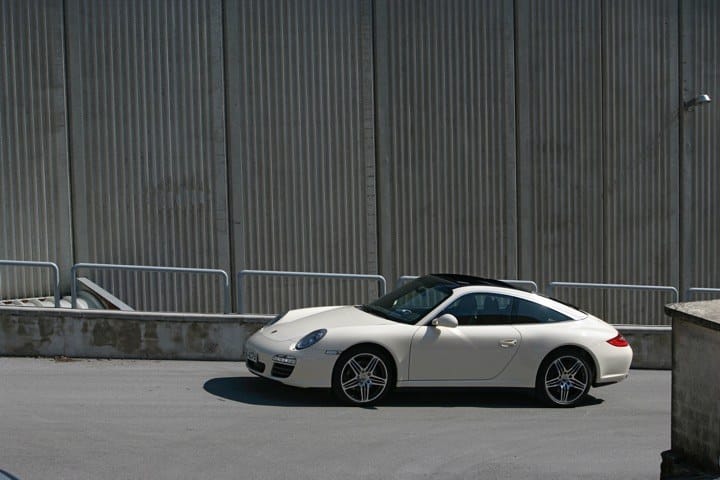
No matter the hue, the Targa is quite the looker. While it retains its legendary 911 shape, it has some unique new styling features. The side window line on the 997 Targa has been highlighted with a polished aluminium metal bar. This frames the panoramic glass roof well and gives the top of the car a more solid, less vulnerable look than the 993 Targa. Porsche have also incorporated the wider body into the design of the Targa and the wheel arches look like they have spent time beefing up at the gym. Indeed the car enjoys more visible power and muscle than its predecessors. The redesigned rear lights are definitely slicker than those of the outgoing model and they are now connected by a red reflective band that harks back to the days of old. This styling cue, along with the more prominent twin exhausts, accentuates the extra body width at the rear giving it ever more toned look from behind.
Another cool new element that will be common to all 911s is the front light treatment. Porsche has introduced some Audi-style LED daytime driving lights that add some visual drama to the package. These lights may have been developed as a passive safety feature to increase reaction times in allowing other drivers to better see you during the day, but they also give the car a more distinguished presence on the road.
The highlight of the car is clearly the panoramic glass roof which extends a full 1.5 metres from the windshield through the tailgate at the rear. Unlike the Porsche Targas of the 1980s with their opaque roof panels that owners stowed in the boot, the new design features an enormous sunroof that slides backwards, just beneath the rear window. This setup has three benefits, firstly it is now fully electronic, secondly the car retains a similar profile to the rest of the 911 range and lastly it offers vertical visibility even when the roof is closed. I also discovered one other useful aspect that you would no doubt cherish should you make the Targa your daily runner, the rear window can be opened like a hatch for exterior access to the backseat storage area.
I personally loved the Targa roof as it conveys an overwhelming feeling of what I suppose can only be likened to being in a cockpit rather than a sports car. When open, it creates a huge 0.45 square metre cavity above the passenger compartment which is perfect for the ‘tan & drive’ crew. For those with more sensitive complexions you will be reassured to know that the roof has a highly effective UV filter that protects occupants from excessive sunshine. The interior, as with most Porsches was nothing to get too excited about although it does have simple, clean lines and you feel well-nestled and amply equipped in the driving seat. The fit and finish is exemplary and I liked how the dashboard is now covered in leather rather than plastic. After all the 911 is as much a luxury car as it is a sportscar so you will find a user friendly computer console / satnav in addition to every other little extra you'd care to think of.
In regards to power this model is available as a 3.6-litre Targa 4 or a 3.8-litre Targa 4S. The better option to go for is, if you can afford the extra 10,000 USD, is the 4S as it copes effortlessly with the extra weight from the glass roof. With a maximum output of 385bhp the 4S will get you to 100km/h in 4.7 seconds and is good for a top speed of 297km/h. The new direct fuel injection system (DFI) improves both the performance and fuel efficiency of the car and makes for lower CO2 emissions. Additionally Porsche Traction Management (PTM) now replaces the regular all wheels drive system. It is an advanced driver aid system that actively distributes engine torque precisely where it’s needed most. The last significant addition to the latest Targa is the Porsche-Doppelkupplungsgetriebe optional automatic gearbox. Known as PDK, it is a double clutch gearbox with super quick shifts that replaces the former Tiptronic S automatic transmission making for better performance and responsiveness.
But I am sure that, like I was, you are eager to get down to the honest nitty-gritty. In a nutshell the Targa 4S is seriously fun to drive. Traditionally Targa drivers are supposed to be more into cruising than let’s say GT3 drivers for example and as a result Porsche slightly relaxes the suspension to increase the comfort but you’d never notice it.
I tried out the car in many different settings during my sojourn around Lake Garda. Indeed it quickly became apparent that the route Porsche had sent us along had been specifically selected not only for its vistas but for its melange of open autostrada versus winding country lanes. At the start of our journey we came across roads reminiscent of those where Princess Grace of Monaco met her tragic end. Amazingly however, the narrow country roads that unravelled from the cliffs encircling the lake, bending sharply left then right, hardly perturbed the ever neutral handling of the Targa. The PTM kept the car firmly grounded at speed even around the most unexpected of chicanes. The car was always responsive and oh so quick making overtaking an effortless process. It left me feeling as sure footed as a young Ronaldinho on the soccer pitch.
If truth be told, this car, as with other cars in the 997 range, is extremely forgiving. So much so that even the most inexperienced of drivers will quickly grow in confidence and develop a sense of mastery over the road and conditions. The bond grows when you find the open road and hit the pedal to the metal. As I watched the figures on the speedometer go well over 200km/h, I was suddenly aware that I barely had to grip the wheel, to ensure it went in a straight line.
Bottom line is that you have to think of the Porsche 911 Targa 4S as a more refined, distinguished cousin of the Carrera 4S. One that offers the safety and security of the closed coupé with the open-air fun of the cabriolet. It wants to spoil you and win you over. For a discerning driver that demands that little bit extra from a car, think of the Targa as a Diet Coke, on a hot summer’s day – its satisfying.