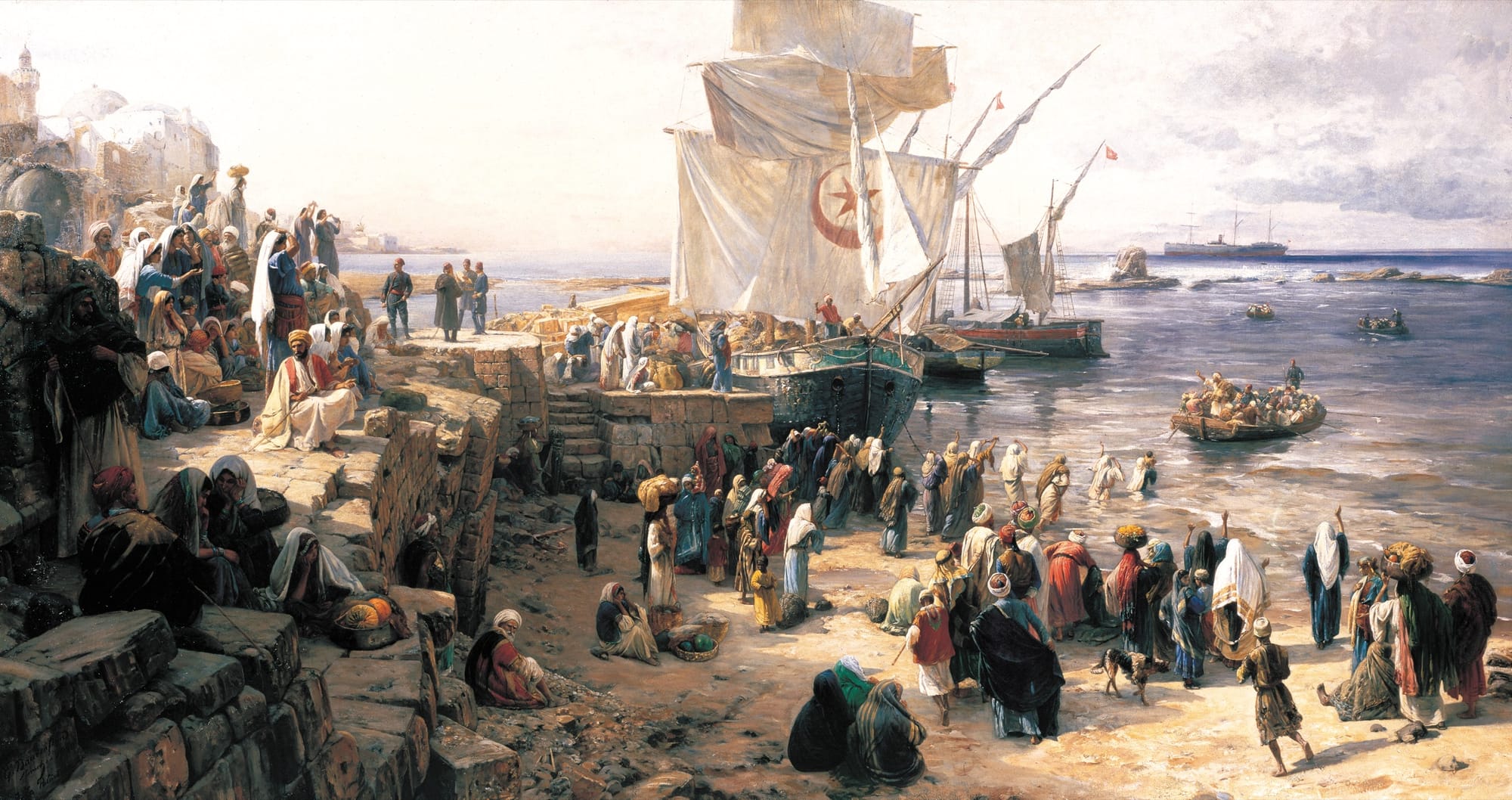
Islam and the West – despite the complex, often tragic history of these two parts of the world, for the past thousand years no region has been a greater source of wonder and a stronger influence on Western art than the Middle East. From the Great Pyramids to the Sahara desert; from ‘Egyptomania’ in furniture and interior design to ‘Turkomania’ in eighteenth century European fashion, to the West’s enduring fascination for camels, narghiles, and the romantic allure of the Bedouin nomadic life, the Middle East has for centuries lured Westerners to travel and has inspired their architecture, literature, music and fashion. Even today, despite global politics, the very names of the great cities – Cairo, Istanbul, Jerusalem, Damascus, Beirut – still beckon Europeans and Americans with the overwhelming desire to travel and to see them.
Perhaps the richest era of this long tradition of fascination was the mid-to-late nineteenth century, when painters from America and from every country in Europe travelled in and painted the vast cities and peoples of North Africa and the Holy Land. Napoleon’s ill-fated invasion of Egypt in 1798 had been a military failure. But the gifted team of artists and draftsmen who accompanied the ‘Grand Armée’ created a monumental body of work of thousands of drawings and etchings that, when published as Description de L’Egypte back in Europe, caused a sensation and laid the groundwork for the entire nineteenth century – the century of Orientalism. Soon, taking trips to the Middle East became the new rights of passage for many young painters.
Western artists travelled to Morocco and Egypt, to Palestine and Tunisia, painting city scenes, landscapes, and portraits. Hugely popular in their time, the major painters like French master Jean-Léon Gérôme, the American Edwin Lord Weeks and the Russian artist Vasily Vereshchagin were celebrities and enjoyed great prestige in Europe and America, where collectors eagerly bought their work. Until the end of the nineteenth century the Orientalists reigned. It was only with the change in taste for Modernism within the art world that the Orientalists working in the realist, academic style fell out favour. For much of the twentieth century, Orientalist paintings vanished from museums, galleries and collectors’ homes.
The presence of European governments for commercial or military reasons, mostly English and French, made it possible to make the trip in the first place, and new technologies like steam ships greatly sped up travel time. Many of the finest Orientalist paintings were created on the backs of colonial infiltration. The artists’ very presence in such countries was facilitated by the colonial governments in the city centres. This inextricably links Orientalist paintings to the arrogance and prejudice so openly displayed throughout the colonial era. And while there is no shortage of Orientalist work that reflects this cultural bias, there are many others that were clearly created by very open-minded artists who were perceiving the Middle East without the slanted viewpoints of their governments. Many of these pictures, created by American and Russian, French and German artists, are a unique visual record of what for Europeans was perhaps the most romanticised part of the world.
These late nineteenth-century Orientalists were painting exceptionally detailed pictures of ancient lands during the last days before Industrialism. With photography still in its infancy, academic painters could capture the traditional Middle East with its sunlight and all its bold colours in ways that cameras were not yet able. Beyond this, there is also certainly less of a tradition of representational art in the Middle East. Throughout the centuries, the great mosques and palaces were decorated with calligraphy and tile work, with patterns and design – rather than landscapes and portraits. What this means is that the Middle East has less of a visual record of its own past, compared to the West, with fewer depictions of its people or its cities predating modern photography. If you wished to discover what exotic cities like Cairo, Istanbul, Damascus, or Jerusalem may have looked like before the modern era, one of the best sources of visual record one could consult is within these paintings by Europeans and Americans.
Countries like Morocco, Algeria, Egypt, Palestine and Turkey were the most often visited. These countries are represented in countless paintings. But there are other regions that the artists painted – places one might never have expected Western artists to have reached – Afghanistan, Uzbekistan, modern-day Pakistan, Tajikistan, Persia (Iran), and even Iraq.
Current events do enough damage to the future. They should not have a right to distort the past as well. There are many things that can be learned from Orientalist paintings. There are many extraordinary works, often rarely seen, that can show a contemporary audience that in an earlier century, there were painters, many of them American, travelling alone or with a few friends, somewhere in the Islamic world, who would sometimes arrive upon a street or a landscape. And despite the fact that fear and antagonism already existed even then, they would put paintbrush to canvas and create something that showed how much admiration and simple human fascination can exist between Orient and Occident, Christians and Muslims, Islam and the West. Orientalist paintings, aside from being exquisite works of art, can also show a contemporary viewer that things have never been as simple or uniform as ‘us’ and ‘them’.