Waggishly dubbed in one famous travel guide as the country ‘best known for being unknown’, when you think about it, Qatar is actually known for quite a lot. Firstly, it’s floating on top of one of the largest gas reserves on Earth (which is currently making many Qataris richer than Croesus). Secondly, it staged last year’s Asian Olympics (outbidding Dubai in the process) and thirdly, it is home to two of the most potent political forces at work in the region today: the studio headquarters of Al-Jazeera International and Centcom, the largest US military base in the Middle East.
A fourth known, albeit one less well known, is that Qatar is one of the leading centres of horse breeding, or more specifically of Arabian horse breeding, in the world. Neighbouring kingdoms might organise the most expensive races in the world or boast larger collections of purebreds, but Qatar’s equine credentials are impressive for a very different reason. It is home to Gazal, Marwan and Al Adeed, the top three prize-winning Arabian stallions in the world today. More importantly, these horses weren’t purchased from western stud farms, they were bred down in Doha.
Mohanad Al Yaqout is the PR director at Al Shaqab, the stud that bred the three champions. Already the youngest licensed judge of endurance races in the world, he will also soon become the first GCC national to hold a degree in Equestrian Management.
My first impression of the stud is that it is less a farm than a building site. Al-Yaqout apologises for the disarray. Al Shaqab, he explains, is in the process of expanding, which is why there is dust everywhere and nary a Gazal or an Al Adeed in sight. “They are being stabled abroad during the construction,” he says, referring to the three champions. “Marwan is a legend in the US, everyone wants to use him for stud.”
This is probably why a single squirt of Marwan (in the wonderful world of horse-breeding, insemination is always artificial) comes with a hefty 500,000 USD price tag. Al Yaqout tells me the point is not to make money. “Al Shaqab is about promoting the name of Qatar. Those horses are good ambassadors for us.”
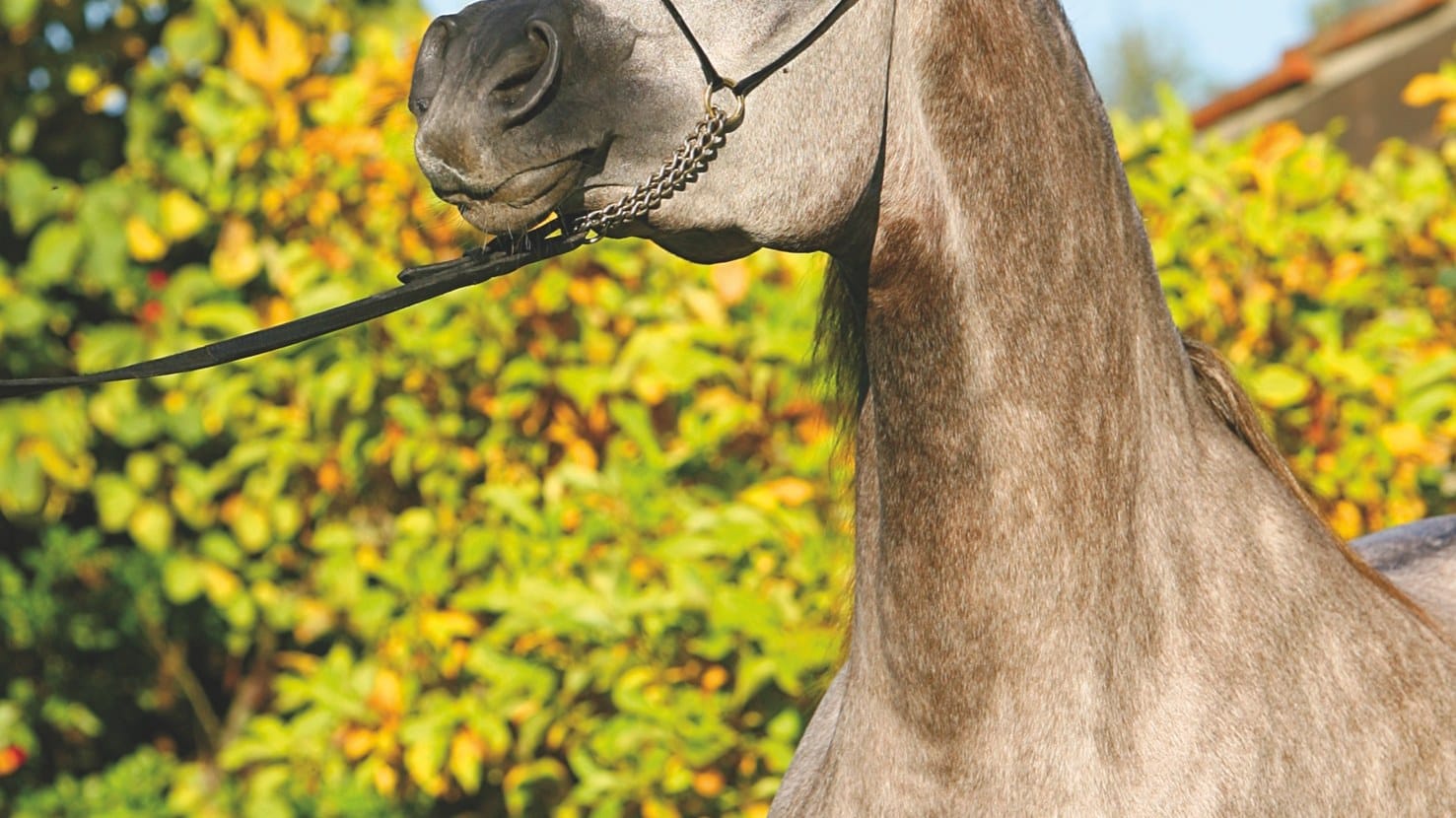
That’s an easy sentiment when your patron, Qatar’s Emir Sheikh Hamad Bin Khalifa Al Thani, is picking up the bills, but looking at photos of the three champions, I can see what he means. With their silky coats, huge eyes, crescent-shaped profiles, rippling muscles and gracefully arched necks, they are real hunks, equine Mr. Qatars all.
The Arabian evolved in an isolated environment, with little influence from crossbreeding. The resulting purity of their bloodstock is said to make them easier to breed, in the sense that it is easier to predict what genetic traits they will bequeath to their off-spring. Still, there are no guarantees. Thorough research, attention to pedigree and searching for bloodlines that most frequently display the traits desired helps, but breeders must be willing to experiment, willing to wait and willing to try, try again if at first they fail. “Sometimes a foal is not very beautiful at birth but a year later, it can change enormously and surprise you,” explains Al Shaqab’s Argentinean breeding and show unit manager, William Oppen. “It’s like Sheikh Hamad once said, breeding is patience plus patience plus patience plus patience.”
The Sheikh Hamad in question is Al Shaqab general manager, Sheikh Hamad bin Ali Al Thani. A soft-spoken, compact man with a firm handshake and the hint of a smile playing around the corners of his mouth, Sheikh Hamad founded the stud in 1992.
As he shows me photos of some of the 150 horses normally stabled at the farm, he speaks with an enthusiasm and passion that leaves little doubt that for him, breeding horses is much more than a profession. With undisguised pride, he casually mentions that some of most distinguished stud farms in Europe and America are lining up to breed their mares with Al Shaqab stallions. When I ask him the secret of his success, his smile broadens. “We are Arabs and we know how we ‘cook’ a good horse, so you can say [breeding] is our game,” he says as he hands me a brochure with Marwan on the cover. “Look at him, the Arabian horse is a work of art. You can’t ask an artist how he creates, he just does. Luck plays a part and so does the environment but these horses are in our blood, they are our culture, we know what to do with them.”
Beyond breeding ‘ambassadors’, Al Shaqab’s mission is to develop a purely Qatari Arabian bloodline. Until relatively recently, Arabian horses were a dying breed. The best stock had all but vanished from the Peninsula. Wars, booty raids – the Egyptians and Ottomans carried off thousands of horses in the nineteenth and twentieth centuries – left the Peninsula with severely diminished bloodlines.
As oil made them wealthy, several Gulf states began to buy Arabians from western stables, building impressive collections of prize-winning stallions. But until Qatar stepped into the game some 20 years ago, few invested seriously in breeding champions of their own. Now everyone is clamouring to follow in Al Shaqab’s footsteps, Saudi Arabia, Dubai and Morocco have all recently announced plans to mount equestrian breeding programmes and after years of decline, the Arabian’s future in the Peninsula once again looks promising.
Al Shaqab may be little more than tractor trails and half-built foundations right now but in two years time, it will be one of the best-equipped facilities of its kind. “All of this,” Al Yaqout says gesturing at what appears to be half of Qatar, “will be the farm. You’ll be able to see it from the highway over there.” The tract he sweeps his arm across is so huge, I’m tempted to suggest that once it is finished, you will probably see the new premises from space, let alone from the highway but I hold my tongue and merely nod.
He tells me that further discussion of the project is not possible and asks me not to write about what is being built anyway. I’m also asked not to mention how much money it is all costing. Suffice to say, the region will have nothing like it elsewhere and the budget is more than double the annual GDP of Monaco. I am puzzled by the desire for secrecy. I mean this is a stud farm we are talking about, not a nuclear power plant.
No one seems to be able, or willing, to tell me why it’s all so hush-hush but when I mention it later to a British friend who has been living in Doha for the last ten years, he says the reason is competition. “It’s all about the Maktoums,” he says, “the minute they hear about a project anywhere in the Gulf, they announce they are going to build the same thing in Dubai, only ten times bigger. Everyone is trying to out do everyone else.”
As my visit draws to a close, Al Yaqout takes me to the stable. It is almost empty, most of the horses have followed Marwan into temporary exile. “Let me show you something really special,” he says, heading for the far end. The air is sweet with the pleasantly pungent smell of horses, manure and straw. I notice that each stall is individually air-conditioned but then when temperatures exceed 45C for most of the year, I shouldn’t be surprised. We stop at what appears to be an empty stall. “There she is,” says Al Yaqout, “She was born right in front of me. I think she is going to be really something when she grows up.”
A foal no more than eight months old, struggles to her feet. One of Marwan’s progeny, she is a beautiful uniform charcoal brown colour. Her saucer-sized eyes are deep, black and penetrating. I get closer to the gate, hoping she won’t start. Unfazed, she turns and after eyeing me up, thrusts her face into mine. I reach out and stroke her velvety jaw and gently tickle her between the eyes. She jerks her muzzle forward. “She wants a kiss,” Al Yaqout says, a little surprised. “She’s not normally this relaxed around strangers, she must like you.”
If she does, the feeling is mutual. I unselfconsciously rub my nose against hers. It’s warm, dry and of course, a little fuzzy. She pushes her head forward again. She wants more. I laugh. I don’t get this sentimental with babies, even those belonging to close friends, yet here I am, utterly in thrall to a seven-month old horse.
My treasures, as one old Arab proverb goes, do not clink together or glitter, they gleam in the sun and neigh in the night. Wise men, those old Arabs. I think it might be love.
Contact
Al Shaqab Stud Farm
Doha, Qatar
Tel +974 480 0348
HYPERLINK "http://www.alshaqabstud.com" www.alshaqabstud.com