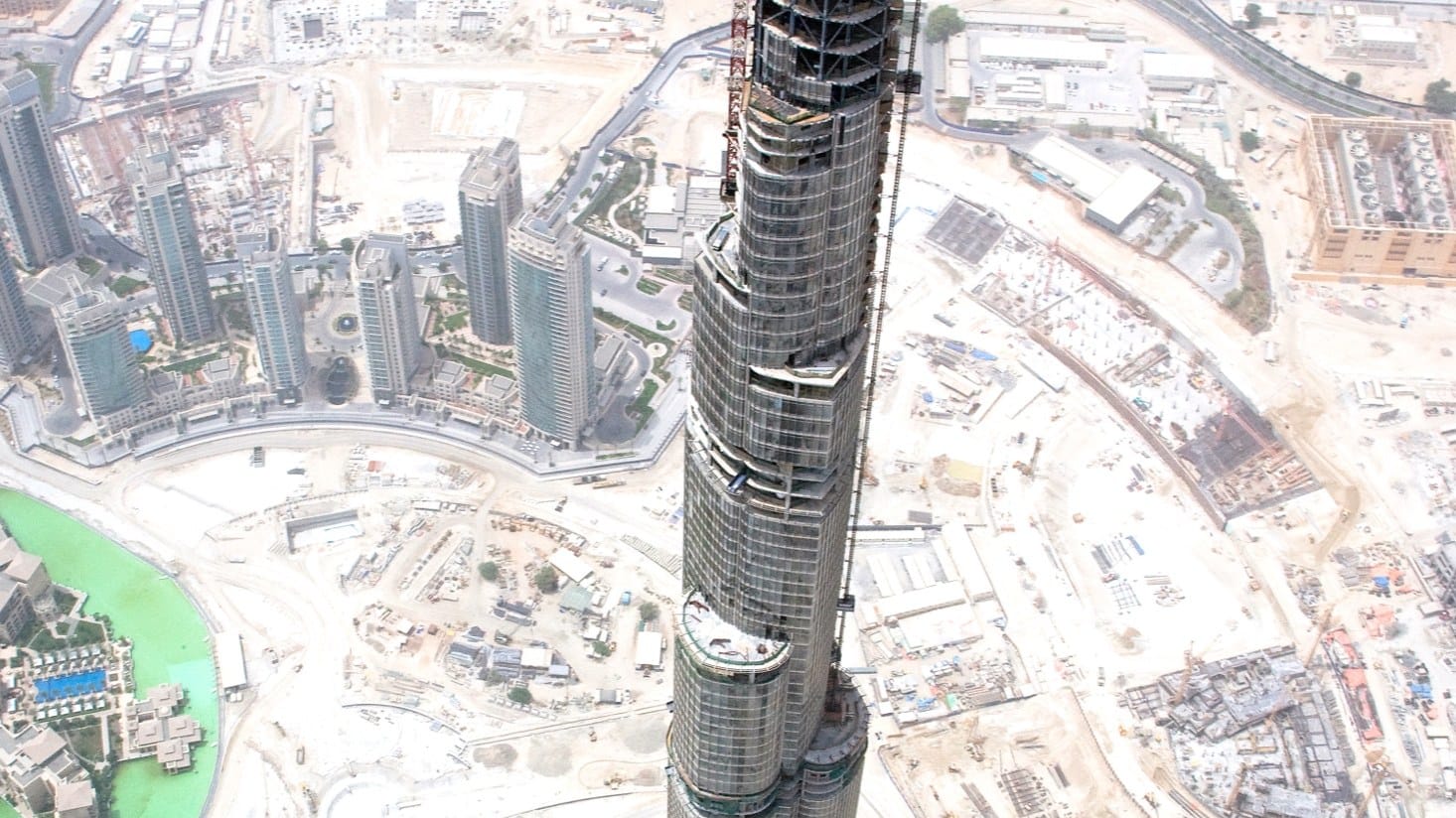
Incredibly the original site for the Burj was Melbourne, Australia. The Chicago-based architects, Skidmore, Owings & Merill (SOM), had made the plans to create ‘Grollo Tower’ - the world’s tallest skyscraper at 560m in the city’s docklands. The project got cancelled. Thereupon, SOM proposed the tower to Emaar for its Downtown Dubai development and the deal was quickly signed.
Modifications were swiftly instigated. First a triple-lobed footprint, inspired by an Emirati desert-flower, was decided upon. Next order of the day was a height extension which was followed by three more before the unequivocally ambitious developer concluded it best to stop going on record, stating only that, “it will be over 800m.”
Now after almost four years of development the building has attained the title of tallest structure on earth. Designed to serve a mixture of purposes, the project will encompass nine hotels (we already know about the Armani one - Bespoke issue 11), in addition to many residential apartments and much office space. Once finished, the Burj Dubai will have a capacity for 35,000 people.
Of course with so many people congregating in one place, it was only natural that, in this post-9/11 era, much effort and attention centred on safety issues. Reinforced-concrete was chosen for the structure up until 586m in height. This was due to its ability to withstand higher temperatures than towers made of steel. Also, an evacuation solution was found in the form of hermetically sealed state-of-the-art refuge points, placed every 25 floors, allowing people to take shelter within, while any fire is controlled.
So back to the record books. When the project began back in 2004, there was a solitary three year period of construction before the height of the building surpassed the Sears Tower of Chicago, once the building with the most floors. Then in September 2007, standing at 555.3 metres, it became the world’s tallest freestanding structure on land. Even though neighbouring countries have recently revealed plans that may dethrone the Burj Dubai, such as the Mile-High Tower in Jeddah, the Nakheel proposed 1,400 metre tall Al Burj in the Dubai Marina, or even Meraas’ 1 Dubai, Burj Dubai still holds on strong. Of course the all important ‘tallest building’ is not going to be wrought from the hands of Emaar easily, which is why the final height of the tower is being kept a secret until completion.
So in the meantime, why not reflect on some key statistics that help visualise the scale of the tower. For example did you know that the tower's peak electricity demand is estimated at 36 MVA? That is equivalent to roughly 360,000 100-watt light bulbs all operating at the same time. Or how about the fact that at peak cooling times, the tower will require approximately 10,000 tons of cooling per hour, which is equivalent to the capacity provided by 10.2 million kg of melting ice in one day. Furthermore were you aware of the fact that the Burj Dubai's water system will supply an average of about 946,000 litres of water per day? That is typically enough water for 125,000 people to brush their teeth once a day, every day.
To say that a lot of clever thinking went into making this project would be an understatement of grand proportions. Building on such a scale in a desert climate presents many obstacles, but solutions were found and ingenuity exercised. A prime example is the condensation collection system which utilises and collects the water build-up on the outside of the tower that comes about due to temperature gradients between the exterior and interior. In this way, roughly 57 million litres of supplemental water – to be used for irrigation - are collected per year. If you felt like it you could fill 20 Olympic-sized swimming pools instead!
But the last and most impressive aspect of the Burj Dubai is its cost, usually the principal factor in hampering a project of this nature. But whether the project finally breaks the 4 billion USD barrier is irrelevant to its significance –this tower is Arab one-upmanship in an unheralded and glorious way.
Project Burj Dubai
Developed by Emaar
For With some incredible will, and immensely deep pockets, the largest structure on Earth is now located in the Middle East.
HYPERLINK "http://www.emaar.com" www.emaar.com