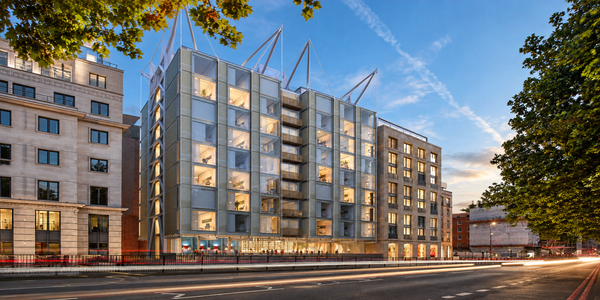
While it isn’t exactly what you would call historic – only dating back to 1961 – Beirut’s Phoenicia Hotel certainly has a lot of history. And it remains an enduring symbol of the city’s golden era, a place that provides a perfect encapsulation of Lebanon’s jet-set prewar years.
You’ll get plenty of that from its gilded grandeur, complete with the requisite sweeping staircases and palatial pillars. Indeed, the hotel has been a hub for glamour from the moment it flung open its doors, with a design penned by the American architect Edward Durell Stone, whose other great works include New York landmarks like the Rockefeller Center, Radio City Music Hall and the MoMA. But its status was solidified when American Academy Award winner Dorothy Dandridge (who, it’s worth noting, was of Jamaican, HYPERLINK "https://en.wikipedia.org/wiki/Mexicans" \o "Mexicans" Mexican and HYPERLINK "https://en.wikipedia.org/wiki/Indigenous_peoples_of_the_Americas" \o "Indigenous peoples of the Americas" Native American descent) performed at the ribbon cutting ceremony at the hotel’s nightclub, Le Paon Rouge. From that day on, the then 600-room Phoenicia operated almost continuously at full capacity, establishing itself as the favourite of politicians, businessmen and movie stars alike. It also served as the setting for numerous films, including the 1965 crime-caper ‘Twenty Four Hours to Kill’, when the country served as a tax haven for the world’s wealthiest globetrotters.
That all came to an abrupt halt in 1975, with the onset of the Lebanese Civil War, and it stayed that way for 15 long years, during which time the hotel was turned into a bona fide battlefield. In 1990, when all was said and done, the former Grande Dame was left as a bullet-riddled reminder of what a mess the Lebanese had made of their country. But, the owners of the property were not dissuaded and they ploughed ahead anyway with a renovation that included a third tower for residences (a second had been added in the early-1970s), which came to a not-to-be-scoffed-at sum of 100 million USD.
Yet, lady luck has not been kind to Lebanon, or the Phoenicia – despite opening with great pomp and circumstance, the hotel has had to withstand the fallout from 9/11, the 2003 invasion of Iraq, the 2005 assassination of Rafic Hariri (which was so close it damaged the hotel and caused a three-month closure), the 2006 war with Israel, followed by the ensuing period of assassinations and explosions that culminated in the 2008 takeover of Beirut by Hezbollah, the start of the Arab uprisings in 2011, and most recently the civil war in Syria.
Of course, sitting by the pool on one gorgeous summer night, I find no trace of any drama whatsoever. Instead, there’s some golden oldie Lebanese comedy film being projected on a garden wall that sets the tone for a quintessentially perfect Beirut evening – one that is oblivious to a troubled past, and seemingly unconcerned with the future. Carpe diem I tell myself as I notice the gentle sound of tapping feet, as one long continuous flow of generous mezzes make their way onto our table, including delicacies like hummus, mutabbal, fattoush, tabboule, arugula salad and hindbeh (a satisfying portion of boiled greens doused in lemon and topped with fried onions). On this particular evening, there happen to be some live cooking stations too, so we help ourselves to a few fresh mana’ish baked over saj ovens, and a handful of juicy meat skewers that continue to sizzle well after they’ve been removed from the grill. Clearly, there’s no faulting the food here, which surpasses an already stellar reputation, and can by the way be served throughout the property, whether at the ground-floor Mosaic restaurant, the rooftop Eau de Vie venue, in the lobby’s Amethyst lounge or even in your room.
Speaking of which, behind the formal-looking door of the spacious Ambassador suite lies another abundance of treats, including a giant fruit bowl, a decadent selection of house-made chocolates and by teatime, various freshly prepared dips and breads that should keep you nourished. I’d say that service and graciousness are two commodities that aren’t in short supply in Lebanon, but the Pheonicia’s superb skill in this domain is maybe best demonstrated by how quickly and efficiently a replacement arrives for my faulty iPhone charger cable. All I needed to do was make one 30-second call to the friendly desk clerk, and 15 minutes later a brand new one arrived with a mere 13 USD supplementary room charge. Such understanding and efficiency is harder to come by than you’d think and it’s these sorts of moments that turn guests into loyal customers.
There are L’Occitane products in the master bathroom (and in the powder room off the living area), which isn’t beyond the realm of expectation considering this suite goes for 1,880 USD per night for a summer weekend stay. But there’s a generosity even in that rate, for they’ll throw in a luxury car airport pick-up and drop-off, in-room champagne breakfast for two, two hours of spa treatments per person and a special gift at checkout.
Immersing oneself into a storied past comes easily here, especially while taking in the hotel’s splendid Mediterranean views over the legendary Saint-Georges Yacht Club and Marina (another hotspot for 1960s decadence) or by dropping in to the impossibly well-appointed business centre, which is more reminiscent of a gentleman’s club than any modern-day computer station will be able to offer – one could easily imagine the romantic scene of an old Hollywood movie unfolding here.
Fittingly, the Phoenicia also has several boutiques lining its lobby. Need a last-minute Givenchy dress or some exquisite jewels? How about a fine Persian carpet to take home as a souvenir? Don’t worry; they’ll have you covered. Indeed, you really won’t need to ever leave the hotel during your stay, but of course this is Beirut, and a city of dreams awaits.