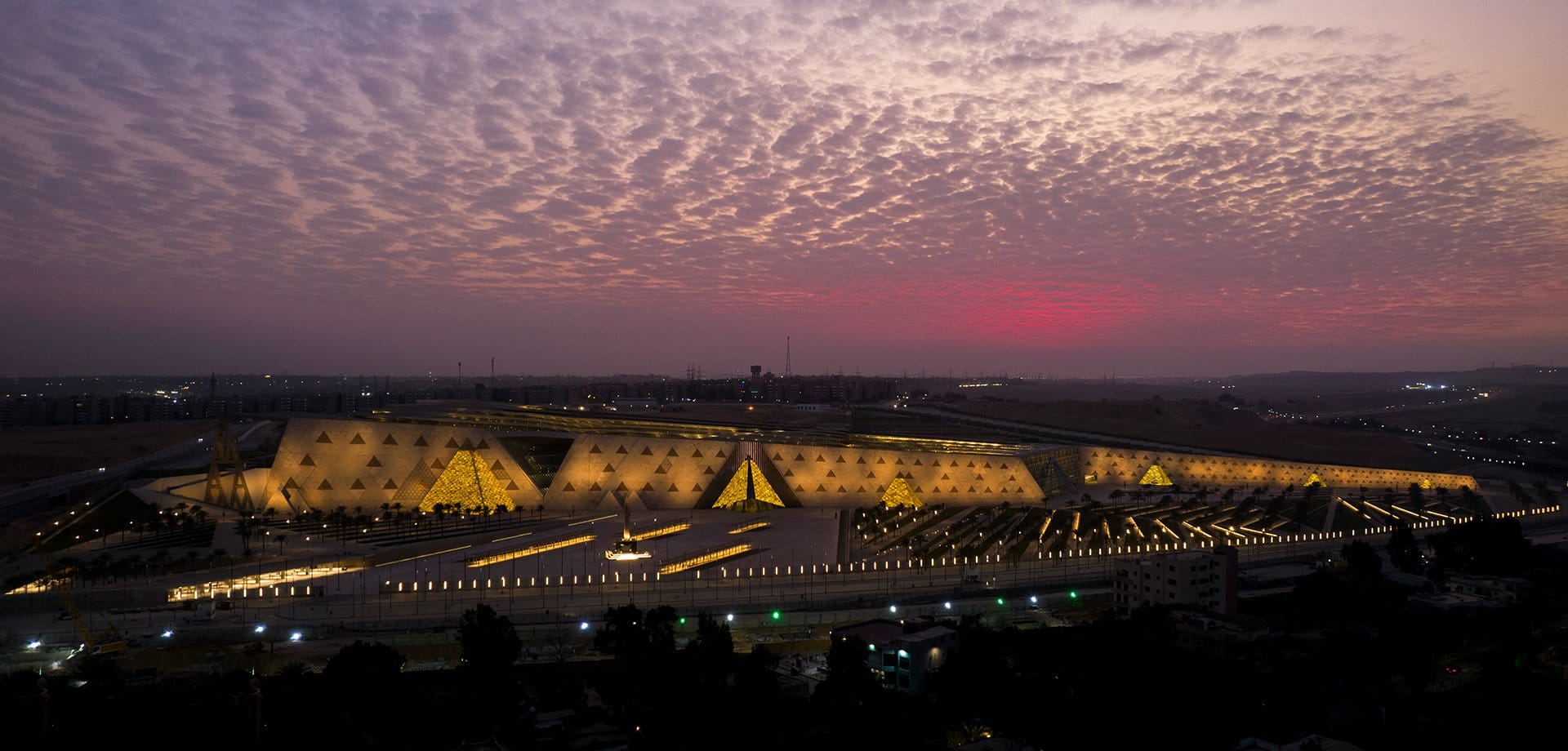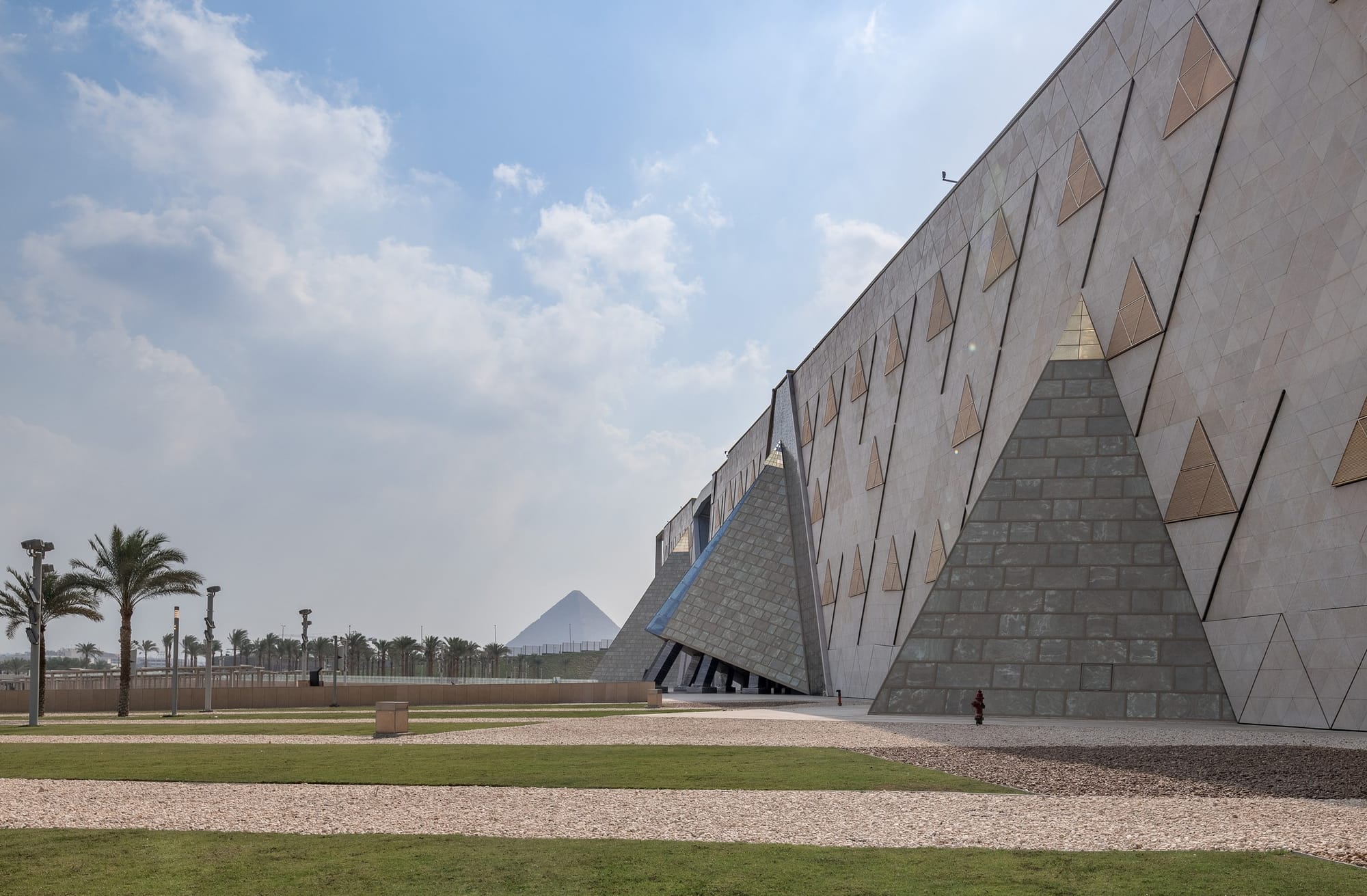
The recently-opened Grand Egyptian Museum emerges from a plateau where desert meets the Nile Valley. Contemporary in its concrete and glass structure, yet in perfect keeping with its ancient neighbours - the pyramids. The 50-hectare site includes 24,000m² of permanent exhibition space, a conference space and children’s museum.
Partners Róisín Heneghan and Shih-Fu Peng stood out from the other 1,557 anonymous entries to win the “largest architecture competition ever” for the Egyptian Ministry of Culture contract after initially submitting just five A3 panels.
Róisín Heneghan describes their winning formula. “I would say I'm probably the more organised, more pragmatic one and Shih-Fu is a bit more kind of ‘out there’. I try to get it all in shape,” laughs Heneghan. “When we graduated [from Harvard] we were doing different competitions together until about 2001 when we won a project. Then we continued the competitions and we won the Egyptian Museum.”
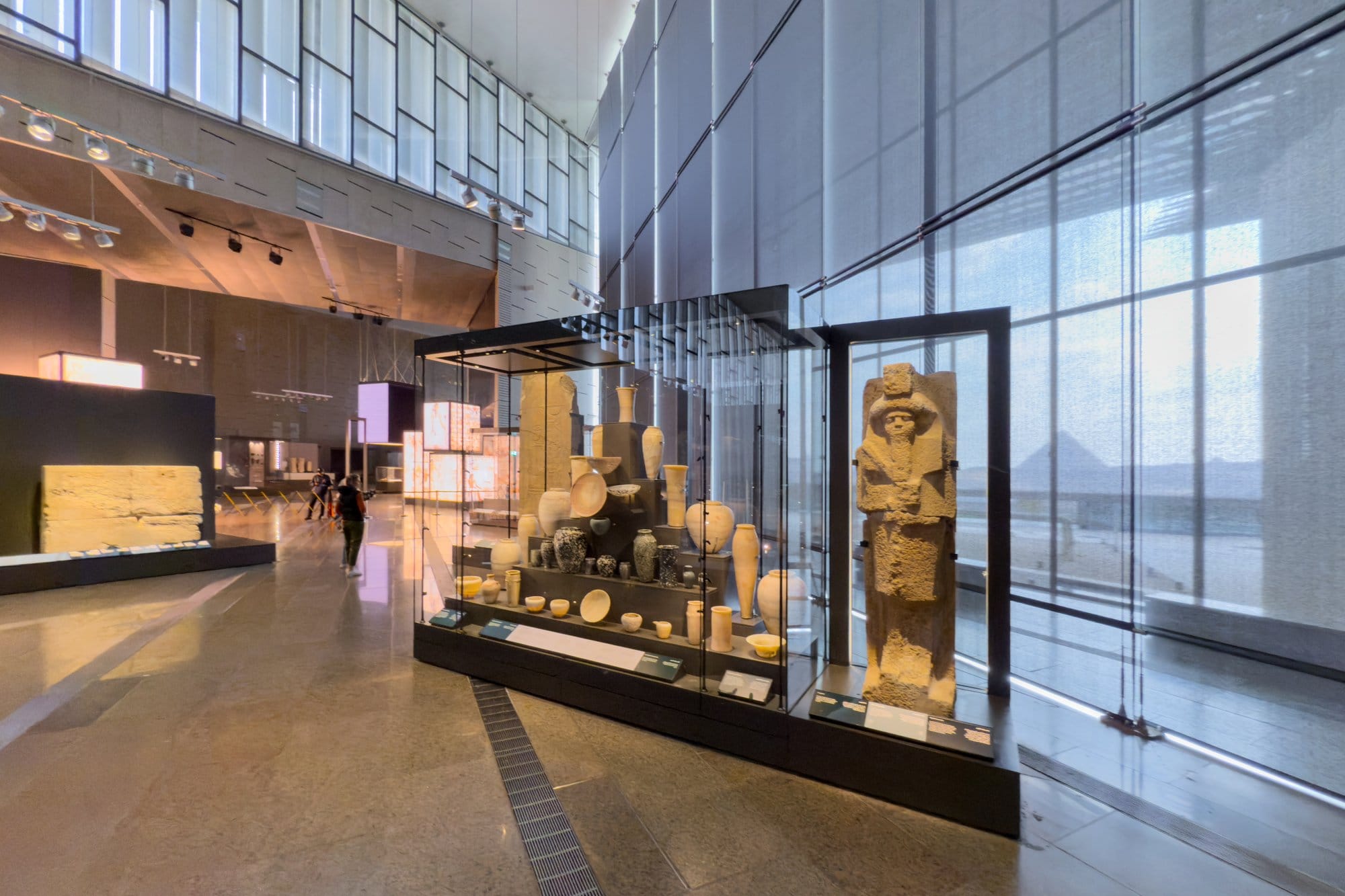
The museum was finally inaugurated on 1 November 2025 after a project spanning over 20 years of ups and downs. “We won the competition in 2003. We had all our drawings finished and all the construction documents finished in 2009. But then there was the Arab Spring and there was a lot of change in Egypt so construction didn't start until 2013. The Global Financial Crisis occurred, and there was covid at the end,” says Heneghan.
With a legacy project of this magnitude, housing such priceless treasures, comes great responsibility. A sensibility is evident in hparc’s work - to respect and pay homage to the past. The Grand Egyptian Museum displays artefacts from the pharaonic era - the extensive Tutankhamen collection, including the king’s golden mask and sarcophagus and the two solar boats of King Khufu. But Heneghan did not get completely overwhelmed. “I think we zoomed above it a little bit, so I had a very broad view of it. And when we started, we didn't know exactly all the pieces that were going to go into it. We didn’t get too caught up in all the details at the beginning, just tried to have this broad overview, designing for future iterations, because buildings last for hundreds of years, whereas exhibitions change.”
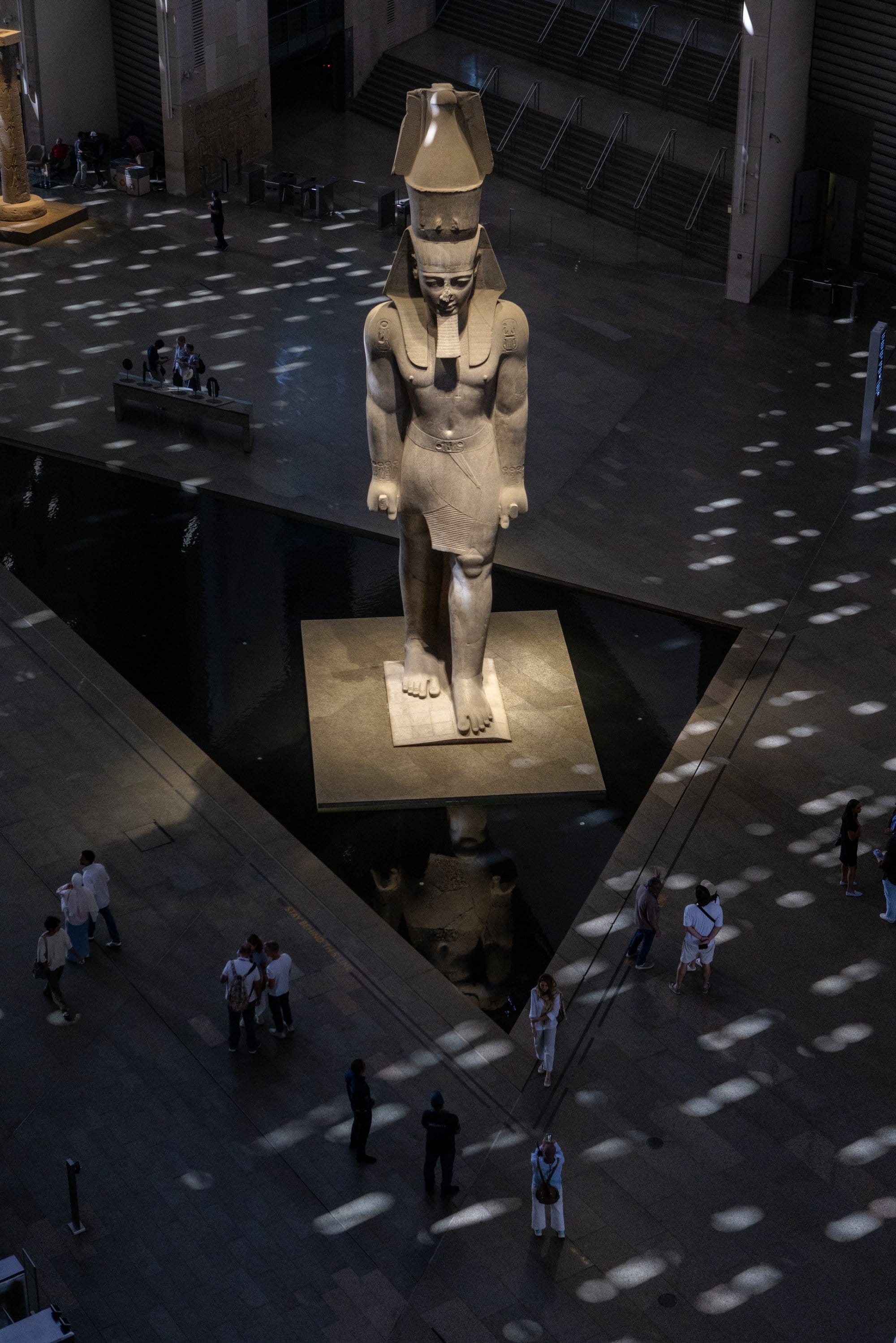
The experience at the Grand Egyptian Museum is very much centred on the visitor journey, a sequence of movement transports through time and Egyptology in a series of layers. “There's a little bit of a procession. The visitor leaves security behind at the roadway, and then goes through this very monumental forecourt, and then you first come into a big entrance courtyard, where the large statue of Ramesses II is,” Heneghan describes, showing me some initial competition drawings.
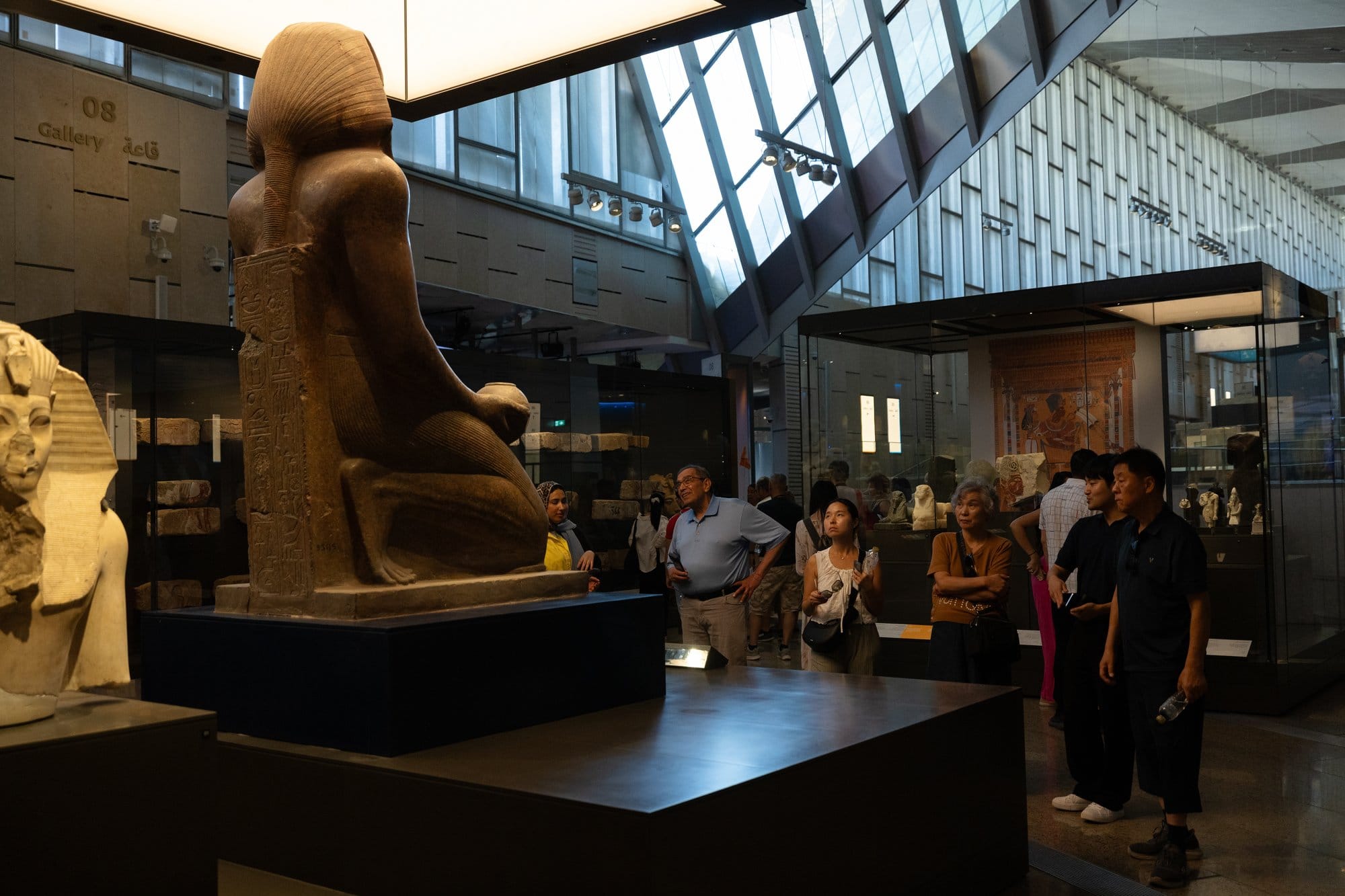
The visitor then ascends a grand staircase - a gallery in itself - to where the exhibition halls are located and the pyramids appear in all their glory, framed within a glass façade. “We had a really clear idea which was built around the view to the pyramids and that drove everything. Sometimes with projects things just fall into place and it feels that it's running itself and others are a bit more challenging. For this one there was real clarity about the idea which really helped inform on the decision-making as we were working through the design. Of course there were a lot of technical challenges,” she adds.
While the Grand Egyptian museum was defined by its collection and the pyramid backdrop, hparc’s other Middle Eastern project, the Palestinian Museum at Birzeit completed in 2016, was all about heritage. “The Palestinian Museum was a completely different type of museum,” Heneghan explains. “At the Egyptian Museum, they had a lot of work and needed a place to store it. The Palestinian Museum was driven by something different - it didn't have a permanent exhibition or collection. It was almost established as a place to have conversation a about Palestinian identity.”
The building, which boasts exhibition areas, an open-air amphitheatre and al fresco café, spans 3,000 m2 on an old farm terrace. Its landscaped gardens blend sympathetically with the rural landscape and visitors are treated to Mediterranean views. “When people walk through the gardens, they start to talk about different food and festivals, because so much culture is built around dishes that are associated with different harvests. It is a way of holding onto something or touching on something, but it is also ephemeral because it is always changing according to the season.”
So what’s next for Heneghan? The teams start work at the end of 2026 renovating the ruined tower of Kaiser Wilhelm Memorial Church in central Berlin, bombed in World War II. The designs, inspired by the rose window in the original church, show circular galleried floors and sunlight reflected in a central pool. The challenge is to preserve the integrity of the ruin while allowing people to gather and pay their respects. “After the war it was kept as a memorial, and it's become the site of reconciliation, which seems so relevant now,” says Heneghan.
ENDS 867 WORDS