I’m looking at deep pile velvet curtains drawn open and a stage, where a procession of people is traversing. There are uniformed children on their way to school, ballet dancers, a funeral march and a runaway bride in the snow, her white veil trailing behind her. It’s totally hypnotic. The motion, an exaggeratedly slow waltz, the music, classical and melancholic and the ornate setting, baroque in its feel.
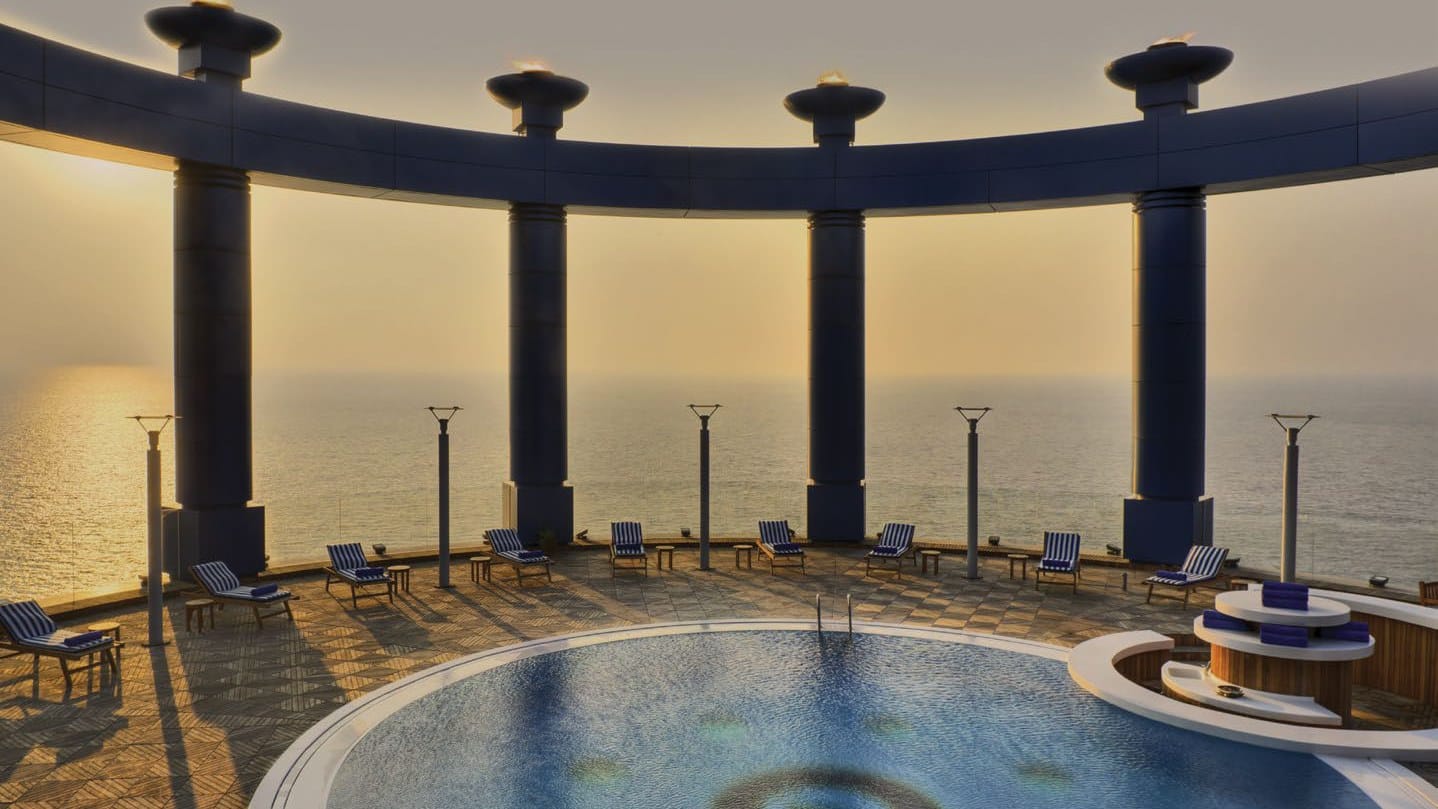
I’m not in an opera house or theatre, I’m actually standing in the lobby of one of Beirut’s oldest luxury institutions, the Phoenicia hotel. After I finish watching Hans Op de Beeck’s ‘Parade’ (2012), I move on to ‘Passaggi’ (2007) by Alice Cattaneo, where all you see is a hand relentlessly passing on random objects such as a carton box, an orange, a bright green stool, a knife and a flower. Before it ends, Rebecca Russo, the creative mind behind all of these video projections, saunters over to meet me, impeccably dressed in stilettos and a white dress suit.
“This film has to do with greed,” she explains as we move over to the Cascade lounge to have a chat. Russo is the woman behind the Videoinsight Foundation and although she has the glamorous air of a well-kept former model, she is not from the fashion industry, nor is she an artist. Rather, she’s a psychologist and psychotherapist and when she casually mentions having almost 20 years of clinical experience, I find myself wondering how she looks so young.
“There’s just one precedent of a hotel streaming video art in its rooms and it is in America,” she tells me, referring to the Phoenicia’s highly innovative, if not entirely unique, concept of creating in-room exhibitions. Basically, via a dedicated complimentary channel, named Videoinsight after Russo’s trademarked method and foundation, any of the hotel’s guests can access this screening of 21 audio-visual artworks.
Russo, who happens to be one of the top five video art collectors in the world today, explains that the key to this video channel is that there’s a transformative and evolutionary awareness that stems from watching the artworks. It’s not just art for art’s sake. “Videos or films embody movement and music, which can be therapeutic,” she explains, “They offer the possibility of narration and I’ve found that they can lead to improved wellness for people having difficulties. While words stimulate the brain, images are more powerful, they reach into the unconscious and subconscious mind, they affect your heart and belly and overcome natural resistances.”
If this sounds unusual, it’s because it actually is. Art therapy, in a conventional sense, normally involves the ‘patient’ creating art, rather than being subject to a constant stream of it. Utilising video certainly isn’t a traditional approach but it is something that Russo has been working on for some time. “Ten years ago, I introduced my private video art collection into my clinical work and just two years ago, I experimented in the medical field, with people who were suffering from neuroses and especially with post-orthopaedic surgery patients who were in Bologna’s Rizzoli hospital, undergoing rehabilitation. After one year of showing them particular videos, the doctors found some amazing results. The patients improved significantly, as compared to those who weren’t exposed to the videos.”
I ask Russo what lead her to decide to show her videos in a more public domain and she tells of a series of events including meeting the mother of performance art, Marina Abramovic. “She discovered my collection in Torino five years ago and she said to me, ‘you need to share this with the world.’ You know, it has become my life, I watch 25 to 30 videos a week. My world has changed, I’ve been invited to 14 international medical congresses in the past few years due to this project because it’s unheard of for an art collector to have medical results. The Videoinsight Method has become an international brand and a certified teaching practice.”
As to what brought her to Lebanon, she says, “It was the fruit of magic. I visited this city in June for the first time and met the owner of the hotel, Nagib Salha. We spoke. This is the result. This is the magic of life and art.”
“I feel that there’s a good energy here in this country,” she continues, “it’s evolving and it’s vibrant. Also, there are so many video artists in Beirut but no actual collectors of the medium. And I think the Phoenicia offers excellent visibility for this. Art is for everyone but I wanted to send a message in the luxury segment as well.”
Still curious to understand how Russo’s choice of videos can have therapeutic and diagnostic potential in the treatment of certain illnesses, she offers to take me on a final tour. We stop at Cheryl Pope’s ‘Stacks’ (2010), which is an aggravating performance of a woman arranging and rearranging endless teacups and saucers on top of one another to reach a kind of ordered chaos whereby nothing will fall down. “This is good for people who have Obsessive Compulsive Disorder,” Russo says, “And Parade, the first video you watched is about the cycle of life, it’s used to treat physical pain because it shows that everything goes on, as we move on and grow older.” Then there’s Sophie Whettnall’s ‘Over the Sea’ (2007), which follows the deliberate stride of a woman, with the camera centred on her calves as she walks across different terrain, from city pavements to the edge of the shore by the lapping sea. “This is for people who have been abandoned, to support separation anxiety, encouraging them to develop independent projects and not look back,” Russo explains, finally leading me to Michael Fliri’s ‘Let Love be Eternal, While it Lasts,’ which follows the painstaking climb up a snowy mountain, by a man who has both his legs in casts. “This is for instilling confidence in people who have physical difficulties,” Russo says, “and at this very moment, people with prosthetics in hospitals are watching this video to help gain strength.”
Naturally, as with any work of art, each video is open to multiplicity of interpretations but after having been put through the mixer, I’d say that they are as elusive as they are challenging to engage with. A bit like a Rorschach test, the images show you the symptoms of your own malaise, real or perceived. And while I cannot say whether or not they had any healing powers on me, I do know that I loved the daring ingenuity from what many regard as a classic Middle Eastern hotel. The Phoenicia is certainly more cutting edge than you might think.
WHO Rebecca Russo
WHAT A 24-hour video art streaming channel
WHERE The rooms of Lebanon’s Phoenicia hotel
WHY In an era of fast downloads and large digital movie databases, hotels’ video-on-demand channels have become an irrelevance to say the least. But with its combination of medicinal and cultural benefits, this channel has us intrigued.