When you approach the Wraith for the first time, it’s the sheer enormity of the car that first strikes you. Somehow pictures just don’t do this car justice because in person it’s magnificently imposing. Then you drink in the details; the countless design delicacies that merge into such a cohesive whole, it almost deserves to be called something other than an automobile.
Curiously, despite a history that stretches back 109 years, Rolls-Royce seems to be getting younger all the time. You see when BMW bought the rights to the name, the logo, the radiator grille shape and the famous Spirit of Ecstasy mascot back in 1998, it basically restarted Rolls-Royce from scratch. Rather than hamstringing the brand, this new beginning meant that BMW could bring some much-needed dynamism to a company name that by then, had become synonymous with stuffy aristocracy and very little else.
Since its launch in 2003, the Phantom has gone on to establish itself as the state carriage of choice for the world’s elite but it was the Ghost, which came along seven years later, that introduced new dynamism. Designed by a 25-year-old, it changed everything and showed that you don’t need to be a retired game show host to own a Rolls.
The Wraith not only takes the Ghost’s dynamism another giant step forward, making it possibly the grandest of all grand tourers, it also excites and there’s definitely something of the night about it. “It is a touch noir,” offers Richard Carter, Rolls-Royce’s communications director. “It exudes a sense of danger.”
He’s right. The Wraith is the most powerful road-going Rolls in history. It’s also physically the smallest in the current range and its perfectly proportioned fastback styling hints heavily at the dynamism its creator has been promising. With 624bhp on tap from its twin-turbo V12 engine, it’s possible to hit 100km/h from rest in just 4.6 seconds and in a car with these proportions, that just confirms Carter’s comment about the “sense of danger”.
The Wraith’s name hails from a Scottish word meaning ‘ghost’, albeit of the more malevolent kind. Despite being based on its predecessor, the Wraith is much more than some Ghost coupé, which is why it deserves to have its own, distinct nomenclature.
Immediately recognisable as a Rolls, it’s still different enough to drop jaws. With bold, broad rear haunches, combined with subtle but important touches like the more forwards positioning of the Spirit of Ecstasy mascot, it looks powerful and menacing, particularly in the darker hues.
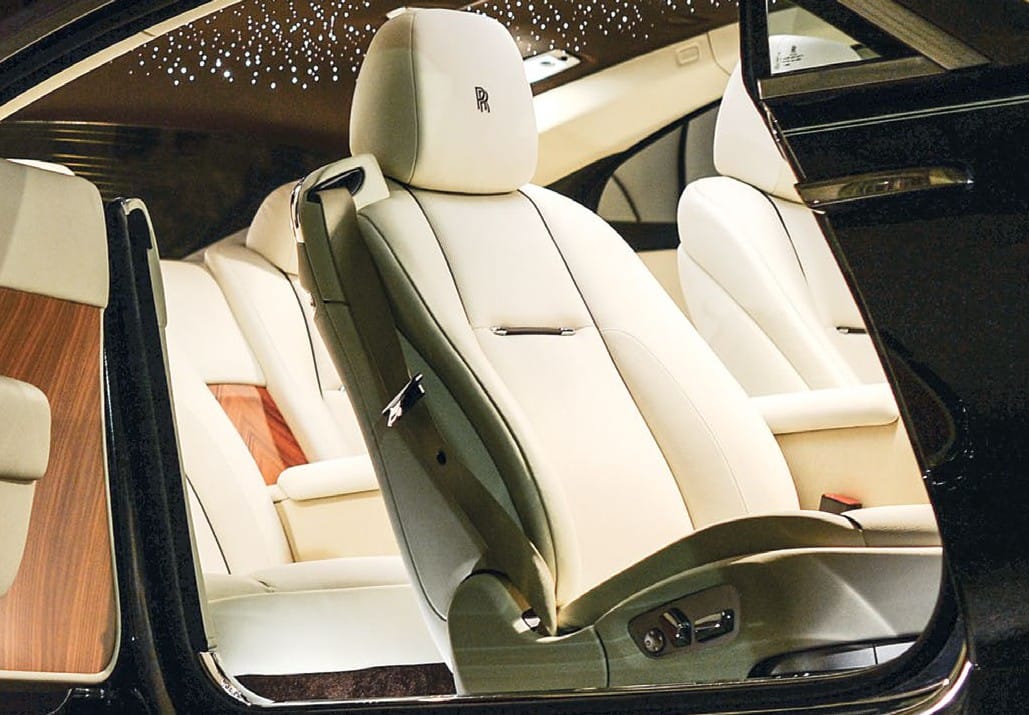
At 5.3 metres in length, it’s hardly a city runabout even if the wheelbase is 180mm shorter than the Ghost. The two coach doors swing open on rear hinges to reveal a sumptuous interior complete with softest Phantom-grade leathers and expanses of wood called Canadel Panelling. Named after the famous cove in the South of France where Sir Henry Royce and his design and engineering teams spent their winters, this tactile open-grain wood sweeps through the interior, offering a contemporary reinterpretation of the classic wood and leather mix.
One of my favourite optional extras is the Starlight Headliner. Available for the first time on a non-Phantom family Rolls-Royce, it encompasses 1,340 fibre optic lamps hand-woven into the roof lining to give the impression of a glittering, starry night sky. It’s awfully cheesy yet utterly enchanting.
The seats are almost throne-like – their position is high and commanding. This car’s prime role in life is to protect its four privileged occupants from the world of hurt that lies outside. Close the door – by pressing a switch, naturally – and it shuts out all gloom and misery. If this car were mine, I’d probably sit in it for a few minutes every day, even if I didn’t need to go anywhere, just to chase the day’s worries away.
Enough with the obsessing. Cars, after all, are meant to be driven. Even magnificent monsters like this. So I press the brake pedal, push the starter button and the Wraith whispers into life. There’s no rev counter, just a Power Reserve metre. At standstill, there’s no indication that the engine is doing anything at all.
After escaping the confines of the city, I reach a short stretch of motorway and decide to test out some of its increased dynamism. As I floor the throttle, the rear of the car immediately squats. Bonnet slightly raised, the transmission shifts down and the engine swaps silence for a throaty roar, quite unlike any Rolls-Royce before it. The speed with which the Wraith accelerates is breath taking. This is no sports car but then Rolls-Royce has never claimed it is one. It’s simply, to borrow their phrase, “more powerful and dynamic”.
Yes, you can hammer along at an impressive rate of knots, if you insist, but the serenity the Wraith exudes in such abundance means it’s much more suited to genteel cruising than powersliding around hairpin bends. As the day unfolds, the roads become more twisting and challenging. Almost on cue, dense mist rises from the thick forest, like dry ice being pumped onto the set of a horror film and eventually, the rain eases off, but throughout it all, the Wraith’s progress along the 400km route remains sedate and steady.
No, it is not the ultimate driver’s car but as a gentleman’s express, it’s without peer and it’s available for the same amount of money that would get you a well-specced Ferrari FF. Regardless of its name, the Wraith is far from malevolent. Its massive reserves of usable power are there to protect, not destroy. Silent and devastatingly quick just like a real wraith might be, this spectre is one in which we can all believe, a truly remarkable automobile.
WHAT Rolls-Royce Wraith
PRICE 285,000 USD
STATS Rear-wheel drive 6.6-litre twin-turbo V12 with 624bhp
WHY Building on the already formidable four-door Ghost, Rolls-Royce’s new Wraith coupé manages to be more eye-catching, more powerful and more desirable.