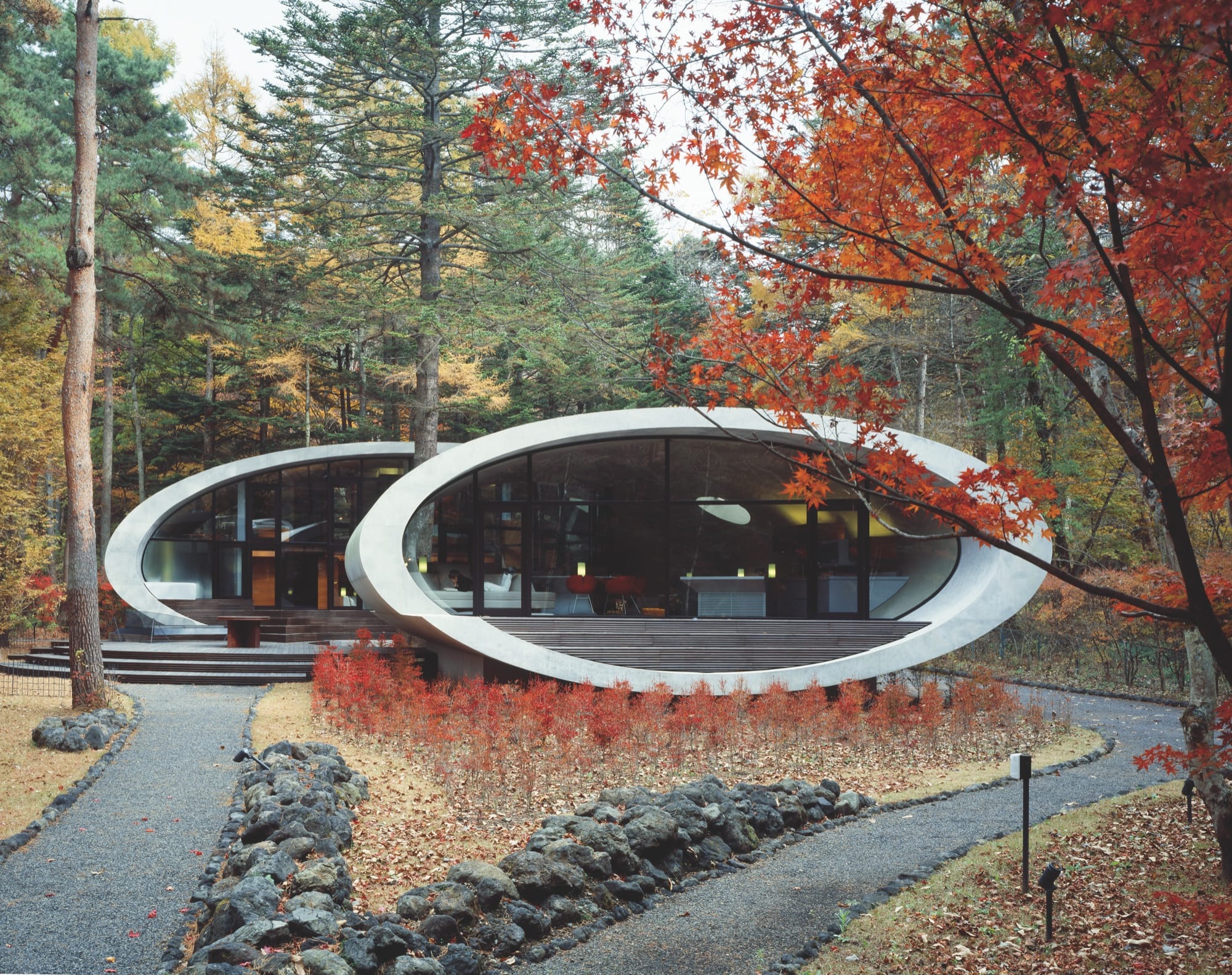
The Shell House is luminous. A stunning white concrete sculpture that contrasts starkly with its rich green surroundings, it appears frozen in motion, captured in the act of unfolding and uncurling. Taking the form of an elliptical tube in two sections, the house tapers gently, only to then separate and spiral lazily around an elderly fir tree, forming a small, inner courtyard in the process. It has an ethereal aspect to it, hovering as it does 1.4 metres above the ground. “It is hard to determine what exactly the structure is,” architect Kotaro Ide explains, “it clearly is not part of nature – nor is it a ruin. With time, trees start to grow, encircling the spacecraft, harmonising it with the landscape.”
When approached by his client to create a villa in the middle of the woods, for weekend retreats or vacations, it was this, perhaps, that appealed most to Ide. The concept of constructing a home that is integrated with its surroundings, blending in and yet serving as a refuge from them at the same time.
“Being in sync with nature isn’t about yielding to nature,” Ide continues, “it’s about coexistence. The existence of the structure depends on its power to endure nature. By isolating living space from the wilderness, and upgrading its quality as a shelter, the house will be protected from nature and will provide a comfortable environment.”
Comfort was Ide’s primary concern when he decided to wrap the house in concrete, which he chose for its durability, and not just aesthetics. Unlike the traditional wooden houses, which decay swiftly in Karuizawa’s damp climate if not regularly maintained, reinforced concrete does not require as much care and insulates effectively against both the high and low temperatures to which the area is subject.
This cocoon-like retreat is also integrates wood panelling, and is lit by oval skylights and vast floor-to-ceiling windows that cap the open wall around the open ends of the cylinders. Seen from a distance, the Shell House may seem narrow, even tunnel-like, but once inside, it reveals itself as airy and open, a series of curving spaces and flowing forms that appear to be cresting. Wherever you look, there is motion. Everything is curvilinear.
From design to completion, the house took two and a half years since all the furniture had to be custom-designed, bending and curving to fit the outer shell. It’s like rolling in a barrel, or being in a cave – yet one that is totally open-ended. The windows can be completely up, merging the inside and out.
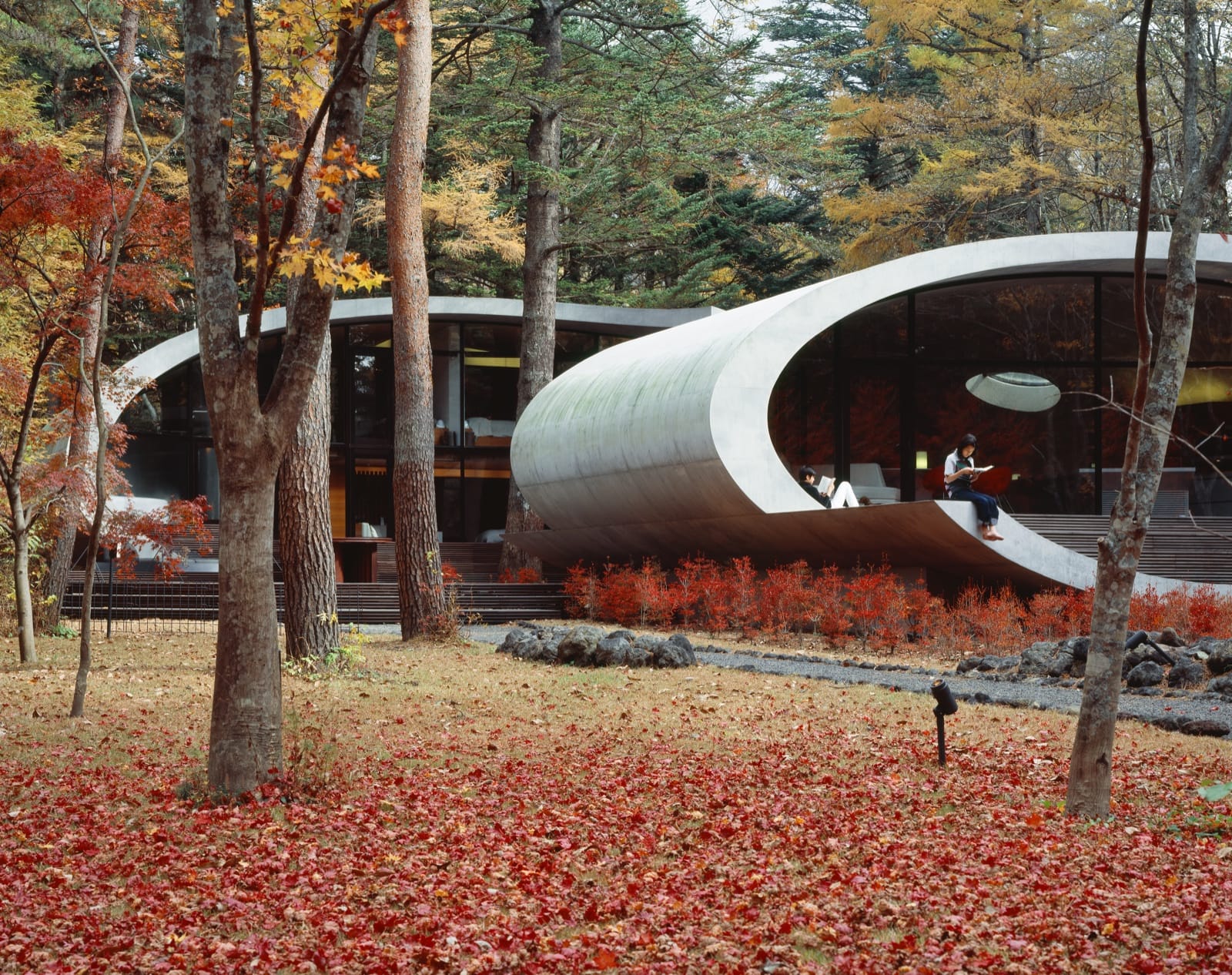
During winters, when windows must be kept closed, an under-floor heating system keeps the home warm, allowing the owner to appreciate what Ide describes as “the luxury of enjoying a hefty amount of space with large openings” throughout the year. Additionally, it’s meant to be an energy-saving and maintenance-free place and an ingenious central control system means all mechanical and electrical equipment can be managed with only three buttons.
The Shell House might look like a bit like an futuristic, abandoned spacecraft, “a frame made in a completely different place, for a completely different purpose,” as Ide puts it, but it does its job with remarkable efficiency. A snug, secluded nook , it’s a perfect balance between rustic environs and luxurious interiors.
For caption:
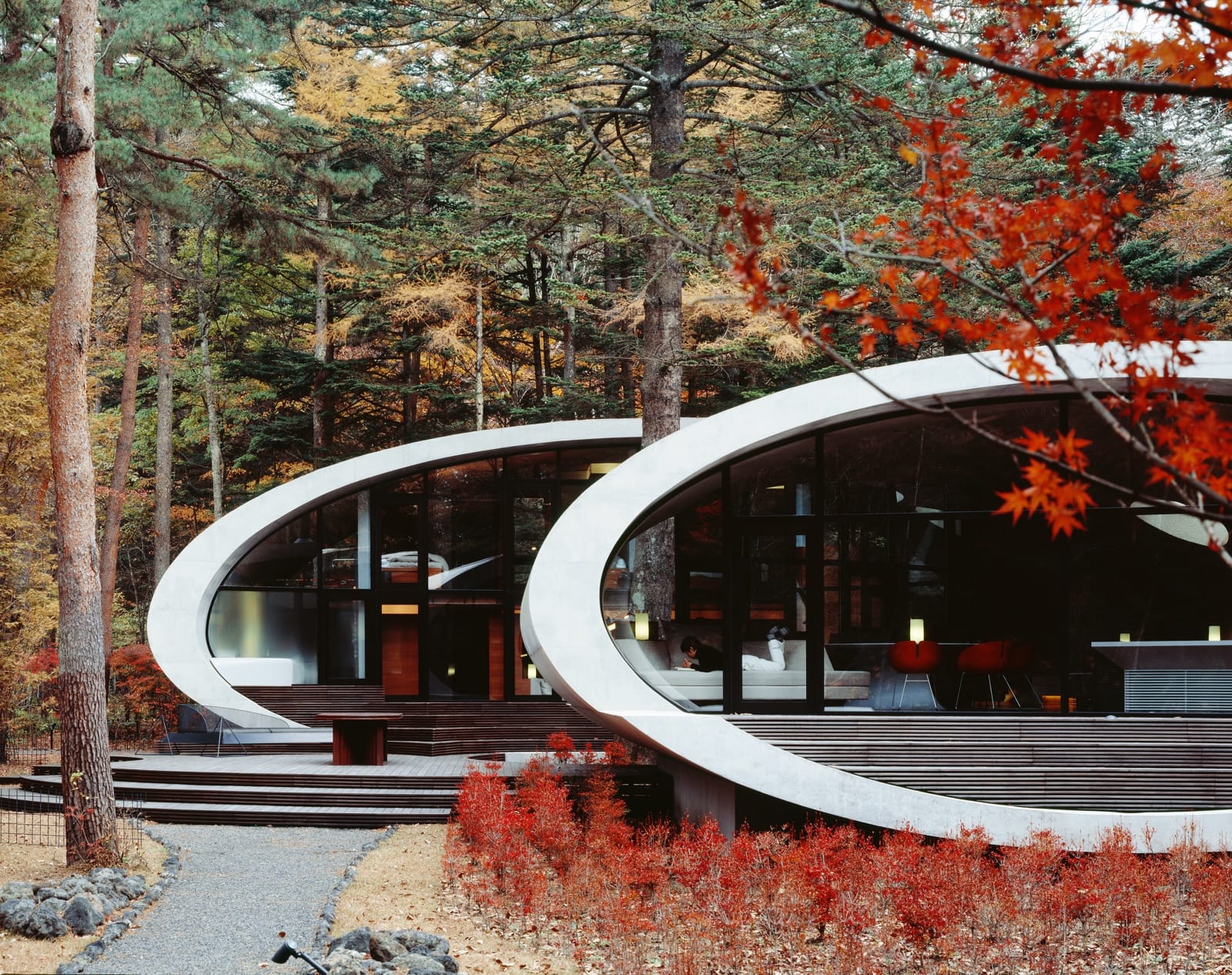
The final finished house did not follow the original blueprint. “Initially, we had planned to build a shell structure with three-dimensionally curved surfaces, the C-shaped section was to surround the fir tree and the plan of the building resembled the letter J,” Ide explains. “Yet, going over the budget, construction method and finish, the plan was revised down.”