They say that braving the Drake Passage is the price you pay to see the Antarctic. They say this in the town of Ushuaia, the embarkation port in Tierra del Fuego. “Some crossings are like being on a canoe in a lake,” says Bob Rowand, a geologist who has made more than 20 Antarctic journeys as a consultant for the U.S. Geological Survey. “Then there are times when you just have to suck it up and get through it.”
The 1,000-kilometre journey takes 2 ½ days from Argentina. You’ve barely hit open sea before all colours drain away, as if nature hadn’t wanted to waste any paint on the trip to the world’s basement. The sky is a weary gray, paunchy with clouds; the sea biblically dark. Fish come to investigate the turbulence stirred up by the ship’s engines and birds come to eat them. For the entire journey, albatrosses and skuas escort us. They too, are monochromatic: black, white and grey.
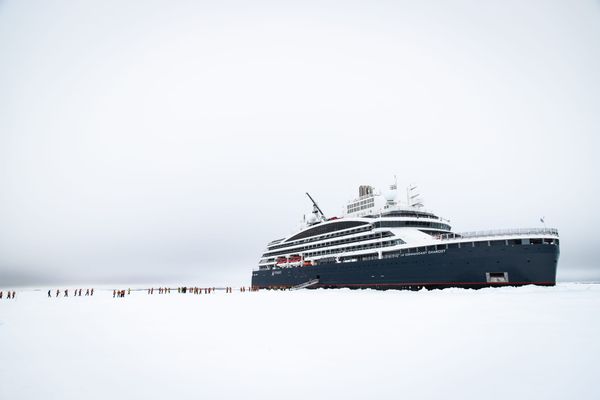
This ship, the National Geographic Explorer, accommodates 148 guests in 81 spacious cabins and even if it is a state-of-the-art, ice-class expedition ship it still dramatically rises and falls on 10-metre swells. Plates, glasses and utensils clash like cymbals. Dramamine is available and people compare notes on when they took a pill and how long it will be before they’ll take another. Some sport small patches behind their ears. I have a device that looks like a wristwatch, I wear it as a kind of talisman to ward off the demons of seasickness.
The waves aren’t an inducement to appetite. On the first morning, I’m among just a handful of passengers at breakfast. Despite the full buffet, the only items that appeal are saltines and black tea. One of my shipmates scarfs down some eggs, then looking like a boy trying not to cry, flees the dining room.
I go back to my cabin and snooze before lunch and dinnertime. After a day of hard rest, I turn in early, my belly mimicking the swells until I’m startled awake by the sensation of my body lifting off the mattress. I grip the pillow for ballast. It rises with me. The next morning, a crewmember tells me the secret to not being thrown from your bed: sleep on the floor.
On the third day, our fall through the rabbit hole of the Drake is complete and we’ve reached a calm wonderland. Our first iceberg is a high-walled rectangular platform, its symmetry almost too exact to be real. The sun comes out and sends a silver streak across one side. Twenty-four hours of light bleaches out the structure of a day and colour returns to people’s faces and to the world around us. Even at a distance, the brilliant blue of packed ice glimmers.
“This has been a dream of mine for 40 years,” says my fellow traveller, Joachim Benemann, a German nuclear scientist turned businessman. “I wanted the feeling of being alone in a great space, to look to the horizon and see no one, only space.”
His wife, like mine, couldn’t relate. We both came alone. The 49 other people on board come from 15 countries and four continents, ranging in age - there’s a 20-year-old who won the trip in a drawing to a septuagenarian Chilean watercolourist. They’re mostly accomplished travellers. A Dutch pair boarded a cargo ship from Antwerp to Rio de Janeiro, and an Australian has spent the past 3.5 years as a vagabond in 99 countries. “A hundred if my girlfriend lets me count Antarctica,” he says.
What all of us have in common is the great fortune to be here. We know what we’re after: possessing a place by feeling it underfoot and taking in a good view.
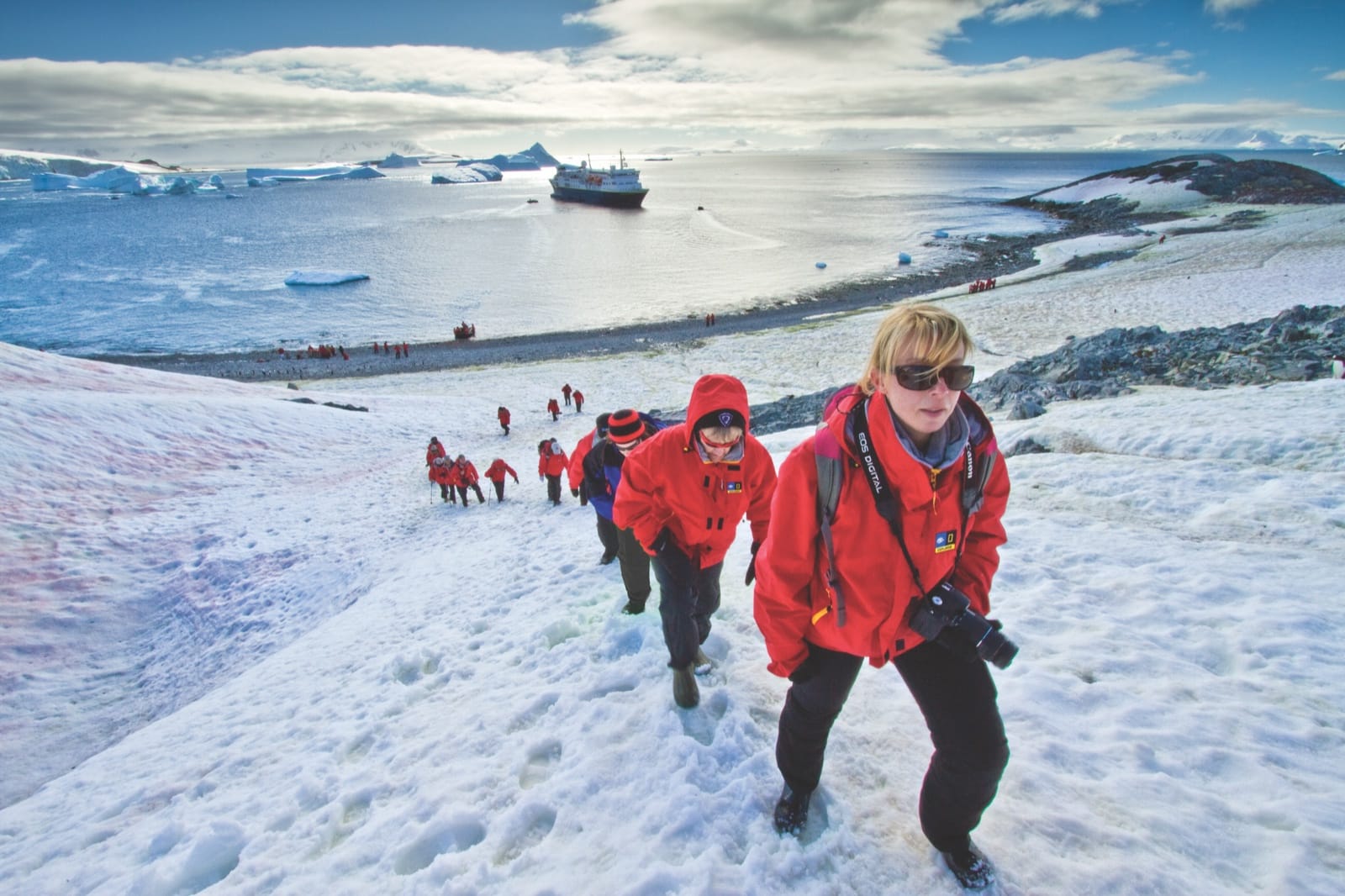
The summit greets us with a vista arranged from snow and ice, water and clouds. Wind-shaped figures called sastrugi arch out from curvilinear ridges. Ice crystals compress into sapphire.
In this Antarctic summer, a colony of Chinstrap and Gentoo penguins are cawing and carrying pebbles for their stone nests as males and females take turns warming their large, speckled eggs. An Elephant seal rests nearby, occasionally bellying up toward the penguins, which seem undisturbed but make space, just in case.
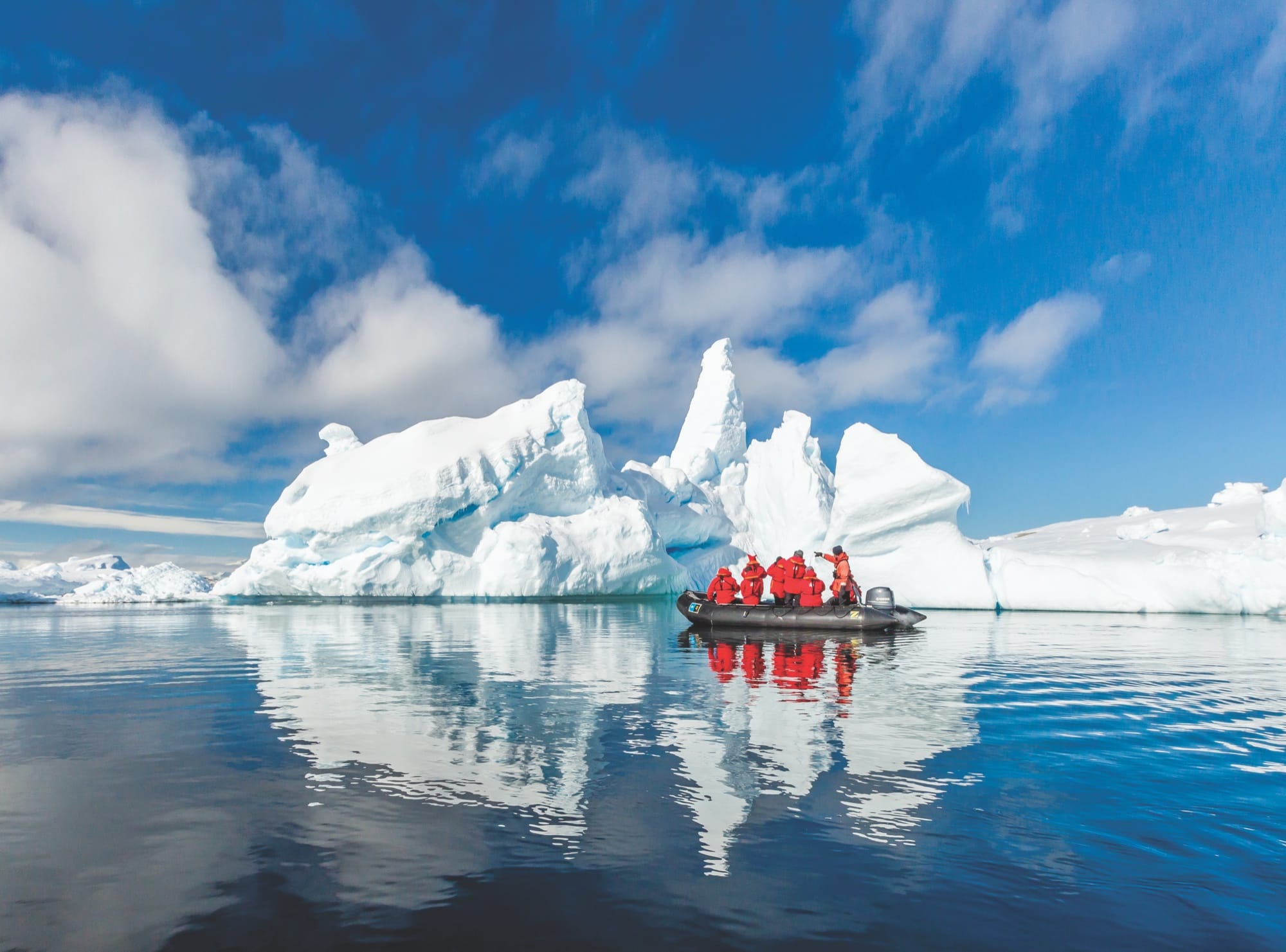
Near Pleneau Island, we come upon an area known as Iceberg Alley. The aquamarine ice below the surface spreads into the cracks and fissures of floes and bergs, spires soar toward the sky. One iceberg is an enormous block of quartz, another is set in angel’s wings. Some surfaces are etched like someone began sculpting a frieze but left before a clear image emerged. Others are polished, wind and water having done their handiwork.
At one point, we turn into an alcove, finding ourselves in the hollow of a berg, a cul-de-sac of sparkling blue and walls of ice of varying shapes. “It changes every time you come,” says Juan Preller, a Zodiac driver. “Next week it will all be different.”
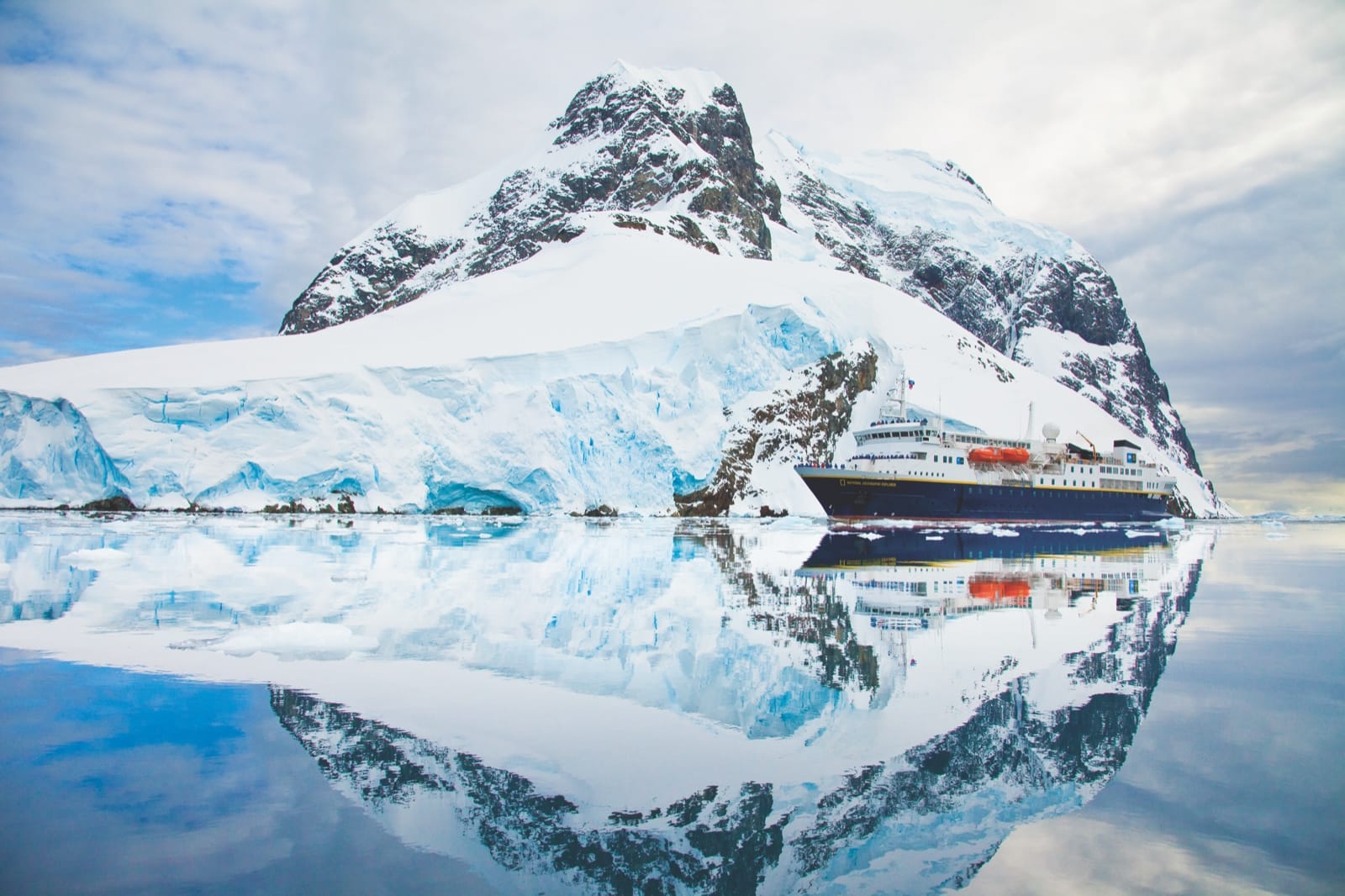
About ten years ago, an American couple became the first to endure winter in Iceberg Alley. They lived in 24-hour darkness, broken only by the Aurora Australis, the Southern lights. They weren’t the first who tried and the risk, apart from running out of supplies, is that freezing ice will crush your boat. There is a kind of mania people have, to accomplish such things in Antarctica.
“An Antarctic expedition, is the worst way to have the time of your life,” wrote Cherry Apsley-Garrard in his classic memoir, The Worst Journey in the World. Part of a small team of scientists who went to study penguin eggs, he describes the bitter cold, the extreme effort of moving, of letting a sleeping bag thaw until it was soft, which is to say liquefied enough to climb in. It’s a genre of literature that leaves you feeling a lesser person.
A lot happens in fleeting moments in Antarctica. In one strait, a pod of whales appeared, blowing spouts under the water to create a net of bubbles in which to trap a meal of krill. The horseshoe inlet at Deception Island, a live volcano, is half-frozen and our ship bursts through ice, splitting open a lane of water. It’s an incredibly satisfying feeling.
“Why is he breaking ice when there is open water right there?” someone asks.
“Possibly,” I answer, “because he can.”
Something also happens to your sense of time, it compresses like blue ice crystals, then falls away like a calving glacier. Without the interstices of darkness, day falls into night, which you only notice when someone says, “Is it midnight already?”
You realise, almost surprised, that days have passed en masse. It seems awfully sudden, a misfortune even, when it’s time to leave.
Our last night had everyone in a festive spirit, a sort of eat, drink and be merry, for tomorrow, we shall suffer in the Drake Passage again. After all the revelry, if you closed your eyes and listened carefully, you could hear the crinkling of Dramamine tablets being ejected from the packaging.
The Drake gave us a free pass, with storm systems moving in from either side and the lull between them allowing us to barrel through at a considerable average speed of 11 knots. We returned so far ahead of schedule that the captain detoured to let us see Cape Horn.
By 6:00 a.m. we were at the southernmost tip of South America and had a silhouetted view of the Cape’s dark peaks. Clouds hung low, like curtains pulled not quite all the way down. Here, the nip in the air is bracing but not at all Antarctic.
Soon enough, we entered the Beagle Channel and the world resumed its familiar dimensions. There was traffic from other boats and eventually, the houses and buildings of the port came into view.
After all that liberating isolation, this felt like waking up to reality after the happiest of dreams.