I’ve never been a fan of pigeonholing artists and Khaled Takreti’s latest collection gives sound reasoning for such a belief. While researching the artist, I found the regional art scene somewhat at odds over which box Takreti belonged in. His evocative, colourful and clearly personal work defies the standard formulaic categories. When I asked the artist for his opinion he responded by saying, “I am a contemporary artist creating figurative paintings,” he went on to suggest that it’s relatively unimportant to him, “Categorisation can be useful for the public, but is mostly the job of critics, not of artists.”
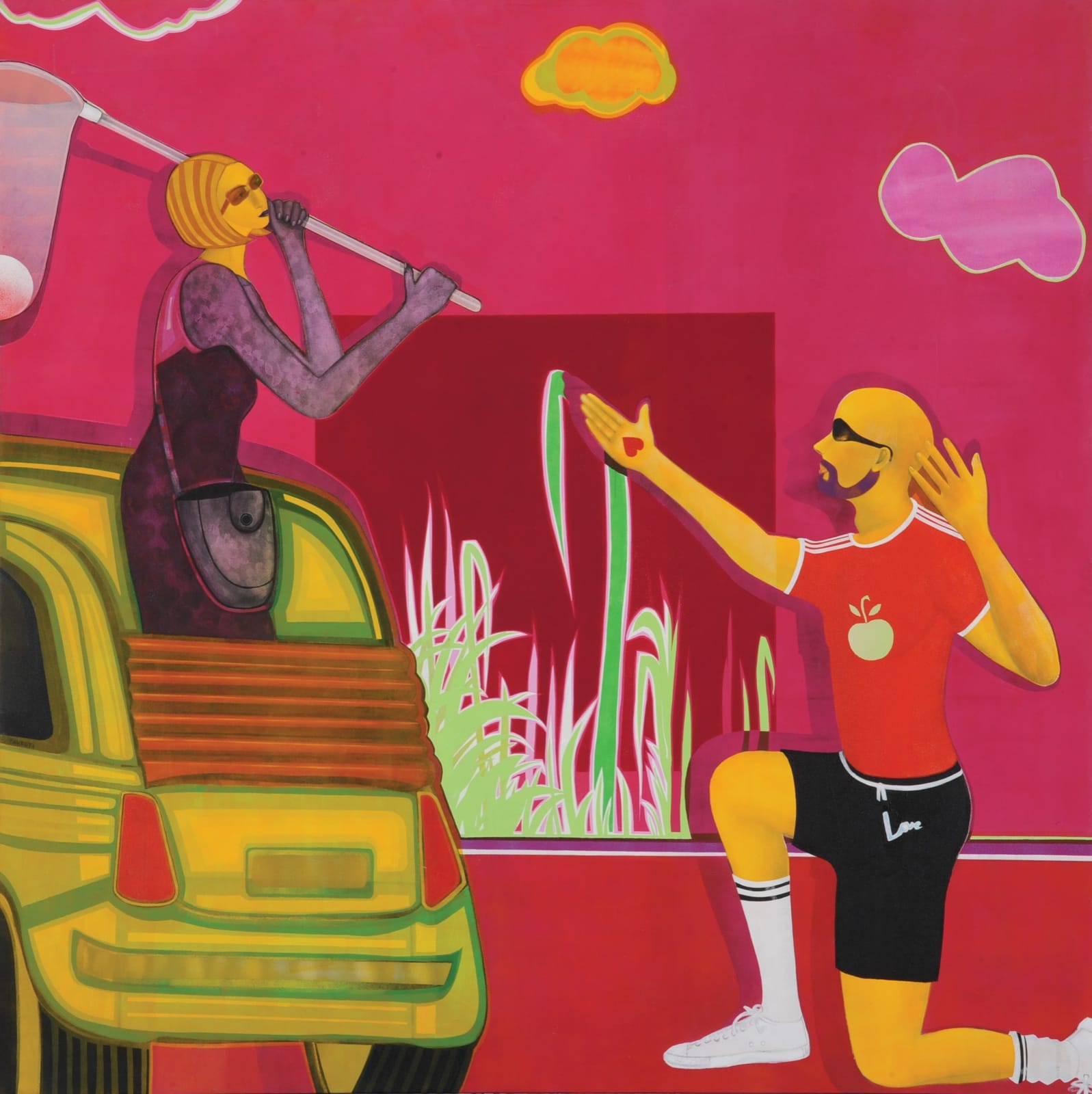
With that out of the way, I went on to discover what inspired Takreti. Looking at the pieces, they’re obviously telling the story of captured moments in time. Yet what I later discovered was that those stories were his very own intimate memories. Auto Stop, shows a young man calling out to his love, his heart in his hand while she flirtingly waves a butterfly net in the air. At once, you understand the message but the piece awakens a curiosity, a desire to know more of the story that inspired it.
Make no mistake, there is a story behind each and every one of Takreti’s pieces, “I think about my painting as my diary. This collection, for the exhibition ‘Me and My Grandmother’, is about my teenage years that were very important to me.” So, if the young man is Takreti then who’s the woman? Takreti skirts the issue, “As in any diary, you can find real people and experiences, but you’ll also find fantasies.” Given how personal his art is, it’s not all that surprising that he wishes to hold a little back.
Though a Syrian, Takreti was raised in Beirut before returning to Damascus to study architecture and design. In the mid-1990s he moved to New York for a couple of years before subsequently going back home to the Syrian capital. His latest move (in 2006) saw him make Paris his new home and this is where he continues to reside.
I pressed on with my interview, unintentionally falling into the trap of trying to isolate the geographical influence of his pieces. “Do you think your work says something about the East and the West?” Takreti coolly responded, “My work says a lot about me. I am influenced by both cultures, but my work is not about East and West as a topic per se. Every kind of cultural influence I met can be found in my work.” Feeling suitably chastened, I let it be.
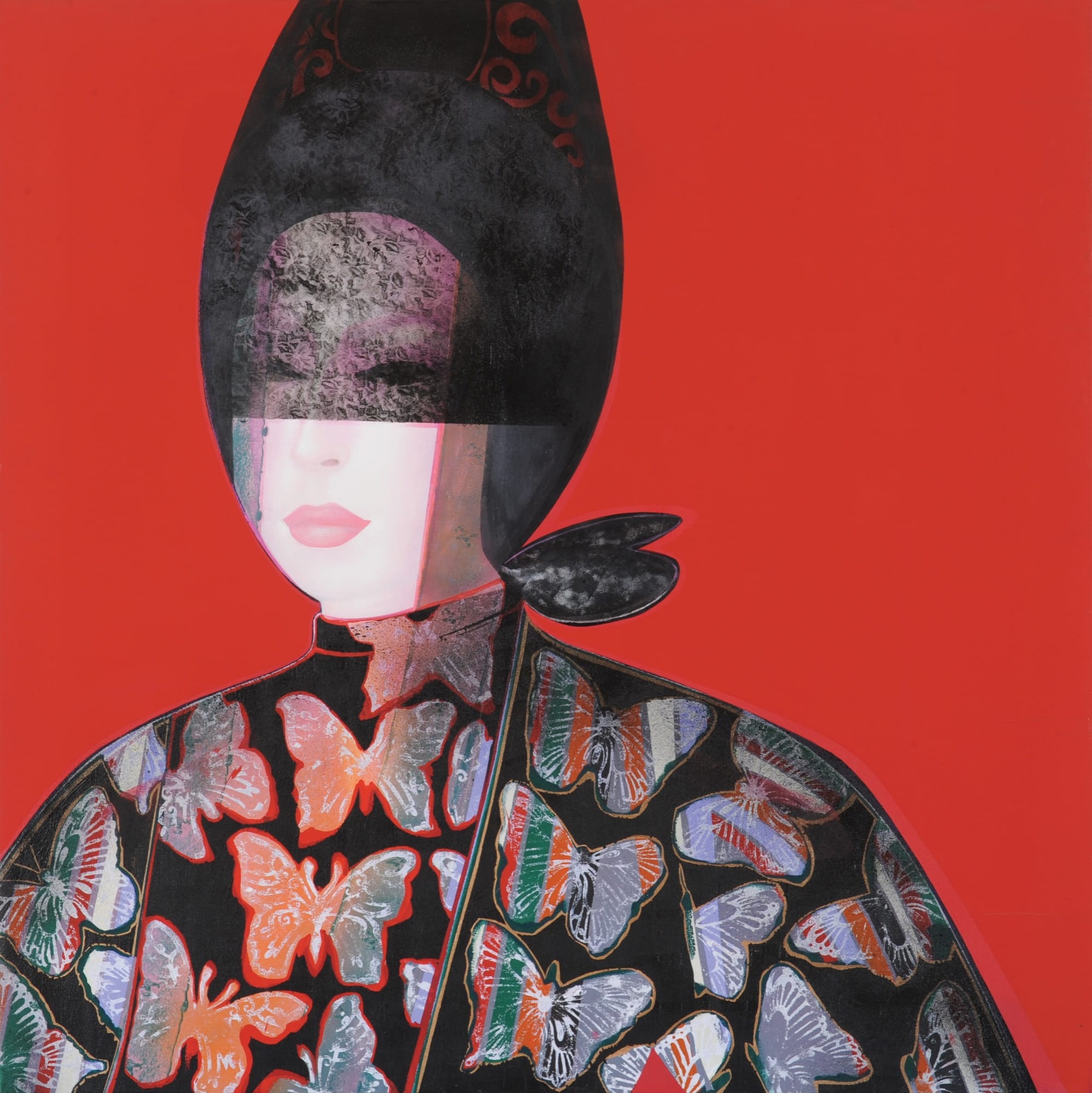
Takreti’s background in architecture and design obviously plays an important part in his craft. Looking at his paintings, the pieces are planned carefully: solid blocks of colour, vertical lines and bright panels form an intelligible composition. “It definitely influences the way I work. If you look carefully, you can see this in my work, especially in the structure, through sometimes unconsciously.”
What is most interesting of all is that looking back at Takreti’s entire body of work clearly demonstrates how his style has remained relatively unchanged throughout his career. Naturally, his technical ability has improved over time and his use of colour has become bolder too, but each Takreti clearly fits within the same body of work. “I think that an artist has one and only one style. What is changing over time and through experience is the technique. I could only describe my work as contemporary,” Takreti says. So the stylisation that you see in the paintings was a deliberate stylistic decision? “With work and experience, I’m able tell what is important or not for my painting. Some parts are very detailed, others are stylised; it helps in getting to the heart of the matter.” Though it’s tempting to see Takreti’s work as heavily stylised, the tiny details, such as the heart in the young man’s hand in Auto-Stop are clever additions that add depth and complexity to each piece.
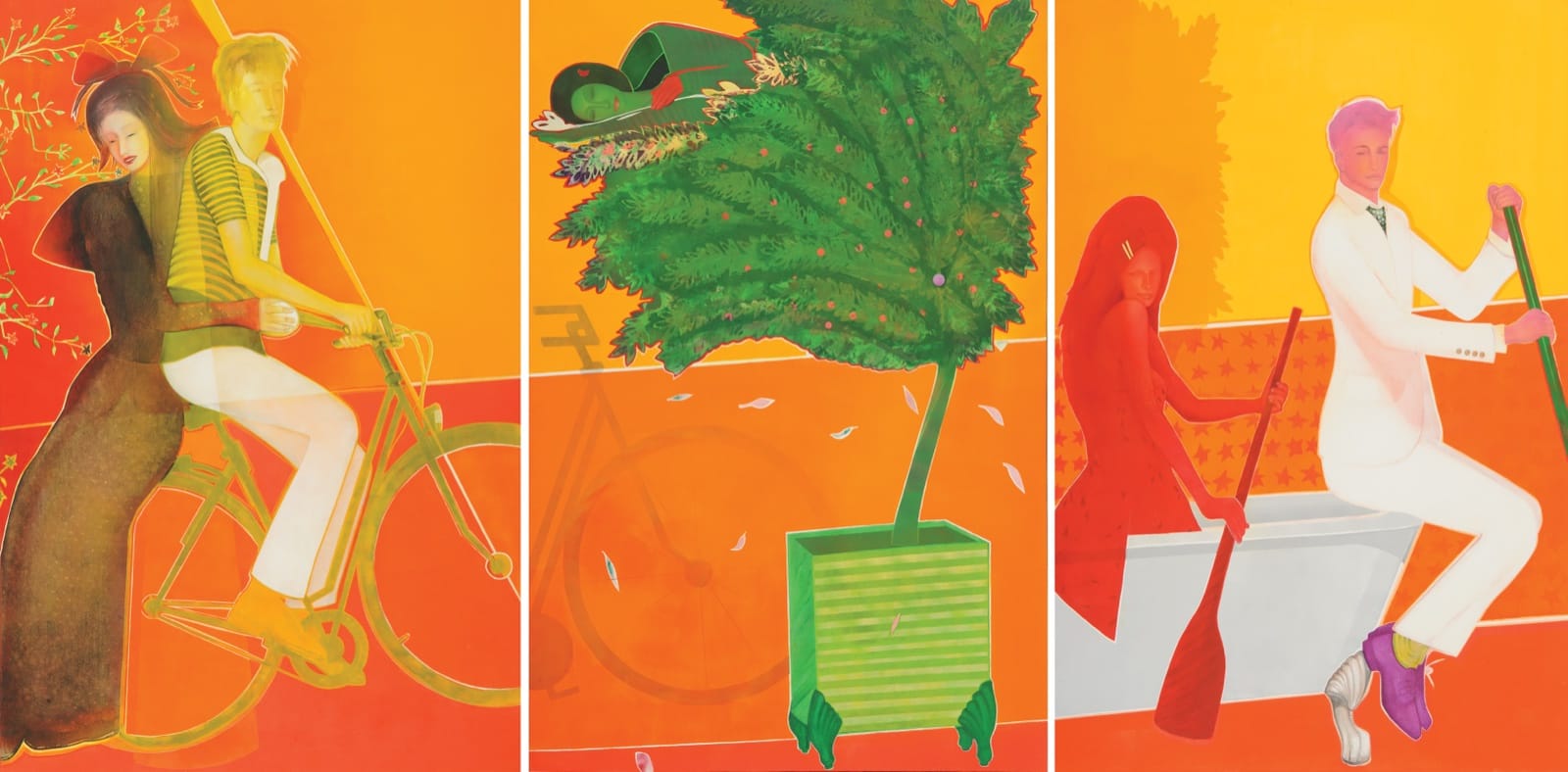
In his early days, Takreti worked in watercolour. Later he decided to move to acrylics, as they were a better means of realising his vision. The radiant colours so prevalent in his latest collection are a direct result of this switch; the acrylic’s ability to create both pastel effects and sheens in the same piece was in direct contrast to watercolours, which, by their nature, result in a very soft, cloud-like end product. “Working on my teenage years, which were full of life and energy made it necessary to use these kinds of colours.”
Wishing to engage the artist on the charismatic subjects of his paintings, I pried into questions about the seductively mysterious woman, the dancing girl, the couple in love and the understated flirtatiousness permeating through the collection. “More than charisma, energy is very important for me. I insist on having it in my work. That makes the paintings as alive as possible.” Though most of the figures aren’t intensely detailed, there’s something about his work that makes each subject mysteriously intriguing. There is an almost figurative sparkle in the eye of the real - or imagined - people on display.
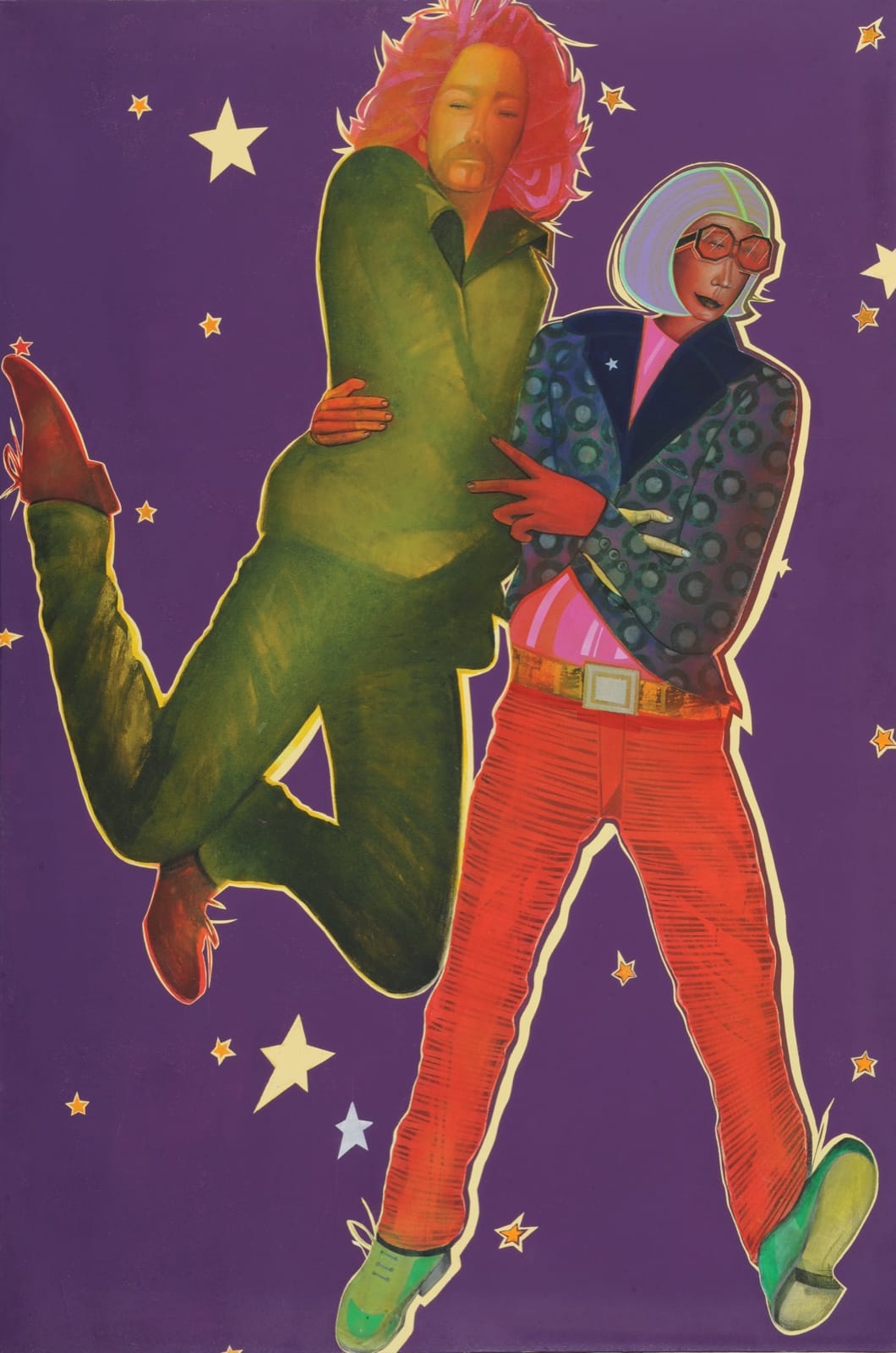
Takreti’s goals for the future are refreshingly simple: he plans to continue offering up his memories for public consumption. An established style, an ever evolving technique and an uncategorisable style seem set to continue and torment lovers of adjectives everywhere.
www.takreti.com