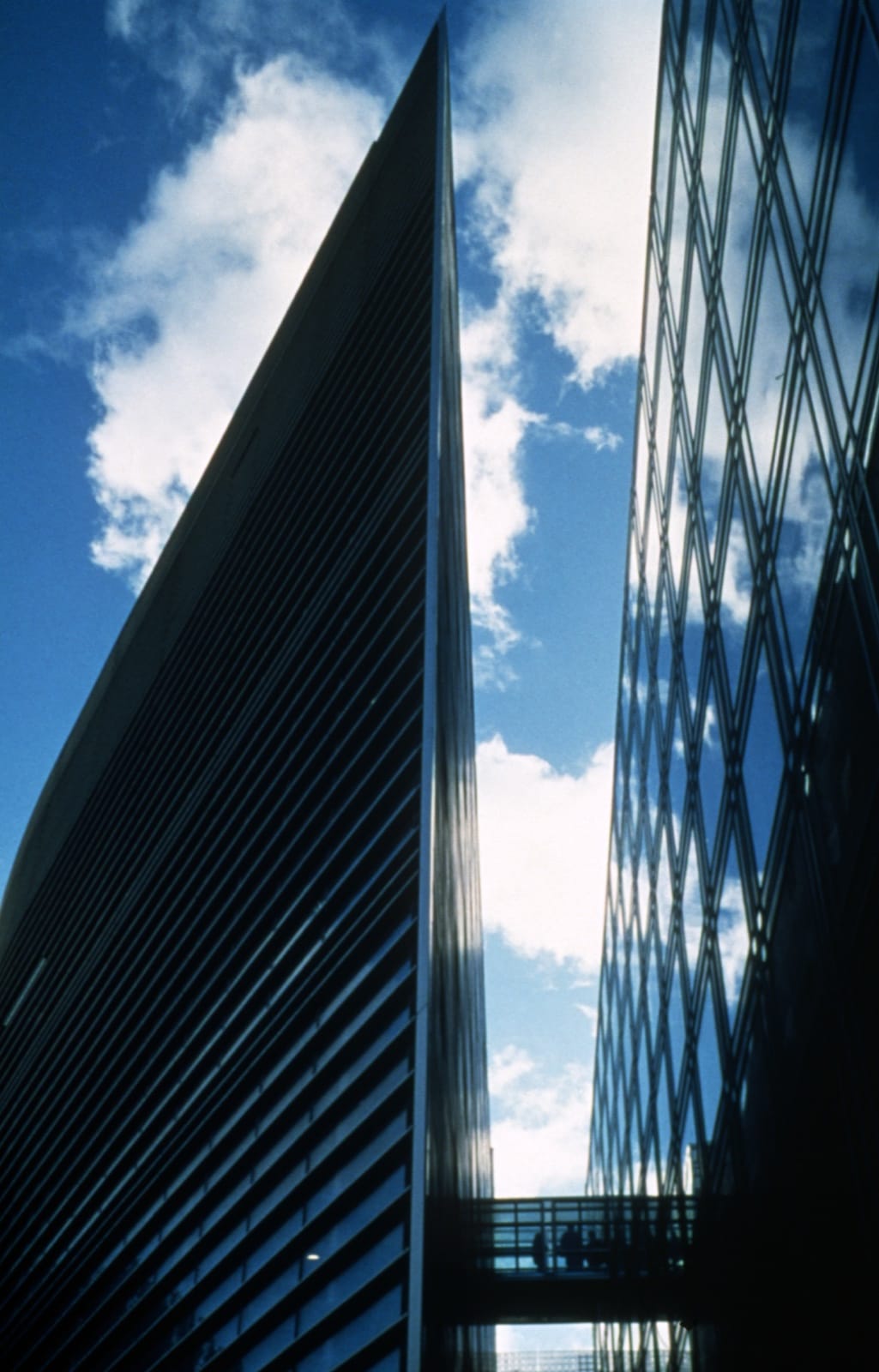
Set on a prominent site in central Paris, a short distance from the Notre-Dame Cathedral, the Institut du Monde Arabe (IMA) is credited in history as being one of the many Grands Projets of President François Mitterrand, which include, among others, the Grande Arche de La Défense, the Louvre Pyramid and the Bibliothèque Nationale de France. It is an urban scheme of great character, consisting of a museum, a library, an auditorium, offices and meeting rooms assembled within two wings that are separated by a courtyard opening out towards Notre-Dame.
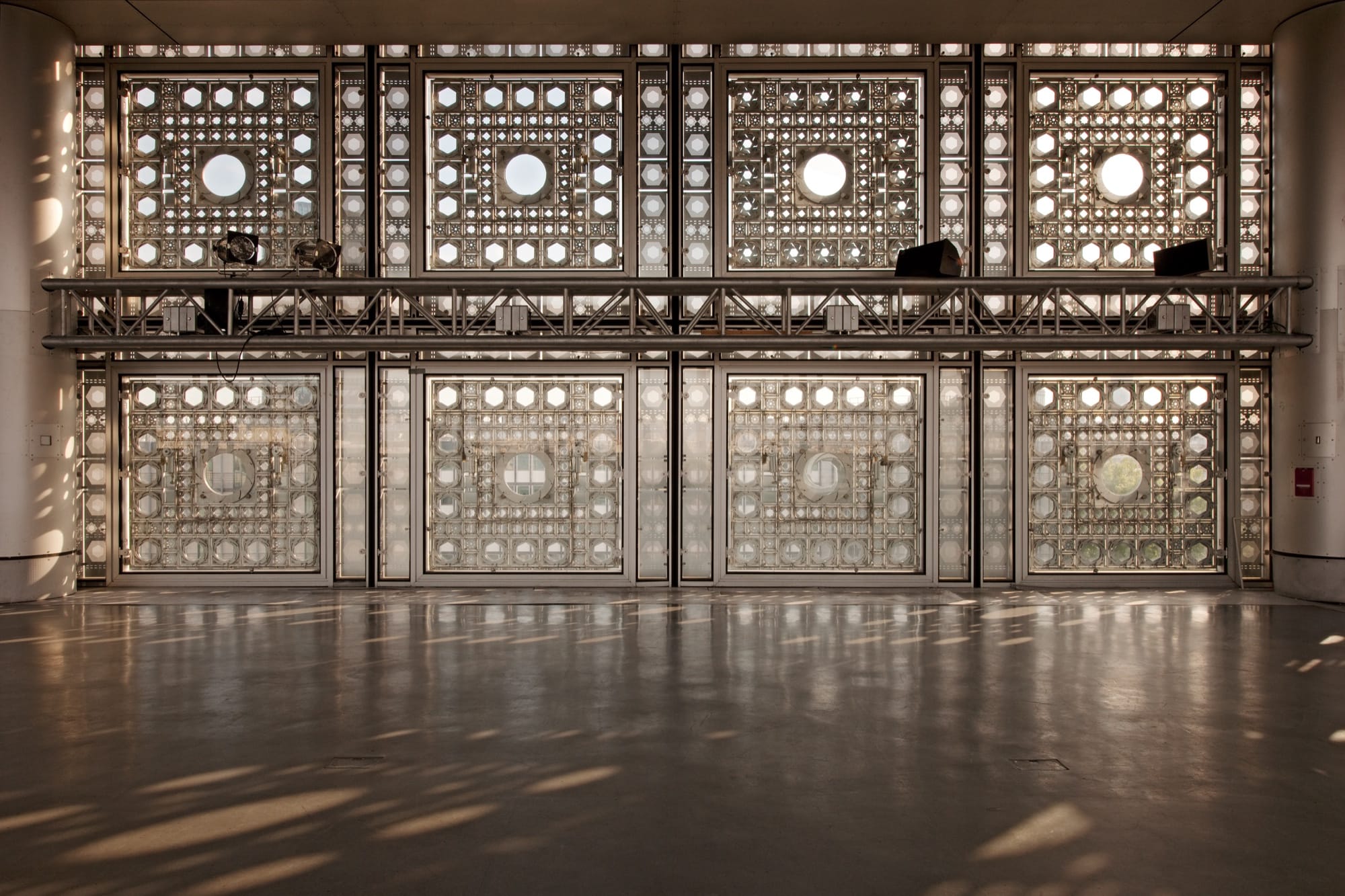
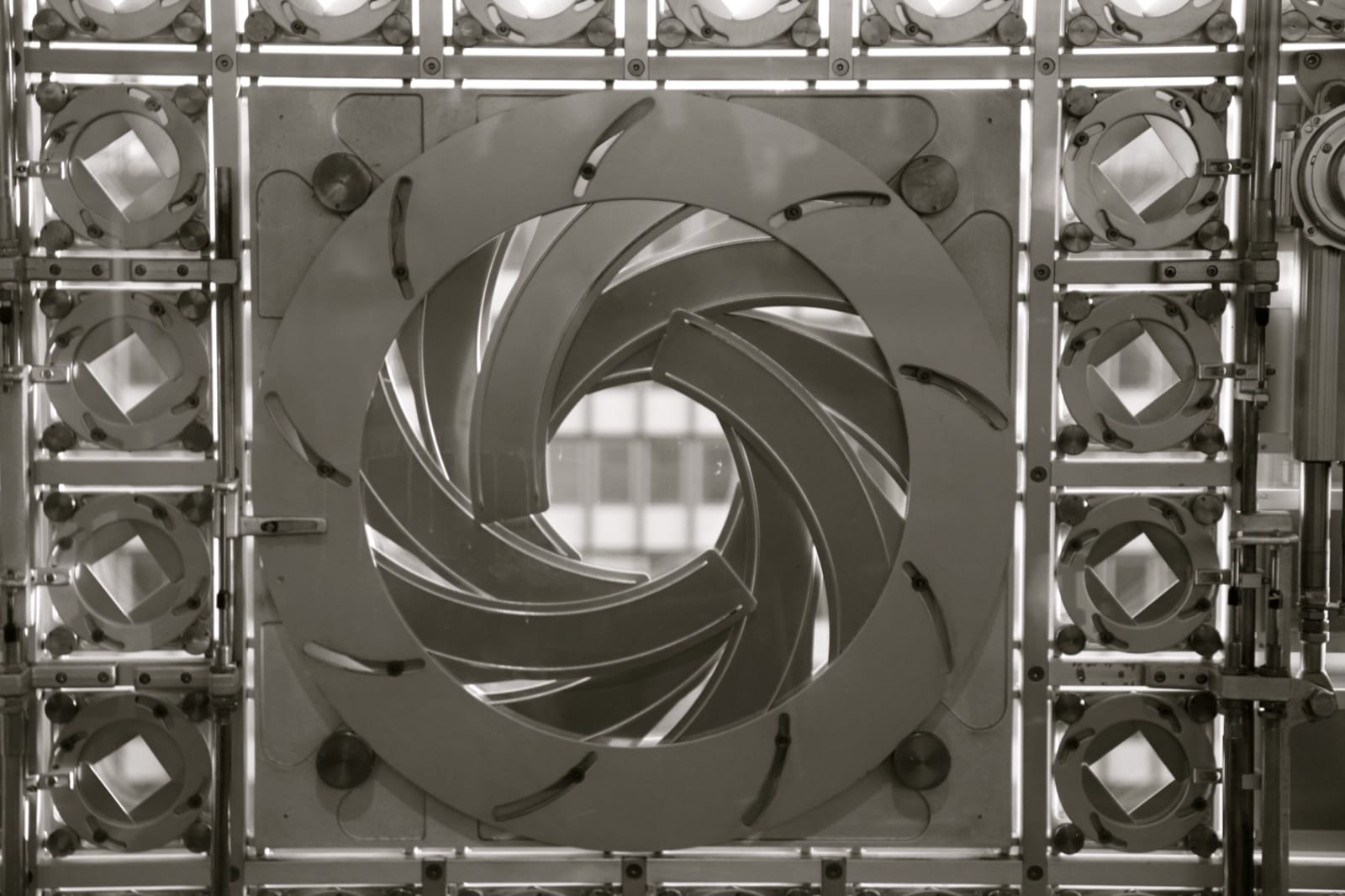
The translucent marble façade of the seven-storey northern wing is elegantly curved to follow the sweep of the quay. At the west end of this wing is the 100,000-volume library, a spiral tower of books behind a transparent wall of glass offering panoramic views. The principal façade of the eleven-storey southern wing comprises 240 photosensitive motor-controlled panels that operate like a camera's diaphragm opening and closing to control the intensity of light in the interior. The effect is like a giant geometrically pierced screen, inspired by mashrabiya latticework, giving symbolic significance and audacious brilliance to this remarkable building. Sadly, however, the delicate mechanism of these award-winning windows ceased working some twenty years ago but, thanks to efforts of the IMA’s latest president, Jack Lang (who took the reigns in 2013), there’s a restoration project underway that’ll see the screens return to full working order later this year.
To understand the past, present and future of the IMA, there is arguably no better interlocutor than Lang. In his former roles as France's Minister of Culture, for two terms, and Minister of Education, also for two terms, under Mitterrand and Chirac, Lang has taken an interest in the Institut through its various stages almost since the very idea of its creation was broached in the midst of the oil crisis of the 1970s.
“The Institut was actually first imagined by the President of the French Republic, Valéry Giscard d’Estaing, and King Khalid of Saudi Arabia, after which they addressed the countries of the Arab League for their participation. I think the idea was to counteract the energy crisis that was disturbing the peaceful relations between the Arab world and the non-Arab world. They conceived an institution that was, and still is, truly unique in the world, that could act as a bridge between the two worlds,” says Lang, whose first personal encounter with the project came during his role as Minister of Culture in 1981.
“When I became a minister, I discovered that the previous government had imagined a large structure in the 15th arrondissement in an architectural style that was academic and Neo-Moorish. When I showed the plans to President Mitterrand, he said, ‘I understand you might not feel favourably about it but if you want to solicit another architect then you’ll have to change the placement of the building,’ which was very wise. So in just a couple of days, I found this site by the Seine in the heart of Paris in the 5th arrondissement, right by Notre-Dame and Île Saint-Louis. We organised a consultation of architects, soliciting only young, up-and-coming ones, which was most unusual for a public building. In the end, the proposal of Jean Nouvel – who was unknown at the time – and Architecture-Studio won us over, so we built it.” Nouvel (who would later become one of the foremost architects in the world, winning the Pritzker Prize for Architecture in 2008) was commended with the 1989 Agha Khan award for this project.
Lang’s office is on the last and eighth floor of the Institut. The terrace restaurant is located upstairs, while everything else, including the impressive museum that was inaugurated in 2012, is below. In keeping with traditional Arab architectural designs, there’s an enclosed courtyard at the heart of the vast cultural centre and from our elevated perspective we can see it abuzz today with activity, as workers prepare the installations for this summer’s major exhibition: ‘Arab-Muslim Gardens: Sources of Modernity’. The show will run until October and trace the origins and evolution of renowned Arab gardens, analysing their influence on urban planning, environment conservation and territorial development.
Lang is keen to point out that his legacy at the IMA should not be confined to just its architecture, for he also helped develop the museum’s collections. “When I was Minister, I decided that the collection of Islamic art at the Louvre should be installed here provisionally. At the time, the Louvre wasn’t at all interested in Islamic art but their collection was extraordinarily rich. We discovered cases, abandoned in the basement and we exhibited them here for seven or eight years until the Louvre finally woke up and said: ‘That’s ours’. Today, of course, there’s a very important department of Islamic art at the Louvre.”
“I would say that my ties with the Arab world are very old,” he continues. “At first, I was a militant anti-colonialist during the Indochina War and the Algerian War. I was passionate about Algeria, Morocco and Tunisia, which was also fighting for its independence. This contributed to me establishing ties with intellectuals, researchers and professors…my relationship with the Arab world is a positive one.” And it needs to be for IMA’s role is, fundamentally, a diplomatic one, by means of culture – linking researchers, lecturers and universities across its broad programme of conferences on historic and contemporary topics in economics, the environment, technology and the arts. But, it also plays an important role in domestic diplomacy, since France has the largest Muslim population in Europe, with as 10 per cent of its 66 million population descending from Arab immigrants.
Consequently, IMA is keen to attract the country’s muslim youth, and has taken a recent change in tack in order to better achieve this. The groundbreaking 2015 exhibit ‘Hip-Hop, from the Bronx to the Arab Streets,’ featuring records, clothes, sneakers and artwork inspired by boom boxes and other symbols of hip-hop culture, is a perfect example of this inventive approach. I ask President Lang how else the IMA is reaching Arab minorities in France, most of whom are marginalized in the city’s low-rent housing projects on the outskirts of Paris, with little exposure to cultural initiatives, let alone cause to visit central Paris.
“By a thousand and one initiatives,” he asserts. “There are concerts, shows, ateliers, Arabic language courses, and we are establishing links with other cities. For example, presently the city of Saint-Denis is organising a magnificent festival of Arab film and we are partners. Before I became President, there was also the establishment of another institute in Nord-Pas-de-Calais, which is growing rapidly; and, we are also in the process of constructing an institute in St-Etienne in the southwest.” Among one of its many upcoming events, Les Rendez-vous de l’Histoire du monde arabe, will be running for a second time, reuniting hundreds of thinkers, politicians and scholars, from May 20th until 22nd, under the theme ‘Religion and Power’. The Institut du Monde Arabe also responded in various ways to the recent Syrian refugee crisis that has been troubling Europe. Clearly, it is not afraid of hot topics and, in fact, it provides a think-tank space in which to tackle them.
“When I assumed the role of President, I wanted to bring back the morale, faith, life and a certain radiance that the Institut had lost. For, once such a dynamic is created, the movement can let loose. We want to multiply links so that the intellectual and scientific aspects of research can develop. When I arrived, the IMA was too closed in upon itself, which is absurd. The goal is to multiply ties with others.” In this way that the cultural light of Paris will shine brighter, reflecting both inward and outwards, and create a much-needed beacon for the Arab world.