“A guy in Azura told me a helicopter uses less fuel than a boat,” says Jonathan Belt, a researcher with Africa Travel Resource and my newly made friend. We’re sat in near blackness, candles providing our only light. They flicker with the wind while the waves beat against the beach. He smiles, teeth white in the gloom. “It’s hard to say what’s really sustainable. That’s why it’s important to talk to an expert.”
It’s not yet 6pm but here, in this isolated luxury lodge in northern Mozambique, the sun sets early and electricity isn’t a thing. Stars, though, are definitely a thing, sweeping in great swatches of white and silver across the sky until I get dizzy trying to walk back to my villa that night, a solar-powered torch my only guide.
It is paradise. And like an increasing number of Mozambique luxury travel options, it is sustainable, allowing high-end travellers the chance to combine decadence with doing good. Without a doubt, Mozambique has had its share of difficulties. This southeastern African country has been colonised by the Portuguese, used extensively for the slave trade, and from 1977 to 1992 became the home of an extended, violent civil war. The result is that today, Mozambique is one of the poorest countries in the world, prone to occasional bursts of local conflict (most recently occurring in a few central provinces). Despite having a wealth of natural resources ranging from oil to gems, infrastructure remains underdeveloped. Poaching is an issue, as is coral destruction through the use of dynamite to fish.
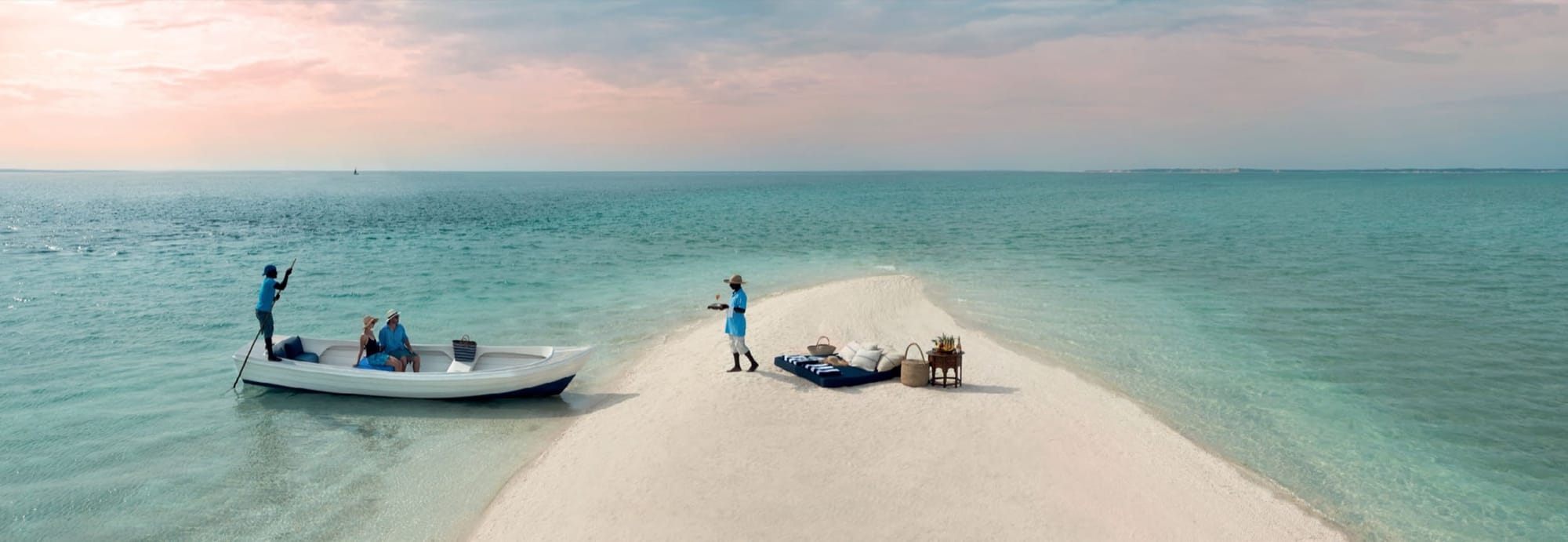
And yet for all of this, or perhaps because of it, Mozambique is beautifully raw. Many travel guides allude to untouched beaches; along Mozambique’s coast, you’ll actually find them. Up north, secluded villages offer a traveller the chance to step back in time. Down south, there’s the bustling capital of Maputo and access to a number of uber-luxury island retreats. Arabic, Portuguese and African cultures mix throughout, making Mozambique a destination entirely its own.
What’s more, with an increasing number of travel providers offering a chance for luxury visitors to explore Mozambique sustainably, exploring this country’s stunning coast could also help save it.
“The best way as a tourist to support development in Africa is to come and spend your money here,” Georges Korb, owner of Ulala Lodge, tells me. A French ex-travel agent who founded the lodge 10 years ago with his wife, Korb is passionate about eco-travel. Solar and wind power provide energy. Open-air villas perched on stilts between leaning palm trees are made using local materials. Behind a protective fringe of trees, the beach waits. “The money you give us, it’s used to buy our groceries from local markets, to pay local salaries, to make local furniture. As a traveller, you should also buy local. Get pencils and papers from shops here to give to children, not biscuits from abroad. They can’t afford dentists.”
I stop at Ulala Lodge a week into my trip. Located just 15 minutes outside the northern city of Pemba, the lodge is eight rooms, and intimate, closed when guests are gone. Korb presumed years ago that Mozambique’s nascent safaris would bring business; with poaching, this hasn’t happened. “We still feel confident tourism will develop here,” he says over a plate of coconut rice. In the morning as I read on the beach a group of local women wade past, baskets on their heads and nets in their hands, singing as they fish.
Heading north next to the isolated Guludo Lodge in the Quirimbas National Park, I’m struck by how expensive my five-hour car-meets-rollercoaster ride is. I shouldn’t be, Belt tells me. “The good stuff in Africa costs a lot. To stay in remote locations, you should expect to spend a fair amount. Giving a western style of life in remote Africa is incredibly expensive. It’s about making sure the boat works every day, the lights go on and the food is there.” He recommends private jets or helicopters for a more seamless journey.
The National Park isn’t what I expected – more thatched-hut villages fringed with smoke from farmers burning underbrush than protected wildlife and throngs of elephants – but Guludo Lodge is. This luxury-meets-eco property features bucket showers with water pouring from coconuts and no electricity save a few outlets in the office. Some of the money goes directly to the Nema Foundation, a charity launched by the lodge’s owners that currently works with 16 communities and approximately 24,000 people around Guludo. Travellers can help out with the charity, should they wish. I spend a morning working alongside locals to build a school, mixing sand and clay and dust until I feel heavy in the heat.
Foolishly, I skip Ibo Island, a World Heritage-nominated spot lost in time that’s filled with crumbling ruins and majestic architecture, and is under a two-hour dhow ride off the coast of Guludo. Later that week Belt messages me: “It’s the most beautiful place,” he says. Ibo Island Lodge, which supports the Montessori English School, offers a romantic luxury retreat.
Instead I head back down south into bigger cities, pausing at Pemba Avani Beach Hotel and Spa. This sprawling property, once designed to capture business travellers in Mozambique for oil, today is drowsy and slow. Its size alone makes it feel like a resort, all infinity pools and long lunches. Even here, charity is a focus. Sheets and towels are sent to the SOS Children Village of Mozambique. Money has been used to rebuild homes after recent floods, while children from a local orphanage have been hosted for a day. In Pemba I walk through a local market that sells second-hand shoes and deep-fried breads.
Even farther south is Maputo, Mozambique’s capital, a lively chaotic mix of fish markets and travellers. It’s also the source of some of the largest ivory markets in southern Africa, explains Victoria Troskie, Head of Africa for Lightfoot Travel. “No matter what the vendor says, poaching remains a huge problem, and there’s no sustainable market for ivory in the region. All wildlife products, including shells, should be avoided until the country shows greater regulation,” she notes.
When I ask Troskie for her eco-travel recommendations, she doesn’t hesitate. “There’s a lot of great work being done despite tourism being in its infancy,” says Troskie. “At Vamizi Island, a luxury island property, [there’s a focus on] research and conservation of coral reefs and marine life. Azura Benguerra offers white-glove luxury at their properties and have many projects to uplift local communities.” These southern islands suit travellers bouncing from a safari in South Africa into Mozambique for the slower pace of the beach, requiring a stop into Vilankulos followed by usually a private helicopter or plane to a neighbouring island.
“As tourism in Mozambique develops, it’s considered to offer some of the best off-the-beaten-track experiences,” she continues. But it’s key to work with a reliable travel company, a sentiment Belt echoes: “A lot of properties say they’re sustainable, but whether they actually are is another story,” he explains. Through the sheer size and rawness of Mozambique, combined with a limited amount of readily accessible information, travel guides can be key to visiting the country sustainably.
I go at it alone, and at the end of over two weeks I am exhausted. Mozambique is logistically difficult to travel, expensive and rugged. Yet it’s fascinating for this very reason. My last night I sit at a beachfront restaurant eating plates of squid and fish, two hopeful kittens winding between my bare feet. The stars are out and the air is warm, the ocean commanding the air with its noise. In silence, I think back to what Belt had said the week before: “This is the Africa people imagine.”