One of the most essential facts of life is that people need to engage. We look for a sense of community. We want to be in a social environment, it’s part of being alive. Just think about how you feel when you’re sitting at an outdoor café in Milan. And contrast that with the drab food court at your local indoor mall. This is why the traditional suburban mall may end up being a thing of the past.
Now consider this: since 2006, not a single such mall has been built in the birthplace of malls, the United States. Instead, lively, engaging and more natural shopping spaces are in ascendancy. Taking inspiration from the enduring success of places like London’s Bond Street, Paris’ Avenue Montaigne, and the souks of Marrakesh, American developers have come up with a new kind of mall, one that’s outdoors. Then again, it’s not really a mall at all since it’s not just designed for people to shop in but rather, to escape from the humdrum of everyday life. This is a place to while away time, a place to wander about, it’s a space of sociability and distraction.
Many of you may already be familiar with The Grove in Los Angeles, which opened next to the gracefully old Farmers Market in 2002. The brainchild of Caruso Affiliated and its chief executive, Rick J. Caruso, a government commissioner turned real estate developer, the 53,000 square-metre retail park quickly became a much-needed public space in this coiffed yet lonely city. Its great appeal is that it’s akin to a little township with 40 shops, meandering lanes, dancing fountains, plots of greenery and old-fashioned trolleys passing by. The formula is working a treat too, raking in five times the national mall average in terms of sales per square metre. It also attracts over 18 million visitors a year, placing it above Disneyland and the Great Wall of China even, in terms of popularity. And best of all, over 90 per cent of these people make purchases, spending more than double the industry average in the process. The secret, it seems, is that The Grove focuses on ‘heart share’ rather than just market share.
So where does this growing trend leave the Middle East? There are already over 70 malls in Dubai, with another eight under construction. In Saudi Arabia’s capital Riyadh, there are over 30 and plenty more on the way. So clearly, mall culture in the Middle East is in rude health, which is probably why the outdoor concept has yet to gain traction here. There’s also the fact that in these hot climes people would rather escape to the comfort of an indoor, air-conditioned mall. Yet that hasn’t impeded the developers of the Boulevard Mall in Jeddah, who have gone and developed a highly forward-looking outdoor shopping destination. And this is no sweltering shopping mart, quite the contrary, as they’ve devised a cutting-edge way to keep their Red Sea paradise cool.
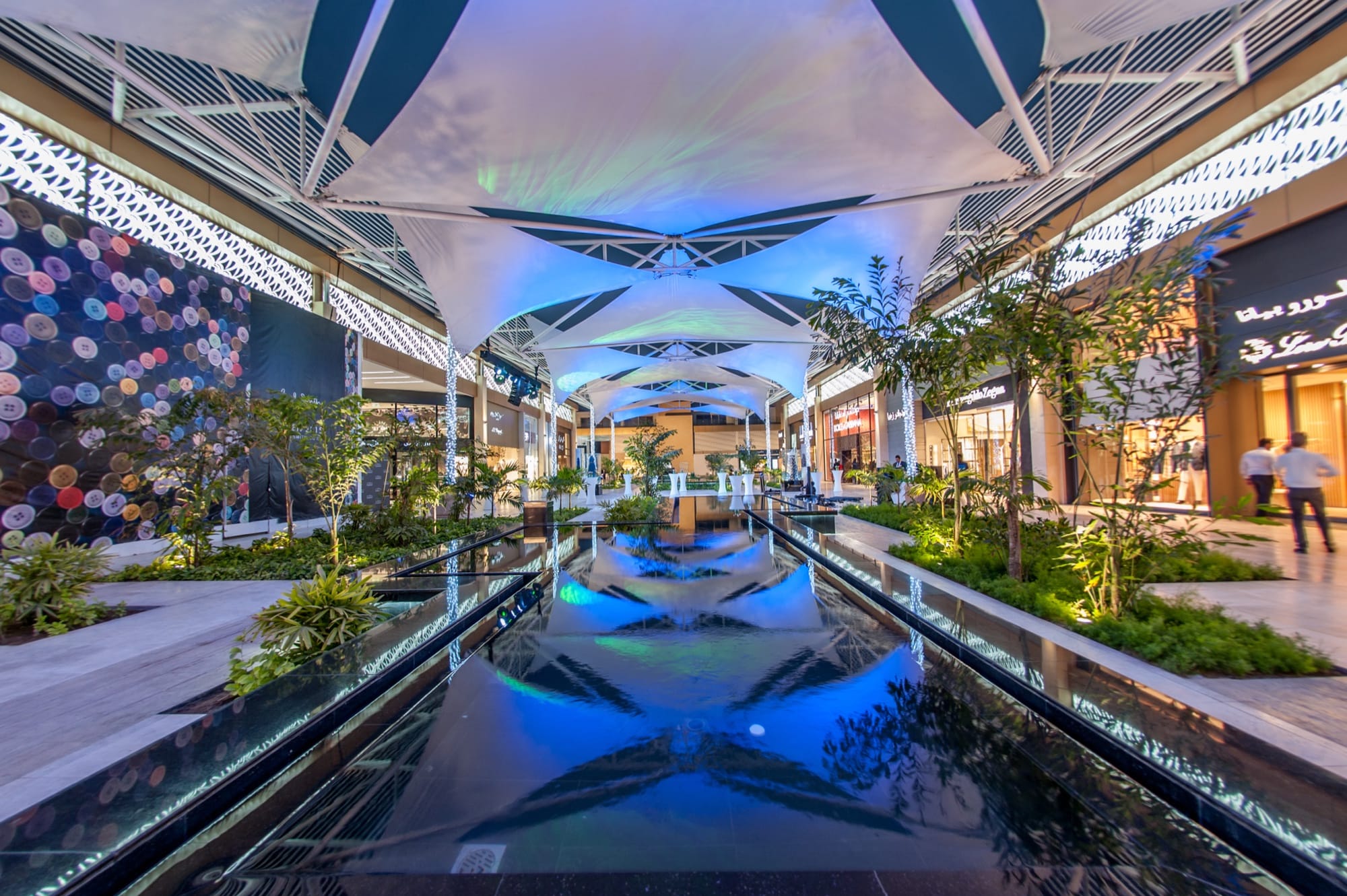
Opened with little fanfare earlier this year (the official grand unveiling has been slated for the end of November), it can be found on the King Abdul Aziz Road and boasts European-style streets that look like grand, graceful alleyways in a maze of verdant manicured gardens.
There are 36 boutiques in all, encompassing three anchor stores – Giorgio Armani, Gucci, and Dolce & Gabbana – alongside some of the world’s best-known men’s, women’s, children’s and home brands like Brioni, Balenciaga, Oscar De la Renta, Hackett Kids, Loro Piana, Dunhill, Jimmy Choo and Baccarat. What’s more, Boulevard doesn’t take any shortcuts when it comes to architectural design either. For instance, Prada’s store, designed by Roberto Baciocchi, makes a remarkable visual impact, blending into the mall’s modern aesthetic composition with a white metal curtain on the external façade, flanked by the two entrances (one for men’s fashion and the other for women’s), windows and light boxes.
“Boulevard is dedicated to creating an upscale luxury experience,” says Firas Haidar, the mall’s project director. “We’ve brought together a unique mix of brands from desirable ladies’ fashion, men’s tendencies and kids’ latest styles to some of the world’s most sought-after home furnishing. In addition to that, we’ve also integrated some truly exciting dining facilities, as well as a dazzling exhibition centre.”
The idea of an exhibition space in a shopping mall is certainly an uncommon concept but it seems the developers have been working closely with contemporary artists such as the Saudi painter, Abdullah Qandeel - who earlier this year, famously smashed Sotheby’s pre-sale estimate when his work, ‘The Enemy Within’ sold for a whopping 209,000 USD, or ten times what it had previously been valued at - and that their plans aren’t just to display art on the premises but rather, to hold regular artistic, fashion and luxury-based exhibitions, which can lend Boulevard a cultural relevance and a distinctive positioning in the industry.
The chairman of the development company behind the mall, Sheikh Abdullah Binzagr says the aim was for Boulevard to seem “inspired by light, anchored by culture, crafted by the environment and decorated by nature”. It’s certainly more than just a place to shop. With its unique look and feel, including wide, semi-covered marble walkways, elegant water features and lush greenery, it’s a stylish, sociable environment that oozes luxury and we, personally, cannot wait to visit.